

The most expensive mop in the world won't save your floor if your cleaning solution is slowly dissolving your grout or leaving a sticky film that acts as a magnet for dirt. Finding the best floor cleaner for tiles isn't just about surface shine; it's about understanding the delicate chemical balance between your tile's porosity and the mineral composition of your grout. If you've ever spent an hour mopping only to see persistent streaks as soon as the floor dries, you're likely using a formula that's incompatible with your specific surface.
We understand how frustrating it's to deal with dull finishes or discoloured grout lines despite your best efforts. This guide will help you navigate the complexities of tile care, ensuring you choose solutions that provide a professional, hygienic finish whilst protecting your flooring investment for years to come. You'll learn how to identify the right chemicals for natural stone versus ceramic, how to adhere to the new August 2026 GB CLP hazard labelling regulations, and the exact steps to establish a simple, repeatable routine that's safe for both pets and children.
Key Takeaways
- Learn why pH-neutral solutions are critical for protecting grout and preventing the irreversible surface dulling caused by harsh chemicals.
- Identify your floor's specific porosity to choose the best floor cleaner for tiles, ensuring compatibility with materials ranging from porcelain to natural stone.
- Master the "Dry First" rule and precise dilution techniques to eliminate sticky residues and achieve a professional, streak-free finish.
- Understand how to achieve a hygienic environment for pets and children whilst adhering to the latest UK safety and labelling regulations.
Why Finding the Best Floor Cleaner for Tiles is Essential for Longevity
Installing high-quality tiles in a UK home or commercial property represents a significant financial commitment. Whether you've chosen elegant natural stone or durable porcelain, these surfaces are designed to last for decades. However, that longevity is entirely dependent on your maintenance programme. Using the wrong product can lead to irreversible dulling of the finish, turning a vibrant floor into a flat, lifeless surface. Identifying the best floor cleaner for tiles is about more than just removing surface dirt; it's about preserving the structural integrity of the material and the grout that holds it together.
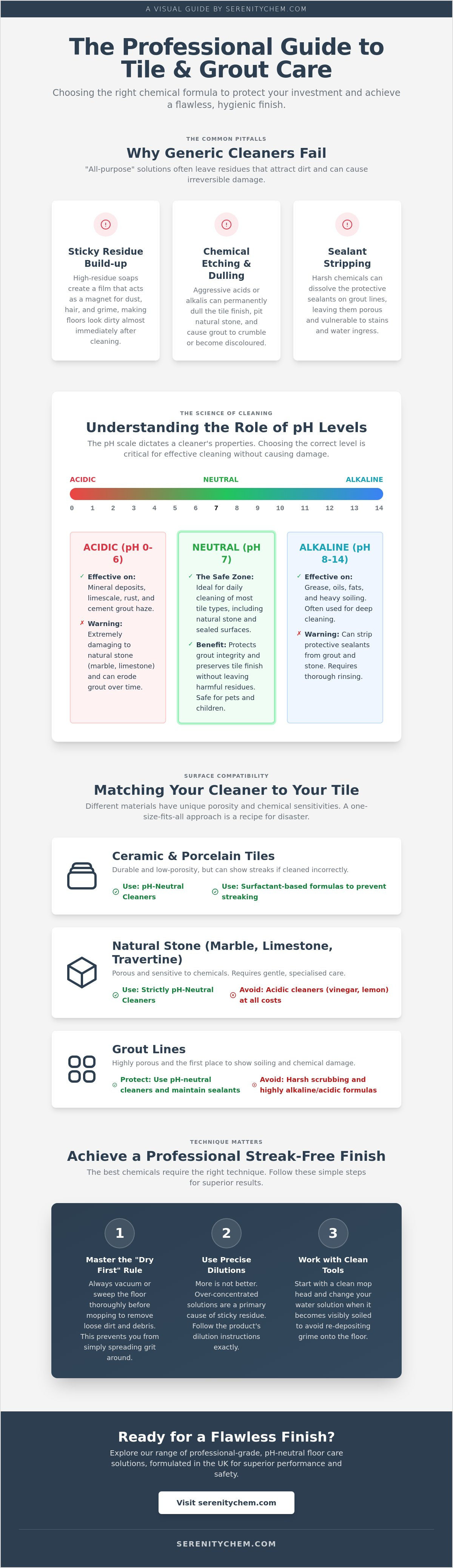
Grout is often the most vulnerable component of any tiled surface. Because it's porous, it absorbs liquids and chemicals more readily than the tiles themselves. Harsh, acidic cleaners can cause grout to crumble or discolour over time, leading to expensive repairs and potential water ingress. Modern porcelain tiles present their own unique challenges. They often have a low surface energy, meaning they can be hydrophobic. Without specific surfactants to break down surface tension, water simply beads up. This leads to the dreaded hydrophobic streaking that ruins the look of a clean floor. Understanding various floor cleaning techniques helps in selecting a solution that works with your flooring's chemistry rather than against it.
The Problem with Generic Floor Cleaners
Many people reach for supermarket "all-purpose" cleaners, assuming they're a safe bet for every room. These products often rely on high-residue soaps that don't fully evaporate or rinse away. This leads to "sticky floor syndrome," where a microscopic film remains on the surface. This film acts like a magnet for dust, pet hair, and general grime. You'll likely notice your tiles look dirty almost immediately after you've finished mopping.
Generic cleaners often cause issues such as:
- Soap Scum Build-up: Layers of residue that hide the tile's natural colour.
- Chemical Etching: Aggressive acids in cheap cleaners that permanently pit natural stone like marble or limestone.
- Sealant Stripping: Harsh alkaline builders that dissolve the protective sealants on your grout lines.
The Aesthetic and Hygienic Benefits of Professional Solutions
Professional-grade solutions are formulated for superior soil suspension. Instead of just moving dirt around the room, these chemicals lift particles off the surface and hold them in the cleaning solution, making them easy to mop away. This results in a "just-installed" look that maintains the original lustre of the tile. In high-traffic areas like kitchens and bathrooms, hygiene is a priority. Using the best floor cleaner for tiles ensures that your surfaces are truly sanitised, removing bacteria rather than just masking odours with artificial fragrances.
By using high-performance chemicals, you also reduce the physical effort required. You won't need to scrub as hard because the chemistry does the heavy lifting for you. This allows for a faster, more efficient cleaning routine that provides peace of mind for homes with children and pets.
Understanding the Chemistry: What Makes a Tile Cleaner Effective?
Efficacy in floor maintenance isn't just about the mechanical action of a mop or the heat of the water. It's about molecular interaction. A professional-grade solution is essentially a pH-balanced emulsifier. Its primary function is to break down complex oils and bind dirt particles so they can be removed from the surface entirely. Without this chemical interaction, you're often just spreading diluted grime across your floor, which eventually settles into the grout lines.
Selecting the best floor cleaner for tiles requires an understanding of how different substances interact with your specific flooring material. Whilst a "clean" floor looks tidy to the eye, a "sanitised" floor is one where pathogens have been significantly reduced through targeted chemical action. In commercial environments or homes with young children, this distinction is vital for maintaining a healthy environment. Chemistry provides the bridge between visible cleanliness and genuine hygiene.
The Role of pH Levels in Tile Care
The pH scale, ranging from 0 to 14, determines how a cleaner behaves. Acidic cleaners (low pH) are effective for removing mineral deposits like limescale or rust. However, they're dangerous for natural stone and can cause grout to become brittle. Alkaline cleaners (high pH) excel at cutting through heavy grease and organic fats. For daily maintenance, a pH-neutral cleaner is the safest and most effective choice. It provides thorough cleaning without the risk of chemical etching. You should specifically avoid bleach-based products on coloured grout; these oxidising agents can strip away pigments, leaving your floor looking aged and patchy.
Surfactants and Soil Suspension Explained
Surfactants are the active components that lower the surface tension of water. This allows the cleaning solution to penetrate the microscopic pores of the tile surface. Once the dirt is reached, the process of soil suspension begins. Soil suspension is the chemical process of lifting dirt particles and holding them buoyant in the cleaning solution to prevent them from settling back onto the floor during the mopping process.
High-quality professional formulas often utilise low-foam surfactants. These are beneficial because they allow for significantly faster drying times and leave zero residue behind. If your floor feels tacky or attracts footprints immediately after mopping, your cleaner likely contains too many high-foaming agents. For those prioritising a streak-free finish, using a Serenity Floor Cleaner provides the precise chemical balance needed for effective soil suspension without the sticky aftermath. It's a principled approach to maintenance that values the long-term integrity of your flooring investment.
Matching Your Cleaner to Your Tile Type: Ceramic, Porcelain, and Stone
Selecting the best floor cleaner for tiles requires more than a cursory glance at a label; it demands an understanding of the material's porosity. Porosity determines how much liquid a surface absorbs, which directly dictates how a chemical solution will behave. Porcelain and ceramic tiles are generally classified as low-porosity materials, meaning they resist liquid penetration. In contrast, natural stone is highly porous. If you treat a slate or limestone floor with the same aggressive chemicals used for factory-finished ceramic, you risk permanent structural damage.
Ceramic tiles remain the versatile all-rounder in British homes and commercial spaces. Whilst they're durable, they still require non-abrasive care to prevent the protective glaze from wearing thin. Once this glaze is compromised, the tile becomes susceptible to deep staining that no amount of mopping can rectify. Identifying the best floor cleaner for tiles involves choosing a product that respects these physical boundaries whilst providing enough power to emulsify surface oils.
Porcelain and Ceramic: The Low-Maintenance Myth
Porcelain is often marketed as a "fit and forget" flooring choice, yet it presents a unique aesthetic challenge known as optical hazing. This occurs when a cleaner leaves a microscopic residue that creates a cloudy, dull appearance on high-gloss or polished surfaces. It's particularly noticeable in rooms with large windows where natural light hits the floor at an angle. To prevent this, you should prioritise no-rinse formulas that evaporate cleanly without leaving surfactants behind.
Textured ceramic tiles present a different problem. Dirt and cleaning water often settle in the "valleys" of the texture, leading to a patchy appearance. For these surfaces, the chemical must have exceptional wetting properties to reach into these depressions and lift the soil. Using a principled, high-performance solution ensures that even the most uneven surfaces remain hygienically clean without a build-up of old cleaning fluid.
Natural Stone: Protecting the Mineral Structure
Natural stone materials like marble, slate, and limestone are essentially collections of minerals that remain chemically active. They're particularly sensitive to pH levels. Acidic cleaners will react with the calcium carbonate in marble and limestone, causing "etching" which looks like dull spots or white marks. This isn't dirt; it's a permanent chemical burn on the stone's surface.
Maintenance for stone must focus on preserving the existing seal whilst removing surface debris. You should always look for professional products that explicitly state they're "safe for stone." These solutions are engineered to be gentle enough for the mineral structure whilst being effective enough for the dirt. By choosing a responsible, pH-neutral chemical, you protect the stone's natural beauty and ensure the longevity of the expensive sealing treatments required for these high-end installations.
Professional Techniques for a Streak-Free, Hygienic Finish
Applying the best floor cleaner for tiles is only half the battle. To achieve a truly professional result, you must combine the right chemistry with disciplined technique. The most common mistake in floor maintenance is skipping the "Dry First" rule. Before any liquid touches the surface, you must remove all loose debris through thorough vacuuming or sweeping. If you skip this, you aren't cleaning; you're simply creating a thin layer of abrasive mud that will settle into your grout lines and potentially scratch your tile glaze.
Precision in dilution is equally vital. Many users believe that adding extra concentrate will result in a deeper clean, but the opposite is true. Over-concentration leaves behind excess surfactants that never fully evaporate, creating a sticky film that attracts dirt immediately. Always follow the manufacturer's instructions to the millilitre. It's a principled approach that saves money and protects your flooring.
To maintain the purity of your cleaning solution, utilise the "Two-Bucket Method." One bucket holds your diluted cleaner, whilst the second contains clean water for rinsing your mop. This ensures you aren't dipping a dirty mop back into your fresh chemical solution. Use warm water to activate the surfactants effectively; boiling water is unnecessary and can sometimes damage sensitive sealants. Finally, for a true mirror finish, perform a dry pass with a clean microfibre mop once the floor is nearly dry. This simple buffing step removes any remaining microscopic droplets that cause water spots and streaks.
Mastering the Mop: Direction and Pressure
Professional janitorial staff rarely move a mop in straight lines. Instead, they use a "Figure-8" technique. This overlapping pattern keeps the leading edge of the mop in contact with the soil, pulling it away from the surface rather than pushing it into the edges. When working near skirting boards, maintain a centimetre of distance to avoid splashing woodwork. Allow the solution a "dwell time" of two to three minutes. This gives the chemistry time to emulsify oils before you physically lift them away, reducing the physical effort required.
Grout Maintenance: The Professional Secret
Grout is often the first part of a floor to show wear. For deep cleans, use a dedicated grout brush with stiff nylon bristles. You should never use wire brushes, as these will shred the grout and strip away protective seals. If you encounter stubborn staining, oxygen-based cleaners provide a safe way to lift deep-seated grime without the bleaching risks. For those seeking a professional-grade solution that simplifies this process, you can buy Serenity Floor Cleaner direct to ensure you're using a formula designed for these exact techniques.
Serenity Floor Care: High-Performance Solutions for UK Homes and Businesses
Serenity Floor Cleaner is engineered to meet the rigorous demands of both domestic and commercial environments. It provides a principled solution for those seeking the best floor cleaner for tiles without compromising on safety or environmental ethics. Our pH-neutral formula ensures that even the most sensitive natural stone surfaces and delicate grout lines are protected from the corrosive effects often found in traditional supermarket alternatives. By prioritising chemical balance, we help you maintain the original lustre of your flooring investment whilst ensuring a deep, hygienic clean.
Choosing a product from a UK manufacturer offers distinct advantages in quality control and logistical value. We maintain full oversight of our production process, ensuring that every batch meets the high standards required for professional use. Our formulations are non-toxic, biodegradable, and pet-friendly. This commitment to safety provides peace of mind for households and businesses where the well-being of occupants is as important as the efficacy of the cleaning solution. It is a no-nonsense approach to floor care that delivers results through superior chemistry rather than harsh, unnecessary additives.
Why Professionals Trust Serenity Chemicals
Serenity Chemicals has a long history of supplying high-traffic commercial environments across the United Kingdom. These spaces require products that deliver results quickly and reliably. Our concentrated formulas are designed for maximum efficiency; a single container goes significantly further than ready-to-use products found on retail shelves. This approach reduces plastic waste and lowers the overall cost-per-clean, aligning financial sense with environmental responsibility. We provide transparent safety data and technical specifications, allowing facility managers and homeowners to make informed decisions based on facts rather than marketing hyperbole.
Transitioning to a Professional Cleaning Routine
Moving to a professional-grade routine is a straightforward process. You can order Serenity Floor Cleaner for national delivery across the UK, ensuring you have access to the same high-performance chemicals used by industry experts. Integrating this specialist solution with our wider range, such as the Serenity Multi-Surface Cleaner, allows for a holistic hygiene strategy that protects every surface in your property. You won't need to worry about the chemical compatibility of different products when using a unified system designed for safety and performance.
It's time to move away from the frustration of sticky residues and dull finishes. You can Upgrade your floor care with Serenity Chemicals today and experience the difference that principled, expert-led chemistry makes to your living or working environment.
Achieving Lasting Brilliance for Your Tiled Surfaces
Maintaining a pristine floor doesn't have to be a source of constant frustration. By prioritising pH-neutral chemistry and mastering professional techniques like the "Dry First" rule, you can protect your flooring investment whilst enjoying a streak-free finish every day. Finding the best floor cleaner for tiles means moving beyond supermarket labels and choosing a solution that respects the delicate balance of your grout and the specific porosity of your surfaces. It's about working smarter with the right chemistry, not harder with aggressive scrubbing.
Serenity Chemicals provides UK-manufactured, professional-grade formulas that are trusted by commercial cleaning experts nationwide. Our concentrated solutions offer maximum value, reducing plastic waste whilst delivering the high-performance results required in the most demanding environments. You deserve a home or workspace that's both hygienically clean and safe for children and pets. With a simple, repeatable routine and the right expert support, a gleaming, professional finish is always within your reach.
Discover the Serenity Floor Care Range for a Professional Finish
Frequently Asked Questions
Is it better to use a steam mop or a chemical cleaner for tiles?
Chemical cleaners are generally superior because they utilise surfactants to lift and hold dirt in suspension for complete removal. Whilst steam mops use high temperatures, the heat can eventually degrade grout integrity and damage protective sealants on natural stone. A professional pH-neutral solution provides a safer, more thorough sanitisation without the risk of thermal shock to your flooring materials.
Can I use vinegar and water to clean my tiled floors?
You should avoid using vinegar as it is an acidic substance that can cause permanent damage. The acetic acid reacts with the calcium carbonate in natural stone like marble or limestone, leading to chemical etching and dull spots. Over time, vinegar also weakens grout lines, making them brittle. It's much safer to use a dedicated, pH-balanced best floor cleaner for tiles to preserve your floor's structure.
How do I get rid of the cloudy film on my porcelain tiles?
Cloudy films, often called optical hazing, are usually caused by a build-up of surfactants from low-quality detergents. To remove this, you need to use a no-rinse professional cleaner that evaporates cleanly. After mopping, performing a final pass with a dry microfibre cloth is an effective way to buff away any remaining microscopic residue. This simple step restores the original lustre and prevents light from catching on a dull film.
What is the best way to clean floor tile grout without scrubbing?
The most effective method involves using an oxygen-based cleaner and allowing for adequate dwell time. By letting the solution sit on the grout for five to ten minutes, the chemical action does the heavy lifting by emulsifying deep-seated oils. This lifts the grime to the surface, where it can be easily mopped away. This principled approach avoids the need for abrasive wire brushes that can shred the grout surface.
Are professional floor cleaners safe for households with pets?
High-quality professional cleaners are specifically formulated to be non-toxic and biodegradable once diluted correctly. Products like the Serenity range are pH-neutral and free from harsh phenols that can be harmful to animals. As long as you allow the floor to dry completely before letting pets back into the area, the surface remains perfectly safe for paws and sensitive skin. It's a responsible choice for any busy home.
How often should I deep clean my tiled floors?
You should aim for a thorough deep clean every three to six months to maintain the best floor cleaner for tiles results. Whilst daily sweeping and weekly mopping handle surface dust, a periodic deep clean ensures that microscopic soil doesn't bond with the grout lines. In high-traffic commercial environments, this frequency may need to increase to once a month to meet stringent hygiene standards and prevent irreversible discolouration.
Why does my floor feel sticky after I have just mopped it?
A sticky finish is almost always the result of over-concentrated cleaning solution or using dirty rinse water. If you use too much chemical, the excess soap remains on the tile as a tacky film that attracts dirt immediately. To fix this, ensure you follow dilution ratios precisely and utilise the two-bucket method. This keeps your fresh solution separate from the grime you've already lifted, preventing the redistribution of sticky residues.

Hand Sanitiser for Frequent Use: Professional UK Guide 2026
The very product you use to protect your health might be the primary cause of your skin's deterioration. While alcohol-based ...

Food Safe Antibacterial Spray UK: The Professional 2026 Hygiene Guide
Using the wrong disinfectant in a commercial kitchen isn't just a minor oversight; it's a direct threat to your Food Hygiene ...