

The traditional reliance on high-concentration alcohol gels is no longer the only path to professional-grade hygiene. While these products are effective, they frequently result in painful dermatitis and present unnecessary flammability risks in busy public spaces. If you're searching for a high-performance alcohol free hand sanitiser UK suppliers can provide, you've likely noticed that skin health is now as critical as antimicrobial efficacy.
We understand that your priority is maintaining a safe environment without compromising the well-being of your staff or visitors. This guide demonstrates how modern, alcohol-free formulations offer superior skin protection and residual action whilst meeting the most stringent medical standards. We'll explore the latest 2026 regulatory updates, including the EN 17430 virucidal efficacy standard, to help you identify a compliant, UK-manufactured solution that guarantees both safety and peace of mind.
Key Takeaways
- Evaluate how alcohol free hand sanitiser UK solutions meet the latest EN 17430 standards to ensure your facility maintains medical-grade hygiene.
- Explore the mechanism of residual action which allows water-based sanitisers to continue protecting hands well after the initial application.
- Assess the safety benefits of non-flammable formulations for high-traffic environments like schools and public transport hubs.
- Navigate the 2026 UK regulatory landscape to ensure your procurement process aligns with the latest Biocidal Products Regulation (BPR) requirements.
What is Alcohol-Free Hand Sanitiser?
An alcohol-free hand sanitiser is a water-based antimicrobial solution designed to eliminate pathogens without the use of ethanol or isopropanol. In the professional UK market of 2026, these formulations have evolved significantly. They primarily rely on Quaternary Ammonium Compounds (QACs), most notably Benzalkonium Chloride, to provide a broad-spectrum kill rate that matches traditional alcohols whilst offering a much gentler experience for the user. Unlike solvent-heavy alternatives, these water-based liquids don't strip the skin of its natural oils; they provide a stable environment for active biocides to operate effectively.
The 2026 UK landscape shows a clear shift toward these alternatives. With the UK hand sanitiser market valued at approximately £400 million (USD 510 million) and projected to grow at a CAGR of 6.5%, businesses are increasingly prioritising dermatological safety. This transition is driven by a need to reduce the high rates of contact dermatitis found in healthcare and hospitality sectors. Professional organisations now recognise that a product's value isn't just in its initial kill rate, but in how it supports long-term hand hygiene compliance amongst staff who must sanitise dozens of times per day.
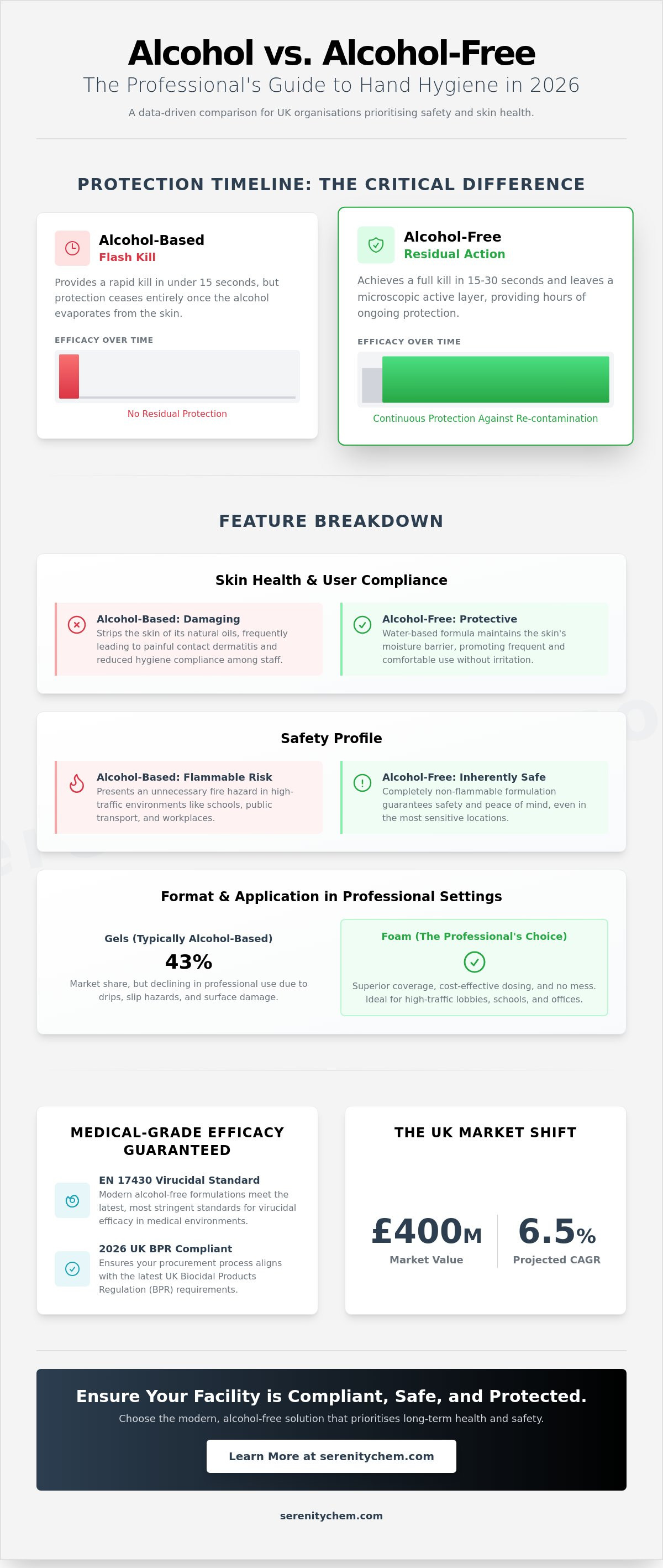
The fundamental difference between these two technologies lies in their "kill window." Alcohol is an evaporative solution; it kills germs quickly but ceases to work the moment the liquid vanishes from the skin. Conversely, an alcohol free hand sanitiser UK formulation is a residual solution. It leaves behind a microscopic, active layer on the skin's surface. This means the protection continues for a period after the hands are dry, providing a proactive barrier against re-contamination that alcohol simply cannot offer.
The Chemistry of Alcohol-Free Protection
The efficacy of these solutions comes from advanced surfactants that physically disrupt the lipid membrane of a pathogen. These surfactants act like a key that unlocks the protective outer shell of a virus or bacteria, causing it to break apart and die. Because the base is water rather than a harsh solvent, the skin's moisture barrier remains intact. This non-drying nature is a primary reason for its popularity in clinical settings. The active ingredients remain stable on the skin surface, ensuring that the antimicrobial action persists longer than the few seconds it takes for a traditional gel to evaporate.
Common Formats: Foam vs Gel
While gel-based sanitisers still hold a significant market share of 43% in 2026, professional UK environments are rapidly moving toward foam formats. Foam provides better coverage with less product, as the aerated liquid spreads more easily into the nail beds and skin creases. It's also far less likely to drip onto floors or furniture, reducing the risk of slips and surface damage. For high-traffic areas like office lobbies or school entrances, foam dispensers are the preferred choice. They offer a more controlled dose, ensuring that the supply lasts longer and provides a more cost-effective solution for bulk procurement.
How Alcohol-Free Formulations Protect Hands Whilst Killing Germs
Speed is often cited as the primary reason for choosing alcohol, but this perspective overlooks the broader timeline of hand hygiene. Whilst alcohol-based gels offer a "flash-kill" in under 15 seconds, they provide no ongoing protection once the liquid evaporates. Professional-grade alcohol free hand sanitiser UK formulations work slightly differently. They typically require 15 to 30 seconds of contact time to achieve a full 99.99% log reduction, but they offer a level of durability that solvent-based products cannot match.
Professional-grade sanitisers distinguish themselves from retail alternatives through their chemical stability and the quality of their emollients. Supermarket options often prioritise a low price point, which can result in thinner formulas that don't coat the skin evenly or lack the necessary concentration of biocides to remain effective in high-pressure environments. By contrast, industrial-strength solutions are designed to maintain their integrity even when stored in large-scale dispensers or used hundreds of times a day by frontline staff.
Residual Antimicrobial Activity
The most significant advantage of water-based sanitisation is its persistent effect. Scientific reviews regarding Efficacy and Standards highlight that whilst alcohol provides an immediate kill, it lacks the ability to prevent re-contamination. Alcohol-free products create a microscopic, non-greasy film on the skin's surface. This active layer continues to neutralise pathogens that the user might touch long after the initial application. Residual action can last for several hours under ideal conditions.
Dermatological Benefits for Frequent Users
Maintaining the skin's barrier integrity is essential for anyone working in healthcare, hospitality, or education. Frequent use of 70% alcohol gels strips away natural lipids, often leading to painful contact dermatitis or exacerbating existing conditions like eczema. Because alcohol-free formulas are pH-balanced and water-based, they don't cause this "dry-out" effect. Instead, they often incorporate high-quality humectants that actually help to hydrate the skin during use.
Beyond sanitisation, maintaining skin health involves using gentle products for regular washing; you can learn more about Glamorously Her to discover their range of handcrafted, natural soap bars designed for sensitive skin.
If you're responsible for the health of a large team, switching to a more skin-friendly option can significantly improve compliance and comfort. You might consider Serenity Chemicals Limited's alcohol-free hand sanitiser as a dependable, British-made alternative that balances high-level efficacy with superior skin care. This approach ensures that your hygiene protocols protect your staff's health as much as they protect your facility from germs.
Efficacy and Standards: Does Alcohol-Free Sanitiser Actually Work?
Determining the actual efficacy of a sanitiser requires looking beyond marketing claims and into the specific British and European standards listed on the label. A common misconception suggests that only high-percentage alcohol can neutralise "heavyweight" viruses. However, a BYU study on hand sanitizer efficacy confirmed that alcohol-free formulations are just as effective as their alcohol-based counterparts against many pathogens, including enveloped viruses. In the UK, professional-grade products must pass rigorous testing to be classified as biocides under the Health and Safety Executive (HSE) guidelines.
To ensure you are purchasing a legitimate alcohol free hand sanitiser UK solution, you must verify that the manufacturer complies with the standard Biocidal Products Regulation (BPR). This includes ensuring the active substance is sourced from a supplier on the GB Article 95 List. Without these certifications, a product cannot legally claim to be a "sanitiser" or "disinfectant" in a professional capacity. Reliability is built on these technical foundations, giving business owners the confidence that their hygiene protocols are legally and medically sound.
Understanding EN 14476 and EN 1500
These alphanumeric codes represent the benchmarks for hand hygiene in the United Kingdom. BS EN 1500 is the mandatory efficacy standard for hygienic hand rubs; it requires a product to demonstrate a microbial reduction equivalent to a 60% propan-2-ol solution. For antiviral protection, BS EN 14476 is the critical standard to look for on a label. It validates that the product is effective against viruses, including those with lipid envelopes.
In Spring 2024, a new Europe-wide standard, EN 17430, was introduced to provide even more realistic data. Unlike older in-vitro tests, this standard tests products directly on subjects' hands to simulate practical, real-world use. Serenity products are formulated to meet these stringent requirements, ensuring that our alcohol free hand sanitiser UK options provide the same level of protection as clinical-grade alcohol gels without the associated drawbacks.
Alcohol vs Alcohol-Free: A Technical Comparison
When choosing between the two, it is helpful to compare their operational impact. Alcohol is effective but carries significant flammability risks, making it a liability in high-traffic public areas or schools. It also evaporates quickly, providing no protection once the hands are dry. Alcohol-free solutions, particularly foam-based ones, are non-flammable and provide the residual protection discussed in previous sections.
- Skin Impact: Alcohol-free is superior for frequent use, preventing the skin cracking that can lead to secondary infections.
- Cost-Efficiency: Foam-based non-alcohol solutions often provide more "uses per litre" compared to gels, as the aerated format ensures better coverage with less liquid waste.
- Safety: Non-alcohol formulas eliminate the risk of accidental ingestion or "hand sanitiser challenges" amongst youth in educational settings.
For public spaces and schools, the safety profile of an alcohol-free solution often makes it the more responsible choice. Whilst alcohol gels still have a place in specific clinical "flash-disinfection" scenarios, the technical evolution of water-based biocides has made them a superior all-rounder for general professional use.
Key Benefits for Schools, Workplaces, and Sensitive Skin
Educational and multi-faith environments present unique challenges that standard alcohol gels cannot always address. While previous sections focused on clinical efficacy, the practicalities of a school or a diverse office require a broader risk assessment. Implementing an alcohol free hand sanitiser UK strategy simplifies these assessments by removing several significant hazards from the workplace. It's a choice that prioritises the physical and cultural safety of every individual on the premises.
A robust hygiene strategy often works best when individual hand care is supported by professional facility maintenance. Many businesses choose to partner with experienced providers such as That's Cleaning to ensure that their physical spaces are kept to the same high standards of cleanliness as their staff's hygiene protocols.
Safety in Educational Environments
Fire safety is a paramount concern for headteachers and facility managers. Alcohol-based sanitisers are classified as highly flammable liquids, which increases the "fire load" of a building. Storing bulk quantities in corridors or classrooms often requires specialised COSHH cabinets and updated risk assessments. Using a non-flammable alternative removes this risk entirely. This allows for easier placement of dispensers in high-traffic areas without violating fire safety protocols or requiring complex storage solutions.
Beyond fire risks, the physical well-being of students is a priority. Traditional sanitisers often have a sharp, clinical smell that can be overwhelming in enclosed classrooms. Alcohol-free formulas are virtually odourless, creating a more pleasant learning environment. Crucially, they protect the developing skin barriers of younger children. Frequent alcohol use can lead to painful cracking, which often discourages children from maintaining consistent hygiene habits. A water-based solution ensures that sanitising remains a comfortable, pain-free part of their daily routine.
The rise of social media "hand sanitiser challenges" amongst youth has also highlighted the danger of alcohol-based products. Accidental or intentional ingestion of high-percentage alcohol gel is a serious medical emergency. Professional-grade alcohol-free solutions mitigate this by using non-toxic bases and incorporating child-safe bittering agents. These agents make the liquid taste extremely unpleasant, effectively preventing ingestion before it occurs.
Whilst these safety measures help prevent immediate harm, those who require broader support with alcohol-related health issues or addiction can find out more through the independent advice and referral services offered by Detox Rehab Clinics UK.
Inclusivity and Religious Considerations
Workplace diversity and inclusion are central to modern UK business operations. For many staff members, including those from Muslim or certain Sikh communities, the use of alcohol is a sensitive issue. Providing a Halal-compliant, alcohol-free option demonstrates a principled commitment to cultural inclusivity. It ensures that all employees can maintain hygiene standards without compromising their personal or religious beliefs. This small adjustment supports a more welcoming and respectful workplace culture for everyone, fostering peace of mind amongst a diverse workforce. For leaders who wish to extend this commitment to their own health and personal well-being, cleanandfree.eu offers specialised, discreet programmes for maintaining a completely alcohol-free lifestyle.
Protecting your team and your premises requires a solution that is as responsible as it is effective. You can order Serenity Alcohol Free Hand Sanitiser to provide a safe, inclusive, and high-performance hygiene solution for your organisation.
Sourcing Reliable Alcohol-Free Hand Sanitiser from UK Manufacturers
Supply chain resilience has become a cornerstone of British procurement strategy in 2026. Relying on international imports often exposes organisations to unpredictable shipping delays and fluctuating tariffs. By prioritising an alcohol free hand sanitiser UK supply chain, businesses ensure a consistent flow of essential hygiene products. Sourcing chemicals locally also aligns with corporate social responsibility goals by significantly reducing the carbon miles associated with heavy liquid freight.
Buying direct from a manufacturer like Serenity Chemicals provides a level of transparency that third-party distributors often can't match. When you deal with the source, you gain direct access to technical data sheets and expert guidance on application. This direct relationship is particularly beneficial for large-scale commercial operations where consistent quality and volume are non-negotiable. It allows for a more agile response to changing health and safety requirements without the communication barriers of a long-distance supply chain.
Reliable supply chains for health products are often bolstered by expert logistics and packing solutions; you can find out more about professional contract packing for the UK health sector.
The Serenity Chemicals Difference
Our approach is rooted in the "Principled Expert" persona. We don't just manufacture biocides; we develop responsible solutions that protect both people and surfaces. Every batch of our alcohol-free sanitiser undergoes rigorous testing to ensure it meets the British standards discussed earlier in this guide. We support UK businesses by providing high-performance supplies that remain stable and effective throughout their shelf life. For high-volume users and wholesale partners, we offer custom supply solutions tailored to specific facility needs, ensuring your hygiene stations never run dry.
Choosing Your Supplier: A Checklist
Selecting a partner for your hygiene supplies requires a methodical approach. It's not enough to simply find the lowest price point; you must ensure the product is legally compliant and operationally efficient. Before committing to a bulk order, use the following criteria to evaluate your supplier:
- Verify Certifications: Always request the Safety Data Sheet (SDS) and official test reports for EN 1500 and EN 14476.
- Assess Cost Per Dose: Don't focus solely on the "cost per litre." Foam-based solutions often provide significantly more applications per bottle than traditional gels, offering better long-term value.
- Check BPR Compliance: Ensure the manufacturer is listed on the GB Article 95 List, confirming their active substances are legally authorised for use in the UK.
- Evaluate Delivery Reliability: Confirm the supplier has the capacity to maintain stock levels during periods of high demand.
Taking the time to vet your manufacturer ensures that your hygiene protocols are built on a foundation of integrity and efficacy. If you're ready to upgrade your facility's safety standards, you can Organise your bulk supply of Serenity Alcohol-Free Hand Sanitiser today and experience the benefits of a professional, UK-based partnership.
Securing Your Facility with Modern Hygiene Standards
Transitioning to a water-based hygiene protocol is a strategic decision that balances medical-grade efficacy with the long-term well-being of your team. By choosing a high-performance alcohol free hand sanitiser UK solution, you aren't just meeting the latest EN 14476 standards; you're actively reducing flammability risks and protecting staff from the debilitating effects of frequent alcohol use. These modern formulations provide the residual protection necessary for high-traffic environments whilst remaining kind to sensitive skin.
Our solutions represent a principled approach to safety. Every product is manufactured right here in the UK and is dermatologically tested to ensure it's safe for frequent use. Because these formulas are non-flammable and fully COSHH compliant, they offer a level of operational peace of mind that traditional gels simply cannot match. Shifting toward residual-action sanitisers ensures that your hygiene standards remain as high as your ethical ones. We're here to help you create a safer, more inclusive environment for everyone.
While odourless sanitisers significantly improve the immediate environment, many organisations also choose to incorporate premium scenting solutions from ISCENT to create a more inviting and professional atmosphere for their visitors and staff.
View the Serenity Alcohol-Free Hand Sanitiser Range
Frequently Asked Questions
Is alcohol-free hand sanitiser as effective as alcohol gel?
Yes, professional alcohol-free sanitisers are as effective as alcohol gels when they are tested to the same BS EN standards. Whilst alcohol kills germs through rapid evaporation, water-based solutions use surfactants to disrupt pathogen membranes. This results in a 99.99% kill rate that matches clinical-grade gels, provided the product is used according to the manufacturer's instructions for contact time.
Can I use alcohol-free hand sanitiser if I have eczema or sensitive skin?
Alcohol-free solutions are the recommended choice for individuals suffering from eczema or chronic skin sensitivity. Because these formulas are water-based and pH-balanced, they don't strip away the natural oils that protect your skin barrier. This prevents the painful cracking and dryness typically caused by 70% alcohol gels, making it easier for those with sensitive skin to maintain consistent hygiene compliance.
For those who want to extend this care to their washing routine, you can check out Oodima for their range of organic, handcrafted soaps which are specifically formulated to be gentle on sensitive skin.
Does alcohol-free hand sanitiser kill viruses like Norovirus or Flu?
Yes, high-quality alcohol-free sanitisers are effective against both enveloped and non-enveloped viruses, including Flu and Norovirus. You should check the product label for the BS EN 14476 certification to ensure it has been laboratory-tested for virucidal efficacy. This standard confirms that the biocide is capable of neutralising these specific pathogens in a professional UK setting.
Why is alcohol-free sanitiser preferred for schools and nurseries?
Schools and nurseries prefer alcohol-free options because they eliminate several significant safety hazards found in educational environments. These products are non-flammable, which simplifies fire risk assessments, and they remove the risk of accidental alcohol poisoning. Additionally, the gentle, odourless formula is better suited for the delicate skin of young children who may be discouraged by the stinging sensation of alcohol.
What are the main active ingredients in non-alcohol sanitisers?
The primary active ingredients in professional-grade non-alcohol sanitisers are Quaternary Ammonium Compounds, with Benzalkonium Chloride being the most common. These compounds work by breaking down the protective outer layers of bacteria and viruses. These active substances must be sourced from suppliers on the GB Article 95 List to ensure they comply with the latest UK biocidal regulations.
Is alcohol-free hand sanitiser Halal-certified or suitable for Muslims?
Yes, alcohol-free formulations are widely considered suitable for Muslims and other groups who avoid alcohol for religious or personal reasons. Since these products contain 0% ethanol or isopropanol, they provide a Halal-compliant alternative for hand hygiene. This makes an alcohol free hand sanitiser UK solution an essential choice for inclusive workplaces and community centres looking to respect the diverse needs of their staff. Supporting a healthy, alcohol-free environment can also involve providing access to professional resources like Detox Rehab Clinics UK for anyone needing guidance on addiction treatment.
How long does the residual protection of alcohol-free sanitiser last?
Residual protection can last for several hours on the skin under ideal conditions, providing a persistent antimicrobial barrier that alcohol cannot offer. Whilst the exact duration depends on hand activity and environmental factors, the active biocide remains present on the skin surface after drying. This helps prevent re-contamination between washes, adding an extra layer of security to your daily hygiene protocol.
Are alcohol-free sanitisers flammable?
No, alcohol-free hand sanitisers are entirely non-flammable because they are water-based and contain no volatile solvents. This makes them much safer to store in bulk and easier to transport than traditional gels. Choosing an alcohol free hand sanitiser UK manufactured solution helps organisations meet strict fire safety regulations without the need for specialised hazardous material storage or expensive COSHH cabinets.

Hand Hygiene in Food Preparation Areas: The 2026 Professional Guide
The Food Standards Agency estimates that foodborne illness costs the UK economy approximately £9 billion every year, with a s...

Sanitising Commercial Kitchen Hard Surfaces: The Professional UK Guide (2026)
Did you know that the average fine for food hygiene offences in the UK has more than tripled since 2016, now reaching over £7...