

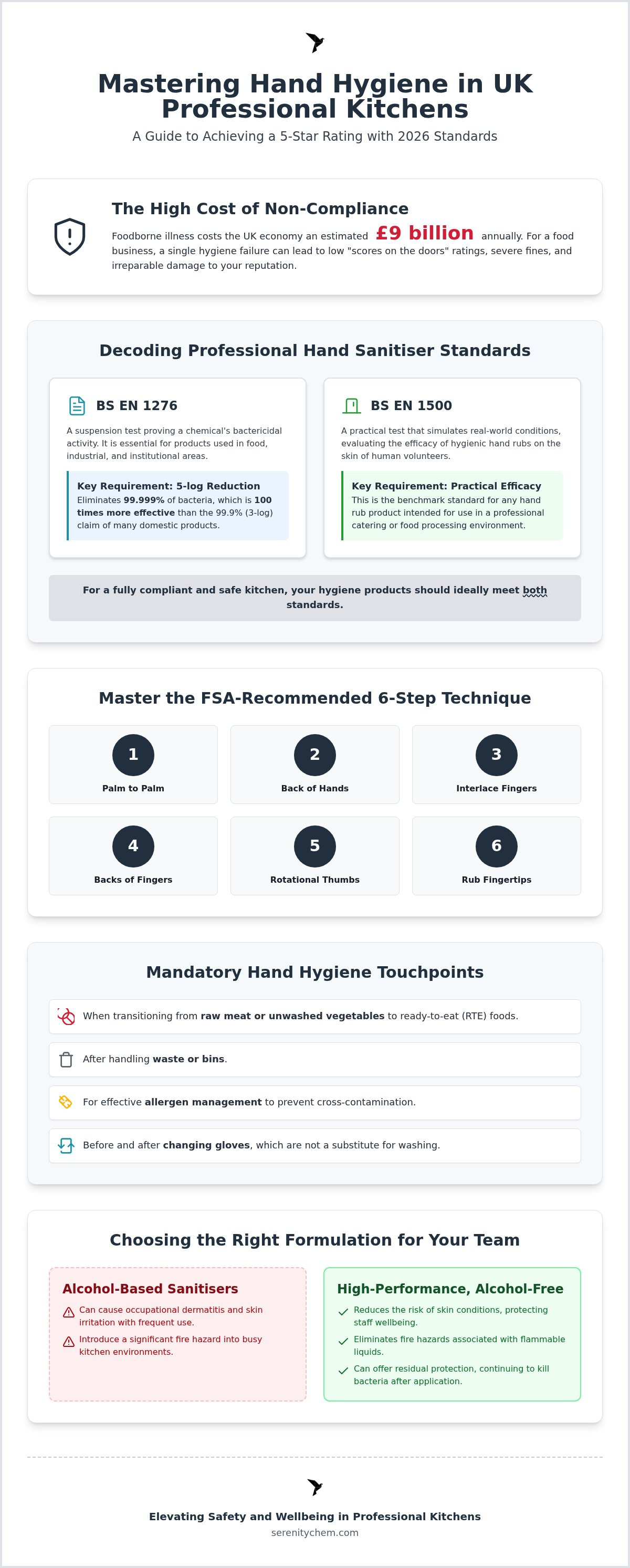
The Food Standards Agency estimates that foodborne illness costs the UK economy approximately £9 billion every year, with a significant portion of these incidents linked to failures in hand hygiene in food preparation areas. For any professional kitchen, these figures represent more than just a statistic; they reflect the constant pressure to maintain impeccable safety standards whilst protecting the bottom line. You likely know the stress of an impending inspection and the frustration of seeing your best staff struggle with occupational dermatitis caused by aggressive chemical soaps.
We believe that high-level safety shouldn't come at the cost of your team's wellbeing. This guide is designed to help you master the latest 2026 standards, including the nuances between BS EN 1276 and BS EN 1500, so you can achieve that coveted 5-star hygiene rating with confidence. We'll walk you through the essential techniques for effective sanitisation, explain how to choose formulations that offer residual protection, and show you how to reduce cross-contamination risks without compromising skin health. By the end of this article, you'll have a clear, actionable roadmap for a safer, more efficient food preparation environment.
Key Takeaways
- Understand the essential differences between BS EN 1276 and BS EN 1500 standards to ensure your sanitisation products are legally compliant.
- Master the 6-step washing technique and station design requirements that are fundamental to maintaining hand hygiene in food preparation areas.
- Explore the safety benefits of alcohol-free sanitisers in reducing the risk of occupational dermatitis and eliminating kitchen fire hazards.
- Learn how a robust hygiene protocol directly influences your Food Hygiene Rating and protects your business from the costs of foodborne illness.
- Identify high-performance, no-rinse solutions that provide residual protection whilst streamlining the workflow in a busy catering environment.
The Critical Role of Hand Hygiene in UK Food Preparation Areas
Maintaining rigorous hand hygiene in food preparation areas is the most effective way to prevent the spread of dangerous pathogens. Bacteria such as E. coli and Salmonella, alongside highly resilient viruses like Norovirus, are frequently introduced into the food chain through skin contact. While many teams rely on gloves, they are not a substitute for thorough washing. In fact, pathogens can easily spread amongst staff if gloves are not changed frequently or if hands aren't washed between changes. Cross-contamination often occurs when a staff member touches a contaminated surface and then handles ready-to-eat ingredients, making hand washing best practices the foundation of any safe kitchen.
The impact of hygiene standards extends to the very survival of a business. The "scores on the doors" system, or the Food Hygiene Rating, is a public testament to an establishment's safety culture. A low rating doesn't just invite more frequent inspections; it actively drives customers away. The financial and reputational fallout from a confirmed food poisoning outbreak is often permanent, involving heavy fines, legal action, and a total loss of consumer trust that few independent businesses can recover from.
The Legal Framework: FSA and HACCP Requirements
The Food Standards Agency (FSA) requires commercial kitchens to identify and control food safety risks. Integrating hand hygiene into your Hazard Analysis and Critical Control Point (HACCP) plan is a mandatory requirement, not an optional extra. Environmental Health Officers look for evidence of "due diligence," which means you must be able to prove that your hygiene standards are consistently met. Maintaining detailed hygiene training logs for all staff members is essential. These documents show that your team understands the specific risks associated with your menu and knows how to mitigate them through proper sanitisation.
When Handwashing is Mandatory in the Food Cycle
Specific moments in the kitchen workflow demand immediate action to maintain safety. Staff must wash their hands whenever they transition from handling raw meat or unwashed vegetables to ready-to-eat (RTE) stations. This prevents the transfer of harmful bacteria to food that will not undergo further cooking. Other mandatory touchpoints include after handling waste, using cleaning chemicals, or touching hair and face. Effective allergen management also relies on clean hands to prevent trace amounts of ingredients like nuts or gluten from reaching sensitive diners. Using a "two-stage" cleaning process, where hands are first washed to remove debris and then sanitised to kill bacteria, ensures the highest level of protection throughout the service.
Understanding British and European Standards for Hand Sanitisers
Selecting the right products for hand hygiene in food preparation areas requires more than just reading the marketing on the bottle. In a professional kitchen, the difference between a domestic grade product and a certified industrial sanitiser is measured in "log reductions." While many supermarket brands claim to kill 99.9% of bacteria, this 3-log reduction is often insufficient for high-risk environments. Professional standards like EN 1276 require a 5-log reduction, meaning 99.999% of bacteria are eliminated. This seemingly small decimal shift represents a hundredfold increase in safety, ensuring that pathogens like E. coli don't survive on the skin.
EN 1500 is the European standard for testing the efficacy of hand rubs by simulating practical conditions. Unlike suspension tests performed in a test tube, EN 1500 involves human volunteers to ensure the product works effectively on actual skin surfaces. It's the benchmark for any hand rub used in a catering or food processing setting.
EN 1276 vs EN 1500: Which Do You Need?
It's vital to understand which specific standard applies to your operational needs. EN 1276 is a quantitative suspension test that proves a chemical's bactericidal activity specifically for food, industrial, and institutional areas. In contrast, EN 1500 focuses on the practical application of hygienic hand rubs on the hands themselves. For a truly compliant kitchen, your hand hygiene products should ideally meet both criteria. You can verify these certifications by checking your professional cleaning chemicals list to ensure every bottle in your store cupboard is fit for purpose. Even with certified chemicals, staff must still follow CDC guidelines on hand washing to remove physical debris before applying rubs.
Antiviral Protection: Looking for EN 14476
Bacteria aren't the only threat in a busy kitchen. Norovirus outbreaks can shut down a business overnight, and many standard antibacterial sanitisers are ineffective against it. This is where EN 14476 becomes essential. This standard certifies that a product has proven antiviral activity. When sourcing supplies from a cleaning products manufacturer UK, always ask for the specific EN 14476 test results for the current year. Protecting your team and customers from viral transmission is a cornerstone of ethical food safety management. If you're unsure which standards your current products meet, you can speak with our technical team for a detailed compliance review.
Comparing Alcohol-Based and Alcohol-Free Sanitisers for Catering
Whilst alcohol-based gels have traditionally been the standard in many industries, they present specific challenges for hand hygiene in food preparation areas. Gas hobs and open flames are common in professional kitchens, making the storage and use of flammable alcohol gels a genuine safety concern. A single spill near a heat source can lead to a serious incident, which is why many health and safety managers are now opting for non-flammable alternatives.
Taint is another critical factor to consider. Alcohol has a sharp, distinctive odour that can easily migrate to delicate ingredients like fresh dough, pastry, or raw seafood. This can compromise the flavour profile of your dishes. Modern alcohol-free formulations now provide the same level of bactericidal efficacy as traditional gels, meeting EN 1500 standards without the risk of tainting food or causing fire hazards.
The Benefits of Alcohol-Free Formulations
Alcohol-free options are naturally non-flammable, so they don't pose a fire risk in hot, cramped kitchen environments. They also support an inclusive workplace. Many of these formulations are Halal-compliant, ensuring that a diverse workforce can adhere to hygiene protocols without conflict. Crucially, whilst alcohol evaporates almost instantly, certain alcohol-free sanitisers offer residual protection. This means they continue to provide a microbial barrier on the skin for a period after the initial application, which is a significant advantage in fast-paced catering settings.
Staff Compliance and Skin Integrity
The effectiveness of any hygiene policy relies entirely on staff behaviour. High-frequency use of alcohol can lead to occupational dermatitis, causing the skin to become dry, cracked, and painful. When hands are sore, staff may subconsciously avoid sanitising, creating a significant weak point in your safety chain. Choosing a high-quality alcohol free hand sanitiser UK businesses trust can help maintain skin integrity and reduce sick leave.
As highlighted by the World Health Organization on hand hygiene, the goal is to make sanitisation a seamless, painless part of the daily routine. By prioritising staff welfare, you foster a culture of care that naturally leads to a cleaner, safer environment. This approach is vital for sustaining high standards of hand hygiene in food preparation areas over long, demanding shifts.
Implementing a Robust Hand Hygiene Protocol in Your Kitchen
A protocol is only as effective as the environment that supports it. To maintain superior hand hygiene in food preparation areas, the physical setup of your handwash stations must be fit for purpose. Dedicated sinks should be easily accessible but positioned to avoid splashing onto food or prep surfaces. Installing non-hand-operated taps, such as those controlled by knee paddles, foot pedals, or infrared sensors, is a critical step in preventing re-contamination. When a staff member has to touch a manual tap handle after scrubbing, they immediately risk picking up pathogens left behind by the previous user. Pairing these taps with durable splashbacks ensures the area remains easy to clean and prevents water from pooling in crevices where bacteria might thrive.
Drying protocols are just as vital as the wash itself. Whilst high-speed air dryers are common in public washrooms, they are generally unsuitable for professional kitchens. These units can aerosolise water droplets and disperse bacteria across a wide area. Single-use disposable paper towels are the professional standard because the friction of the paper helps physically remove any remaining microbes. To ensure your team is following these steps correctly, regular monitoring is essential. Using "glitter bug" lotions or UV lamps during training provides a visual, undeniable demonstration of missed spots, particularly around the thumbs and under the nails.
Step-by-Step Handwashing for Food Handlers
Staff should begin by wetting their hands under warm running water before applying a professional-grade liquid soap. The friction is what does the heavy lifting. They must rub their palms together, then interlace fingers to clean the spaces between. The backs of the hands, the fingertips, and especially the thumbs require focused attention. This process should take at least 20 seconds. Finally, hands must be rinsed thoroughly to remove all soap residue and dried completely with a fresh paper towel. Damp hands are known to spread significantly more bacteria than dry ones.
The Role of Sanitisers in the Workflow
Sanitisers should be viewed as a secondary layer of defence rather than a substitute for soap and water. They are most effective when placed at high-traffic entry and exit points or near touchscreens and order printers. In a busy service, these stations allow for rapid microbial reduction between tasks that don't involve heavy soiling. It is vital to use a food safe sanitiser for commercial kitchens to ensure that no harmful chemical residues are transferred to the plate. If you need assistance designing a custom hygiene plan for your facility, you can request a hygiene consultation with our technical experts.
Why Serenity Chemicals is the Trusted Partner for Food Safety
Serenity Chemicals operates as a specialised UK manufacturer, providing high-performance hygiene solutions directly to the catering and hospitality sectors. By controlling the entire production process from formulation to bottling, we ensure that every product meets rigorous British quality standards. This direct-from-manufacturer model offers more than just supply chain reliability; it provides cost-efficiency for businesses that require consistent, large-scale supplies to maintain hand hygiene in food preparation areas. Our commitment to ethical chemical production means you can trust the integrity of the solutions your team uses every day.
We understand that a professional kitchen is a demanding environment where speed must never compromise safety. Our role is to act as a service-oriented guide, providing the technical expertise you need to navigate complex regulations. We don't just supply products; we provide the peace of mind that comes from knowing your facility is protected by formulations designed for commercial efficacy and user safety.
Serenity Alcohol-Free Hand Sanitiser: A Modern Solution
Our flagship Serenity Alcohol Free Hand Sanitiser was developed specifically to address the challenges of high-frequency use in professional kitchens. Unlike traditional gels that strip the skin of natural oils, our formulation is designed for superior skin compatibility. It's an ideal choice for staff members who suffer from sensitive skin or eczema, ensuring that the "pain barrier" never becomes an obstacle to safety. Despite its gentle nature, it provides uncompromising protection, with full compliance to EN 1276 and EN 1500 standards. For large-scale catering operations, our bulk purchasing options provide a methodical way to manage costs whilst ensuring that your hygiene stations are never empty.
Total Kitchen Hygiene Beyond the Hands
Superior food safety requires a joined-up approach where hand hygiene and surface disinfection work in tandem. A clean hand that touches a contaminated prep table immediately loses its integrity. To prevent this, we recommend using our Serenity Kitchen Sanitiser alongside our hand-care range. This creates a comprehensive "hygiene shield" across your entire workspace. You can apply these same high standards to all touchpoints by selecting a certified antibacterial surface spray UK professionals trust for its efficacy and safety.
We provide expert support for every client, including detailed technical data sheets and safety documentation to assist with your HACCP records. Our focus on non-tainting, no-rinse formulations ensures that your workflow remains brisk and your food remains untainted. By partnering with a principled expert, you ensure that your kitchen remains a safe, productive, and compliant environment for the long term.
Advancing Your Food Safety Culture
Mastering hand hygiene in food preparation areas is a continuous commitment that balances technical compliance with staff wellbeing. By understanding the rigorous requirements of EN 1276 and EN 1500 standards, you can move beyond basic domestic cleaning to a professional grade "hygiene shield." We've explored how transitioning to alcohol-free formulations eliminates fire risks and protects your team from the debilitating effects of occupational dermatitis, ensuring that your safety protocols are both effective and sustainable.
As a UK-based manufacturer operating to strict ISO standards, Serenity Chemicals provides the reliable, high-performance solutions trusted by professional catering environments nationwide. Our 100% alcohol-free and skin-friendly formulations are designed to maintain skin integrity whilst delivering the pathogen protection your business demands. Transitioning to a joined-up hygiene strategy doesn't just protect your customers; it secures your reputation and your Food Hygiene Rating for the long term.
Browse the Serenity range of food-safe hygiene solutions to find the right products for your facility. We look forward to helping you maintain a safe, compliant, and productive kitchen.
Frequently Asked Questions
Do food handlers have to wear gloves by law in the UK?
No, there is no legal requirement to wear gloves in UK food businesses. The Food Standards Agency emphasises that thorough handwashing is more important than glove use. If gloves are used, they must be changed as often as hands would be washed to prevent cross-contamination. Poor glove management can actually increase risks if staff feel a false sense of security and fail to maintain hand hygiene in food preparation areas.
Is alcohol-free hand sanitiser allowed in commercial kitchens?
Yes, alcohol-free hand sanitiser is permitted and often preferred in commercial kitchens. It eliminates the flammability risks associated with gas hobs and open flames whilst being gentler on the skin for high-frequency use. Products like Serenity Alcohol Free Hand Sanitiser are formulated to meet BS EN 1500 standards. This ensures they provide the necessary bactericidal efficacy without the risk of tainting delicate food flavours or causing skin irritation for your staff.
How often should staff wash their hands during a shift?
Staff must wash their hands whenever there is a risk of contamination, rather than following a set timer. Mandatory moments include when entering the kitchen, after touching raw meat, or handling waste. Other key times include after using the toilet, sneezing, or touching the face. Consistent handwashing is the most effective way to manage hand hygiene in food preparation areas throughout a busy service, ensuring your team remains compliant.
What is the difference between EN 1276 and EN 1500?
EN 1276 is a quantitative suspension test that evaluates how well a chemical disinfectant kills bacteria in a controlled laboratory environment. EN 1500 is a practical test that specifically measures the efficacy of hygienic hand rubs when applied to human skin. For comprehensive safety, professional kitchen sanitisers should meet both standards. This ensures the product is effective against food-industry pathogens and performs reliably during real-world application on the hands of your catering team.
Can I use scented hand soaps in a food preparation area?
It is strongly recommended to use unscented, food-grade hand soaps in any preparation environment. Strong perfumes can easily migrate from a staff member's hands to porous ingredients like bread, butter, or raw fish. This leads to "taint" that ruins the taste of the food. Professional kitchens should prioritise fragrance-free formulations to ensure that hygiene practices don't inadvertently compromise the quality and flavour of the dishes being served to your customers.
What should I do if a staff member develops dermatitis from cleaning chemicals?
You should immediately review the chemicals being used and provide a gentler alternative. Occupational dermatitis is often caused by the high alcohol content in traditional sanitisers or harsh surfactants in soaps. Switching to a 100% alcohol-free and skin-friendly formulation can help the skin recover whilst maintaining safety standards. It is also important to ensure staff dry their hands thoroughly with paper towels, as damp skin is far more susceptible to irritation.
Does hand sanitiser kill all types of food-borne bacteria?
No, hand sanitiser is not a universal cure-all and is less effective on visibly dirty or greasy hands. Whilst professional sanitisers kill 99.999% of many bacteria, they often struggle against certain resilient viruses and spores. For example, some formulations require specific EN 14476 certification to be effective against Norovirus. Sanitiser should always be used as a supplement to, rather than a replacement for, thorough washing with professional-grade soap and warm water.
Are hand dryers more hygienic than paper towels in kitchens?
No, single-use disposable paper towels are considered the professional standard for food environments. Air dryers can aerosolise water droplets and disperse bacteria across a wide area, potentially contaminating nearby prep surfaces. The physical friction of using a paper towel also helps to remove any remaining microbes that weren't rinsed away. Using paper towels allows staff to dry their hands more quickly and completely than most air-based systems commonly found in public washrooms.

Hand Hygiene in Food Preparation Areas: The 2026 Professional Guide
The Food Standards Agency estimates that foodborne illness costs the UK economy approximately £9 billion every year, with a s...

Sanitising Commercial Kitchen Hard Surfaces: The Professional UK Guide (2026)
Did you know that the average fine for food hygiene offences in the UK has more than tripled since 2016, now reaching over £7...