

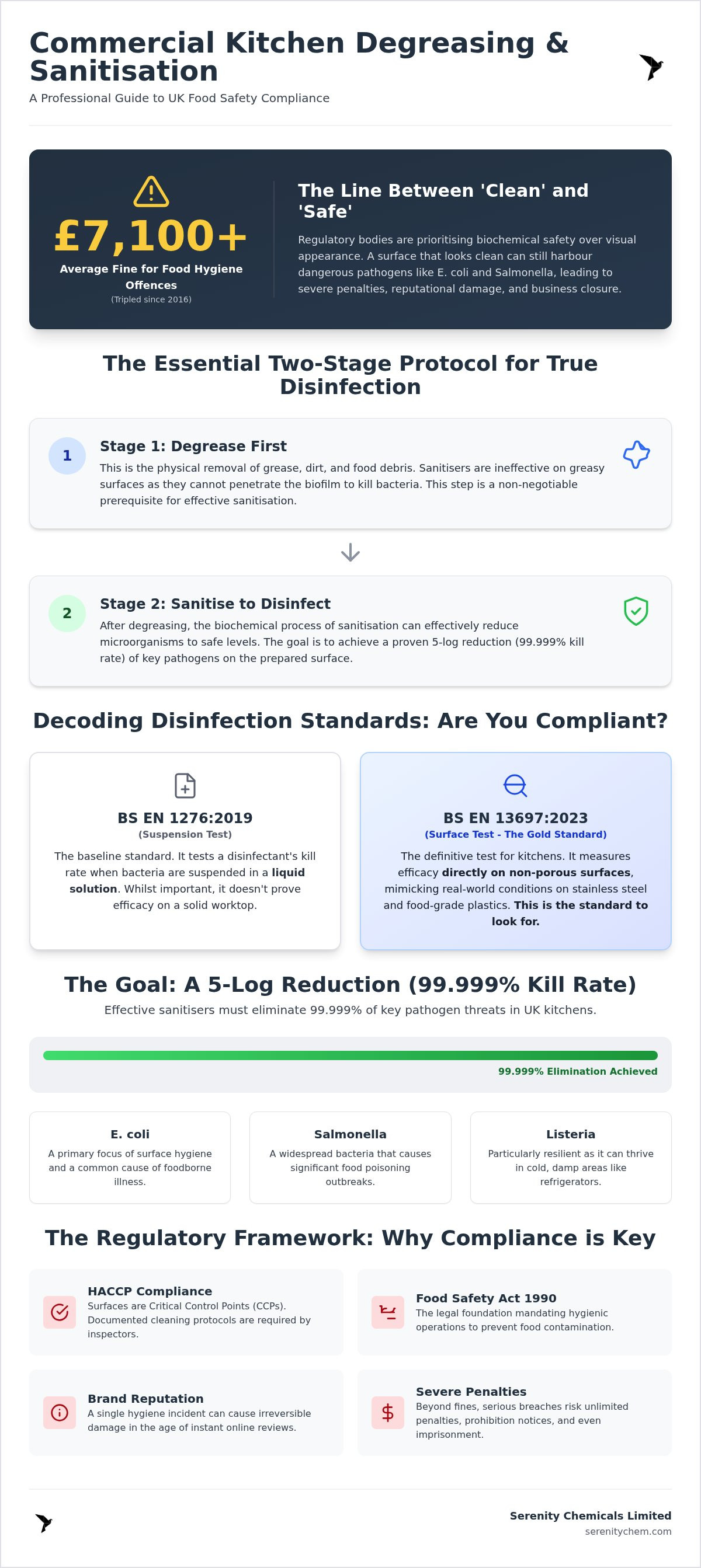
Did you know that the average fine for food hygiene offences in the UK has more than tripled since 2016, now reaching over £7,100 per incident? It's a sobering figure that confirms regulatory bodies are prioritising safety over excuses. For many head chefs and facility managers, the pressure of a surprise Food Standards Agency inspection is a constant source of stress. You're likely already working hard to keep your surfaces clear, but in a high-pressure environment, the line between "visibly clean" and "biochemically safe" can feel dangerously thin. This commercial kitchen degreasing guide bridges that gap by providing the technical expertise needed to maintain a truly bacteria-free environment.
We'll help you navigate the complexities of current UK standards, including the critical differences between BS EN 1276:2019 and the latest BS EN 13697:2023 requirements. You'll learn the essential two-stage cleaning process that ensures your sanitisers actually work as intended, rather than being neutralised by surface grease. By the end of this guide, you'll have a clear, HACCP-compliant protocol that protects your customers, satisfies the inspectors, and preserves the lifespan of your expensive catering equipment. It's about moving beyond simple cleaning and adopting a principled approach to kitchen safety that gives you total peace of mind.
Key Takeaways
- Understand how strict adherence to FSA standards and HACCP principles protects your business from significant fines and legal repercussions.
- Learn why BS EN 13697:2023 is the definitive standard for surface-level disinfection, moving beyond basic suspension tests.
- Follow this commercial kitchen degreasing guide to master the two-stage cleaning process that ensures chemical efficacy on greasy surfaces.
- Identify best practices for sanitising different materials, from corrosion-resistant stainless steel to porous food-grade plastics.
- Gain confidence in your supply chain by choosing UK-manufactured chemicals designed for professional catering compliance.
Why Sanitising Commercial Kitchen Hard Surfaces is a Regulatory Necessity
In the UK catering sector, surface hygiene isn't a matter of personal preference; it's a strict legal obligation. The Food Safety Act 1990 mandates that food businesses ensure their operations are conducted in a hygienic manner to prevent contamination. As of 2026, the Food Standards Agency (FSA) has increased its focus on the efficacy of chemical agents, moving beyond simple visual cleanliness. This commercial kitchen degreasing guide highlights that whilst a surface might look spotless, it can still harbour pathogens like E. coli or Salmonella if not treated with professional-grade solutions.
Understanding The Science of Disinfection is vital for any kitchen manager. Cleaning involves the physical removal of grease and dirt, but sanitising is the biochemical process of reducing microorganisms to safe levels. Failing to distinguish between these two steps is a leading cause of cross-contamination. Poor hygiene doesn't just risk public health; it carries severe penalties. Since the 2016 sentencing guidelines, the average fine for food safety offences has risen to over £7,100, with serious breaches resulting in unlimited fines or imprisonment. Beyond the financial cost, a single outbreak can destroy a brand's reputation permanently in the age of instant online reviews.
The Role of HACCP in Surface Hygiene
Hazard Analysis and Critical Control Point (HACCP) plans are the backbone of UK food safety. Every worktop, prep table, and high-touch surface is a Critical Control Point (CCP) where contamination must be prevented. You must document exactly when and how these areas are sanitised to satisfy local authority inspectors. Following a structured commercial kitchen degreasing guide ensures that grease is removed before sanitisation begins, which is essential for compliance. Using professional chemicals like Serenity Kitchen Sanitiser simplifies this audit trail. These products are formulated to meet specific EN standards, providing the documented proof of efficacy that environmental health officers (EHOs) require during a routine inspection.
UK Food Safety Standards and Chemical Efficacy
Domestic cleaning products often fail the rigorous demands of a busy commercial kitchen. They lack the concentration and specific certifications required to combat the high bacterial loads found in professional environments. The current regulatory environment requires a shift toward higher efficacy standards, meaning UK-manufactured solutions are more important than ever. Direct sourcing from a manufacturer like Serenity Chemicals Limited ensures that your business uses products specifically designed for British regulatory compliance. This principled approach protects your reputation and prevents the devastating impact of Hygiene Emergency Prohibition Notices that can close a business overnight.
The Science of Disinfection: Understanding EN Standards and Contact Times
Effective sanitisation in a professional kitchen is measured by its ability to achieve a 5-log reduction in microbial populations. This technical benchmark means a product must eliminate 99.999% of the specific pathogens that plague food preparation areas. In the UK, we focus heavily on three primary threats: Salmonella, E. coli, and Listeria. Whilst E. coli is often the focus of surface hygiene, Listeria is particularly resilient because it can thrive in cold, damp environments like refrigerators. This commercial kitchen degreasing guide emphasises that without the right chemical certification, you're merely moving bacteria around rather than destroying it.
EN 1276 vs EN 13697: Which do you need?
EN 1276 is the most widely recognised standard for chemical disinfectants in the food industry. It is a quantitative suspension test; bacteria are added to a liquid solution of the chemical to measure the kill rate. It's a vital baseline, but it doesn't account for how bacteria behave on a solid worktop. For a more realistic assessment, you should look for BS EN 13697:2023. This standard tests the chemical's efficacy on non-porous surfaces, ensuring it can penetrate the microscopic ridges of stainless steel or food-grade plastics. Always check your chemical labels or technical data sheets to confirm both standards are met, as this provides the highest level of protection for your HACCP audit trail.
Mastering Contact Times for Maximum Efficacy
A common error in high-pressure kitchen environments is the "spray and wipe" habit. If a disinfectant is wiped away too quickly, it fails to complete the biochemical process required to neutralise pathogens. Contact time is the duration a sanitiser must remain wet on a surface to kill 99.999% of bacteria. Most professional-grade sanitisers require between 30 seconds and 5 minutes to be fully effective. This "dwell time" can be negatively impacted by surface temperature or high organic loads. If a surface is covered in grease, the bacteria can hide beneath the oil, preventing the sanitiser from making direct contact. This is why a commercial kitchen degreasing guide always prioritises a clean surface before the final sanitising stage begins.
Achieving the correct balance between speed and safety is essential for maintaining a smooth service without compromising on hygiene. If you're unsure which standards your current chemicals meet, you can speak with our technical team for a detailed compliance review. Ensuring your team understands the "wet time" required for each product is the simplest way to reduce the risk of a foodborne illness outbreak and maintain your professional reputation.
Surface-Specific Sanitisation: Tailoring Your Approach to Kitchen Materials
Whilst the previous sections established the regulatory and scientific foundations of hygiene, the practical application depends entirely on the material being treated. Using a harsh chemical on the wrong surface doesn't just risk failing an inspection; it can lead to permanent equipment damage. A comprehensive commercial kitchen degreasing guide must prioritise material compatibility to ensure that your sanitisation routine preserves your assets whilst destroying pathogens. Every surface, from the heavy-duty prep table to the delicate oven dial, requires a specific chemical touch.
Stainless Steel Maintenance and Hygiene
Stainless steel is the industry standard for its durability, but it isn't indestructible. Many operators mistakenly use bleach-based products, which cause "pitting" and corrosion over time. This damage creates microscopic crevices where bacteria can hide, making future sanitisation nearly impossible. Instead, professionals should use non-corrosive, pH-balanced solutions like Serenity Kitchen Sanitiser. These no-rinse formulations are ideal for high-speed environments, allowing staff to sanitise prep tables quickly between tasks without the need for a secondary water rinse, saving time whilst maintaining a principled standard of safety.
Porous Surfaces and Cross-Contamination
Polyethylene chopping boards and other food-grade plastics present a unique challenge. These surfaces are prone to deep scratches from knife work, creating perfect reservoirs for bacteria like Salmonella. Surface-level sprays often fail to reach the bottom of these grooves. For these porous materials, you need deep-penetrating sanitisers that can soak into the material. Implementing a strict colour-coding protocol alongside specialised chemical treatment ensures that cross-contamination risks are managed effectively across different food groups, providing peace of mind for both the chef and the consumer.
Natural stone surfaces, such as granite or marble, require even more care. These materials are highly sensitive to acidic sanitisers, which can "etch" the surface and leave it dull or porous. For these areas, a neutral hard surface sanitiser is essential. This is a critical detail often missed in a standard commercial kitchen degreasing guide, where the focus is usually on grease removal rather than surface preservation. Using the correct neutraliser ensures the stone remains non-porous and easy to clean over the long term.
High-touch points like oven dials, fridge handles, and light switches require a methodical approach to avoid electrical damage. Never spray chemicals directly onto electrical components; instead, apply a product like Serenity Antibacterial Surface Spray to a clean microfibre cloth first. This targeted method ensures these critical contact points are disinfected without risking electrical shorts or mechanical failure. By treating each material with the respect its chemistry demands, you ensure a kitchen that is both legally compliant and operationally efficient.
Establishing a Robust Two-Stage Kitchen Sanitisation and Degreasing Protocol
The core of any professional hygiene regime is the two-stage process. Many kitchens attempt a single-stage approach, but this often fails under technical scrutiny. This commercial kitchen degreasing guide advocates for a clear separation between soil removal and pathogen destruction. Without this distinction, your sanitiser is forced to work through layers of organic matter, which significantly reduces its efficacy. It's a methodical approach that ensures every square inch of your workspace meets the highest safety standards.
The Importance of Effective Degreasing
Bacteria are remarkably resilient, often shielding themselves within a "bio-shield" of fats, oils, and proteins. If you apply a disinfectant directly to a greasy surface, the chemical is neutralised by the organic load before it can reach the microbes. You must use a high-performance solution like Serenity Heavy Duty Degreaser to remove this protective layer first. Implementing a structured commercial kitchen degreasing guide ensures your team understands that sanitisation cannot happen in the presence of grease. This ensures the surface is physically clean, leaving pathogens exposed for the second stage.
Step-by-Step Sanitising Execution
Once the degreaser is rinsed away and the surface is dry, the sanitising phase begins. Use a consistent S-pattern spray technique to ensure uniform coverage without missing corners or edges. In hot kitchen environments, evaporation happens quickly. You'll need to apply enough product to keep the surface visibly wet for the entire required contact time. Whilst some surfaces benefit from a final wipe with a single-use paper towel, many modern formulations are designed to air-dry. This prevents the risk of re-contamination from a dirty cloth and ensures the chemical has finished its work.
Maintaining high standards requires more than just trust; it requires verification. Professional kitchens often use ATP (Adenosine Triphosphate) swabs to get an instant reading of the biological load on a surface. This data-driven approach provides objective proof that your protocol is working. Additionally, managing your equipment is just as critical as the chemicals themselves. You should focus on these key areas:
- Cloth Management: Use colour-coded microfibre cloths for different zones to prevent cross-contamination.
- PPE: Ensure all staff wear appropriate nitrile gloves to prevent chemical irritation during the degreasing phase.
- Sprayer Calibration: Regularly check trigger sprayers to ensure they deliver a consistent mist rather than a stream.
If you want to implement a bespoke protocol for your facility, you can contact our hygiene specialists for expert guidance on chemical selection and application techniques. Establishing a principled cleaning culture is the most effective way to protect your customers and your business reputation.
Professional Solutions: Why UK-Manufactured Chemicals Lead the Way
Sourcing chemicals from a domestic manufacturer provides a layer of security that international retailers simply cannot match. In 2026, the complexity of UK food safety regulations requires more than just a wide product range; it demands technical accountability. When you follow a commercial kitchen degreasing guide, the efficacy of the results is only as good as the chemistry behind the bottle. UK-manufactured solutions are blended specifically to meet local environmental and safety standards, ensuring every batch is compliant with the latest FSA guidance.
The Serenity Approach to Kitchen Hygiene
Serenity Kitchen Sanitiser is formulated to meet the rigorous demands of professional food preparation. Unlike many mass-market alternatives, it's an alcohol-free solution. This provides two distinct advantages: it's gentler on the skin of your kitchen team and it won't cause the clouding or degradation of sensitive surfaces like polycarbonate or acrylic. For those needing a deeper dive into regulatory alignment, our professional food safe sanitiser reference provides the granular data required for high-level HACCP documentation. By choosing a product designed for the specific challenges of British kitchens, you ensure your sanitisation phase is as effective as your degreasing phase.
Sourcing and Logistics for UK Businesses
The benefits of working with a cleaning products manufacturer UK extend beyond the chemical formula. Direct-from-manufacturer supply chains significantly reduce the carbon footprint of your procurement process by eliminating unnecessary international transit. It also guarantees consistent availability; you aren't at the mercy of global shipping delays that could leave your kitchen without essential hygiene supplies. This reliability is a cornerstone of a principled business approach, ensuring you never have to compromise your standards because a delivery failed to arrive.
Technical support is another area where UK manufacturing leads. If an inspector asks a specific question about contact times or material compatibility, you have direct access to the chemists at Serenity Chemicals Limited who formulated the product. This level of transparency builds long-term trust and ensures your commercial kitchen degreasing guide is backed by expert knowledge rather than generic marketing claims. It's about providing a solution that's both effective and responsible, protecting your staff, your customers, and the environment simultaneously.
Enquire about bulk supply for your commercial kitchen today to secure your supply of professional-grade chemicals and discuss your specific facility requirements with our technical team.
Securing the Future of Your Kitchen Hygiene
Maintaining a bacteria-free environment requires a principled commitment to technical accuracy. By following this commercial kitchen degreasing guide, you've moved beyond surface-level cleaning to a robust two-stage protocol that satisfies both inspectors and safety standards. You now understand that the right chemical choice, coupled with correct contact times and material-specific care, is the only way to ensure full HACCP compliance in 2026. Safety shouldn't be a gamble. It's about protecting your reputation whilst ensuring the well-being of every customer who walks through your doors.
Our solutions are manufactured in the UK to ISO standards and are fully compliant with EN 1276 and EN 13697. They're already used by leading catering and hospitality businesses nationwide to maintain impeccable hygiene levels. When you choose professional-grade chemicals, you're investing in peace of mind and operational excellence. View our range of UK-manufactured commercial kitchen sanitisers to find the right fit for your facility. We're here to help you uphold the highest standards of safety with confidence.
Frequently Asked Questions
What is the difference between a kitchen cleaner and a kitchen sanitiser?
A kitchen cleaner is designed to remove visible dirt and organic matter, whilst a kitchen sanitiser uses chemical agents to reduce microorganisms to safe levels. In any professional environment, these must be used sequentially. This commercial kitchen degreasing guide highlights that sanitisers cannot penetrate layers of fat or oil. Therefore, you must use a cleaner or degreaser first to expose the bacteria before the sanitising agent can effectively neutralise the remaining pathogens.
Do I need to rinse surfaces after using a food-safe sanitiser?
Whether you need to rinse depends entirely on the formulation of the product and current FSA guidance. Many modern solutions, such as Serenity Kitchen Sanitiser, are designed as no-rinse formulations to save time during busy service periods. These products are tested to ensure they leave no harmful residues on food-contact surfaces. However, you should always check the manufacturer’s instructions on the label to confirm if a water rinse is required for your specific chemical.
How often should hard surfaces be sanitised in a commercial kitchen?
Hard surfaces should be sanitised throughout the day as part of a "clean-as-you-go" policy and always between different preparation tasks. This is a fundamental requirement of your HACCP plan to prevent cross-contamination. High-touch areas, such as fridge handles and prep tables, require more frequent attention than low-traffic zones. A comprehensive commercial kitchen degreasing guide suggests a full deep clean and sanitisation at the end of every shift to maintain a sterile environment.
What EN standards should I look for on a kitchen sanitiser label?
You should look for the following certifications on your labels to ensure professional efficacy:
- BS EN 1276: Confirms the chemical kills 99.999% of bacteria in a liquid suspension.
- BS EN 13697: Evaluates the product's efficacy when applied directly to non-porous surfaces.
Having both provides documented proof that the product is effective against common kitchen pathogens like E. coli and Salmonella, which is essential for a successful EHO inspection.
Can I use the same sanitiser for front-of-house and back-of-house surfaces?
You can use the same sanitiser across both areas, provided the product is food-safe and compatible with the materials in each zone. Using a single versatile solution like Serenity Multi-Surface Cleaner can simplify your cleaning inventory and reduce the risk of staff using the wrong chemical in the wrong place. This ensures that front-of-house tables and back-of-house prep stations both meet the same high standards of hygiene without damaging delicate finishes.
What happens if I do not leave the sanitiser on the surface for the full contact time?
If you don't respect the full contact time, the sanitiser won't achieve the required 5-log reduction in bacteria. Wiping a surface too early leaves survivors behind, which can then multiply rapidly in the warm kitchen environment. This "spray and wipe" habit is a major cause of failed hygiene audits and foodborne illness outbreaks. You must allow the chemical to remain wet on the surface for the duration specified by the manufacturer to ensure total disinfection.
Are alcohol-free sanitisers effective against viruses and bacteria in kitchens?
Yes, alcohol-free sanitisers are highly effective and are often preferred in catering environments. These formulations, such as Serenity Kitchen Sanitiser, use advanced antimicrobial agents that provide a high kill rate without the fire risk or surface damage associated with alcohol. They're also much kinder to the skin of your kitchen team, reducing the risk of occupational dermatitis. These solutions provide a principled balance between high-level efficacy and the long-term protection of your staff.
How should sanitising chemicals be stored to maintain their efficacy?
Sanitising chemicals should be stored in a cool, dry area away from direct sunlight and heat sources. They must always remain in their original, clearly labelled containers to prevent confusion and ensure the stability of the active ingredients. In a commercial setting, this usually means a dedicated COSHH cupboard that's secure and well-ventilated. Proper storage prevents the chemicals from degrading over time, ensuring they remain fully effective until the very last drop is used.

Hand Hygiene in Food Preparation Areas: The 2026 Professional Guide
The Food Standards Agency estimates that foodborne illness costs the UK economy approximately £9 billion every year, with a s...

Sanitising Commercial Kitchen Hard Surfaces: The Professional UK Guide (2026)
Did you know that the average fine for food hygiene offences in the UK has more than tripled since 2016, now reaching over £7...