

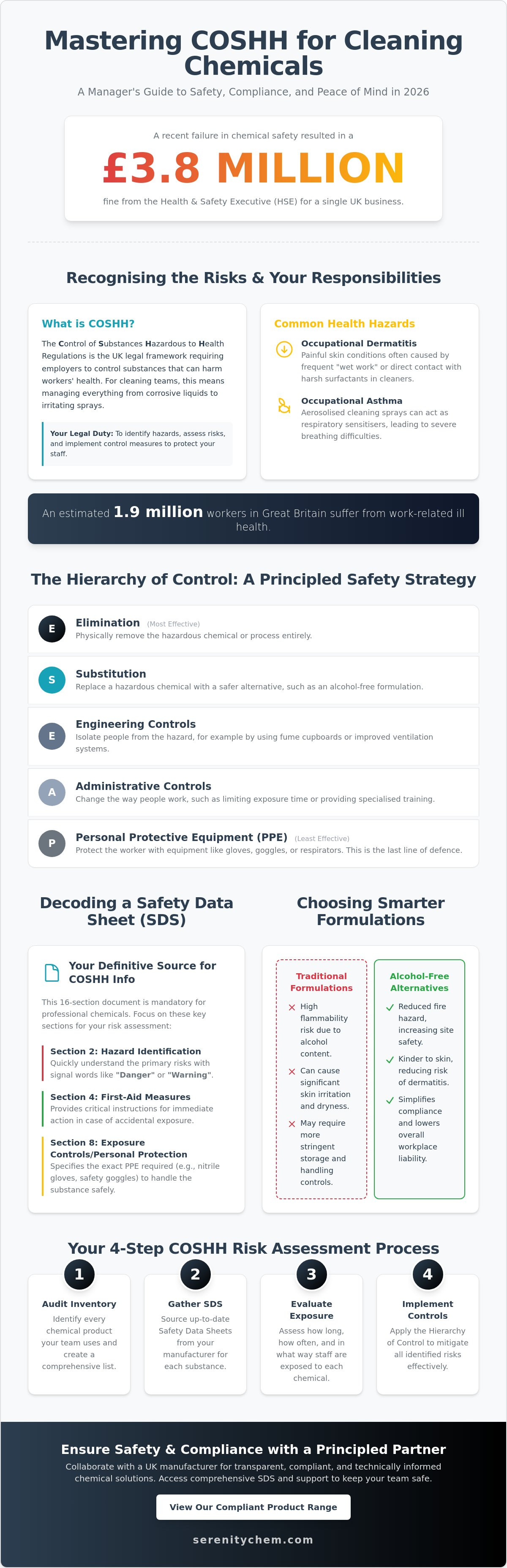
Did you know that a single failure in chemical safety recently resulted in a £3.8 million HSE fine for a UK business? It's a stark reminder that the stakes for workplace safety have never been higher. Most managers find it exhausting to stay on top of COSHH information for cleaning chemicals, especially when faced with confusing hazard symbols and the constant need to update Safety Data Sheets. You want to protect your staff from painful health risks like skin irritation, yet the technical requirements often feel like a barrier to actual safety.
We believe that safety should be straightforward and principled. This guide will help you master the essentials of COSHH compliance and chemical safety to protect your staff and ensure regulatory adherence in 2026. We will provide a clear breakdown of your legal duties, a simplified approach to risk assessments, and insights into how choosing smarter formulations can reduce your liability whilst keeping your environment spotless.
Key Takeaways
- Understand the legal framework of COSHH and why cleaning chemicals like corrosives and irritants require strict regulatory oversight in 2026.
- Learn how to accurately interpret Safety Data Sheets and source essential COSHH information for cleaning chemicals from reputable UK manufacturers.
- Explore the hierarchy of control to see how substituting harsh substances with alcohol-free alternatives reduces flammability and skin health risks.
- Follow a structured approach to risk assessments by auditing your chemical inventory and evaluating the duration of staff exposure.
- Identify how direct collaboration with a principled UK manufacturer ensures your business remains compliant and technically informed.
Understanding COSHH Regulations for Cleaning Chemicals in 2026
The Control of Substances Hazardous to Health Regulations, often referred to as the COSHH Regulations, represent the primary legal framework for workplace safety in the United Kingdom. These rules mandate that employers must identify and control any substance that could harm an employee's health. In the cleaning industry, where daily contact with chemical agents is standard, this duty of care is paramount. The consequences of overlooking these duties are severe. In early 2026, the Health and Safety Executive (HSE) concluded a prosecution resulting in a £3.8 million fine for a firm that failed to manage hazardous chemical exposure. This serves as a reminder that safety is both a moral and financial imperative.
Accessing accurate COSHH information for cleaning chemicals is not merely a box-ticking exercise. It's a vital part of protecting your workforce from substances that are often corrosive, toxic, or highly irritating. As a manager, you're legally responsible for ensuring that every product in your cupboard is assessed. This involves understanding the specific hazard profile of each cleaner and implementing controls to prevent harm before it occurs. You don't have to manage this alone, but you do have to manage it thoroughly.
The legal duty of care for UK business owners extends beyond just providing equipment. It requires a thorough understanding of exposure limits and the implementation of the hierarchy of control. With an estimated 11,000 deaths each year in the UK linked to occupational lung disease and cancer from past exposures, the moral argument for safety is as strong as the financial one. The total annual cost of workplace ill health reached £22.9 billion in the 2024/2025 period. This proves that a lack of oversight carries a heavy price for both the national economy and individual enterprises.
The Scope of COSHH in the Cleaning Industry
Common janitorial supplies frequently contain hidden hazards. Whilst some products are "dangerous" due to their physical properties, such as flammability, others are "hazardous" because of their long-term effect on human biology. A principled expert looks beyond the label to distinguish between manageable risks and those that should be substituted. This proactive stance ensures safety protocols are built on transparency and technical precision rather than guesswork.
Recognising Health Hazards: Dermatitis and Asthma
Health impacts in this sector are often slow to develop but difficult to reverse. HSE data from November 2025 shows that 1.9 million workers in Great Britain suffer from work-related ill health. Occupational dermatitis is a frequent complaint, often caused by "wet work" or direct contact with harsh surfactants. Similarly, aerosolised cleaning sprays can act as respiratory sensitisers, leading to occupational asthma if not managed with proper COSHH information for cleaning chemicals.
Deciphering Chemical Labels and Safety Data Sheets (SDS)
Every effective risk assessment begins with a Safety Data Sheet (SDS). This 16-section document is the definitive source of COSHH information for cleaning chemicals, providing technical data that a standard product label simply cannot accommodate. Whilst a domestic "home use" cleaner might only list basic precautions, professional products must adhere to strict Classification, Labelling and Packaging (CLP) regulations. This ensures that managers have access to precise data regarding chemical stability, toxicology, and environmental impact. Relying on domestic labels in a workplace is a common mistake; they don't account for the high-frequency use or the large volumes typical in commercial settings.
When you partner with a professional UK manufacturer like Serenity, obtaining these documents is straightforward. We provide comprehensive data sheets for our entire range, from our Serenity Antibacterial Surface Spray to our heavy-duty degreasers. This transparency allows you to build a safety folder that aligns with HSE COSHH guidance and stands up to any regulatory inspection. If you're looking to simplify your compliance, you can view our full product range to access the technical specifications you need.
Crucial SDS Sections for Cleaning Managers
Navigating a multi-page document can feel daunting, but you only need to focus on a few key areas to ensure safety. Section 2 is your first port of call, as it identifies the hazards and uses signal words like "Warning" or "Danger" to indicate severity. Sections 4 and 8 are equally vital; they dictate first-aid measures and the specific Personal Protective Equipment (PPE) your team must wear. Finally, Section 13 outlines disposal considerations. Professional-grade chemicals often require specific handling to protect local water systems, making this section essential for environmental responsibility.
Understanding Hazard and Precautionary Statements
SDS documents use a standardised system of H-statements and P-statements. Hazard (H) statements describe the nature of the chemical's danger, such as "May cause an allergic skin reaction." Precautionary (P) statements provide the solution, such as "Avoid breathing vapours." For a business, "Keep out of reach of children" is an insufficient safety measure. You must instead implement the specific P-statements found in your COSHH information for cleaning chemicals. It's best practice to review your SDS library annually or whenever a manufacturer updates a formulation to ensure your risk assessments remain accurate and legally sound.
Comparing Chemical Hazards: Alcohol-Free vs Traditional Formulations
The hierarchy of control is the foundation of any principled safety strategy. Under UK law, you're expected to manage risks by following a specific order of priority: elimination, substitution, engineering controls, administrative controls, and finally, PPE. Substitution is often the most effective tool for a cleaning manager. By replacing a hazardous substance with a safer alternative, you remove the threat rather than just trying to contain it. This is where modern COSHH information for cleaning chemicals becomes invaluable, as it highlights advanced formulations that traditional guides often overlook.
Traditional alcohol-based sanitisers present two major issues: flammability and skin dehydration. In a commercial environment, storing large quantities of flammable liquids complicates your fire risk assessment and requires specific storage protocols. Furthermore, alcohol strips natural oils from the skin. This directly contributes to the 1.9 million cases of work-related ill health reported in Great Britain. Switching to alcohol-free options removes these specific liabilities from your documentation and protects your team's long-term health.
Referencing HSE guidance on COSHH for cleaners, we see a clear preference for using the least hazardous product that gets the job done. pH-neutral cleaners, such as Serenity Multi-Surface Cleaner, are far less aggressive than traditional acids or alkalis. This shift often reduces the legal requirement for heavy-duty PPE. It makes the workday more comfortable for your staff and reduces the overhead costs of safety gear.
Substitution in Practice: Choosing Safer Chemicals
Swapping corrosive bleach for a stabilised Serenity Antibacterial Surface Spray is a practical example of substitution. It moves the risk profile from "corrosive" to a much safer category. Using Serenity Alcohol Free Hand Sanitiser simplifies your COSHH folder because you don't need to document complex fire suppression measures for hand hygiene stations. It's a direct, honest approach to safety that respects both your staff and your regulatory obligations.
Performance vs. Safety: Debunking the Myth
Many managers worry that safer chemicals won't kill germs as effectively. Safe chemicals aren't weak. Our alcohol-free disinfectants are validated against EN 14476 standards, proving they are highly effective against viruses and pathogens. By choosing smarter chemical procurement, businesses see a documented reduction in workplace dermatitis whilst maintaining high hygiene standards. You can rely on the COSHH information for cleaning chemicals provided by professional manufacturers to prove that your "green" or alcohol-free choices meet rigorous industrial requirements.
Carrying Out a COSHH Risk Assessment for Your Cleaning Team
Creating a compliant risk assessment is a practical exercise in professional responsibility. It's more than a document stored in a filing cabinet; it's a live safety plan that protects your team from harm. To begin, conduct a thorough audit of your chemical cupboard. You must gather the latest Safety Data Sheets for every product to ensure you have the most current COSHH information for cleaning chemicals. This data serves as the technical foundation for every decision you make regarding staff safety.
Evaluate the exposure patterns within your facility. It isn't enough to know a chemical is hazardous; you must understand how it's used in practice. For instance, when a staff member uses Serenity Floor Cleaner, are they working in a well-ventilated hall or a cramped corridor? Consider who is exposed, how often the task is performed, and the duration of each session. Once these risks are identified, you can implement control measures following the hierarchy of control, prioritising substitution wherever possible.
Record your findings in a formal document. If your business employs five or more people, a written COSHH assessment is a legal requirement. This record must be accessible to your team and used as a basis for training. Finally, commit to a regular review cycle. You should re-evaluate your assessments at least once a year or immediately if you change suppliers or introduce a new product like Serenity Heavy Duty Degreaser. If you're looking to update your inventory with safer, professional-grade products, you can explore our professional cleaning range to find solutions with transparent technical data.
Implementing Effective Control Measures
Engineering controls are your first line of defence after substitution. This might include automatic dilution systems for concentrates, which prevent splashes and ensure the correct chemical-to-water ratio. Administrative controls involve staff training and the use of colour-coded systems to prevent cross-contamination. PPE remains the last resort. When selecting gloves or eye protection, refer back to your COSHH information for cleaning chemicals to ensure the material is resistant to the specific substances being used.
Storage and Safe Handling Protocols
A dedicated chemical store must be organised with precision. Always segregate acids from alkalis to prevent dangerous chemical reactions in the event of a leak. Decanting chemicals into unlabelled spray bottles is a significant safety breach; original labelling is a strict COSHH requirement. If decanting is necessary, the new container must carry identical hazard warnings. You should also maintain a professional spill kit that includes absorbent pads, neutralising agents, and heavy-duty disposal bags for immediate incident response.
Professional Chemical Supply: Safety and Compliance with Serenity
Buying direct from a UK manufacturer like Serenity Chemicals Limited ensures technical transparency that resellers can't match. When you source from the point of origin, you speak to the experts who formulated the solutions. This accountability ensures that the COSHH information for cleaning chemicals provided is accurate and robust. Safety is built on this foundation of clear communication and technical integrity. It's about knowing exactly what is in your products and how they react in real-world environments.
Our commitment to your staff's health is reflected in our development of alcohol-free and pH-neutral formulations. These products help you meet safety goals without losing efficacy. Serenity Chemicals Limited provides detailed COSHH information for cleaning chemicals across our entire range. You gain the data needed to protect your workforce and your business reputation. This approach reduces the burden on your internal safety teams whilst maintaining the highest hygiene standards across your facilities. To maintain these standards on specialist surfaces, you can check out The Rutland Cleaning Company for their professional upholstery cleaning services.
Once you have established these high standards of hygiene and safety, you can focus on further enhancing the atmosphere of your premises. For those looking to elevate their professional environment through premium sensory solutions, discover ISCENT and their innovative approach to luxury scenting in 2026.
Accessing professional support shouldn't be a hurdle. Serenity Chemicals Limited maintains a dedicated network for wholesale and commercial queries. Whether you manage one site or a national contract, we offer the guidance needed to keep your environment safe. We understand that every business has unique challenges. Our team is ready to provide the specific technical advice required to integrate our solutions into your existing safety protocols seamlessly.
Reliable Documentation for Your Safety Folder
Compliance requires meticulous record-keeping. We offer instant access to Safety Data Sheets for our range, including multi-surface cleaners and degreasers. Our technical team monitors regulatory shifts, like the 2026 chemical amendment regulations, to keep you ahead. This vigilance ensures that your risk assessments are always based on the most current data available. To maintain a consistent safety standard, you can bulk buy antibacterial spray and access technical documentation immediately.
The Serenity Advantage: Principled Protection
The focus of our team remains on ethical manufacturing and user-safe profiles. Serenity Chemicals Limited supports UK businesses by providing high-performance, low-hazard solutions. You're partnering with a seasoned professional who values long-term trust over short-term gains. This partnership ensures that your cleaning operations are both effective and responsible. For personalised support, please contact Serenity Chemicals Limited for expert safety advice and supply.
Future-Proofing Your Chemical Safety Strategy
Managing workplace hazards doesn't have to be a source of stress. By prioritising the hierarchy of control and utilising technical data effectively, you transform compliance from a regulatory burden into a core business strength. You've learned how to decode Safety Data Sheets and why substituting traditional irritants with alcohol-free alternatives protects both your staff and your fire risk profile. Accessing reliable COSHH information for cleaning chemicals is the first step toward a more responsible and efficient cleaning operation.
As a UK-based chemical manufacturer specialising in alcohol-free hygiene, Serenity Chemicals Limited is here to support your transition to safer formulations. We provide full SDS documentation for every product to ensure your safety folder remains impeccable and aligned with current standards. Explore Serenity Chemicals Limited’s range of COSHH-compliant cleaning solutions to see how our principled approach to manufacturing can enhance your workplace safety. Building a safer environment is a journey worth taking, and with the right technical partners, you'll ensure your team remains protected for years to come.
Frequently Asked Questions
What is the most important COSHH information for cleaning chemicals?
The Safety Data Sheet (SDS) is the most critical source of COSHH information for cleaning chemicals as it outlines specific hazards, exposure limits, and emergency protocols. Without this document, you cannot conduct a legally compliant risk assessment. It ensures you understand the technical properties of the substance and the exact measures required to keep your team safe from harm whilst they are on duty.
Do I need a COSHH risk assessment for "eco-friendly" cleaning products?
Yes, you must carry out a risk assessment for eco-friendly products. Natural or biodegradable ingredients can still act as skin irritants or respiratory sensitisers in a professional setting. If a product contains any chemical substance that could potentially harm health, it falls under COSHH regulations. Always check the SDS to determine if the product requires specific handling controls or protective equipment for your staff.
How often should Safety Data Sheets (SDS) be updated for my business?
You should review your Safety Data Sheets at least once a year or immediately if a manufacturer updates a product formulation. Regular audits ensure your safety folder remains accurate and compliant with the latest UK standards. Keeping your COSHH information for cleaning chemicals current is vital for protecting employees and avoiding regulatory penalties in the event of an HSE inspection or a workplace incident.
Is PPE always required when using COSHH-regulated cleaning chemicals?
PPE is not always required; it is the final line of defence in the hierarchy of control. You should first attempt to eliminate the hazard or substitute it with a safer alternative, such as a pH-neutral cleaner. If these steps don't remove the risk, engineering controls like improved ventilation should be used. Only when these measures are insufficient should you mandate the use of gloves or goggles.
Can I store different cleaning chemicals together in the same cupboard?
You can store compatible chemicals together, but you must never mix incompatible substances like acids and alkalis in the same space. Storing bleach near acidic toilet cleaners can lead to the release of dangerous chlorine gas if a leak occurs. Ensure your chemical store is well-ventilated, secure, and organised according to the compatibility instructions found in Section 10 of each product's Safety Data Sheet to prevent accidents.
What should I do if a staff member develops a skin rash from a cleaning product?
You must immediately remove the employee from the source of exposure and provide appropriate first aid as detailed in Section 4 of the SDS. Following this, you should review your COSHH risk assessment to determine why the irritation occurred. This might involve checking if the correct PPE was used or if a safer, alcohol-free alternative should be substituted to prevent any future health issues for your team.
Are alcohol-free sanitisers covered under COSHH regulations?
Yes, alcohol-free sanitisers are covered under COSHH because they are chemical substances used in a workplace environment. Whilst they often present a lower hazard profile than alcohol-based alternatives, they still require a formal assessment. You must document how they are used and ensure your staff understand any minimal risks, such as accidental eye contact, to maintain full regulatory compliance and employee peace of mind.
Who is responsible for COSHH training in a small business?
The employer holds the ultimate legal responsibility for ensuring that all staff receive adequate COSHH training. In a small business, the owner or a designated safety manager must provide clear instructions on how to handle chemicals safely. This includes teaching employees how to read labels, use PPE correctly, and follow the specific control measures outlined in your company's formal risk assessments to ensure a safe environment.

Hand Hygiene in Food Preparation Areas: The 2026 Professional Guide
The Food Standards Agency estimates that foodborne illness costs the UK economy approximately £9 billion every year, with a s...

Sanitising Commercial Kitchen Hard Surfaces: The Professional UK Guide (2026)
Did you know that the average fine for food hygiene offences in the UK has more than tripled since 2016, now reaching over £7...