

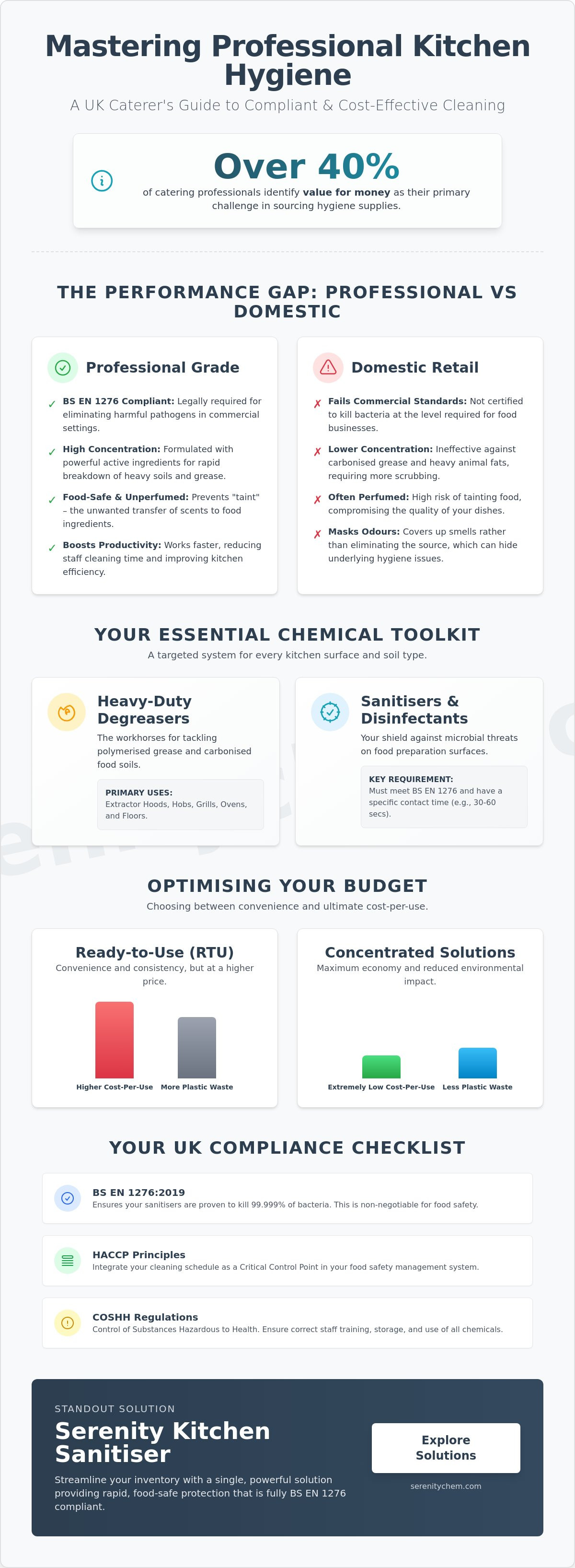
Did you know that over 40% of catering professionals now identify value for money as their primary challenge when sourcing essential hygiene supplies? It is a common frustration; you must meet rigorous BS EN 1276:2019 standards whilst managing the rising costs of inflation and overheads. Selecting the right catering kitchen cleaning chemicals UK often feels like a trade-off between absolute food safety and the reality of a tightening budget, particularly when chemical wastage and complex COSHH requirements are involved.
This guide helps you master these complexities by identifying compliant, high-performance solutions that protect both your guests and your bottom line. You will learn how to build a streamlined cleaning inventory that ensures full regulatory compliance whilst reducing your total cost-per-use. We examine the shift toward digital-first enforcement under the Product Regulation and Metrology Act 2025 and provide a clear framework for choosing smarter, concentrated products that deliver professional results every time.
Key Takeaways
- Understand why professional-grade chemistry is vital for preventing cross-contamination and why domestic products don't meet UK commercial standards.
- Identify the core categories of catering kitchen cleaning chemicals UK needed to maintain everything from heavy-duty hobs to food preparation surfaces.
- Learn how to balance your cleaning budget by choosing between the convenience of ready-to-use sprays and the economic power of high-concentration solutions.
- Master the technical requirements of BS EN 1276 and HACCP principles to ensure your kitchen remains compliant with the latest UK safety legislation.
- Discover how targeted solutions like Serenity Kitchen Sanitiser can streamline your inventory whilst providing rapid, food-safe protection.
Understanding the Essentials of Catering Kitchen Cleaning Chemicals in the UK
Professional kitchen hygiene isn't merely about removing visible dirt. It is a technical discipline designed to eliminate invisible pathogens that cause foodborne illnesses. In a high-pressure environment, using the correct catering kitchen cleaning chemicals UK is the foundation of a robust food safety management system. These specialised solutions are formulated to work faster and more reliably than standard retail products, ensuring that your team can maintain a sterile environment without sacrificing operational speed.
The High Stakes of Kitchen Hygiene
Compliance is not optional. Under the Food Safety Act 1990, UK food businesses have a legal obligation to ensure that food is prepared in a safe and hygienic manner. A poor Food Hygiene Rating can devastate a brand's reputation; consumers increasingly check these scores before booking. By using high-performance chemicals, you aren't just following the law; you're protecting your business's future. Efficient chemistry also boosts labour productivity. When a product like Serenity Heavy Duty Degreaser works on contact, your staff spend less time scrubbing and more time on service, directly improving your kitchen's efficiency.
While operational efficiency is key, the personal resilience of the business owner is equally vital. For leaders and entrepreneurs navigating the high-pressure catering environment, cleanandfree.eu offers discreet, specialised support for addiction recovery and wellbeing.
Professional vs Domestic: The Performance Gap
It's tempting to think that supermarket cleaners are sufficient for a small cafe or restaurant, but the performance gap is significant. Professional solutions contain much higher concentrations of active ingredients and specific types of cleaning agents designed to break down carbonised grease and heavy animal fats. Domestic products often rely on heavy perfumes to mask odours, which can lead to "taint", the unwanted transfer of scents to food. In contrast, professional catering kitchen cleaning chemicals UK, such as Serenity Kitchen Sanitiser, are typically unperfumed and food-safe, ensuring that the integrity of your ingredients remains uncompromised.
Achieving a balance between powerful degreasing and safe sanitisation is the hallmark of a well-managed kitchen. You need chemistry that is aggressive enough to clear an extractor hood but gentle enough for a prep table. This dual requirement is why a tiered inventory, featuring both heavy-duty cleaners and rapid-action sanitisers, is essential for any professional UK catering operation. By selecting products specifically designed for the rigours of commercial use, you ensure a higher level of protection for your customers and your staff.
Identifying the Core Chemical Categories for Professional Kitchens
Organising a commercial cleaning inventory requires more than just purchasing a selection of liquids. You need a targeted system of catering kitchen cleaning chemicals UK that addresses the specific soil types found in professional environments. From the carbonised deposits on a chargrill to the fingerprints on a pass-through mirror, each surface demands a unique chemical profile to ensure both hygiene and longevity. A methodical approach to chemical selection prevents cross-contamination and ensures that your staff aren't using overly aggressive agents on sensitive equipment.
Degreasers: Tackling the Toughest Kitchen Soil
Heavy-duty degreasers are the workhorses of the kitchen. These alkaline solutions are specifically formulated to break down polymerised grease, the stubborn, varnish-like coating that forms when cooking oils are repeatedly heated. Using a product like Serenity Heavy Duty Degreaser is essential for maintaining extractor hoods, hobs, and floors where grease build-up creates slip hazards. For vertical surfaces, choosing a formula that can be applied as a foam is beneficial; it allows the chemical to cling to the surface longer, increasing dwell time and reducing the need for manual scrubbing. It's also vital to check if your degreaser is safe for sensitive metals like aluminium, which can be easily corroded by highly caustic chemicals.
Sanitisers and Disinfectants: The Prep Area Shield
Whilst degreasers remove the visible grease, sanitisers handle the microbial threats. It's helpful to distinguish between cleaning, which is the removal of physical dirt, and sanitising, which reduces bacteria to safe levels. Adhering to industry-recognized hygiene standards ensures your kitchen remains compliant with FSA expectations. A common error in busy kitchens is ignoring contact times; most sanitisers require at least 30 to 60 seconds of wet contact to meet BS EN 1276 standards. Using a no-rinse solution like Serenity Kitchen Sanitiser allows your team to maintain rapid service speeds without compromising on safety. You can find these professional-grade solutions at serenitychem.com to help streamline your daily hygiene routines.
High-touch points such as fridge handles, light switches, and tap heads require frequent attention with an antibacterial surface spray. These areas are prime vectors for cross-contamination amongst staff. For front-of-house areas, a specialist glass and mirror cleaner ensures that your customer-facing zones reflect the same level of care as your kitchen. Clear, streak-free surfaces provide the peace of mind that guests expect in a professional establishment.
Finally, your commercial dishwashing system relies on a precise balance of detergents and rinse aids. These chemicals must work in harmony with your local water hardness to prevent limescale build-up and ensure that crockery emerges dry and spot-free. Selecting the right catering kitchen cleaning chemicals UK for your machine not only protects your equipment but also guarantees the consistent results necessary for high-volume service.
RTU vs Concentrated Solutions: Optimising Your Cleaning Budget
Deciding between ready-to-use (RTU) sprays and high-strength concentrates is a pivotal choice for any UK catering business. Whilst both formats have a role in a compliant kitchen, the decision usually rests on the specific needs of your service and the scale of your operation. Managing your inventory of catering kitchen cleaning chemicals UK effectively means understanding where convenience justifies a higher price point and where bulk purchasing can significantly lower your overheads. It is about finding a balance that ensures safety without inflating your operational costs.
When to Choose Ready-To-Use Formulas
RTU products like Serenity Antibacterial Surface Spray are designed for immediate application. These are ideal for high-speed service environments or mobile catering units where space is limited and time is the most precious commodity. By removing the need for manual mixing, you eliminate the risk of human error in dilution. This ensures that every spray meets the required bactericidal standards without fail. It also simplifies the training process for temporary or seasonal staff, as there's no need to teach complex mixing ratios or COSHH handling for raw concentrates.
In these mobile settings, maintaining a professional atmosphere in the vehicle cabin is just as important as hygiene in the prep area; you can check out Flava Car Scents to learn how to choose the most effective, long-lasting fragrances for your business vehicle.
The Financial Logic of Concentrated Chemicals
For established kitchens, the economic power of 5L and 20L concentrates is undeniable. Buying in bulk reduces your cost-per-use to a fraction of the RTU equivalent. For example, a single 5L container of Serenity Multi-Surface Cleaner can produce dozens of trigger bottles when diluted correctly. This approach also aligns with Food Standards Agency guidance on effective cleaning, which emphasises the need for consistent, reliable chemical application. Beyond the financial savings, concentrates offer several operational benefits:
- Reduced Plastic Waste: Using concentrates drastically cuts down on the number of single-use plastic bottles entering your waste stream.
- Storage Efficiency: One 5L bottle takes up far less room than the twenty 750ml bottles it replaces, which is vital in cramped storage areas.
- Precision Dosing: Implementing wall-mounted dosing systems or simple pelican pumps prevents "glug-loading". This is a common issue where staff over-pour chemicals, leading to wastage and potential surface damage.
Calculating the true value of your catering kitchen cleaning chemicals UK requires looking past the initial purchase price. When you factor in the number of litres produced from a concentrate, the professional choice becomes clear. By organising a safe, dedicated dilution station, even a small kitchen can benefit from the high-performance chemistry and reduced costs associated with professional-grade concentrates. This methodical approach to purchasing ensures that your budget is spent on active ingredients rather than water and plastic packaging.
While reducing water in chemical shipping is a priority for sustainability, securing a reliable supply of drinking water remains a separate, vital necessity for any facility. For instance, businesses in the Gulf region often visit Basma Business Company (شركة بصمة الأعمال) to manage their bulk drinking water requirements through dependable delivery services.
Key Safety Standards and UK Compliance (EN 1276 & HACCP)
Maintaining a professional kitchen in the UK requires a deep understanding of the regulatory landscape. It isn't enough for a surface to look clean; it must be microscopically safe. Regulatory bodies and local authority inspectors look for evidence that your catering kitchen cleaning chemicals UK meet specific British and European standards. This technical compliance provides the legal "due diligence" necessary to protect your business in the event of a food safety inspection or incident. As enforcement moves toward a digital-first model under the Product Regulation and Metrology Act 2025, having the correct certifications for your inventory is more critical than ever.
Deciphering EN Standards for Catering
The most vital designation you will encounter is BS EN 1276. This standard ensures that a disinfectant is capable of a 99.999% reduction in bacteria, often referred to as a "log 5" kill rate. In a busy kitchen, pathogens like E. coli, Salmonella, and Listeria can spread rapidly if your chemistry is weak. EN 1276 is the benchmark for chemical efficacy under dirty conditions. This "dirty condition" testing is crucial because it proves the chemical remains effective even when organic matter, such as food debris or grease, is present on the surface. Whilst bactericidal efficacy is the priority, many modern kitchens also look for EN 14476. This standard ensures virucidal efficacy, providing an extra layer of protection against viral outbreaks that can sideline an entire team. For those interested in personal health screening for antibiotic-resistant bacteria, mrsatest.co.uk offers accessible at-home testing kits.
HACCP and Documentation
Hazard Analysis and Critical Control Point (HACCP) principles require you to identify and control risks at every stage of food production. Your choice of chemicals must fit seamlessly into this management system. This involves more than just buying the right bottle; it requires meticulous record-keeping. You should maintain a dedicated COSHH (Control of Substances Hazardous to Health) folder that includes Safety Data Sheets (SDS) for every product on-site. Inspectors will expect to see that your staff are trained to use these chemicals safely and that you are monitoring contact times as part of your daily hygiene logs.
A holistic hygiene plan also extends to personal care. Integrating a high-quality alcohol-free hand sanitiser UK into your staff's routine ensures that hand hygiene remains consistent without causing the skin irritation often associated with frequent alcohol use. When your chemical inventory and your staff protocols work in harmony, you create a culture of safety that is easy to document and defend. To ensure your kitchen meets these rigorous benchmarks, you can browse our fully compliant range of catering kitchen cleaning chemicals UK today.
Standout Solutions from the Serenity Catering Collection
The Serenity Catering Collection is built on the principle that high-performance chemistry should be both accessible and responsible. Every product is formulated to meet the rigorous demands of British hospitality whilst ensuring the safety of the staff who use them daily. Selecting the right catering kitchen cleaning chemicals UK isn't just about efficacy; it's about choosing a partner that understands the specific challenges of a high-volume kitchen. From stubborn carbonised grease to invisible microbial threats, our collection provides a comprehensive shield for your operation.
Serenity Heavy Duty Degreaser serves as the ultimate solution for extractor hoods and hobs, where polymerised oils often resist standard cleaners. For food preparation surfaces, Serenity Kitchen Sanitiser offers rapid contact times, allowing for a seamless transition between different menu items without compromising safety. When versatility is required, Serenity Multi-Surface Cleaner delivers consistent results across both front-of-house guest areas and back-of-house prep zones. For high-traffic areas where bacteria can accumulate quickly, Serenity Hard Surface Sanitiser provides essential residual protection, maintaining a cleaner environment for longer periods between deep cleans.
Recommended Starter Kit for New Kitchens
For businesses establishing a new site, we recommend a curated selection of five essential chemicals to ensure immediate compliance and operational readiness:
- Serenity Kitchen Sanitiser: For all food-contact surfaces and prep tables.
- Serenity Heavy Duty Degreaser: For hobs, ovens, and grease-prone extractors.
- Serenity Floor Cleaner: To maintain slip-free, hygienic flooring throughout the unit.
- Serenity Antibacterial Surface Spray: For rapid disinfection of high-touch points like fridge handles.
- Serenity Glass & Mirror Cleaner: For a streak-free finish in customer-facing zones and pass-throughs.
Buying directly from a UK manufacturer ensures a consistent supply chain and removes the uncertainty often found with third-party logistics. Our formulations prioritise user safety by avoiding harsh, unnecessary irritants, ensuring that your team can work comfortably and effectively without sacrificing cleaning power. If you manage your own distribution, you can discover Flava Car Scents to ensure your delivery vehicles maintain a fresh and professional atmosphere.
Why Catering Professionals Choose Serenity
The preference for British-made catering kitchen cleaning chemicals UK is rooted in both reliability and responsibility. By manufacturing locally, we significantly reduce the carbon footprint associated with long-distance shipping and provide a logistics network you can depend on during your busiest seasons. We believe that professional-grade hygiene should be simple to procure. You can browse the full catering kitchen cleaning chemicals UK collection today through our easy-to-use Shopify store. This direct access allows you to manage your inventory with quiet confidence, knowing that your kitchen is protected by principled, expert-led chemistry.
Securing Your Kitchen's Future with Smarter Hygiene
Selecting the right catering kitchen cleaning chemicals UK is a strategic decision that impacts every facet of your business, from your Food Hygiene Rating to your annual overheads. We've explored how transitioning to high-concentration formulas and strictly adhering to BS EN 1276 standards can streamline your operations whilst ensuring absolute compliance. By prioritising professional-grade chemistry, you eliminate the inefficiencies of domestic products and the risks associated with improper dilution.
As a UK-based chemical manufacturer, Serenity provides solutions specifically formulated for HACCP compliance. We offer direct-to-business wholesale pricing to ensure that high hygiene standards remain affordable for every catering operation. This approach provides the peace of mind that comes from knowing your staff and customers are protected by principled, expert-led solutions. You can take the next step toward a more efficient, safer kitchen environment today.
Shop the full range of professional Serenity Catering Chemicals and experience the difference that dedicated British manufacturing makes to your daily service. We look forward to helping you maintain a kitchen that is as safe as it is successful.
Frequently Asked Questions
What are the most essential catering kitchen cleaning chemicals for a new business?
A new kitchen requires a core selection of three primary products to ensure immediate safety and compliance. These include a high-performance food-safe sanitiser for prep surfaces, a heavy-duty degreaser for cooking equipment, and a reliable multi-surface cleaner for general areas. Starting with these essentials allows you to maintain a sterile environment whilst you build a more comprehensive inventory based on your specific menu and volume.
Does my kitchen sanitiser need to be EN 1276 compliant by law?
Yes, the Food Standards Agency (FSA) and local authorities require that disinfectants and sanitisers used in food businesses meet the BS EN 1276 or BS EN 13697 standards. These certifications prove that the product can kill 99.999% of bacteria within a specified contact time. Using non-compliant catering kitchen cleaning chemicals UK puts your business at risk of failing inspections and compromising public health.
Can I use the same degreaser for my kitchen floors and my oven?
You can use a professional heavy-duty degreaser for both, but the dilution ratios must be adjusted for each task. Oven cleaning usually requires a concentrated application to break down carbonised deposits and burnt-on grease. For flooring, the same chemical should be diluted significantly to prevent a slippery residue from building up; this ensures the surface is clean without creating a safety hazard for your staff.
What is the difference between a sanitiser and a disinfectant in a catering context?
A sanitiser is a dual-action product that both cleans and reduces bacteria to safe levels, which makes it ideal for the fast-paced nature of a busy kitchen. A disinfectant is designed specifically to kill microorganisms and is typically applied to a surface that has already been cleaned of physical dirt. In most UK kitchens, a food-safe sanitiser is the preferred choice for daily prep surface hygiene due to its efficiency.
How often should I update my COSHH assessments for kitchen chemicals?
You should review your COSHH assessments at least once a year or whenever you introduce new catering kitchen cleaning chemicals UK to your site. It's also vital to update your documentation if a manufacturer changes a product's formulation or issues a new Safety Data Sheet (SDS). Keeping these records current is a fundamental part of your due diligence and is a key focus during local authority audits.
Are alcohol-free sanitisers safe to use in food preparation areas?
Alcohol-free sanitisers are entirely safe and are increasingly popular in professional kitchens because they are non-flammable and gentler on the skin. They don't carry the risk of tainting food with strong chemical odours, which is a common concern with some high-alcohol formulas. These products provide the same level of bactericidal protection whilst being more pleasant for staff to use during frequent hand-hygiene routines. Maintaining a healthy workforce also means being aware of broader health issues; you can learn more about Detox Rehab Clinics UK for advice on supporting staff through addiction recovery.
How can I reduce the cost of cleaning chemicals in my restaurant?
The most effective way to lower your expenditure is to switch from ready-to-use sprays to concentrated solutions. By using a precise dosing system, you eliminate chemical wastage caused by staff over-pouring. Buying in bulk from a manufacturer also reduces the cost-per-litre significantly, allowing you to maintain high hygiene standards without inflating your monthly overheads.
What happens if a local authority inspector finds non-compliant chemicals in my kitchen?
If an Environmental Health Officer (EHO) discovers non-compliant chemicals, they may issue a Hygiene Improvement Notice or lower your Food Hygiene Rating. This can have a serious impact on your reputation and customer trust. In cases where the lack of proper sanitisation poses an immediate risk to the public, the inspector has the power to pursue prosecution or even temporary closure of the premises.

Hand Hygiene in Food Preparation Areas: The 2026 Professional Guide
The Food Standards Agency estimates that foodborne illness costs the UK economy approximately £9 billion every year, with a s...

Sanitising Commercial Kitchen Hard Surfaces: The Professional UK Guide (2026)
Did you know that the average fine for food hygiene offences in the UK has more than tripled since 2016, now reaching over £7...