

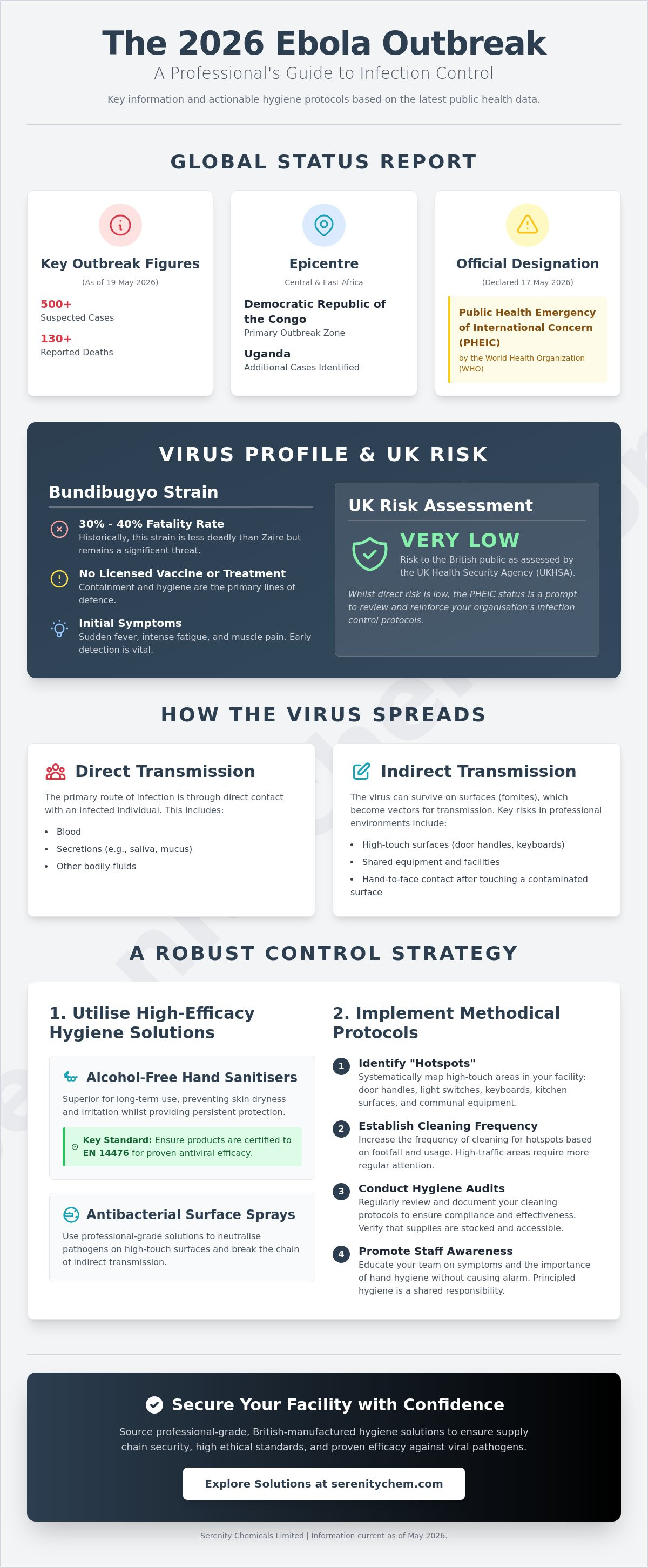
With over 500 suspected cases and 130 deaths reported in the DRC by 19 May 2026, the current Ebola outbreak has officially become a Public Health Emergency of International Concern. It's natural to feel a sense of unease when global health reports become a daily fixture in the news. You want to protect your team and maintain a safe environment, but the influx of information can make it difficult to distinguish between effective protocols and mere speculation regarding viral transmission.
This briefing cuts through the noise to provide a clear understanding of the 2026 Ebola situation alongside professional-grade infection control standards. We'll explore the specific characteristics of the Bundibugyo virus, outline an actionable hygiene checklist, and discuss the technical efficacy of professional cleaning solutions in high-risk contexts. By the end of this guide, you'll have the knowledge needed to implement a principled hygiene programme that prioritises both safety and technical reliability.
Key Takeaways
- Understand the global context of the 2026 Ebola outbreak and the current risk assessment for organisations operating within the United Kingdom.
- Identify the critical transmission dynamics of the Bundibugyo virus to effectively mitigate risks associated with contaminated surfaces and communal facilities.
- Compare the efficacy of alcohol-free hand sanitisers against traditional options, focusing on the EN 14476 standard for antiviral protection and long-term skin health.
- Learn how to implement a structured infection control strategy using professional-grade antibacterial surface sprays and methodical hygiene audits.
- Explore the benefits of sourcing British-manufactured hygiene solutions to ensure supply security and maintain high ethical standards in your facility management.
The 2026 Ebola Outbreak: Current Global Status and UK Risk Assessment
On 15 May 2026, the Democratic Republic of the Congo (DRC) Ministry of Health declared a new Ebola outbreak, which quickly escalated in both scale and international significance. By 17 May 2026, the World Health Organization (WHO) designated the situation a Public Health Emergency of International Concern (PHEIC). As of 19 May 2026, reports indicate over 500 suspected cases and 130 fatalities in the DRC, with additional cases identified in Uganda. Whilst the geographic epicentre remains in Central and East Africa, the scale of this event necessitates a measured and informed response from professional organisations across the globe.
Understanding the 2026 Viral Strain
The current crisis involves the Bundibugyo virus, a strain that historically presents a case fatality rate between 30% and 40%. Unlike the Zaire strain, there are currently no licensed vaccines or specific treatments available for Bundibugyo; this makes containment and principled hygiene the primary lines of defence. Ebola virus disease typically begins with non-specific symptoms such as a sudden fever, intense fatigue, and muscle pain. For UK businesses with international operations or employees returning from affected regions, early detection is vital. Monitoring for these initial signs amongst the workforce allows for swift isolation and prevents potential transmission in communal environments. It's a matter of professional responsibility to ensure that staff are aware of these symptoms without creating unnecessary alarm.
The Role of the UK Health Security Agency
The UK Health Security Agency (UKHSA) continues to monitor international infectious disease trends to ensure national safety. Currently, the risk to the British public is assessed as very low. The UK maintains a robust "specialist centre" approach, where any suspected rare viral cases are managed in high-consequence infectious disease units within the NHS. Whilst the UKHSA currently deems the risk from this specific Ebola outbreak to be low for the general population, they maintain strict surveillance protocols at major travel hubs.
For corporate risk registers, a "Public Health Emergency" status serves as a prompt for review rather than a cause for panic. It's a reminder to verify that infection control protocols are current and that supplies of high-performance hygiene products are readily available. Maintaining this level of preparedness ensures that even if the local risk remains low, the organisation's resilience remains high. Professional environments thrive on this type of quiet confidence, where safety is managed through technical expertise and methodical planning.
How Viral Pathogens Spread: Transmission Dynamics and Environmental Risks
Effective containment of any Ebola outbreak requires a precise understanding of how the virus moves through an environment. While the primary route of infection is direct contact with the blood, secretions, or bodily fluids of an infected person, professional organisations must also account for indirect transmission. Viral pathogens can survive on surfaces for varying periods, meaning that a shared workspace can inadvertently become a vector for spread if hygiene protocols aren't strictly maintained. This technical reality is why "principled hygiene" focuses on breaking the chain of infection at every possible touchpoint.
Direct vs Indirect Transmission in Professional Settings
In a busy office or canteen, viral particles don't just stay in one place. They move through human interaction and the frequent touching of shared equipment. According to current Ebola outbreak facts, the virus is highly infectious, and even small amounts of fluid can carry a significant viral load. Hand-to-face contact is a primary concern amongst staff; we often touch our eyes, nose, or mouth without conscious thought, transferring pathogens from contaminated surfaces directly into our systems. Standard cleaning routines often fail to break this chain because they don't use the correct chemical concentrations to fully neutralise the virus, or they don't occur frequently enough to keep up with high-traffic usage.
High-Risk Environments and Fomite Management
Identifying "hotspots" is a critical part of any risk assessment. These are high-touch areas that act as reservoirs for pathogens. In a typical facility, these include:
- Door handles and push plates
- Lift buttons and stair railings
- Shared keyboards, mice, and desk phones
- Kitchen tap handles and kettle switches
The science of viral persistence shows that orthoebolaviruses can remain viable on non-porous surfaces, such as stainless steel and plastic, longer than on porous materials like fabric or paper. This makes the frequent disinfection of metal hardware and electronic equipment a priority. Implementing a "clean-as-you-go" culture encourages staff to take individual responsibility for their immediate workspace, significantly reducing the overall environmental viral load. If you're unsure about the specific requirements for your facility's layout, it's advisable to speak with a technical specialist for tailored guidance on infection control during this Ebola outbreak.
Evaluating Antiviral Efficacy: The Case for Alcohol-Free Hand Sanitisers
Whilst traditional guidance often defaults to high-concentration alcohol formulas, the 2026 Ebola outbreak has highlighted the necessity for sustainable, long-term hygiene strategies. In professional environments where staff must sanitise their hands dozens of times a day, the choice of chemistry becomes a balance between technical efficacy and dermatological safety. Relying solely on harsh chemicals can lead to skin degradation, which paradoxically creates entry points for pathogens. A principled approach to infection control involves selecting products that meet rigorous British and European standards whilst preserving the skin's natural defences.
In the UK, the benchmark for any antiviral product is the EN 14476 standard. This certification ensures that a solution has been laboratory-tested to prove its effectiveness against a broad spectrum of viruses. For organisations managing high-traffic centres, such as schools or transport hubs, alcohol-free alternatives offer a distinct advantage. They are non-flammable, making them safer to store in large quantities, and they don't carry the risk of accidental ingestion or misuse that accompanies ethanol-based products.
The Science of Alcohol-Free Sanitisers
Advanced alcohol-free sanitisers utilise specialised surfactants and biocides that work by disrupting the lipid envelope of a virus. This mechanical action effectively neutralises the pathogen without the need for volatile organic compounds. There's a common misconception that only alcohol can provide the necessary level of protection during an Ebola outbreak; however, modern chemical engineering has produced water-based formulas that achieve high-level virucidal results. EN 14476 is the European standard for virucidal activity that defines the testing requirements for chemical disinfectants used on human skin and surfaces. These formulas often provide a residual effect, staying active on the skin for longer than alcohol, which evaporates almost instantly.
Benefits for Sensitive Skin and Frequent Use
Maintaining the integrity of the skin's barrier is a critical component of infection control. Frequent use of alcohol-based gels can strip away natural oils, leading to dryness, cracking, and contact dermatitis. For employees with pre-existing conditions, finding the best hand sanitiser for eczema is not just a matter of comfort; it's a health and safety requirement. Alcohol-free options, such as Serenity Alcohol Free Hand Sanitiser, are specifically designed to be non-drying and gentle on sensitive skin.
By using a non-irritating formula, organisations can ensure higher compliance rates amongst staff. When sanitising doesn't cause pain or discomfort, employees are more likely to follow protocols consistently. This steady, methodical adherence to hygiene is what ultimately prevents the environmental spread of viruses in communal workspaces. Protecting the workforce means providing solutions that work with the body's natural biology rather than against it.
Implementing a Robust Infection Control Strategy for Professional Environments
Protecting a professional environment during an Ebola outbreak requires a transition from reactive cleaning to a structured infection control framework. This "Principled Hygiene" approach ensures that every action taken serves a specific purpose in breaking the chain of transmission. By following a methodical five-step strategy, organisations can maintain operational resilience whilst providing peace of mind to their workforce. A disciplined routine is the most effective way to manage the environmental risks associated with high-traffic facilities.
- Step 1: Conduct a thorough hygiene audit of all communal facilities to identify high-touch "hotspots" such as lift buttons and shared handsets.
- Step 2: Deploy high-performance Serenity Antibacterial Surface Spray at all entry points and reception desks to ensure immediate decontamination upon arrival.
- Step 3: Establish a mandatory hand hygiene programme for all visitors and staff, utilising non-irritating sanitisers that encourage frequent use.
- Step 4: Organise regular deep-cleaning schedules using industrial-grade solutions like Serenity Heavy Duty Degreaser and Serenity Floor Cleaner to remove organic matter that can harbour pathogens.
- Step 5: Educate the workforce on the "Principled Hygiene" framework and ensure all staff understand COSHH safety requirements for the chemicals in use.
Surface Disinfection Protocols
Choosing the right antibacterial multi-surface spray is only the first part of the solution. Technical efficacy depends heavily on "contact time", the duration a disinfectant must remain wet on a surface to fully neutralise viral particles. Skipping this step or wiping away a product too quickly can leave pathogens active. In kitchen and food preparation environments, it's essential to use no-rinse, food-safe options like Serenity Kitchen Sanitiser. This ensures that hygiene standards are maintained without risking chemical contamination of food surfaces.
Workforce Education and Engagement
A strategy is only as strong as the people implementing it. Effective signage should be placed at eye level to encourage correct hand-washing and sanitising behaviour amongst staff and visitors. This visual guidance serves as a constant reminder of the organisation's commitment to safety. Additionally, making Safety Data Sheets (COSHH) easily accessible ensures that cleaning personnel can operate with confidence and integrity. Staff should be empowered to report hygiene equipment failures or supply shortages immediately to prevent any lapse in the infection control chain.
If you require assistance in developing a tailored infection control plan or selecting the correct chemical solutions for your facility, please contact our technical team for professional guidance on managing hygiene during the current Ebola outbreak.
Securing Your Facility with British-Manufactured Hygiene Solutions
Maintaining a safe environment during an Ebola outbreak requires more than just the right protocols; it demands a reliable and secure supply of high-performance chemicals. When global health alerts occur, international supply chains often face significant strain, leading to delays and shortages of essential hygiene products. By sourcing directly from a UK-based manufacturer, organisations can bypass these logistical hurdles. This local approach ensures that your facility remains fully equipped to handle infection control challenges without the uncertainty of extended lead times or fluctuating import regulations.
Reliability and UK Supply Chain Integrity
Buying British-made chemicals provides a level of quality assurance that's vital for industrial-scale safety. Serenity manufactures all products within the UK, allowing for rigorous oversight of every formulation. This consistency is essential when dealing with viral threats, as it ensures that every batch of sanitiser or cleaner performs exactly as specified. For national businesses, this proximity also means access to expert hygiene consultations. Our technical team works with facility managers to identify specific needs, ensuring that the solutions provided are both effective and proportionate to the risk level. This partnership builds a foundation of trust that is difficult to replicate with overseas suppliers.
A Principled Approach to Protection
At the heart of a robust hygiene strategy is the Serenity Alcohol Free Hand Sanitiser. As discussed in previous sections, protecting the skin's natural barrier is a core pillar of infection control, particularly in environments requiring frequent application. Beyond hand hygiene, maintaining sanitary industrial floors is equally important. Using Serenity Heavy Duty Degreaser ensures that organic contaminants are removed from high-traffic areas, preventing the build-up of material that could harbour pathogens. We offer customised hygiene bundles tailored for schools, offices, and industrial centres, providing a comprehensive toolkit for any professional setting.
Ensuring your organisation is "outbreak-ready" involves proactive planning and the procurement of bulk supplies. Having a ready stock of Serenity Antibacterial Surface Spray and Serenity Floor Cleaner allows for an immediate escalation of cleaning routines if the local risk assessment changes. This level of preparedness reflects a commitment to both operational integrity and the well-being of every individual who enters your facility. To ensure your protocols meet the highest standards of safety and efficacy, you can contact Serenity Chemicals for a bespoke hygiene assessment today.
Building a Resilient Hygiene Framework for the Future
Managing the environmental risks associated with the 2026 Ebola outbreak requires a transition from standard cleaning to a technical, principled approach. We've explored how a clear understanding of viral transmission, combined with the adoption of EN-certified, alcohol-free solutions, can protect both your facility's integrity and your workforce's health. Maintaining skin barrier safety whilst ensuring total viral neutralisation is no longer a secondary concern; it's a core operational requirement. By implementing a structured infection control strategy and securing a reliable UK-based supply chain, your organisation can maintain operational safety with quiet confidence.
As a specialist in alcohol-free virucidal formulations, Serenity Chemicals is a UK-based manufacturer trusted by schools and industrial centres nationwide. Our commitment to technical efficacy and ethical responsibility ensures your facility remains prepared for any hygiene challenge. Taking proactive steps now builds long-term trust and provides essential peace of mind for your staff and visitors alike. We're here to help you navigate these requirements with expert guidance and high-performance solutions.
Enquire about professional hygiene solutions for your organisation
Frequently Asked Questions
Is the 2026 Ebola outbreak a threat to people in the UK?
The current risk to the UK population from the 2026 Ebola outbreak is assessed as very low by the UK Health Security Agency. Whilst the World Health Organization has declared a Public Health Emergency of International Concern, the threat remains concentrated in the Democratic Republic of the Congo and Uganda. UK businesses should stay informed via official government updates but don't need to implement emergency measures unless staff are travelling to affected regions.
What are the first symptoms of Ebola that I should look out for?
Early symptoms of Ebola virus disease typically include a sudden onset of fever, intense fatigue, muscle pain, and a sore throat. As the illness progresses, individuals may experience vomiting, diarrhoea, and impaired kidney or liver function. It's vital for returning travellers to monitor their health for 21 days; early detection is the most effective way to prevent further transmission within a workplace or community.
Does alcohol-free hand sanitiser work against viruses like Ebola?
Official health bodies like the WHO and FDA recommend soap and water or alcohol-based sanitisers specifically for the Ebola virus. Whilst alcohol-free sanitisers tested to EN 14476 standards are effective against many enveloped viruses, there's currently no documented evidence confirming their efficacy against this specific strain. For general infection control against common workplace pathogens, alcohol-free options remain a valuable tool for maintaining skin integrity and high compliance.
How long can the Ebola virus survive on surfaces in an office?
The Ebola virus can survive on dry surfaces, such as office desks or door handles, for several hours; however, in moist or organic environments, it can persist for several days. Non-porous materials like stainless steel and plastic are particularly prone to acting as reservoirs for viral particles. This makes the frequent use of a high-performance antibacterial surface spray essential for breaking the chain of environmental transmission in communal areas.
What is the EN 14476 standard and why does it matter for my business?
EN 14476 is the European standard that proves a chemical product has the necessary virucidal activity to neutralise enveloped viruses. For your business, selecting products with this certification provides technical assurance that your hygiene protocols are based on verified laboratory testing. It moves your safety strategy from guesswork to a principled, evidence-based framework that protects your employees and visitors with reliable, professional-grade chemistry.
Can I buy professional-grade antiviral sanitisers in bulk for my school?
Yes, professional-grade sanitisers and cleaners are available in bulk to ensure schools and industrial centres maintain a consistent supply. Serenity Chemicals provides a range of products, including Serenity Alcohol Free Hand Sanitiser and Serenity Multi-Surface Cleaner, in various volumes to suit large-scale facility requirements. Sourcing directly from a UK manufacturer helps avoid the supply chain disruptions often seen during global health alerts.
What should I do if an employee returns from an affected region?
If an employee returns from an area affected by the Ebola outbreak, they should be advised to monitor their health closely for a period of 21 days. They don't need to isolate unless they develop symptoms such as a fever or muscle pain. If symptoms occur, the individual must contact NHS 111 immediately and inform them of their travel history. Ensuring your workforce knows the reporting procedure is a key part of responsible management.
Are Serenity Chemicals products safe for use on sensitive skin?
Serenity Chemicals products, particularly our alcohol-free range, are specifically formulated to be gentle on sensitive skin whilst maintaining high hygiene standards. Unlike traditional alcohol-based gels that can strip natural oils and cause cracking, our water-based sanitisers help preserve the skin's natural barrier. This makes them suitable for frequent use in environments where staff must sanitise their hands multiple times throughout the day without risking dermatitis.

Summer Cleaning Checklist for a Fresh, Hygienic Home
Could the rising mercury be the biggest threat to your business's reputation this season? As the British summer time official...

The Ultimate Picnic Hygiene Guide for a Safe Summer
With salmonella infections in England reaching a decade-high of 10,406 cases in 2025, the hidden risks of outdoor dining have...