

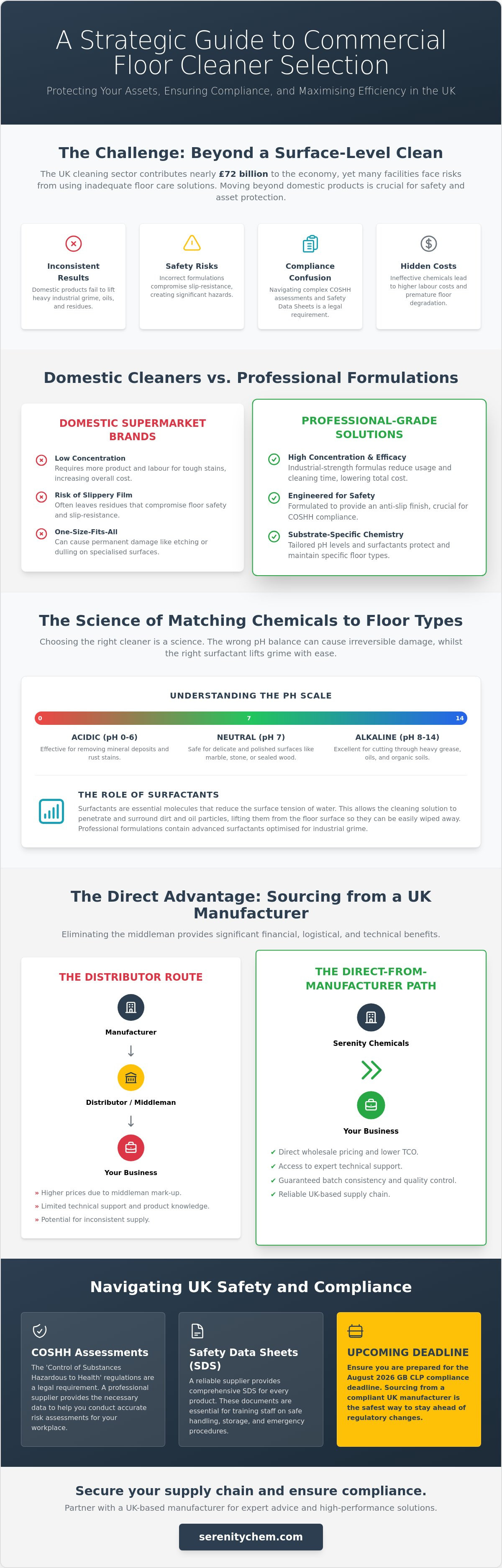
Did you know that the UK cleaning and hygiene sector now contributes nearly £72 billion to the economy, yet many facilities still struggle with the basics of floor maintenance? It's a common frustration to invest in professional staff only to be let down by inconsistent results from generic supermarket brands or the confusion of complex COSHH safety requirements. Finding a reliable commercial floor cleaner supplier is about more than just buying soap; it's about securing the technical expertise needed to protect your flooring and your reputation.
You likely want a facility that isn't just visually clean, but safe, slip-resistant, and fully compliant with rigorous UK health and safety standards. In this guide, we'll show you how to select the ideal chemical formulations for your specific industrial surfaces and explain why sourcing directly from a UK manufacturer is the most cost-effective path. We'll also look at how to stay ahead of upcoming regulatory changes, including the August 2026 GB CLP compliance deadline, ensuring your business stays efficient whilst avoiding the high costs of middleman distributors.
Key Takeaways
- Understand why professional-grade solutions outperform domestic products in maintaining facility safety and long-term floor aesthetics.
- Learn how to evaluate a commercial floor cleaner supplier based on their ability to match chemical pH levels and surfactants to your specific flooring substrates.
- Discover how industrial-strength, rapid-drying formulations can reduce business downtime and improve safety in high-traffic environments.
- Gain clarity on navigating UK COSHH assessments and effectively interpreting Safety Data Sheets (SDS) for workplace compliance.
- Identify the logistical and financial advantages of sourcing high-performance solutions directly from a UK-based chemical manufacturer.
Choosing the Right Commercial Floor Cleaner Supplier for Your Business
A specialist commercial floor cleaner supplier acts as a vital partner in maintaining both the safety and the professional appearance of your facility. Whilst it's tempting to rely on generic supermarket brands, these domestic products often fail to meet the demands of industrial environments. They lack the concentration of active ingredients required to effectively lift heavy grime, oils, and stubborn residues found in high-traffic areas. Relying on inadequate solutions doesn't just lead to poor cleaning results; it often compromises the slip-resistance of your flooring, creating significant health and safety risks.
Choosing the right partner involves looking beyond the initial price per litre. You must consider the total cost of ownership (TCO) in your floor maintenance strategy. Ineffective chemicals require more manual labour, more frequent re-application, and can eventually lead to the premature degradation of expensive floor substrates. By contrast, a professional supplier provides the expertise to match specific chemical formulations to your floor type. Understanding the science of cleaning agents is essential for this process, as the wrong pH balance can permanently etch or dull certain surfaces. Sourcing from a UK-based manufacturer also ensures supply chain reliability, which is critical for businesses that cannot afford downtime due to stock shortages.
The Difference Between a Distributor and a Manufacturer
Many businesses mistakenly treat distributors and manufacturers as the same entity. However, sourcing directly from a manufacturer like Serenity Chemicals Limited provides distinct advantages. You gain direct access to technical support, allowing you to ask specific questions about chemical interactions and application methods. By removing the middleman, you also secure wholesale pricing that distributors simply can't match. Perhaps most importantly, a manufacturer has total control over their production line. This ensures that every batch of Serenity Floor Cleaner or Serenity Heavy Duty Degreaser remains consistent in its formulation, providing predictable results every time you clean.
Criteria for Evaluating a Professional Supplier
When you're vetting a potential commercial floor cleaner supplier, safety documentation should be your first priority. A principled expert will provide comprehensive COSHH documentation and Safety Data Sheets (SDS) without being prompted. These documents are essential for your own workplace risk assessments and legal compliance. You should also evaluate the breadth of their specialised range. A one-size-fits-all approach doesn't work in industrial settings; you need a supplier that offers everything from antibacterial surface sprays to high-performance carpet shampoos. Finally, look for evidence of British Standards compliance and industrial-grade efficacy. Products that meet EN 1276 or EN 14476 standards provide the peace of mind that your facility isn't just clean, but hygienically safe for all users.
The Science of Substrates: Matching Chemicals to Floor Types
Selecting an experienced commercial floor cleaner supplier is as much about chemistry as it is about logistics. Every floor surface has a unique molecular structure that reacts differently to chemical exposure. The pH scale, ranging from 0 to 14, dictates whether a solution is acidic, neutral, or alkaline. Using the wrong product can lead to irreversible damage, such as pitting in concrete or etching in natural stone. Beyond pH, surfactants play a critical role; these molecules reduce the surface tension of water, allowing it to penetrate and lift industrial grime and oils more effectively.
Modern facilities are also increasingly adopting "no-rinse" formulations. These products stay active on the surface without requiring a secondary water pass, which significantly improves labour efficiency and reduces water consumption. However, the most important chemical property for many industrial environments is slip-resistance. A principled supplier ensures that their formulations leave behind an anti-slip finish, which is a key component of COSHH safety compliance and general workplace welfare. This attention to detail prevents the build-up of slippery films that often result from using generic detergents.
Neutral Cleaners for Delicate and Polished Surfaces
Natural stone, marble, and polished concrete require a gentle touch to maintain their structural integrity and lustre. pH-neutral solutions are essential here because they clean without reacting with the calcium carbonate in the stone or the sealants on the concrete. Using harsh alkaline cleaners on these surfaces often results in a "clouding" effect, where chemical residues build up and dull the finish. pH-neutral cleaners are the safe choice for daily maintenance on all sensitive or high-shine flooring.
Alkaline Degreasers for Heavy-Duty Industrial Use
In environments like commercial kitchens or automotive workshops, organic fats and greases pose a constant challenge. Alkaline builders are designed to saponify these oils, turning them into a water-soluble substance that can be easily rinsed away. Serenity Heavy Duty Degreaser is specifically formulated for these high-stress applications, providing the strength needed to break down carbonised grease whilst remaining safe for the user. These solutions are indispensable for maintaining hygiene in heavy industry and food preparation areas.
Acidic Solutions for Limescale and Mineral Deposits
Washrooms and areas with hard water frequently suffer from mineral build-up and limescale. Acidic cleaners are the primary tool for dissolving these inorganic deposits. However, they must be used with extreme caution; applying an acid to a sensitive substrate like marble can cause instant and permanent etching. We always recommend careful dilution and strictly adhering to recommended application times to prevent surface damage. If you're unsure about the compatibility of a product with your facility's flooring, you can consult our technical team for expert guidance.
Industrial-Strength Solutions for High-Traffic Environments
High-traffic environments represent the ultimate test for any commercial floor cleaner supplier. In these spaces, the accumulation of soil and contaminants happens at an accelerated rate, requiring formulations that can emulsify dirt quickly without leaving a sticky residue. Speed is a critical factor; if a floor takes too long to dry, it creates a bottleneck for operations and increases the likelihood of accidents. Rapid-drying solutions allow for continuous use of the space, which is vital for 24-hour logistics hubs or busy retail centres.
For large-scale facilities, the efficiency of your cleaning regime often depends on the concentration of your chemicals. High-dilution ratios mean you store less product on-site and generate less plastic waste, aligning with modern sustainability goals. When evaluating the safety of these concentrated solutions, many professionals look to international benchmarks like the EPA Safer Choice program as a reference for responsible chemical selection. This helps ensure that even the most powerful industrial cleaners remain safe for the staff applying them whilst delivering the required efficacy.
Warehouse and Factory Floor Maintenance
Logistics centres and manufacturing plants face unique challenges like black tyre marks from forklifts, oil spills, and fine carbon dust. Mechanical floor scrubbers are powerful tools, but they require the correct chemical assistance to fully lift ingrained grime. Without a specialised formulation, brushes can simply smear oils across the surface. Our Warehouse Floor Cleaner guide provides a detailed look at how to manage these industrial contaminants whilst protecting the underlying substrate from abrasion. Combining heavy-duty chemicals with mechanical agitation ensures a deep clean that manual mopping cannot achieve.
Retail and Hospitality: Balancing Safety and Shine
In the retail sector, the floor is a direct reflection of the brand's standards. You need a solution that provides a high-shine finish whilst maintaining strict slip-resistance to protect members of the public. During busy shifts, the efficiency of a no-rinse floor cleaner is invaluable, as it allows cleaning teams to maintain standards without blocking off aisles for extended periods. Fragrance control is also a factor; a clean, fresh scent enhances the customer experience without being overbearing or clinical.
Specialist Hygiene: Vets, Kennels, and Healthcare
Clinical environments require a specific type of chemical expertise. In veterinary surgeries and kennels, cleaners must be broad-spectrum bactericides whilst remaining completely non-toxic to animals. This necessitates a move away from harsh phenols or bleach-based products toward safer, more advanced alternatives. For more information on selecting these specialised solutions, refer to our pet friendly floor cleaner UK reference. These products ensure that surfaces are hygienically safe for both patients and practitioners without compromising on cleaning power.
Navigating COSHH and Safety Compliance in Floor Care
Compliance with the Control of Substances Hazardous to Health (COSHH) regulations is a mandatory requirement for any UK business using industrial cleaning agents. It's not merely a box-ticking exercise; it's a fundamental framework designed to protect your employees from preventable health risks. When you partner with a professional commercial floor cleaner supplier, you're securing the safety data required to perform these assessments accurately. Every product must be accompanied by a comprehensive Safety Data Sheet (SDS), which outlines potential hazards, first-aid measures, and necessary exposure controls.
Reading an SDS might seem daunting at first, but focusing on key sections like hazard identification and handling instructions simplifies the process. Correct dilution is equally vital for workplace safety. Using too much chemical doesn't just waste money; it can create dangerously slippery surfaces or release harmful vapours. Conversely, under-diluting leads to poor hygiene results. We advocate for precise measurement systems to ensure both safety and optimal cleaning performance. If you need help aligning your cleaning protocols with current regulations, you can request a consultation with our safety experts.
Environmental responsibility is also shifting from a preference to a requirement. With the GB CLP regulation updates approaching in August 2026, manufacturers are refining labels and formulations to be more transparent about chemical impact. Reducing your facility's environmental footprint often starts with choosing biodegradable surfactants and concentrated formulas that minimise plastic waste. This principled approach ensures your cleaning regime is as responsible as it is effective.
Risk Assessment and Staff Training
Effective risk management starts with identifying the chemical class of each product. Whether you're using a heavy-duty degreaser or a neutral floor cleaner, staff must understand the specific hazards involved. This includes the mandatory use of Personal Protective Equipment (PPE) such as chemical-resistant gloves and eye protection. Training should be regular and documented to ensure everyone knows how to handle spills or accidental exposure. A responsible supplier provides clear, accessible safety documentation to facilitate this training.
Storage and Disposal of Commercial Chemicals
Best practices for chemical storage involve more than just a locked cupboard. You should organise your store to prevent cross-contamination, keeping acidic and alkaline products separate to avoid dangerous reactions. Colour-coded labelling is an excellent way to reduce human error during busy shifts. Regarding disposal, you must comply with local authority regulations for industrial waste, ensuring that hazardous residues never enter the general water system. Proactive management in this area protects both your local environment and your legal standing.
The Serenity Advantage: Direct Supply from a UK Chemical Manufacturer
Sourcing from a commercial floor cleaner supplier that also serves as the manufacturer provides a level of transparency and reliability that resellers simply cannot match. At Serenity Chemicals Limited, we operate as a principled expert in UK chemical manufacturing, ensuring that every solution we produce meets our rigorous standards for efficacy and safety. By maintaining a national supply chain with UK-based production, we eliminate the delays and uncertainties often associated with imported goods. This direct relationship allows for a steady, composed partnership where your facility's needs are met with precision and care.
Ethical responsibility is at the heart of our operations. We believe that professional-grade chemistry should not come at the expense of our values, which is why we provide effective, cruelty-free solutions that respect both the user and the environment. Moving away from generic, domestic-grade supplies to industrial formulations is a step toward better facility protection and long-term cost savings. When you source directly from the manufacturer, you gain peace of mind knowing the exact provenance and chemical integrity of the products used in your workplace.
Bespoke Solutions and Technical Support
Finding the right formulation for a specific facility requires more than a catalogue; it requires technical insight and a deep understanding of substrate science. Our team assists businesses in selecting the most appropriate Serenity Floor Cleaner for their specific floor types, whether they are managing polished retail spaces or heavy-duty industrial warehouses. For organisations with multiple locations, we offer bulk-buy options and national account management to ensure consistency across every site. This technical support ensures that your cleaning teams aren't just working hard, but working effectively with the correct chemical tools for the job.
Streamlining Your Procurement
Ordering a full suite of professional-grade products from a single manufacturer reduces administrative burden and ensures chemical compatibility across your entire facility. Beyond floor care, our range includes essential solutions like the Serenity Multi-Surface Cleaner and the Serenity Heavy Duty Degreaser, allowing you to streamline your procurement process whilst maintaining the highest hygiene standards. By choosing a dedicated commercial floor cleaner supplier with in-house production, you simplify your operations without compromising on quality. If you are ready to upgrade your facility maintenance regime, contact Serenity Chemicals Limited for your professional floor care needs and discover the benefits of sourcing direct from a UK manufacturer.
Securing a Cleaner, Safer Future for Your Facility
Investing in the right chemical solutions is a strategic decision that impacts your facility's safety, aesthetics, and bottom line. By understanding the science of substrates and the importance of pH-balanced formulations, you can protect your flooring from premature wear and costly damage. Navigating the complexities of UK safety regulations becomes significantly easier when your commercial floor cleaner supplier provides comprehensive COSHH documentation and industrial-grade efficacy as standard.
Sourcing directly from a UK-based manufacturer like Serenity Chemicals Limited ensures you receive high-performance formulations used by UK industrial leaders without middleman markups. We provide full COSHH compliance and Safety Data Sheets for every product, supporting your commitment to workplace safety and ethical responsibility. Our direct national distribution network guarantees that your supply chain remains resilient, even in high-demand environments.
Take the first step toward a more efficient and professional cleaning regime by upgrading your chemical inventory today. Browse our range of professional Serenity Floor Cleaners to find the ideal match for your industrial requirements. We're here to help you maintain a facility that is clean, compliant, and safe for everyone.
Frequently Asked Questions
What should I look for in a commercial floor cleaner supplier?
You should prioritise technical expertise, UK-based manufacturing, and the provision of comprehensive safety documentation. A reliable partner acts as a principled expert, helping you select formulations that match your specific substrates whilst ensuring full regulatory compliance. Look for a commercial floor cleaner supplier that offers direct technical support and clear Safety Data Sheets (SDS) to help protect your staff and your facility's reputation.
Are industrial floor cleaners safe for all types of flooring?
Industrial cleaners are not universally safe and must be matched to specific flooring materials to prevent permanent damage. For instance, harsh alkaline solutions can dull the lustre of natural stone, whilst acidic cleaners will etch marble surfaces. It's essential to consult with your supplier to determine the pH compatibility of a product with your flooring, ensuring that the cleaning regime is both effective and responsible.
How does a no-rinse floor cleaner improve business efficiency?
No-rinse formulations improve efficiency by removing the need for a secondary rinsing pass, which significantly reduces labour time. These products are engineered to dry rapidly without leaving a tacky film, allowing high-traffic zones to remain operational. This streamlined approach is particularly beneficial for 24-hour facilities or retail environments where minimising business downtime and preventing slip hazards are top operational priorities.
What is the difference between a floor sanitiser and a floor cleaner?
A floor cleaner focuses on removing physical soil and grease, whilst a sanitiser is formulated to kill or reduce microbial populations. In high-risk environments like healthcare or food production, cleaning alone is insufficient to ensure safety. Using a specialist sanitiser ensures that surfaces meet British Standards for bactericidal efficacy, providing peace of mind that the environment is hygienically safe for all users.
Can I buy commercial floor cleaning chemicals in bulk from the manufacturer?
Purchasing directly from a UK manufacturer allows you to source high-performance chemicals in bulk at wholesale rates. By choosing a direct commercial floor cleaner supplier, you eliminate middleman costs and ensure a more reliable supply chain for your facility. Bulk orders also support sustainability goals by reducing the frequency of deliveries and the amount of plastic packaging required for large-scale maintenance operations.
How do I ensure my floor cleaning chemicals are COSHH compliant?
Compliance is achieved by conducting a thorough risk assessment based on the Safety Data Sheet (SDS) provided by your supplier. You must document how chemicals are stored, handled, and disposed of, whilst ensuring all staff are trained in the use of appropriate PPE. A professional supplier will offer clear safety guidance and accessible documentation to help you meet your legal duties under UK health and safety law.
What is the best floor cleaner for heavy-duty warehouse use?
Heavy-duty warehouses require alkaline degreasers that can emulsify stubborn industrial contaminants like forklift tyre marks and leaked oils. These concentrated formulas are designed to work effectively with mechanical scrubbers to lift ingrained grime from concrete and resin floors. Using a specialist industrial solution ensures that large floor areas are cleaned thoroughly and safely, maintaining a professional appearance even in high-stress logistics environments.
Why is pH balance important in commercial floor cleaning?
The pH level of a cleaning agent determines its chemical reactivity and its suitability for different types of soil and flooring. Acidic cleaners are used for mineral deposits, whilst alkaline solutions are necessary for organic greases and fats. Using a product with the wrong pH balance can lead to irreversible surface damage, such as the clouding of polished stone or the pitting of concrete surfaces.

Hand Hygiene in Food Preparation Areas: The 2026 Professional Guide
The Food Standards Agency estimates that foodborne illness costs the UK economy approximately £9 billion every year, with a s...

Sanitising Commercial Kitchen Hard Surfaces: The Professional UK Guide (2026)
Did you know that the average fine for food hygiene offences in the UK has more than tripled since 2016, now reaching over £7...