

What if the very spray intended to protect your gym was actually the primary cause of your equipment's early retirement? Many fitness facility managers find themselves in a frustrating cycle where harsh chemicals strip the life from upholstery, leading to cracked vinyl and costly repairs. We understand that maintaining a pristine environment shouldn't come at the expense of your assets or your members' comfort. Often, procurement teams tasked with sourcing a restaurant table sanitiser spray bulk for leisure complexes find that general-purpose products lack the material safety required for specialised gym gear.
This guide explores how to transition to professional-grade, alcohol-free bulk sanitisation that aligns with UK health and safety standards like EN 1276 and EN 14476:2026. You'll discover how to protect your equipment and members whilst significantly reducing plastic waste and procurement frequency. We will examine the science of material preservation, the economic logic of 5L and 20L refills; and the importance of choosing solutions that respect both the environment and the skin of those using your facility. By the end of this article, you'll have a clear framework for a more sustainable, cost-effective hygiene strategy.
Key Takeaways
- Identify why alcohol-free sanitisers are the industry standard for protecting expensive vinyl, leather, and rubber grips from chemical degradation.
- Evaluate the significant cost savings and environmental benefits of transitioning from single-use trigger bottles to 5L and 20L bulk refill systems.
- Learn why procurement for high-traffic fitness centres requires more specialised antimicrobial properties than a standard restaurant table sanitiser spray bulk typically provides.
- Verify your compliance with the latest UK hygiene regulations, specifically the bactericidal standards of EN 1276 and the 2026 virucidal updates of EN 14476.
- Gain practical insights into establishing a robust sanitisation protocol that combines member engagement with professional-grade staff cleaning schedules.
Why Gym Equipment Hygiene Requires a Specialist Approach
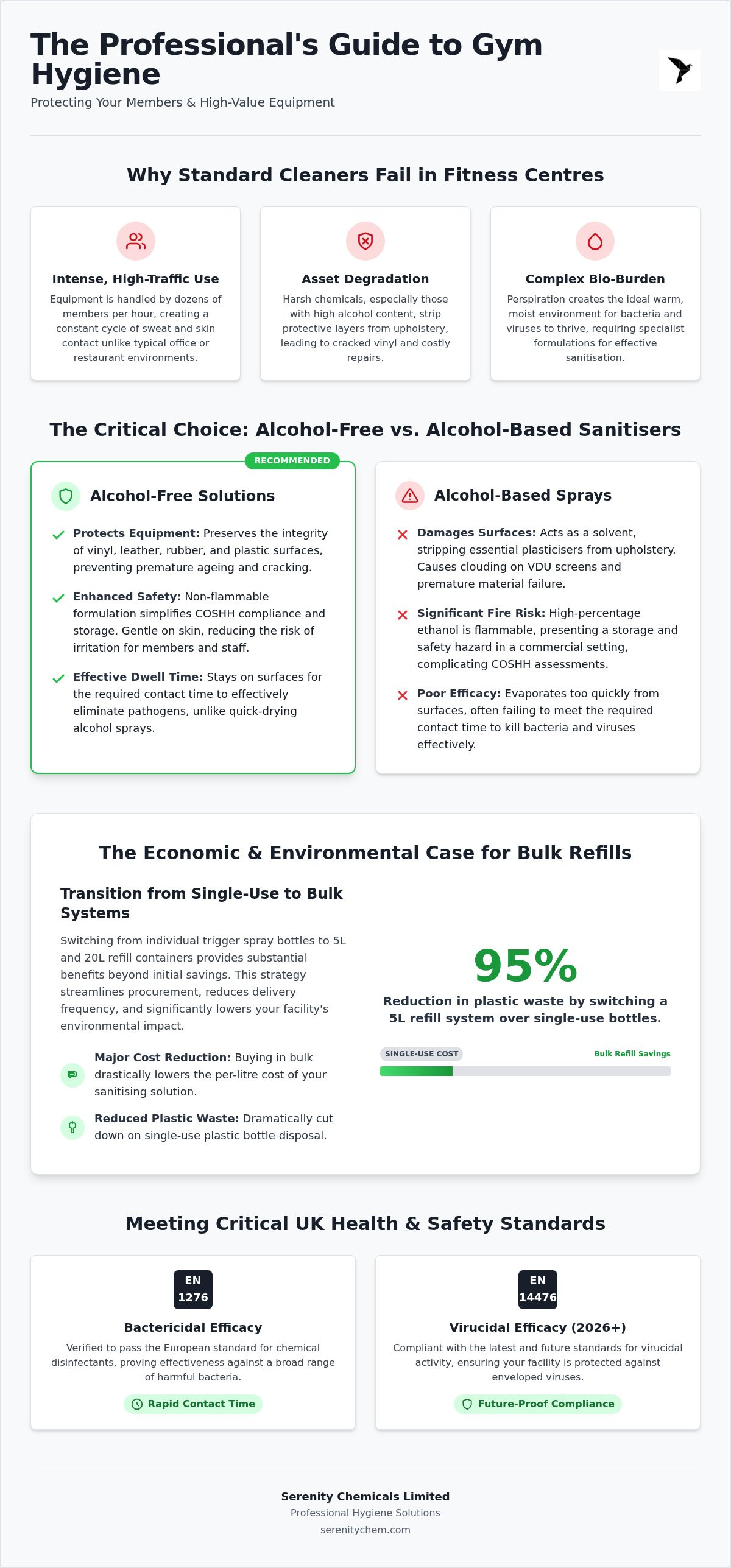
A commercial fitness centre is a high-performance environment, and the hygiene standards must match that intensity. Unlike a standard office where a desk might be touched by one person throughout the day, gym equipment is handled by dozens of members every hour. These high-frequency touchpoints create a unique challenge for procurement managers. Whilst a standard restaurant table sanitiser spray bulk might be effective for clearing food residues from a laminate surface, it often lacks the specific properties required to neutralise the complex bio-burden found in a commercial fitness centre. A comprehensive overview of disinfectants reveals that different active ingredients are necessary for different surface types to ensure both microbiological efficacy and material safety.
Perspiration acts as a primary transport medium for microbes in leisure facilities. It provides the warmth and moisture that bacteria need to thrive, especially on porous surfaces like rubber grips and foam padding. Generic household cleaners often fail to meet professional standards because they don't account for this constant cycle of sweat and skin contact. Professional-grade chemicals are formulated to work in these specific conditions, ensuring that surfaces remain hygienic even during peak hours when the volume of users is at its highest. Purchasing a restaurant table sanitiser spray bulk designed for hospitality may save initial costs, but it often fails to provide the specialist protection needed for gym-specific pathogens.
The Bio-Burden of Modern Fitness Centres
The transfer of bacteria and viruses between members is a constant risk in any high-traffic facility. For a sanitisation protocol to be effective, the products used must offer rapid contact times. In a busy gym, equipment is often used in quick succession; if a spray requires ten minutes of dwell time to work, it's practically useless for between-set cleaning. Members also demand a comfortable environment. Professional solutions, such as the Serenity Antibacterial Surface Spray, focus on non-residual scents. This avoids the harsh, clinical chemical odours that can cause respiratory irritation amongst members during intense cardiovascular exercise.
Protecting High-Value Assets
Maintaining the professional appearance of your facility is a matter of asset management as much as cleanliness. Replacing a single treadmill console or re-upholstering a cracked weight bench can cost hundreds of pounds. Improper chemicals, particularly those with high alcohol content or aggressive bleaches, cause the "clouding" of VDU screens and the premature degradation of vinyl. By choosing specialist chemicals like the Serenity Hard Surface Sanitiser, you protect the long-term value of your equipment whilst ensuring a safe environment for your community.
Alcohol-Free vs. Alcohol-Based: Protecting Your Investment
Choosing between alcohol-based and alcohol-free solutions is one of the most critical decisions in fitness procurement. Whilst high-percentage ethanol is a common disinfectant, its physical impact on gym assets is often overlooked. Equipment manufacturers frequently recommend alcohol-free alternatives because they preserve the integrity of specialised materials. A standard restaurant table sanitiser spray bulk is often formulated for hard, non-porous surfaces like laminate or stainless steel. When these same chemicals are applied to gym upholstery, the alcohol acts as a solvent, stripping away the plasticisers that keep vinyl and leather supple. Over time, this leads to unsightly cracking and peeling. These damaged areas then become pockets where bacteria can hide, making the equipment harder to sanitise effectively.
Safety extends beyond the equipment itself. Storing large quantities of flammable liquids presents a significant fire risk in a commercial environment. Using alcohol-free alternatives simplifies COSHH compliance and reduces the need for specialised hazardous material storage. Additionally, these formulations are far gentler on the skin, reducing the risk of contact dermatitis for staff and members who interact with treated surfaces daily. For a facility manager, this transition represents a principled choice that prioritises both member well-being and the lifespan of the equipment.
The Problem with Alcohol-Based Sprays
The quick-dry nature of alcohol is often marketed as a benefit, but it can be a hidden weakness. For a sanitiser to be truly effective, it must remain in contact with the surface for a specific duration. If a spray evaporates too rapidly, it may fail to achieve the microbial reduction required by UK standards. High-alcohol sprays can also leave a dulling residue on powder-coated steel and electronic consoles, diminishing the premium feel of your facility. Furthermore, the corrosive effect of ethanol on metal frames can lead to structural weaknesses over several years of use.
The Advantages of Serenity Alcohol-Free Technology
Modern antibacterial surface spray UK formulations provide a sophisticated alternative that balances efficacy with safety. These non-toxic solutions are designed to be material-neutral, meaning they won't cloud VDU screens or corrode chrome. They provide a streak-free finish that keeps your facility looking brand new whilst ensuring total microbiological protection. If you're unsure which formulation best suits your specific equipment range, you can speak with our technical team for expert advice on material compatibility and safety standards.
The Economic Logic of Buying Gym Sanitiser Spray in Bulk
Procurement for large-scale fitness centres requires a shift from retail-style purchasing to industrial bulk sourcing. The economic benefits of this transition are clear when you look at the cost-per-litre of 5L or 20L refills compared to single-use 500ml or 750ml trigger sprays. Much of the cost in small-format bottles goes toward packaging, labelling, and the logistics of shipping individual units. By sourcing a restaurant table sanitiser spray bulk for your facility's front-of-house and matching it with a dedicated gym equipment sanitiser in 20L drums for the floor, you significantly lower your operational overheads. It's a simple change that yields immediate dividends for your bottom line.
Environmental responsibility is no longer a secondary concern; it's a core requirement for modern UK businesses. Moving to a bulk refill system drastically reduces the volume of high-density polyethylene (HDPE) plastic entering your waste stream. Instead of discarding dozens of trigger bottles each month, your team uses heavy-duty, reusable containers filled from a central source. This approach also improves logistical efficiency by reducing the frequency of deliveries, which in turn lowers the carbon footprint of your supply chain. It's a principled way to manage a facility that respects both the budget and the planet.
Refill Stations and Operational Efficiency
Centralising your chemical storage allows for better inventory management. By organising a dedicated refill station, you ensure that your cleaning team always has access to the supplies they need without the clutter of half-empty bottles scattered around the facility. Using professional, reusable trigger sprays also provides a more consistent application than cheap, disposable alternatives. This system minimises the risk of stock-outs during peak membership periods, ensuring your hygiene standards never slip when the gym is at its busiest. It's about creating a predictable, reliable workflow for your staff.
Direct-from-Manufacturer Benefits
Sourcing your supplies from a cleaning products manufacturer UK based offers more than just financial savings. It eliminates middleman markups and provides direct access to technical support and batch-consistent formulations. When you deal directly with the manufacturer, you receive the latest COSHH documentation and safety data sheets as standard. This ensures your facility remains fully compliant with UK health and safety regulations. This level of transparency builds long-term trust and guarantees that every drum of chemical meets the same high performance standards, regardless of the order size.
Compliance and Standards: EN 1276, EN 14476, and Beyond
Understanding the technical jargon behind hygiene standards is essential for making an informed procurement decision. Whilst a basic restaurant table sanitiser spray bulk might claim to kill bacteria, professional gym environments require specific certifications to ensure member safety. The gold standard for bactericidal activity in the UK is EN 1276:2019. This certification proves that a product can achieve a 99.999% reduction in bacteria within a specific contact time. In a fitness setting, where skin-to-surface contact is constant, this level of precision isn't just a preference; it's a necessity for preventing the spread of common gym-floor infections.
As we move through 2026, antiviral protection has become a non-negotiable requirement for the leisure industry. The EN 14476:2026 standard is the benchmark for virucidal activity. Unlike simpler formulations, products meeting this standard are verified to be effective against enveloped viruses and more resilient pathogens like norovirus. When you procure a restaurant table sanitiser spray bulk for your facility's cafe, it may not meet these rigorous antiviral requirements. Specialist gym sanitisers are formulated to tackle the specific viral bio-burden found in high-traffic leisure centres, providing peace of mind for both management and members.
Contact time is another frequently misunderstood variable in hygiene protocols. A "kill claim" is only valid if the chemical remains wet on the surface for the required duration. A 30-second kill claim is ideal for high-turnover equipment, whereas a 5-minute claim is better suited to deep-cleaning protocols. BS EN 13697 takes this further by testing disinfectants on actual surfaces rather than just in suspension. This provides a more accurate reflection of how the chemical performs on the rubber, steel, and vinyl found in your facility. If you're unsure if your current supplies meet these benchmarks, you can request a compliance audit for your facility to ensure you're fully protected.
Navigating UK Health and Safety Legislation
Incorporating bulk chemical safety into your COSHH assessments is a legal requirement. You must ensure that your staff have immediate access to updated Safety Data Sheets (SDS) for every product used. When using bulk refills, it's vital that secondary trigger bottles are clearly labelled with the correct chemical names and safety icons. This level of organisation ensures your cleaning protocols meet local authority inspections and maintain a safe working environment for your team. It's about building a culture of safety that starts in the chemical store.
Verification of Efficacy
It's important to distinguish between products that are "tested to" a standard and those that actually "conform to" it. Conformance implies the product passed every parameter of the test under official conditions. Some modern alcohol-free sanitisers even offer residual barrier protection, which can be reactivated by moisture or sweat. This latent effect provides an additional layer of safety between scheduled cleans. Always ask your supplier for independent laboratory reports to verify their claims before committing to a long-term bulk contract.
Implementing a Professional Sanitisation Protocol
Establishing a robust hygiene protocol is the final step in transitioning from a reactive cleaning model to a proactive, cost-effective system. Whilst many facility managers use a generic restaurant table sanitiser spray bulk for their reception and cafe areas, the gym floor demands a more specialised approach. Training your team on the correct application of professional cleaning chemicals ensures that your high-value assets are protected from degradation whilst maintaining the highest microbiological standards. It's about creating a predictable routine that monitors consumption to predict future bulk procurement needs, preventing the disruption of stock-outs during peak membership periods.
Logistical efficiency is often found in the details of placement and monitoring. Optimising spray bottle placement involves positioning stations at every major cluster of machines to ensure they're always within a member's line of sight. By tracking how quickly your team moves through a 20L drum of concentrate or ready-to-use solution, you can refine your ordering schedule. This data-driven approach ensures you aren't over-ordering restaurant table sanitiser spray bulk for the cafe whilst under-supplying the weight room. It's a principled way to manage a facility that respects both the budget and the staff's time.
Member Education and Engagement
A successful "spray and wipe" culture relies on accessibility and clear communication. Using professional signage that explains the "why" behind your choice of alcohol-free chemicals helps build trust amongst your community. Providing high-quality microfibre cloths instead of disposable paper towels not only reduces waste but also provides a better tactile experience for the member. When hygiene protocols are visible and easy to follow, member retention naturally increases. People value a facility that takes a principled stand on safety and material care, and they're more likely to contribute to that environment themselves.
The Serenity Chemicals Limited Solution
Choosing the right bulk size is essential for operational efficiency. We recommend 5L containers for smaller studios, whilst 20L drums are the standard for high-traffic commercial centres. Integrating Serenity Alcohol Free Hand Sanitiser alongside your equipment sprays creates a cohesive hygiene environment that protects members from the moment they enter the building. For the equipment itself, Serenity Hard Surface Sanitiser meets gym needs by offering a non-toxic, material-safe formulation that conforms to the latest UK standards. Sourcing these solutions directly from Serenity Chemicals Limited ensures batch consistency and provides you with the technical expertise needed to maintain a world-class fitness environment.
Future-Proofing Your Facility Hygiene
Transitioning to a professional bulk sanitisation strategy is a principled choice that protects your members, your equipment, and your bottom line. We've explored how specialist, alcohol-free formulations prevent the premature degradation of expensive gym assets whilst ensuring compliance with the latest EN 14476:2026 virucidal standards. While a standard restaurant table sanitiser spray bulk serves its purpose in hospitality settings, the unique bio-burden of a high-traffic fitness centre requires the technical precision of industrial-grade solutions. By moving to a 5L or 20L refill system, you reduce plastic waste and secure a more sustainable operational model for your business.
As a dedicated UK manufacturer and alcohol-free specialist, Serenity Chemicals Limited is committed to providing high-performance hygiene solutions that you can trust. Our formulations are fully EN 14476 compliant, ensuring your facility meets the highest safety benchmarks for the years ahead. To see how our range can streamline your procurement and enhance your facility standards, contact Serenity Chemicals Limited for a bulk quote today. We look forward to helping you create a safer, more efficient environment for your fitness community.
Frequently Asked Questions
Is it better to use gym wipes or a sanitiser spray for equipment?
Spray is often superior for both coverage and cost-efficiency. Wipes create significant non-recyclable waste and often dry out before the required kill-time is reached. Using a professional spray allows for precise application on complex surfaces like pulley systems and weight stacks. It also enables the use of reusable microfibre cloths, which is a more sustainable practice for modern fitness centres looking to reduce their environmental footprint.
Will alcohol-free sanitiser spray kill viruses like COVID-19 and Flu?
Yes, provided the formulation conforms to EN 14476 standards. Alcohol-free sanitisers using quaternary ammonium compounds or other advanced surfactants are highly effective against enveloped viruses, including coronaviruses and influenza. These products provide the necessary virucidal protection without the risk of damaging equipment upholstery or causing skin irritation for your members. You should always check the technical data sheet to verify specific viral kill claims for your facility.
Can I use bulk surface sanitiser on electronic treadmill screens?
You should only use sanitisers that are specifically labelled as safe for VDUs and electronic consoles. Many products, including some generic restaurant table sanitiser spray bulk options, contain chemicals that can cloud or degrade touchscreens over time. Alcohol-free formulations are generally safer for these sensitive components. We recommend spraying the chemical onto a cloth first rather than directly onto the screen to prevent moisture ingress into the internal electronics.
How often should gym equipment be sanitised throughout the day?
High-traffic equipment should be sanitised after every individual use by the member. This "spray and wipe" culture is the first line of defence against cross-contamination in a busy gym. Additionally, staff should conduct a thorough deep clean of all touchpoints at least twice daily during quieter periods. For facilities with 24-hour access, increasing the frequency of staff-led cleaning rounds is essential to maintain hygiene standards when the floor is unstaffed.
What is the shelf life of gym equipment sanitiser spray bought in bulk?
Most professional-grade bulk sanitisers have a shelf life of 12 to 24 months when stored in original, sealed containers. Once opened or diluted into trigger bottles, the efficacy remains stable for several months, though we recommend rotating stock to ensure maximum potency. Storing your 5L or 20L drums in a cool, dry place away from direct sunlight will help maintain the chemical stability and efficacy of the formulation over time.
Is your gym sanitiser spray safe for use on yoga mats and Pilates reformers?
Alcohol-free sanitisers are ideal for yoga mats and Pilates equipment because they don't perish natural rubber or synthetic materials. Harsh chemicals can cause mats to become brittle or lose their grip, which creates a safety hazard for users during exercise. A gentle, antibacterial spray ensures the equipment remains hygienic and supple. It's an essential part of maintaining specialised studio gear that requires a more delicate touch than heavy iron weights.
Do I need to rinse the equipment after using the sanitiser spray?
No, most modern gym sanitisers are designed as "leave-on" formulations that don't require rinsing. This allows the active ingredients to maintain contact with the surface for the required kill-time. Rinsing would actually decrease the efficacy of the product. Simply spray the surface and wipe it down with a clean cloth to remove perspiration and grime. This efficient process is perfect for fast-paced fitness environments where equipment turnover is high.
What are the COSHH requirements for storing bulk cleaning chemicals in a gym?
You must store bulk chemicals in a secure, well-ventilated area that's inaccessible to the public. Every product, from floor cleaners to restaurant table sanitiser spray bulk refills, must have a corresponding Safety Data Sheet (SDS) available for staff. Secondary containers, such as trigger sprays, must be clearly labelled with the product name and relevant hazard symbols. Regular staff training on spill management and the use of PPE is also a mandatory requirement.

Hand Sanitiser for Frequent Use: Professional UK Guide 2026
The very product you use to protect your health might be the primary cause of your skin's deterioration. While alcohol-based ...

Food Safe Antibacterial Spray UK: The Professional 2026 Hygiene Guide
Using the wrong disinfectant in a commercial kitchen isn't just a minor oversight; it's a direct threat to your Food Hygiene ...