

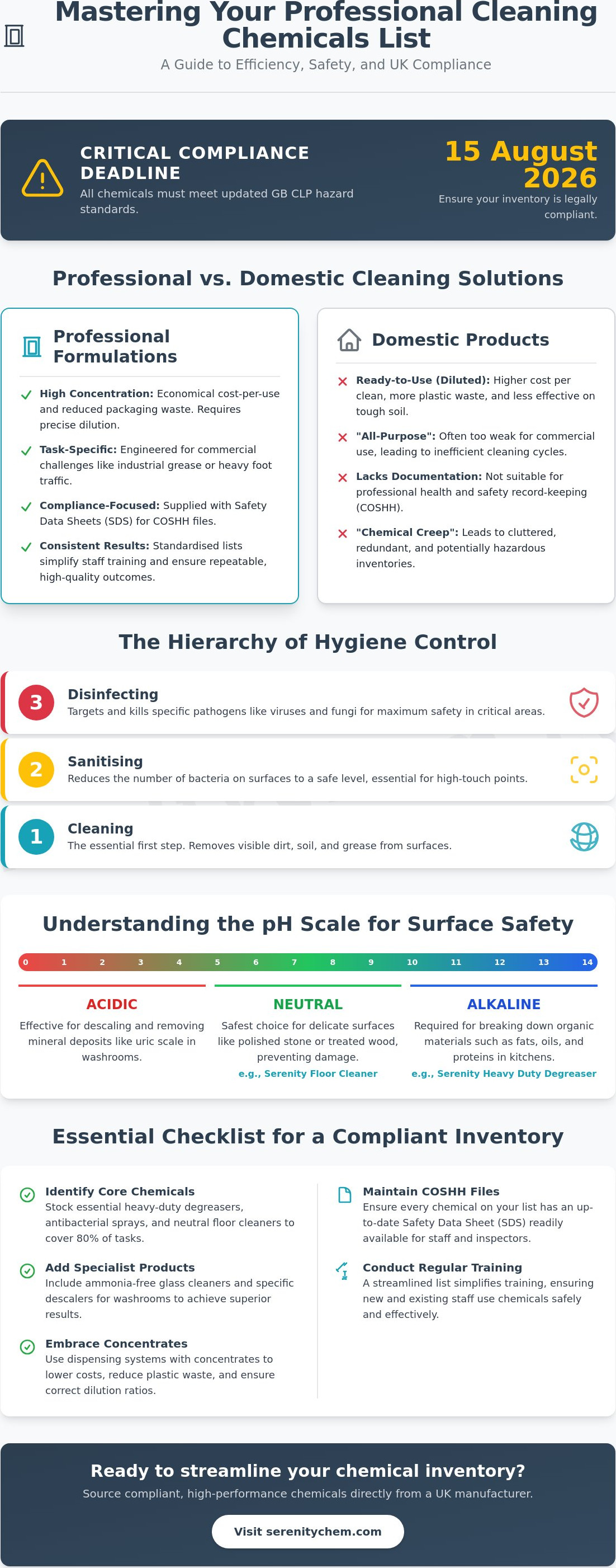
By August 15, 2026, every chemical in your facility must meet the updated GB CLP hazard standards; otherwise, your business is operating outside of legal safety requirements. It's a significant deadline that forces a hard look at your current inventory. You've likely felt the frustration of navigating complex EN standards or the worry that your team might be using the wrong product for a critical task. Relying on an outdated or bloated professional cleaning chemicals list doesn't just waste money; it creates genuine risks for cross-contamination and safety breaches.
We agree that maintaining a compliant, efficient workspace shouldn't feel like a chemistry experiment. This guide provides a clear path to mastering your inventory, ensuring you stock only what's necessary for high-standard hygiene and safety. You'll learn the specific functions of essential specialist products and how to align your COSHH files with the latest 2026 regulations. By the end, you'll have a streamlined, compliant list that protects your staff, your customers, and your professional reputation.
Key Takeaways
- Understand the fundamental difference between generic domestic products and high-concentration professional formulations designed for commercial durability.
- Learn to distinguish between cleaning, sanitising, and disinfecting to ensure high-touch points remain hygienic and safe for all users.
- Master your professional cleaning chemicals list by identifying essential items like heavy-duty degreasers and antibacterial sprays that prevent cross-contamination.
- Discover how to achieve streak-free finishes on glass and manage uric scale in washrooms without relying on harsh ammonia-based chemicals.
- Ensure your business remains compliant with UK safety standards by understanding the critical role of COSHH files and up-to-date Safety Data Sheets.
Defining the Professional Cleaning Chemicals List: Beyond Domestic Solutions
A professional cleaning chemicals list represents a strategic approach to facility management rather than a simple shopping tally. Unlike domestic supplies found in local supermarkets, these are high-concentration formulations built for the rigours of commercial environments. If you've ever wondered what are cleaning agents? in a scientific context, they're substances designed to lift and suspend soil so it can be removed from a surface. In a professional setting, this process must be fast, repeatable, and safe for both the user and the environment.
Domestic "all-purpose" cleaners are often diluted for general safety in untrained hands, which makes them inefficient for stubborn industrial grease or high-traffic floor scuffs. Professional products are task-specific. By maintaining a standardised professional cleaning chemicals list, you simplify staff training and ensure your COSHH files remain accurate. This consistency reduces the risk of mixing incompatible chemicals, which is a primary safety concern in commercial cleaning. It also stops "chemical creep," where cupboards fill with redundant bottles that serve the same purpose.
Standardising your inventory makes training much more straightforward. When a new team member joins, they don't have to guess which bottle to grab from a chaotic shelf. They follow a precise protocol based on your curated list. This clarity isn't just about speed; it's about integrity. It ensures that every surface is treated with the respect and care it deserves, prolonging the life of your building's assets whilst improving cost-per-use efficiency.
Why Concentration and Dilution Matter in 2026
Concentrates are the backbone of a modern professional cleaning chemicals list. While a ready-to-use bottle offers convenience, concentrates provide far better economic value and a smaller environmental footprint. When used with precise dispensing systems, they ensure the correct dilution every time. This precision is vital for effective soil suspension; the chemical must lift the dirt and hold it in the solution so it's actually removed rather than just moved around. It's a methodical way to reduce plastic waste and lower your overall overheads without sacrificing performance.
The Role of pH in Chemical Selection
Understanding the pH scale is essential for surface protection and effective cleaning. Acidic cleaners are generally used for descaling tasks, whilst alkaline products are required for breaking down organic fats and proteins. Using Serenity Heavy Duty Degreaser on a kitchen floor is a perfect example of matching an alkaline chemical to a specific task. However, many surfaces require a neutral touch. Products like Serenity Floor Cleaner are the safest choice for delicate surfaces like polished stone or treated wood, preventing the chemical etching or dulling that can occur with harsher substances. Choosing the right pH ensures you protect the integrity of the materials you clean.
The Core Categories: Essential Sanitisers and Surface Disinfectants
Maintaining a safe commercial environment requires more than just a surface-level wipe. The foundation of any robust professional cleaning chemicals list is built on understanding the hierarchy of pathogen control. Whilst cleaning removes visible soil and grease, sanitising reduces bacteria to safe levels. Disinfecting goes a step further by targeting and killing specific viruses and fungi. In 2026, the industry has shifted towards products that offer residual efficacy, meaning they continue to protect surfaces long after the initial application has dried. This proactive approach is essential for high-traffic areas where re-contamination happens almost immediately after a cleaning cycle.
Adhering to Professional cleaning industry standards ensures that your facility remains compliant with health and safety regulations. It's about building trust with your staff and visitors by providing a demonstrably hygienic environment. A well-curated list doesn't just include these chemicals; it organises them by their specific biocidal activity, ensuring you aren't using a high-level disinfectant where a simple sanitiser would suffice, or vice versa.
High-Level Surface Disinfection
Choosing the right antibacterial surface spray UK involves more than checking for a "99.9% kill rate" on the label. In professional settings, you must ensure the product meets specific EN standards for the pathogens most likely to be present in your sector. Using a dedicated Serenity Hard Surface Sanitiser on non-porous areas in offices or healthcare settings provides a reliable layer of protection. A critical, often overlooked factor is contact time. For any disinfectant to work effectively, the surface must remain wet for the duration specified by the manufacturer. This can range from thirty seconds to several minutes; ignoring this detail renders the disinfection process incomplete.
Hand Hygiene as a Chemical Category
Hand hygiene is no longer just a washroom extra; it's a core component of your professional cleaning chemicals list. There's a clear trend towards alcohol free hand sanitiser UK solutions in professional settings. Alcohol-based gels often cause skin irritation or dermatitis with frequent use, which leads to poor compliance amongst employees. Alcohol-free alternatives, such as Serenity Alcohol Free Hand Sanitiser, provide a skin-safe, non-flammable option that is often preferred in schools, care homes, and high-security environments. Foam formulations are typically more cost-effective than gels because they provide better coverage with less product, making them a smarter choice for high-volume dispensers. If you're unsure which disinfectants meet your specific sector requirements, our team can help you audit your current inventory to ensure full compliance.
Specialised Hygiene Products for Floors, Kitchens, and Heavy Industry
While surface sanitisers handle high-touch points, a professional cleaning chemicals list must also address the more stubborn challenges found on floors and in food preparation areas. Industrial environments require formulations that can penetrate layers of built-up soil without damaging the underlying substrate. Selecting the wrong chemical for a safety floor or a commercial kitchen doesn't just result in poor hygiene; it can create significant safety hazards, such as increased slip risks or food contamination. Each product in this category serves a specific purpose within a broader, methodical cleaning schedule.
Heavy-duty tasks, such as removing carbonised grease from ovens or industrial oils from concrete warehouse floors, require high-alkaline solutions. A product like Serenity Heavy Duty Degreaser is engineered to break the molecular bonds of tough organic soiling, making it easier to rinse away. Integrating these powerful agents into a HACCP-compliant schedule ensures that your business meets the highest standards of structural hygiene whilst protecting your equipment from the corrosive effects of improper chemical use.
Commercial Floor and Carpet Care
Maintaining the integrity of commercial flooring requires a nuanced approach. For hard surfaces, using a neutral pH solution like Serenity Floor Cleaner prevents the dulling of finishes on tiles and treated concrete. However, soft furnishings and high-traffic walkways require deeper intervention. Your inventory should include a high-performance carpet shampoo for machines UK to ensure deep fabric hygiene and soil removal. In hospitality settings, where lingering smells can impact the customer experience, an odour neutralising carpet shampoo is an essential addition. These products don't just mask scents; they neutralise the bacteria that cause them, ensuring a truly fresh environment.
Kitchen and Food Prep Hygiene
In any environment where food is handled, chemical safety is paramount. Kitchen sanitisers must be fragrance-free to prevent the risk of "taint," where the smell of a cleaning product is absorbed by the food. Using a dedicated Serenity Kitchen Sanitiser ensures that worktops and equipment are hygienically clean without leaving behind harmful residues. It's vital to select a food safe sanitiser for commercial kitchens that specifically meets the EN 1276 standard for bactericidal efficacy. This ensures that your professional cleaning chemicals list provides the necessary protection against common food-borne pathogens, keeping both your customers and your business safe from the consequences of a hygiene breach.
Specialist Additions: Glass, Washrooms, and Fabric Care
While the previous sections focused on high-risk areas like kitchens and industrial floors, the aesthetic and hygienic standards of your public-facing spaces rely on specialist additions. A lean professional cleaning chemicals list shouldn't just be about raw power; it needs to include products that deliver precision and care. This is where your "workhorse" chemicals come into play. A product like Serenity Multi-Surface Cleaner is indispensable for non-critical areas, providing a consistent standard of cleanliness across desks, shelves, and general furniture without the need for aggressive biocides.
Maintaining these areas requires a shift in focus from heavy degreasing to fine-tuned maintenance. Using the right specialist products prevents the build-up of unsightly residues and protects the long-term value of your fixtures. By categorising these chemicals clearly, you ensure that your team uses the most efficient tool for the job, reducing the time spent on repetitive tasks whilst improving the overall finish of the facility.
Washroom and Glass Maintenance
Glass surfaces are often the first thing a visitor notices. Achieving a professional finish requires more than just a quick wipe. Learning how to get mirrors streak free involves using alcohol-free glass cleaners that don't leave hazy residues. Serenity Glass & Mirror Cleaner is formulated to evaporate cleanly, ensuring clarity on windows and mirrors alike. In the washroom, the challenges shift to mineral deposits and uric scale. To manage these effectively, you need a viscous product like Serenity Toilet Cleaner. Its thicker consistency allows for extended contact time on vertical surfaces, which is crucial for breaking down hard water stains that thinner liquids simply run over. Don't forget the high-traffic touch-points; using Serenity Antibacterial Surface Spray on flush handles and taps completes the hygiene cycle.
Fabric and Upholstery Specialist Chemicals
Soft furnishings require a different chemical logic. Unlike hard surfaces, fabrics trap dirt and bacteria within their fibres. Domestic sprays often only address surface-level stains or use heavy perfumes to mask smells. Professional-grade solutions, such as Serenity Carpet Shampoo, use soil-suspension technology to lift contaminants from deep within the pile. The science of odour neutralisation is about more than just scent; it's about breaking down the molecules that cause the smell in the first place. When selecting chemicals for your professional cleaning chemicals list, ensure they are safe for the specific upholstery types in your building. Look for formulations that offer fast drying times and leave no sticky residues that attract more dirt. If you're looking to refine your inventory and ensure every product serves a distinct, valuable purpose, get in touch with our specialist team for a bespoke consultation.
Compliance and Sourcing: Buying from a UK Chemical Manufacturer
Building a professional cleaning chemicals list is only half the battle; ensuring that list remains legally compliant and ethically sourced is what separates a standard business from a principled leader. Under the Control of Substances Hazardous to Health (COSHH) regulations, every employer has a duty to assess and control the risks associated with hazardous substances. This begins with maintaining a comprehensive folder of Safety Data Sheets (SDS) for every product in your inventory. These documents provide the technical specifications required to manage spillages, exposure, and storage safely. By August 15, 2026, all cleaning chemicals used in facilities across Great Britain must comply with the updated GB Classification, Labelling and Packaging (CLP) hazard standards. Sourcing directly from a UK manufacturer ensures that your documentation is already aligned with these domestic shifts, saving you the headache of retroactive compliance audits.
Sourcing your supplies within the UK offers more than just logistics; it provides supply chain stability that international imports often lack. When you buy British-made chemicals, you support local manufacturing whilst significantly reducing the carbon footprint associated with long-distance shipping. This proximity allows for tighter quality control and a more transparent manufacturing process. It also means you have a direct line to the experts who formulated the products, providing you with peace of mind that every batch meets the high standards your business requires. Choosing a local partner helps you stay ahead of divergence between GB and EU regulations, ensuring your facility remains on the right side of the law.
Navigating UK Hygiene Standards (EN 14476 & EN 1276)
EN 14476 is the European standard for virucidal efficacy in chemicals. To verify that your professional cleaning chemicals list meets current UK regulations, you should cross-reference each product's technical data with the specific demands of your environment. This is where principled expertise becomes invaluable. A partner who understands the nuance of biocidal efficacy will help you select products that are not just effective, but responsible and safe for the end-user. Relying on verified EN standards ensures that your cleaning protocols are backed by scientific rigour rather than marketing claims.
The Serenity Chemicals Limited Advantage
Serenity Chemicals Limited provides a complete range of high-performance solutions designed for the modern UK business. Our portfolio covers every essential category, including Serenity Alcohol Free Hand Sanitiser for skin-safe hygiene and Serenity Heavy Duty Degreaser for industrial challenges. We also offer specialised products such as Serenity Kitchen Sanitiser, Serenity Floor Cleaner, and Serenity Glass & Mirror Cleaner to maintain every corner of your facility. By buying direct from the manufacturer, you benefit from consistent quality and competitive wholesale pricing for bulk procurement. Whether you need Serenity Carpet Shampoo for deep fabric care or Serenity Toilet Cleaner for washroom maintenance, Serenity Chemicals Limited ensures your facility remains compliant, efficient, and safe.
Future-Proofing Your Commercial Hygiene Strategy
Mastering your professional cleaning chemicals list is about more than just stocking shelves; it's about building a system that prioritises safety, efficiency, and regulatory compliance. By moving away from domestic-grade products and embracing high-concentration, task-specific formulations, you protect your staff and your building's assets whilst reducing unnecessary waste. We've explored how the right pH balance and specialised sanitisation protocols create a demonstrably safer environment for everyone who enters your facility.
As the August 2026 deadline for updated GB CLP standards approaches, the importance of reliable documentation and principled expertise has never been higher. Serenity Chemicals Limited operates as a dedicated UK-based manufacturer and blender, providing specialist alcohol-free hygiene formulations alongside comprehensive COSHH and SDS support to keep your business running smoothly. We ensure your inventory is lean, effective, and fully compliant with the latest British safety regulations.
Browse the Serenity range of professional cleaning chemicals today to streamline your inventory and ensure your facility meets the highest standards of modern hygiene. We're here to help you navigate these technical requirements with confidence and ease.
Frequently Asked Questions
What are the 4 main types of cleaning chemicals on a professional list?
The four primary types of chemicals found on a professional cleaning chemicals list are detergents, degreasers, abrasives, and acids. Detergents are used for general soil removal, whilst degreasers target organic oils and fats. Acids are essential for descaling washrooms and removing mineral deposits, and abrasives provide the physical grit needed for scrubbing stubborn stains on hard surfaces. Choosing the correct category ensures you protect your building's assets whilst maintaining high hygiene standards.
What is the difference between a sanitiser and a disinfectant in the UK?
Sanitisers reduce bacteria to a safe level, whilst disinfectants are designed to kill a wider range of specific pathogens, including viruses and fungi. In the UK, sanitisers are often used in food preparation areas because they are frequently non-tainting and fast-acting. Disinfectants usually require a longer contact time to be effective and are typically used in high-risk areas like healthcare or washrooms to ensure complete pathogen eradication and infection control.
How do I ensure my cleaning chemicals list is COSHH compliant?
To ensure COSHH compliance, you must maintain a dedicated file containing up-to-date Safety Data Sheets (SDS) for every product in your inventory. You also need to perform documented risk assessments for each chemical and ensure your staff are trained on correct dilution and PPE requirements. Regularly checking that your labels meet the August 2026 GB CLP standards is a critical step for modern compliance management and workplace safety.
Why should I choose alcohol-free hand sanitisers for my business?
Alcohol-free hand sanitisers, such as Serenity Alcohol Free Hand Sanitiser, are preferred in professional settings because they are gentler on the skin and non-flammable. Frequent use of alcohol-based gels can lead to skin irritation or dermatitis, which often reduces employee compliance with hygiene protocols. These formulations provide a safe, effective alternative for schools, care homes, and offices where fire safety and long-term skin health are high priorities.
What EN standards should I look for on professional cleaning chemicals?
You should look for EN 1276 for bactericidal efficacy and EN 14476 for virucidal protection on your chemical labels. Other important standards include EN 1650 for fungicidal activity and EN 13697 for surface disinfection. These certifications provide scientific proof that the chemical will perform as claimed under specific conditions. Always verify these standards with your supplier to ensure your professional cleaning chemicals list meets the necessary UK safety and legal requirements.
Can I use the same multi-surface cleaner for glass and mirrors?
Using a multi-surface cleaner on glass is generally not recommended because these formulations often contain surfactants that leave hazy streaks. Whilst a product like Serenity Multi-Surface Cleaner is excellent for desks and shelves, glass requires a specialist solution. Serenity Glass & Mirror Cleaner is specifically designed to evaporate quickly without leaving any residue, ensuring a crystal-clear, professional finish that general-purpose cleaners simply cannot replicate on reflective surfaces.
What are the essential chemicals for a commercial kitchen cleaning list?
A commercial kitchen requires a food-safe sanitiser, a heavy-duty degreaser, and a dedicated floor cleaner. Serenity Kitchen Sanitiser is essential for worktops as it is fragrance-free and non-tainting, preventing food contamination. You will also need Serenity Heavy Duty Degreaser to manage carbonised grease on ovens and extractor fans. These products, combined with a methodical cleaning schedule, ensure your kitchen remains HACCP-compliant and safe for high-volume food preparation.
How often should I review and update my professional chemical inventory?
You should review your chemical inventory at least once a year or whenever you introduce a new product to your facility. Significant regulatory changes, such as the transition to the GB CLP regime by August 15, 2026, also necessitate an immediate audit. Regular reviews help you identify redundant products, ensuring your inventory remains streamlined, cost-effective, and fully aligned with the latest safety standards and environmental best practices.

Hand Hygiene in Food Preparation Areas: The 2026 Professional Guide
The Food Standards Agency estimates that foodborne illness costs the UK economy approximately £9 billion every year, with a s...

Sanitising Commercial Kitchen Hard Surfaces: The Professional UK Guide (2026)
Did you know that the average fine for food hygiene offences in the UK has more than tripled since 2016, now reaching over £7...