

The very product you use to protect your health might be the primary cause of your skin's deterioration. While alcohol-based gels are often viewed as the gold standard, they frequently leave professionals with cracked, bleeding, or painfully dry hands after just a few hours on shift. Finding an effective hand sanitiser for frequent use shouldn't mean choosing between clinical hygiene and personal comfort.
Most of us agree that maintaining high antiviral standards is non-negotiable, especially in sectors where safety is paramount. However, dealing with sticky residues and the constant risk of flammability in the workplace adds unnecessary stress to an already demanding environment. You deserve a solution that supports your workflow rather than hindering it with physical discomfort or safety concerns.
You'll discover how to achieve sustained skin integrity even with 50 or more applications per day through advanced alcohol-free technology. This guide provides a comprehensive look at the Serenity Alcohol Free Hand Sanitiser range, ensuring your organisation remains compliant with the latest EN 14476:2025 and EN 1276:2019 standards. We'll show you how to transition to a solution that's safer, more cost-effective, and far kinder to the dermal barrier.
Key Takeaways
- Define the clinical requirements for frequent hand hygiene and the impact of 10 or more daily applications on dermal integrity.
- Master the technical distinction between evaporative alcohol solutions and residual, pH-balanced alternatives that support the skin's natural barrier.
- Navigate the current UK regulatory landscape, ensuring your facility meets the rigorous EN 14476:2025 and EN 1276:2019 certifications for maximum protection.
- Optimise workplace hygiene stations using a hand sanitiser for frequent use that eliminates the risks of flammability and uncomfortable sticky residue.
- Evaluate the long-term cost-effectiveness and safety benefits of transitioning to a professional-grade, UK-manufactured alcohol-free range.
Understanding Hand Sanitiser for Frequent Use
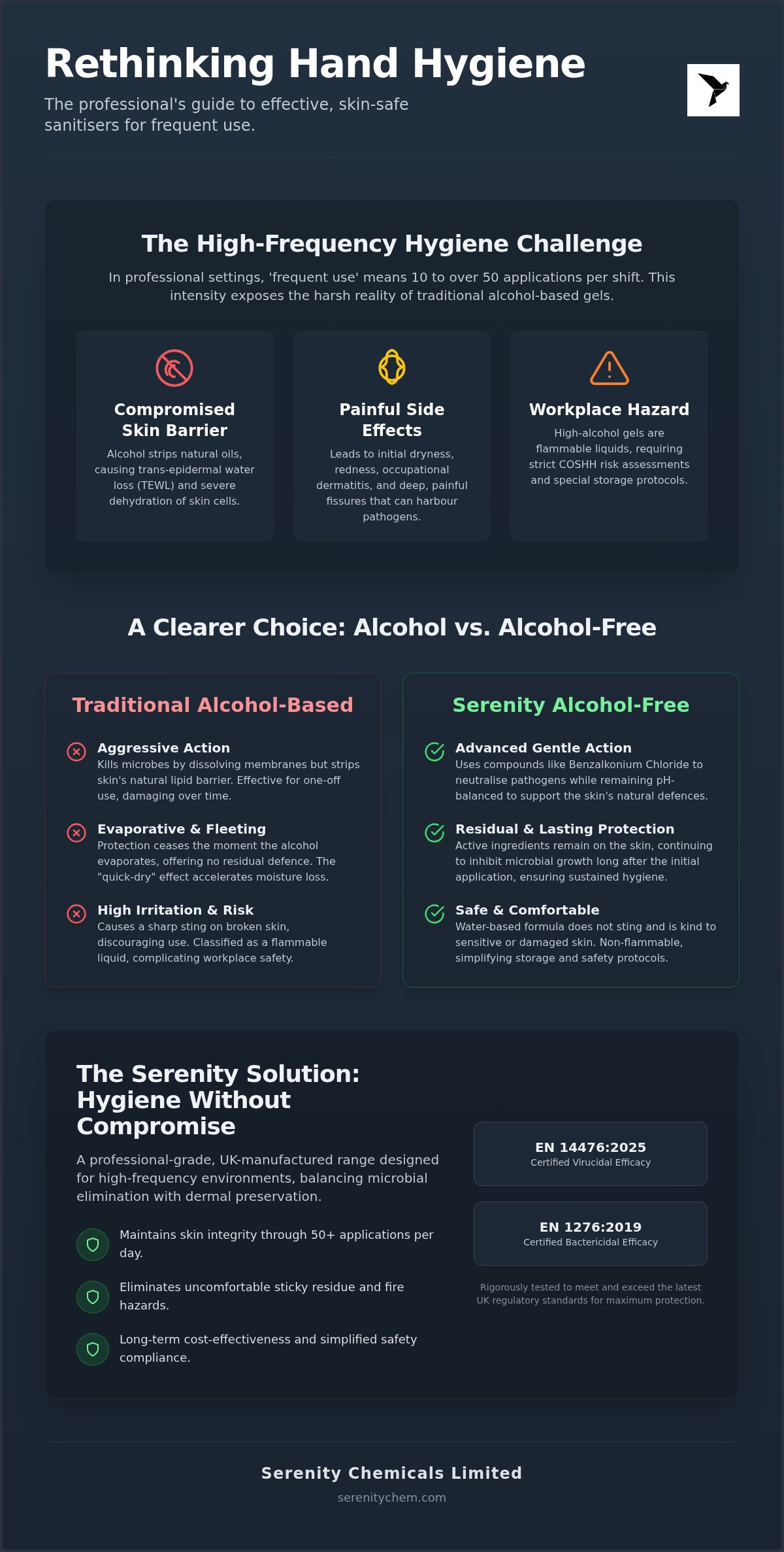
In professional environments such as healthcare, education, or food service, "frequent use" is defined as ten or more applications during a single shift. For many front-line workers, this number can easily exceed fifty. When choosing a hand sanitiser for frequent use, the priority shifts from simple germ-kill to a more complex requirement: maintaining a sterile environment without destroying the user's skin.
Traditional alcohol-based products rely on high concentrations of ethanol or isopropanol to denature viral proteins. While effective in a single burst, these solvents are aggressive. They trigger trans-epidermal water loss (TEWL) by drawing moisture out of the dermis as the alcohol evaporates. Over time, this dehydrates the skin cells, leading to a compromised barrier that can no longer protect itself from environmental irritants.
The history and development of Hand sanitizer show a long reliance on these volatile organic compounds; however, modern advancements have introduced alcohol-free formulations that offer a more sustainable path for long-term skin health. These newer solutions focus on maintaining the skin's natural pH whilst providing rigorous protection against pathogens.
The Impact of High-Alcohol Gels on Skin Health
Alcohol doesn't just kill pathogens; it effectively dissolves the natural oils and lipids that hold our skin cells together. This stripping process leads to a predictable and painful progression for the user:
- Initial dryness and a persistent feeling of tightness in the dermis.
- Visible redness and inflammation, particularly around the knuckles and finger webs.
- Development of occupational contact dermatitis, which can require medical intervention.
- Deep fissures and cracks that serve as reservoirs for pathogens.
Once the skin reaches this stage, it becomes a liability. Cracked or fissured skin is significantly harder to sanitise. Bacteria and viruses can hide within deep dermal breaks where topical gels may not reach effectively. Consequently, the very tool meant to ensure safety becomes the reason the hygiene protocol fails.
Why Frequency of Use Changes the Hygiene Equation
A single application of a high-alcohol gel might be tolerated by healthy skin. However, the cumulative effect over an eight-hour shift is where the damage occurs. The "quick-dry" feature often praised in alcohol formulas is actually a sign of rapid evaporation that accelerates skin cooling and moisture stripping. This makes the formula increasingly irritant with every subsequent use.
Selecting an appropriate hand sanitiser for frequent use requires looking beyond the immediate kill rate to the residual impact on the user. Professional hygiene standards in 2026 demand a more sophisticated approach. Frequent use hand hygiene is the deliberate balance between rapid microbial elimination and the preservation of the skin's biological protective barrier.
Alcohol vs Alcohol-Free: Which is Better for Your Skin?
The fundamental difference between alcohol-based and alcohol-free solutions lies in their chemical mechanism. Alcohol-based sanitisers kill microbes by dissolving their outer membranes, but this process is instantaneous and ceases as soon as the liquid evaporates. In contrast, an alcohol-free hand sanitiser for frequent use often provides residual protection. This means the active ingredients remain on the skin surface, continuing to inhibit microbial growth long after the initial application.
The "sting factor" is a significant hurdle for workplace compliance. When skin is already irritated or broken, applying high-concentration ethanol causes immediate, sharp pain. This often leads staff to avoid sanitising altogether, which compromises site safety. Alcohol-free formulas are water-based and don't cause this reaction, making them much more suitable for those with existing skin sensitivities or minor abrasions.
For many UK organisations, safety extends beyond biology. Alcohol-based gels are classified as flammable liquids, requiring specific storage conditions and rigorous risk assessments under COSHH regulations. Switching to non-flammable alternatives simplifies workplace safety protocols and reduces fire risk in high-traffic environments or areas with restricted ventilation. It's a pragmatic choice that values both the user's physical comfort and the facility's overall safety profile.
The Science of Alcohol-Free Protection
Modern formulations often utilise Benzalkonium Chloride (BKC), a quaternary ammonium compound that acts as a powerful surfactant. Unlike alcohol, which vanishes in seconds, BKC stays active on the skin. Because the formula doesn't evaporate instantly, it allows for more thorough coverage of the hands. Following Best Practices for High-Frequency Hygiene ensures that these surfactants are applied correctly to reach all areas of the hand, including finger webs and nail beds. Foam formats are particularly effective for this, as they distribute the active ingredients evenly without the sticky, heavy residue often associated with poor-quality gels.
Maintaining the Dermal Barrier
Healthy skin maintains a slightly acidic pH, known as the acid mantle, which acts as a natural defence against infection. Alcohol-free sanitisers are typically formulated to respect this balance. They often include humectants and conditioners that actively draw moisture into the skin rather than stripping it away. This makes them a viable choice for those seeking the best hand sanitiser for eczema or other chronic dry skin conditions. By preserving the dermal barrier, these products ensure the skin remains intact and resilient against both chemical and biological threats. If you're looking to upgrade your facility's hygiene standards, you can speak with our technical team to find the right solution for your specific environment.
Efficacy and UK Standards: EN 14476 and Beyond
Efficacy in hygiene is often misunderstood as being synonymous with alcohol content. This is a technical misconception. In professional environments, the only valid measure of performance is a product's compliance with specific British Standards. For a hand sanitiser for frequent use, achieving a high kill rate whilst maintaining skin safety is the primary objective of modern formulation.
Professional-grade hygiene requires an understanding of "log reduction," which measures how effectively a product reduces pathogens. A Log 4 reduction kills 99.99% of microorganisms, while a Log 5 reduction removes 99.999%. While the difference sounds marginal, in a high-risk environment like a hospital or school, that extra decimal point represents a significant increase in safety. UK manufacturers must adhere to the Biocidal Products Regulation (BPR), overseen by the Health and Safety Executive (HSE), ensuring that every claim of "99.99% efficacy" is supported by rigorous laboratory data.
Understanding EN 14476 Antiviral Testing
The gold standard for antiviral performance is BS EN 14476:2025. This certification proves a product is effective against enveloped viruses, which include many of the most common seasonal threats. Businesses shouldn't rely on marketing jargon; they should demand test certificates from their chemical supplier to verify these claims. EN 14476 is the benchmark for antiviral claims in the UK as of 2026. Choosing a certified solution like Serenity Alcohol Free Hand Sanitiser ensures that your organisation meets these strict clinical requirements without the drawbacks of traditional gels.
Residual Activity and Surface Tension
One of the most significant advantages of advanced alcohol-free formulas is their "persistence of effect." Alcohol is a "flash" killer; it works brilliantly for a few seconds but offers no protection once it evaporates. Benzalkonium Chloride (BKC) based formulas provide a residual shield that continues to work on the skin surface. This makes them highly effective for staff who move between different tasks quickly.
The physical delivery of the product also matters. Foam sanitisers typically have lower surface tension than thick gels. This allows the liquid to spread more easily into skin folds, nail beds, and under fingernails where pathogens often congregate. When selecting a hand sanitiser for frequent use, this superior coverage combined with a Log 5 kill rate provides a level of protection that alcohol alone cannot match. Laboratory tests show that while 70% ethanol has a rapid initial kill, the residual activity of BKC-based solutions provides a more consistent hygiene profile over a full working day.
Best Practices for High-Frequency Hygiene in the Workplace
Successful hygiene protocols depend as much on placement as they do on the chemical formula. To encourage compliance, sanitising stations should be positioned at natural transition points, such as entrance lobbies, lift banks, and outside communal breakrooms. When using a hand sanitiser for frequent use, these stations should be highly visible but also accompanied by clear instructional signage. This reminds staff that a quick splash isn't enough; a thorough 20-second rub is required to ensure the liquid or foam reaches all areas of the hand, including the fingertips and thumbs.
Whilst alcohol-free sanitisers are designed to be kind to the skin, they contain humectants and conditioners that can occasionally lead to a "tackiness" or build-up after multiple consecutive applications. It's a professional best practice to advise staff to wash their hands with soap and water at least once every few hours. This resets the dermal surface by removing residual conditioners and any physical debris that sanitiser alone cannot eliminate. This balanced approach maintains the skin's integrity throughout a long shift.
In high-risk environments like commercial kitchens, workshops, or laboratories, managing flammability is a critical safety concern. High-alcohol gels represent a significant fire risk when used near open flames or heat sources. Choosing a non-flammable, water-based solution like Serenity Alcohol Free Hand Sanitiser removes this hazard entirely. It allows organisations to maintain rigorous hygiene standards in areas where traditional sanitisers would be considered a liability under standard health and safety assessments.
Implementation in Schools and Childcare
In educational settings, the switch to alcohol-free solutions offers a distinct safety advantage. Children are naturally more prone to accidental ingestion or rubbing their eyes after application. Using child-safe hand sanitisers eliminates the risk of alcohol poisoning and the painful "sting" associated with high-proof gels. Because these formulas are non-toxic and non-flammable, they can be placed more freely throughout classrooms and play areas without the same level of restrictive supervision required for flammable chemicals.
Bulk Sourcing and Cost-Efficiency
For large-scale organisations, procurement strategy is vital for long-term sustainability. Refillable dispensers combined with bulk containers significantly reduce plastic waste and lower the cost per application compared to individual pump bottles. Investing in high-quality hygiene also has a direct impact on the bottom line; reducing the spread of seasonal viruses and preventing occupational dermatitis lowers absenteeism and improves staff morale. To ensure consistent supply and compliance with UK regulations, it's often more efficient to buy direct from a cleaning products manufacturer in the UK. If you need assistance planning a high-frequency hygiene rollout for your facility, you can contact our technical advisory team for a tailored consultation.
Choosing Serenity Alcohol Free Hand Sanitiser for Your Organisation
Serenity Alcohol Free Hand Sanitiser represents the pinnacle of modern hygiene technology, developed specifically for environments where safety and skin health are equally weighted. As a dedicated UK-based manufacturer, we've refined our proprietary formulation to meet the precise needs of high-traffic professional sectors. It's engineered as a premier hand sanitiser for frequent use, ensuring that rigorous antiviral protection doesn't come at the cost of staff well-being. By focusing on skin-compatible chemistry, we provide a solution that professionals can rely on for fifty or more applications per day without the risk of dermal degradation.
Our commitment to high-performance hygiene is rooted in a manufacturing heritage that began in 2020. Since then, we've specialised in creating solutions that bridge the gap between industrial-strength efficacy and consumer-friendly safety. Every batch of our alcohol-free sanitiser is produced with meticulous attention to detail, ensuring it remains gentle on sensitive skin whilst maintaining the high kill rates required by modern clinical standards. This balance is what makes our range a dependable choice for organisations that value long-term trust over short-term fixes.
To support diverse operational requirements, we provide our sanitiser in a variety of functional formats. Whether your team requires pocket-sized bottles for mobile use or 5-litre bulk refills for permanent wall-mounted dispensers, our range scales to fit your facility's needs. This versatility ensures that a consistent hygiene standard is maintained across all areas of your business, from the front desk to the stockroom.
Why Professionals Trust Serenity Chemicals
Professionals across the UK choose Serenity Chemicals because we operate with a sense of quiet confidence and ethical responsibility. We aren't simply selling a product; we're providing a principled solution that respects the health of the user. This "Principled Expert" approach ensures our formulations are transparent, honest, and technically superior. Our alcohol-free range is designed to work seamlessly alongside a wider professional cleaning chemicals list, allowing for a unified and safe hygiene strategy across your entire organisation.
Next Steps: Securing Your Supply
Transitioning your organisation to an alcohol-free hygiene protocol is a straightforward process that yields immediate benefits in user comfort and workplace safety. We make it easy to switch by providing comprehensive technical data sheets and clear guidance on application. If you're managing large-scale procurement, our team is ready to discuss bulk pricing and consistent supply chains to support your 2026 hygiene goals. Explore our range of Serenity Alcohol Free Hand Sanitisers today to secure a solution that protects your people as effectively as it protects your facility.
Advancing Your Workplace Hygiene Standards
Maintaining rigorous hygiene doesn't have to result in occupational dermatitis or complex workplace safety hazards. By transitioning to a dermatologically considerate formulation, you protect both your staff and your facility's operational integrity. We've explored how modern alcohol-free technology provides a residual shield that alcohol simply cannot match, especially when meeting the latest BS EN 14476:2025 antiviral standards.
Selecting the right hand sanitiser for frequent use is a strategic decision that balances clinical efficacy with long-term dermal health. As a UK manufactured solution, Serenity Chemicals ensures your organisation remains compliant with the highest biocidal regulations whilst prioritising the physical comfort of your team. It's about building a culture of safety that staff can actually adhere to without discomfort or skin damage.
Browse the Serenity Alcohol Free Hand Sanitiser Range to secure a safer, more sustainable hygiene protocol for your organisation today. Taking this proactive step ensures your team stays protected and productive throughout 2026 and beyond.
Frequently Asked Questions
Is alcohol-free hand sanitiser as effective as alcohol-based ones for frequent use?
Modern alcohol-free options are just as effective as alcohol-based alternatives when formulated to professional standards. Our solution provides a Log 5 reduction, which removes 99.999% of pathogens, including enveloped viruses. Unlike alcohol, which evaporates instantly, alcohol-free formulas offer residual protection that remains active on the skin. This makes them a highly reliable hand sanitiser for frequent use in environments where constant re-application is necessary to maintain a sterile workspace.
Can I use alcohol-free hand sanitiser if I have eczema or sensitive skin?
Yes, you can safely use alcohol-free sanitisers if you suffer from eczema or other sensitive skin conditions. These water-based formulas avoid the aggressive drying effect of ethanol, which often triggers painful flare-ups. Serenity's range includes skin-conditioning agents that help maintain the dermal barrier whilst providing clinical-grade protection. Because there is no "sting factor" on broken or irritated skin, compliance remains higher amongst staff who have previously struggled with traditional gels.
Does Serenity Alcohol Free Hand Sanitiser meet EN 14476 standards?
Serenity Alcohol Free Hand Sanitiser fully complies with BS EN 14476:2025 standards. This certification ensures the product is effective against a broad spectrum of enveloped viruses, providing the high level of protection required in UK professional settings. We maintain rigorous quality control as a UK manufacturer to ensure every batch meets these biocidal requirements. Technical data sheets are available for organisations that need to document their hygiene compliance for health and safety audits.
Why is alcohol-free sanitiser safer for use in schools and nurseries?
Alcohol-free solutions are significantly safer for childcare environments because they are non-flammable and non-toxic. High-proof alcohol gels present a fire risk and a danger of accidental ingestion poisoning amongst young children. Using a water-based hand sanitiser for frequent use in classrooms removes these hazards entirely. Additionally, the lack of skin irritation ensures that children are more willing to participate in regular hygiene routines throughout the school day without discomfort or stinging.
How often should I use hand sanitiser during a typical work shift?
You should apply sanitiser at every transition point in your shift, such as after touching communal handles or moving between different patient or student groups. In high-frequency roles, this often results in ten or more applications daily. Using a formula that is enriched with humectants ensures that these constant re-applications don't strip your skin of its natural moisture, allowing you to maintain clinical standards without the risk of developing painful cracks or irritation.
Will using hand sanitiser frequently lead to "superbugs" or antibiotic resistance?
There is no evidence that using professional hand sanitisers leads to the development of "superbugs" or antibiotic resistance. Active ingredients like Benzalkonium Chloride work by physically disrupting the microbial cell wall, a process that is very difficult for bacteria to adapt to. This is fundamentally different from how internal antibiotics work. You can maintain a rigorous hygiene schedule with confidence that you aren't contributing to long-term microbial resistance or creating stronger pathogens.
Does Serenity hand sanitiser leave a sticky residue on the skin?
Serenity products are specifically formulated to avoid the uncomfortable sticky residue associated with many lower-quality gels. Our foam application is particularly effective at distributing the active ingredients evenly across the skin whilst drying to a clean, smooth finish. This non-tacky feel is essential for professionals who need to put on gloves or handle paperwork immediately after sanitising. It ensures that frequent re-application remains a comfortable and efficient part of your daily workflow.
Can I buy Serenity Alcohol Free Hand Sanitiser in bulk for my business?
Yes, Serenity Alcohol Free Hand Sanitiser is available in various bulk formats specifically for business use. We provide 5-litre refill containers that are compatible with most standard wall-mounted dispensers, helping to reduce plastic waste and lower the cost per application. Organisations can also source bulk quantities of individual pump bottles or pocket-sized units. Buying direct from a UK manufacturer ensures a consistent supply chain and access to professional-grade hygiene solutions at scale.

Hand Sanitiser for Frequent Use: Professional UK Guide 2026
The very product you use to protect your health might be the primary cause of your skin's deterioration. While alcohol-based ...

Food Safe Antibacterial Spray UK: The Professional 2026 Hygiene Guide
Using the wrong disinfectant in a commercial kitchen isn't just a minor oversight; it's a direct threat to your Food Hygiene ...