

Using the wrong disinfectant in a commercial kitchen isn't just a minor oversight; it's a direct threat to your Food Hygiene Rating and your customers' safety. It's understandable if you feel overwhelmed by the technical jargon of BS EN 1276 certifications or the vague instructions found on many retail labels. You want a kitchen that's truly sterile, but you also don't want your prep surfaces smelling like a hospital ward or leaving behind a greasy residue.
This professional 2026 guide is designed to help you master the standards of food safe antibacterial spray UK so you can protect your reputation with confidence. We'll clarify exactly which certification codes matter for Environmental Health Officer (EHO) inspections, explain the reality of contact times, and help you establish a cleaning routine that's both efficient and odourless. By the end, you'll have the technical knowledge to keep your workspace compliant and your food untainted. You'll gain the peace of mind that comes from knowing your hygiene standards are managed by a principled, expert approach.
Key Takeaways
- Learn how to navigate BS EN 1276 and BS EN 13697 standards to ensure your business remains fully compliant with current UK food hygiene regulations.
- Identify the specific characteristics of a high-quality food safe antibacterial spray UK to ensure surfaces are disinfected without the risk of tainting ingredients.
- Master the essential two-stage cleaning process to eliminate pathogens effectively by ensuring sanitisers are applied to a properly degreased surface.
- Explore the efficiency of modern no-rinse solutions and how they can safely streamline your hygiene routines whilst maintaining rigorous safety standards.
- Understand the benefits of sourcing professional-grade chemicals directly from a UK manufacturer for enhanced technical support and supply chain reliability.
Understanding Food Safe Antibacterial Spray Standards in the UK
A professional food safe antibacterial spray UK is more than a simple disinfectant; it's a non-tainting solution engineered specifically for environments where food is handled. Unlike standard domestic cleaners, which often rely on heavy perfumes and dyes, professional-grade products leave no sensory footprint. This is vital because strong chemical scents can easily migrate into high-fat ingredients like butter or cream, ruining the final product and compromising your standards. UK catering businesses operate under strict legal frameworks. The Food Standards Agency (FSA) provides the guidelines, but local Environmental Health Officers (EHOs) enforce them during inspections. Adhering to established food safety principles means you must be able to prove your cleaning chemicals are fit for purpose and legally compliant.
The Significance of BS EN 1276 and BS EN 13697
In the UK, two primary European standards dictate whether a disinfectant is suitable for a commercial kitchen. Understanding the difference between them is a key part of professional hygiene management.
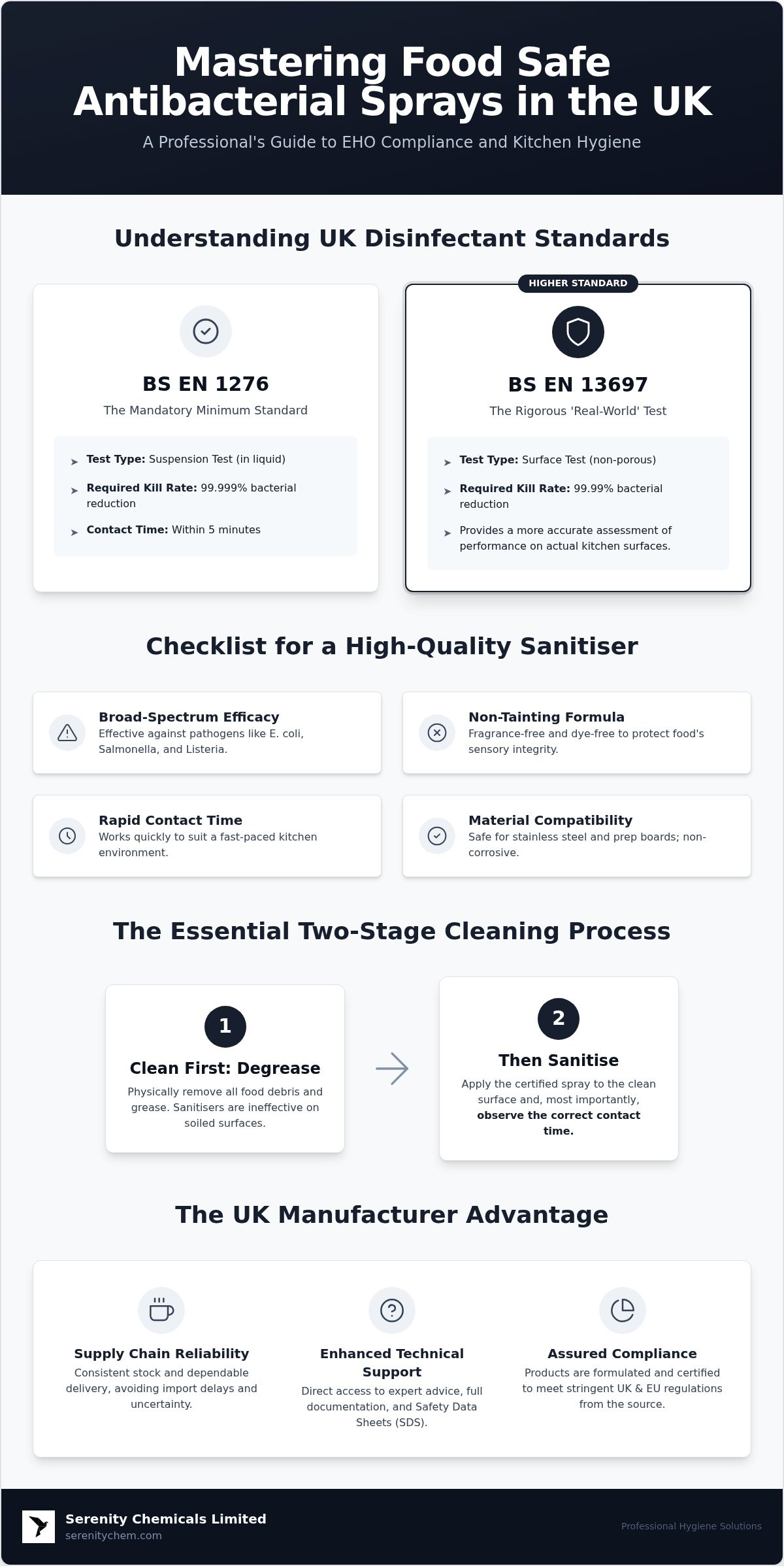
- BS EN 1276: This is the mandatory minimum for most food prep areas. It's a suspension test, meaning it measures the product's ability to kill bacteria in a liquid state. To pass, the chemical must achieve a 99.999% reduction in bacteria within 5 minutes under specific test conditions.
- BS EN 13697: This standard offers a more rigorous, real-world assessment. It tests the bactericidal activity on a non-porous surface rather than just in a liquid. A product meeting this standard must achieve a 99.99% reduction.
It's best practice to verify these codes on your product labels or Safety Data Sheets (SDS). If a product doesn't explicitly state these certifications, it shouldn't be used on food-contact surfaces in a commercial setting.
HACCP Compliance and Your Cleaning Schedule
A robust Hazard Analysis and Critical Control Point (HACCP) plan depends on the reliability of your cleaning schedule. One of the most common failures during an audit is ignoring "contact time." If a sanitiser requires 60 seconds to work, wiping it away after 10 seconds means the surface isn't legally disinfected. EHOs look for this level of detail. Fragrance-free formulas are equally essential; they eliminate the risk of chemical taints that can lead to customer complaints or batch wastage. By choosing a certified food safe antibacterial spray UK, you ensure your team has the right tools to meet these technical requirements without guesswork.
Key Characteristics of High-Quality Food Contact Sanitisers
High-performance hygiene in a commercial setting depends on chemistry that's as safe as it is strong. A professional food safe antibacterial spray UK must provide broad-spectrum efficacy against dangerous pathogens like E. coli, Salmonella, and Listeria. Without this level of protection, your kitchen remains vulnerable to cross-contamination risks that can lead to serious illness. Beyond microbial control, the spray must demonstrate excellent material compatibility. It shouldn't corrode expensive stainless steel surfaces or cause polymers like polyethylene prep boards to become brittle over time. Adhering to UK food hygiene regulations ensures you're using a solution specifically designed for the high-intensity rigours of professional catering.
Non-Tainting Formulas: Protecting the Product
Sensory integrity is paramount when preparing high-quality dishes. Residual scents from floral or citrus-based cleaners can easily migrate into high-fat ingredients such as butter, cream, or fresh meat. This chemical transfer ruins the intended flavour profile and can lead to significant batch wastage and customer complaints. The chemistry behind professional non-tainting agents relies on low-volatility surfactants that don't leave behind aromatic residues. Non-tainting is defined as the absolute absence of transferrable odours or flavours from a cleaning agent to a food product. By opting for dye-free and fragrance-free formulations, you eliminate the risk of sensory contamination entirely. This principled approach to hygiene ensures that the only thing your customers taste is your food.
The Importance of Rapid Contact Times
In a high-turnover kitchen, time is a finite resource. Traditional domestic disinfectants often require a 5-minute contact time to achieve their stated kill rates, which is rarely practical during the heat of a busy service. If your team "sprays and wipes" too quickly with a slow-acting product, they aren't actually disinfecting the surface. They're merely cleaning away visible debris whilst leaving invisible pathogens behind. Professional solutions like Serenity Kitchen Sanitiser are formulated to solve this problem. They are engineered to achieve the required bacterial reduction in much shorter windows, often between 30 and 60 seconds. This allows for rapid station resets that remain fully compliant with safety standards. It's about finding a balance between operational speed and technical thoroughness.
If you're unsure which formulation best suits your specific equipment, you can speak with our technical team for expert guidance.
Comparing No-Rinse vs. Traditional Antibacterial Solutions
Modern UK commercial kitchens are increasingly moving towards no-rinse technology to streamline their hygiene protocols. A traditional food safe antibacterial spray UK often requires a two-step process involving application followed by a potable water rinse. Whilst this method ensures no chemical residue remains, it adds significant time and water usage to every cleaning cycle. No-rinse sanitisers are specifically engineered to be safe for direct food contact once they've air-dried or undergone a brief drainage period. This shift is largely driven by a need for higher operational speed without compromising the rigorous safety standards outlined in this University of Minnesota Extension guide to sanitizing.
The Efficiency of No-Rinse Food Safe Sprays
The primary benefit of no-rinse technology is the immediate reduction of steps in the cleaning cycle. By eliminating the final rinse, staff productivity increases, which is vital during peak service hours when station resets must happen in seconds. However, it's critical to ensure the product is explicitly labelled as "safe for food contact without rinsing" to remain compliant with EHO expectations. These formulas are particularly effective for prep boards, utensils, and deli slicers where water rinsing is cumbersome. Traditional rinse-off cleaners are still necessary for heavy-duty tasks where higher chemical concentrations are needed to break down stubborn fats before the final disinfection occurs.
Alcohol-Free vs. Alcohol-Based Surface Sprays
Selecting between alcohol-based and alcohol-free solutions requires an assessment of your kitchen's physical layout and staff needs. Alcohol-based sprays are often praised for their rapid evaporation, making them a popular choice for high-speed environments. However, they can be harsh on the skin with repeated use and present a genuine flammability risk near open gas ranges. Alcohol-free sprays, like the Serenity Kitchen Sanitiser, provide a safer, non-flammable alternative that maintains high efficacy without the risk of skin irritation. For a comprehensive look at these standards, you can read our professional guide to antibacterial surface spray UK.
A thorough cost-benefit analysis should look beyond the price per bottle. No-rinse solutions might carry a slightly higher initial cost, but the savings in water and labour time are substantial over a fiscal year. Reducing the "rinse" step also lowers the risk of introducing water-borne bacteria back onto a freshly disinfected surface. When you source a food safe antibacterial spray UK directly from a manufacturer, you also gain better access to the technical data sheets required for your COSHH assessments. It's a principled choice that balances operational efficiency with the ultimate goal of consumer protection.
Best Practices for Surface Disinfection in Professional Kitchens
Environmental Health Officers (EHOs) often observe a common mistake in UK kitchens: the attempt to sanitise a dirty surface. Disinfection isn't a substitute for cleaning; it's the final step of a rigorous hygiene protocol. To ensure your food safe antibacterial spray UK performs as intended, your team must understand that physical debris, grease, and proteins act as a shield for bacteria. If these aren't removed first, the disinfectant cannot reach the pathogens underneath. Establishing a clear, documented routine is the only way to guarantee consistent compliance and protect your customers from foodborne illnesses.
The Two-Stage Cleaning Process Explained
The Food Standards Agency (FSA) mandates a two-stage process for all food-contact surfaces to ensure maximum safety. Stage 1 involves using a detergent or degreaser to remove visible dirt, crumbs, and grease. This step is vital because it breaks down the organic matter that allows biofilms to form. Stage 2 is the application of the antibacterial spray. By applying the sanitiser to a visibly clean surface, you ensure the chemical makes direct contact with any remaining microscopic bacteria. Skipping the first stage renders the second stage largely ineffective, as the sanitiser is exhausted trying to penetrate grease rather than killing the germs.
Managing Cross-Contamination with Colour-Coded Systems
Organising your cleaning station with a colour-coded system is a principled way to prevent cross-contamination. You should use specific cloths and spray bottles for food-prep zones only, typically following the industry standard of green for food areas and blue for general surfaces. This visual guide helps staff avoid using a cloth that just wiped a floor on a prep table. Chemicals must be stored in a dedicated area, away from raw ingredients and packaging, to prevent accidental chemical contamination. For more detailed advice on selecting the right products for your setup, refer to our guide on food safe sanitiser for commercial kitchens.
Staff training is the backbone of kitchen safety. Every team member needs to know the specific contact time for the products they use; if they wipe away the spray too quickly, the surface remains unsterile. Dilution is equally important if you are using concentrates. Using too much chemical is wasteful and can leave residues, whilst using too little fails to kill the bacteria. High-touch points like fridge handles, light switches, and taps require frequent attention throughout the day, whilst prep surfaces must be disinfected between every task to maintain a sterile environment.
If you need help drafting a compliant cleaning schedule or require technical data for your COSHH assessments, contact our specialists for professional support.
Sourcing Reliable Food Safe Chemicals from a UK Manufacturer
Choosing where to source your hygiene supplies is a strategic decision that affects both your compliance and your bottom line. When you procure a food safe antibacterial spray UK directly from a domestic manufacturer, you're investing in a shorter, more transparent supply chain. This proximity ensures rigorous quality control and batch-to-batch consistency that international resellers often struggle to guarantee. UK-based blenders operate under strict environmental and safety regulations, providing a principled and ethical foundation for your business's cleaning protocols.
Access to technical data is another significant advantage of the direct-to-manufacturer model. Environmental Health Officers (EHOs) require up-to-date COSHH (Control of Substances Hazardous to Health) assessments for every chemical on your premises. Buying direct means you have a straight line to the experts who formulated the product, ensuring you receive accurate Safety Data Sheets (SDS) and technical support without delay. This level of service is essential for addressing bespoke hygiene challenges or managing bulk requirements for larger catering operations across the UK.
Why Buying Direct from a UK Blender Matters
Consistency is the cornerstone of professional hygiene. A UK blender maintains total control over their proprietary formulations, ensuring that the food safe antibacterial spray UK you receive this month performs exactly like the one you used previously. Direct communication also allows for tailored advice on specific surface materials or high-risk prep zones. By supporting British manufacturing, you aren't just boosting the local economy; you're ensuring your business remains compliant with the highest national standards whilst benefiting from reliable lead times.
Serenity Kitchen Sanitiser: Your Compliance Partner
The Serenity Kitchen Sanitiser is a prime example of a specialist range built for professional performance. It's designed to meet the technical demands of 2026 hygiene standards whilst remaining user-friendly for your team. To help you organise your storage and training, Serenity Chemicals Limited provides the ultimate professional cleaning chemicals list. This resource serves as a reference for UK businesses looking to upgrade their protocols and ensure every product in their arsenal is fit for purpose and legally compliant.
Ethical manufacturing is no longer optional in the UK chemical industry. Sustainable sourcing of raw materials and reducing plastic waste through bulk supply options are standard practices for principled manufacturers. Choosing Serenity Chemicals Limited means you can verify these claims and demonstrate your own commitment to responsible business practices during your annual reviews or audits. It's a no-nonsense approach to hygiene that values long-term trust and safety over short-term savings.
Advancing Your Kitchen Hygiene Standards
Maintaining a sterile environment in a professional kitchen requires a disciplined approach to both chemistry and method. By prioritising products that meet BS EN 1276 and BS EN 13697 standards, you ensure your business remains fully compliant with the latest UK food safety regulations. Implementing a rigorous two-stage cleaning process, where surfaces are degreased before disinfection, is the only way to effectively eliminate pathogens and prevent the formation of resilient biofilms.
Choosing a high-quality food safe antibacterial spray UK manufactured by a domestic blender provides you with more than just a cleaning solution. It grants you direct access to expert technical support for your COSHH and HACCP documentation, ensuring every aspect of your hygiene routine is backed by professional data. Serenity Chemicals Limited is a trusted partner for catering environments across the country, focusing on ethical manufacturing and reliable, non-tainting formulations that protect your customers and your reputation.
Explore the Serenity range of food-safe antibacterial sprays today to elevate your safety standards and lead your team with total confidence.
Frequently Asked Questions
Is food safe antibacterial spray actually safe to ingest in small amounts?
Food safe antibacterial sprays are not safe for ingestion. Whilst they are formulated to be non-tainting and safe for surfaces that touch food, the chemicals themselves remain toxic if swallowed directly. The "food safe" designation means that once the product has been applied according to instructions and allowed to dry or be rinsed, any microscopic residue left behind won't harm consumers or alter the flavour of your ingredients.
What is the difference between a cleaner, a sanitiser, and a disinfectant?
These terms describe different levels of hygiene. A cleaner physically removes dirt and grease but doesn't necessarily kill pathogens. A disinfectant is a stronger chemical designed to eliminate specific bacteria and viruses to a safe level. A sanitiser, such as a professional food safe antibacterial spray UK, often combines these roles. It reduces the number of microorganisms on a surface to a level deemed safe by public health standards, typically meeting BS EN 1276.
How long should I leave an antibacterial spray on a kitchen worktop?
Contact time varies by product, but you should typically leave a professional spray for at least 30 to 60 seconds. Domestic products often require up to 5 minutes to achieve their stated kill rates, which is often impractical in a busy kitchen. Always check the manufacturer's instructions on the label. Wiping the surface immediately after spraying is a common mistake that fails to give the active ingredients enough time to neutralise bacteria effectively.
Can I use food safe antibacterial spray on wooden chopping boards?
It's generally best to avoid using antibacterial sprays on wooden chopping boards. Wood is a porous material that can absorb the liquid chemicals, potentially leading to food tainting or the degradation of the timber over time. For wooden surfaces, traditional scrubbing with hot soapy water followed by thorough air-drying is safer. Professional food safe sanitisers are specifically designed for non-porous surfaces like stainless steel, plastic prep boards, and high-quality polymers.
Does food safe spray kill viruses like Norovirus or Influenza?
Most standard antibacterial sprays are designed to kill bacteria rather than viruses. To ensure protection against Norovirus or Influenza, you must check that the product meets the BS EN 14476 standard for virucidal efficacy. Whilst a standard food safe antibacterial spray UK is excellent for E. coli and Salmonella, it may not be sufficient for viral outbreaks. Always verify the technical data sheet to confirm which specific pathogens the formulation is certified to eliminate.
What should I look for on a label to ensure it is food safe in the UK?
To ensure a product is legally compliant for UK commercial kitchens, look for BS EN 1276 or BS EN 13697 certifications. The label should also explicitly state that it is "food safe" and "non-tainting." Additionally, professional products will include a batch number and a clear statement of the required contact time. If a label lacks these specific European standard codes, it likely hasn't been tested to the rigour required by Environmental Health Officers.
Can I use a food-safe spray in a microwave or fridge?
Yes, food safe sprays are ideal for cleaning the internal surfaces of microwaves and fridges. Because these are enclosed spaces, it's particularly important to use a fragrance-free, non-tainting formula to prevent lingering chemical odours from affecting stored food. Ensure the appliance is switched off before application. Spray the surfaces, allow for the required contact time, and then wipe with a clean cloth. For microwaves, ensure the product is completely dry before use.
Do I need to wear gloves when using professional food-safe sanitisers?
Whether you need gloves depends on the specific product's Safety Data Sheet (SDS). Whilst many ready-to-use food safe sanitisers are formulated to be kind to the skin, repeated exposure can cause irritation or dermatitis for some users. If you are using a concentrated version that requires dilution, gloves and eye protection are usually mandatory. It's a principled safety practice to provide staff with nitrile gloves to ensure their long-term well-being during frequent cleaning shifts.

Hand Sanitiser for Frequent Use: Professional UK Guide 2026
The very product you use to protect your health might be the primary cause of your skin's deterioration. While alcohol-based ...

Food Safe Antibacterial Spray UK: The Professional 2026 Hygiene Guide
Using the wrong disinfectant in a commercial kitchen isn't just a minor oversight; it's a direct threat to your Food Hygiene ...