

With over 42,000 reported cases of E. coli in the UK last year, the margin for error in your hygiene protocol has never been slimmer. It's often frustrating to navigate a market filled with confusing EN certification codes and sprays that require impractical contact times to be effective. You shouldn't have to worry about whether your antibacterial surface spray UK is actually killing pathogens or if it's slowly damaging your expensive equipment. We understand that you need a solution that is both technically superior and ethically responsible.
This guide will help you master the technical standards and selection criteria for professional-grade sanitisers in 2026. You'll learn how to identify products that meet the latest EN 1276 and EN 14476:2025 requirements whilst establishing a cleaning protocol that is safe for your team and your surfaces. We'll break down the essential efficacy standards and provide a clear framework for finding a reliable UK-based manufacturer to support your bulk supply needs.
Key Takeaways
- Understand the critical distinctions between cleaning, sanitising, and disinfecting to ensure your hygiene protocols are fit for purpose.
- Identify the specific requirements of EN 1276 and EN 14476 to verify that your antibacterial surface spray UK provides genuine protection against pathogens.
- Compare the efficacy and surface compatibility of alcohol-based versus alcohol-free disinfectants to protect your facility's assets from chemical damage.
- Implement the professional two-stage cleaning method and colour-coded cloth systems to effectively eliminate the risk of cross-contamination.
- Discover the logistical and environmental advantages of sourcing high-performance sanitisers directly from a specialist UK manufacturer for expert technical support.
Understanding the Role of Antibacterial Surface Spray in UK Hygiene
An antibacterial surface spray UK is a precision-engineered chemical solution designed to significantly reduce the microbial load on hard surfaces. These products have evolved from simple cleaning aids into critical infrastructure for public health. In recent years, the focus has shifted towards products that offer verifiable efficacy whilst remaining safe for regular use. Modern facility management now relies on these sprays to maintain high standards of safety without compromising the integrity of expensive surface materials.
The Difference Between Cleaning, Sanitising, and Disinfecting
Understanding the hierarchy of hygiene is essential for any professional cleaning programme. Cleaning is the physical removal of dirt, dust, and organic matter. Whilst it makes a surface look better, it doesn't necessarily kill pathogens. Sanitising goes a step further by reducing bacteria to levels deemed safe by public health standards. However, a professional disinfectant is required when the goal is to eliminate specific pathogens entirely. Disinfection usually requires a specific contact time, the duration the surface must remain wet, to achieve its full effect. Using a product like Serenity Antibacterial Surface Spray ensures that you are moving beyond simple aesthetics to genuine microbial control.
Why Surface Hygiene Matters for UK Businesses
For UK businesses, the stakes of surface hygiene are higher than ever. Protecting staff and customers from cross-contamination in high-traffic areas is a primary responsibility. Effective hygiene protocols reduce workplace illness and the resulting operational downtime. There's also a significant psychological component to consider; visible hygiene standards directly impact brand trust. When customers see a clean environment, it reassures them that the business operates with integrity and care. Compliance with UK health and safety regulations isn't just a legal requirement; it's a foundational part of modern commercial reputation.
Facility managers are increasingly adopting multi-surface solutions to simplify their inventory and reduce training requirements. Products such as Serenity Multi-Surface Cleaner allow for a streamlined approach to maintenance. By using a single, high-quality antibacterial surface spray UK across various areas, businesses can ensure consistent results whilst minimising the risk of chemical misuse. This shift towards versatile, high-performance formulations reflects a broader trend in the UK market towards efficiency and professional reliability.
Decoding British and European Efficacy Standards (EN 1276 & EN 14476)
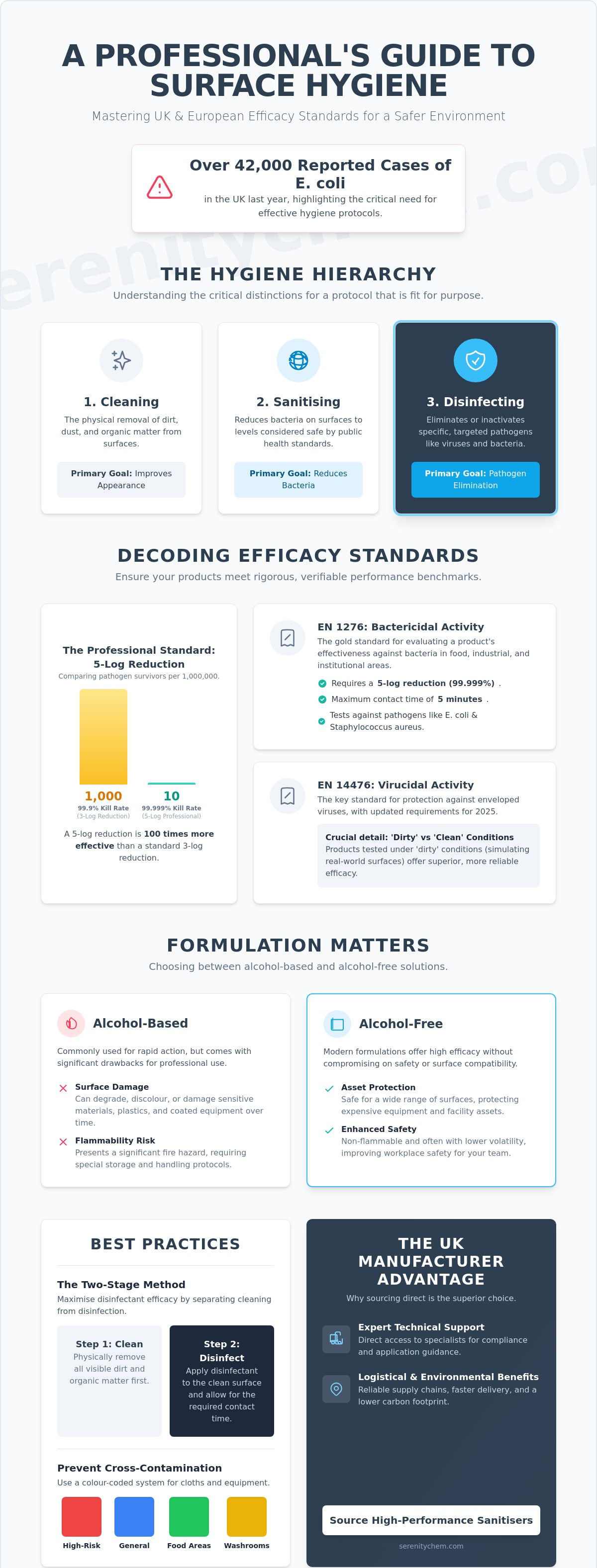
In the UK, the efficacy of a sanitiser isn't a matter of opinion or marketing flair. It's dictated by the European Norm (EN) system. These rigorous protocols ensure that when you use an antibacterial surface spray UK, it performs exactly as described under controlled conditions. Many high-street brands rely on the phrase "kills 99.9% of germs," but in a professional or healthcare setting, this is often insufficient. A 99.9% kill rate is a 3-log reduction, which sounds impressive until you realise it leaves 1,000 bacteria alive for every million present. Professional standards require a 5-log reduction, or 99.999%, which is a significantly higher threshold for safety.
Testing conditions are equally vital. Products are tested under either "clean" or "dirty" conditions. Dirty conditions involve adding organic matter like bovine albumin to the test to simulate a real-world, uncleaned surface. If a spray only passes under clean conditions, its efficacy may plummet the moment it hits a speck of dust or grease. Adhering to the National standards of healthcare cleanliness requires using formulations that have proven their worth against these challenging environments. For businesses, this means looking beyond the label and into the technical data sheets.
What is EN 1276 and Why is it Essential?
EN 1276:2019 is the quantitative suspension test for the evaluation of bactericidal activity. It's the gold standard for chemicals used in food, industrial, domestic, and institutional areas. To pass, a product must achieve a 5-log reduction in bacteria within a maximum contact time of five minutes. The test specifically targets resilient pathogens such as E. coli, Staphylococcus aureus, and Enterococcus hirae. If your current spray doesn't explicitly state EN 1276 compliance, it hasn't been verified to meet these professional bactericidal requirements.
Antiviral Protection and the EN 14476 Standard
Viruses require a different chemical approach than bacteria. EN 14476 is the standard for virucidal efficacy. With the EN 14476:2025 update becoming the national benchmark in April 2026, staying current is vital for compliance. You'll often see "limited virucidal" claims, which mean the product is effective against enveloped viruses like influenza. A "fully virucidal" claim indicates efficacy against non-enveloped viruses, which are much harder to kill. During winter months, ensuring your antibacterial surface spray UK meets these standards is a critical step in infection control. If you're unsure which standard your facility requires, we can provide technical advice on chemical compliance to help you choose with confidence.
Comparing Alcohol-Based vs Alcohol-Free Surface Disinfectants
Selecting the right antibacterial surface spray UK involves choosing between traditional alcohol-based formulations and modern alcohol-free alternatives. Alcohol-based disinfectants, typically containing 70% Isopropyl Alcohol (IPA) or Ethanol, are expected to hold a 42.7% share of the surface disinfectant market in 2026. Their primary advantage is speed; they evaporate quickly and kill many pathogens on contact. However, this rapid evaporation can be a double-edged sword. If the liquid vanishes too quickly, it might not maintain the wet contact time required to meet rigorous EN standards, potentially leaving resilient microbes behind.
Alcohol-free sprays, often formulated with Quaternary Ammonium Compounds (Quats), offer a different set of benefits that are increasingly valued in professional settings. These solutions are becoming the preferred choice in schools and healthcare environments where safety and surface longevity are paramount. Unlike alcohol, which can cause plastics to become brittle or damage the protective coatings on electronic screens and treated woods, alcohol-free options are generally non-corrosive. This compatibility makes them an excellent choice for protecting expensive facility assets whilst maintaining high hygiene standards.
The Benefits of Alcohol-Free Formulations
Safety is a significant factor in the shift towards alcohol-free solutions. Because these products are non-flammable, they are much safer to store in bulk and use near heat sources in commercial kitchens or laboratories. Their lower evaporation rate is a technical advantage; it ensures the surface remains wet long enough to achieve the necessary microbial kill rate. They are also much gentler on the skin of the user, reducing the risk of occupational dermatitis amongst cleaning staff. This focus on user well-being reflects a principled approach to facility management that doesn't sacrifice efficacy for convenience.
Understanding Residual Protection and Contact Times
A critical concept in professional hygiene is "contact time." This is the specific duration a surface must remain visibly wet with the chemical to ensure pathogens are eliminated. Whilst alcohol often dries in seconds, many EN-certified results require several minutes of exposure. This is where residual antibacterial surface spray technology provides a distinct advantage. Unlike "instant kill" products that stop working the moment they dry, residual formulations create a microscopic barrier that continues to inhibit microbial growth. Serenity Hard Surface Sanitiser is engineered specifically for this lasting efficacy, providing peace of mind between scheduled cleaning intervals. This ongoing protection is essential in high-traffic UK environments where surfaces are frequently re-contaminated throughout the day.
Best Practices for Effective Surface Sanitisation and Safety
Achieving a safe environment requires more than just purchasing a high-quality antibacterial surface spray UK; it demands a disciplined application method. Many users fall into the trap of a quick "spray and wipe" routine, which often fails to meet the technical requirements for pathogen elimination. With healthcare-associated infections (HCAIs) affecting approximately 1 in 13 patients in English hospitals, the necessity for a rigorous protocol is clear. Efficiency in cleaning is not about speed, but about the thoroughness of the process.
A core component of professional hygiene is the use of colour-coded cloths. This simple yet effective system prevents cross-contamination by ensuring that materials used in high-risk areas, like washrooms, never touch food preparation surfaces. Alongside this, every facility should maintain an easily accessible Safety Data Sheet (SDS) for every chemical in use. The SDS provides essential information on first aid, handling, and environmental hazards, ensuring that your team is protected whilst they work. Proper organisation of these documents is a hallmark of a principled and responsible business.
Step-by-Step Protocol for Professional Disinfection
To ensure your antibacterial surface spray UK delivers its promised efficacy, follow this four-step sequence:
- Step 1: Pre-clean. Use a detergent such as Serenity Multi-Surface Cleaner to remove visible debris, dust, and grease. Disinfectants cannot penetrate layers of grime effectively.
- Step 2: Apply liberally. Cover the entire surface with the sanitiser. Partial coverage leads to "hotspots" where bacteria can survive and multiply.
- Step 3: Observe contact time. Allow the product to remain wet on the surface for the full duration specified by the manufacturer. This is typically between 30 seconds and 5 minutes.
- Step 4: Wipe or air dry. Use a clean, dry cloth to remove any residue, or allow the surface to air dry if the product is a "no-rinse" formulation.
COSHH Compliance and Chemical Safety
UK employers have a legal obligation under the Control of Substances Hazardous to Health (COSHH) regulations to assess and limit the risks associated with chemical use. This involves identifying hazard symbols on labels, such as those for skin irritation or environmental toxicity. Proper storage is also vital; chemicals should be kept in a cool, dry place away from direct sunlight to maintain their shelf life and chemical stability. If you require assistance in establishing a compliant hygiene programme, you can contact our technical support team for expert guidance. Training staff on correct PPE, such as gloves and eye protection, is a non-negotiable step in maintaining a safe workplace.
Sourcing High-Performance Antibacterial Sprays Direct from a UK Manufacturer
Procuring your antibacterial surface spray UK through retail channels often results in higher costs and unnecessary packaging waste. For professional facilities, sourcing directly from a UK manufacturer provides a level of technical oversight and supply chain security that retail outlets cannot match. Direct procurement ensures that the formulations you receive are fresh and consistent; this is vital for maintaining the efficacy standards discussed in previous sections. By removing the middleman, your organisation gains access to specialist expertise and a transparent manufacturing process that prioritises both performance and safety.
UK-based manufacturing also offers a significant advantage in terms of technical support. When you have questions regarding EN compliance or surface compatibility, you can speak directly to the experts who formulated the product. This relationship fosters long-term trust and ensures that your hygiene protocols are supported by genuine chemical authority. In an era where supply chain disruptions are common, having a reliable domestic partner ensures your facility never runs short of essential sanitising solutions.
The Advantages of Buying Bulk Direct
Moving away from individual trigger sprays toward a bulk procurement model offers several operational benefits:
- Significant cost savings: Buying in 5L concentrates or bulk refills reduces the price per litre, providing better value for high-volume environments.
- Environmental responsibility: Using refillable containers and bulk sizes drastically reduces plastic waste, helping your business meet its sustainability targets.
- Supply chain reliability: Direct sourcing from a UK factory provides a more stable inventory, protecting your business from the fluctuations of international shipping.
Serenity Chemicals Limited: Ethical Manufacturing and Efficacy
Serenity Chemicals Limited operates as a principled expert in the UK hygiene market. Our Serenity Antibacterial Surface Spray is specifically engineered for professional applications where high-level disinfection is non-negotiable. We're committed to ethical manufacturing; this means our products are cruelty-free and produced with a focus on environmental sustainability. We don't just provide chemicals; we provide solutions that protect your staff and your surfaces without compromise.
Choosing a partner that aligns with your values is an essential part of facility management. It's important to choose an alcohol-free surface spray supplier in the UK that can provide the technical data sheets and certification proof you need for a compliant workplace. By selecting a manufacturer that values integrity and professional reliability, you can establish a hygiene protocol that is as responsible as it is effective.
Securing the Future of Your Facility Hygiene
Establishing a robust hygiene protocol is a continuous commitment to safety and professional integrity. By prioritising EN 1276 and EN 14476 compliance, you ensure your facility is protected against the most resilient pathogens whilst preserving the condition of your surfaces. Choosing a high-performance antibacterial surface spray UK provides the added benefit of residual protection, keeping high-traffic areas safer for longer between scheduled cleans. Moving toward a bulk-buy model from a domestic manufacturer doesn't just save costs; it secures your supply chain and reduces your environmental footprint.
Serenity Chemicals Limited has operated as a principled UK-based manufacturer since 2020. Our professional formulations are strictly tested to EN 1276 and EN 14476 standards, ensuring they deliver the technical performance your business requires. Because we value ethical responsibility, our entire range is cruelty-free and produced with sustainability at its core. Browse our range of UK-manufactured antibacterial surface sprays to secure a reliable, high-performance supply for your facility. With the right tools and a disciplined approach, you can maintain a cleaner, safer environment for everyone with complete peace of mind.
Frequently Asked Questions
Is antibacterial surface spray the same as disinfectant?
No, these terms represent different levels of microbial control. Antibacterial sprays are specifically formulated to target and reduce bacteria, whereas a disinfectant has a broader spectrum, killing viruses and fungi as well. When selecting an antibacterial surface spray UK for a commercial setting, it's vital to check the EN certifications to ensure the product meets the specific hygiene requirements of your industry.
Does antibacterial spray kill viruses like the flu?
An antibacterial spray will only kill viruses if it is also certified as a virucide under the EN 14476 standard. Standard antibacterial formulations are designed to eliminate 99.999% of bacteria but may be ineffective against viral pathogens like influenza. For comprehensive protection during cold and flu seasons, you should verify that your chosen product has been tested against enveloped viruses.
What does EN 1276 mean on a cleaning product label?
EN 1276 is the rigorous European standard for chemical disinfectants used in food, industrial, and institutional areas. It confirms that the product can achieve a 5-log reduction, killing 99.999% of bacteria within a specified contact time. This certification provides a guarantee of efficacy that simple marketing claims cannot match, ensuring the product is fit for professional use in the UK.
Can I use antibacterial spray on food preparation surfaces?
Yes, you can use these sprays on food surfaces provided they are labelled as food-safe and ideally "no-rinse." It is essential to follow the two-stage cleaning process by removing visible grease and debris before applying the sanitiser. Using a specialised product like Serenity Kitchen Sanitiser ensures that the formulation is effective against food-borne pathogens whilst remaining safe for areas where meals are prepared.
How long should I leave antibacterial spray on a surface?
You must leave the spray for the exact contact time stated by the manufacturer, which typically ranges from 30 seconds to 5 minutes. This duration is the time required for the chemical to penetrate and eliminate the targeted microbes. Wiping the surface dry too early is a common mistake that prevents the antibacterial surface spray UK from reaching its certified level of efficacy.
Is it better to buy antibacterial spray in bulk or individual bottles?
Bulk purchasing is the superior choice for professional environments as it offers significant cost savings and reduces environmental impact. Buying 5L concentrates to refill existing trigger bottles lowers the cost per litre and dramatically cuts down on single-use plastic waste. This approach also ensures a more consistent supply chain, which is a priority for businesses that value operational reliability and ethical responsibility.
Are alcohol-free surface sprays as effective as alcohol-based ones?
Alcohol-free sprays are just as effective as alcohol-based versions, provided they carry the same EN 1276 or EN 14476 certifications. Many alcohol-free formulations offer the added benefit of residual protection, continuing to inhibit microbial growth long after the surface has dried. They are also safer for use on sensitive materials like plastics and screens, which can be damaged by repeated exposure to high-strength alcohol.
What is the shelf life of a professional antibacterial spray?
Most professional-grade sprays have a shelf life of 12 to 24 months when stored correctly. To maintain the stability and efficacy of the active ingredients, you should keep the containers in a cool, dry place away from direct sunlight. Always check the "use by" date on the packaging, as chemicals can degrade over time, leading to a reduction in their ability to kill harmful pathogens.

Hand Hygiene in Food Preparation Areas: The 2026 Professional Guide
The Food Standards Agency estimates that foodborne illness costs the UK economy approximately £9 billion every year, with a s...

Sanitising Commercial Kitchen Hard Surfaces: The Professional UK Guide (2026)
Did you know that the average fine for food hygiene offences in the UK has more than tripled since 2016, now reaching over £7...