

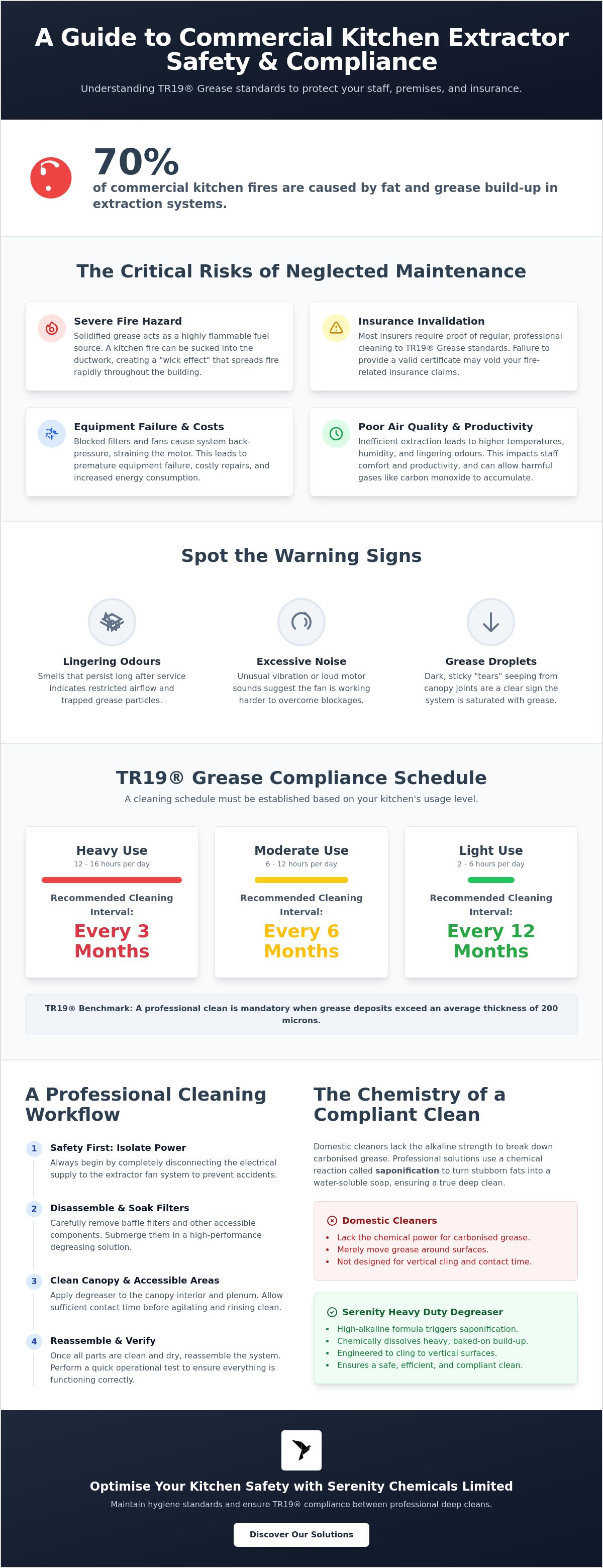
An estimated 70% of commercial kitchen fires are caused by the build-up of fat and grease in extraction and ventilation systems. For any head chef or facility manager, this isn't just a routine chore; it's a critical safety obligation. You likely understand the frustration of tackling stubborn, carbonised grease that standard cleaners simply won't shift. Learning how to clean commercial kitchen extractor fans correctly is essential to protect your premises and ensure your insurance remains valid in the event of a claim.
In this guide, we provide a professional workflow to help you master the technical process of maintaining your extraction system. We'll clarify the TR19® Grease regulatory requirements, including the 200-micron limit that dictates when a professional clean is mandatory. You'll discover how to select effective industrial solutions, such as Serenity Heavy Duty Degreaser, to maintain hygiene standards between scheduled deep cleans. From understanding UK fire safety laws to establishing a clear maintenance schedule, this article ensures your kitchen remains efficient, safe, and fully compliant.
Key Takeaways
- Understand the physics of grease accumulation and how cooling vapours create a significant fire risk within your ventilation system.
- Learn the science behind saponification and why industrial-grade alkaline degreasers are necessary to break down heavy carbonised build-up.
- Follow a professional workflow on how to clean commercial kitchen extractor fans, including safety isolation procedures and baffle filter soaking techniques.
- Establish a TR19-compliant maintenance schedule tailored to your kitchen’s specific usage levels to ensure legal and insurance compliance.
- Optimise your cleaning routine with high-performance solutions like Serenity Heavy Duty Degreaser to maintain a safe and efficient catering environment.
The Critical Role of Commercial Kitchen Extractor Maintenance
The extractor fan is the heartbeat of any professional kitchen. It isn't just a piece of metal above the stove; it's a sophisticated ventilation system responsible for removing smoke, heat, and airborne grease. Without it, the environment would quickly become uninhabitable. However, as these grease-laden vapours travel through the ductwork, they begin to cool. This cooling process causes the grease to solidify, coating the internal surfaces with a highly flammable fuel source. If left unmanaged, this build-up poses a severe risk of flash fires within the ducts, which can spread throughout the building in seconds.
Understanding Fire Safety and TR19 Standards
Compliance isn't optional for a professional establishment. TR19® Grease is the current UK standard for the internal cleanliness of ventilation systems, published by BESA. It provides specific benchmarks, such as the 200-micron limit, to manage fire risks effectively. When grease accumulates, it creates a "wick effect" during a kitchen fire. This means flames from the cooking surface can be sucked into the extraction system, where the grease acts as an accelerant. Most insurers now demand proof of regular commercial kitchen exhaust cleaning to honour any fire-related claims. If you cannot provide a post-clean report and a TR19 certificate, you might find your insurance void after an incident.
How do you know when it's time to investigate? Your staff will likely notice the signs before you do. Lingering odours that persist long after service ends are a common indicator that the airflow is restricted. You might also hear excessive noise or vibration from the motor, suggesting it's working harder than intended. A more visual warning sign is the appearance of grease "tears" or dark droplets seeping from the canopy joints. These are clear signals that the system is saturated. Understanding how to clean commercial kitchen extractor fans is the first step in addressing these issues before they lead to a total system failure.
Impact on Air Quality and Equipment Longevity
A clogged system does more than just smell; it damages your bottom line. When filters and fans are blocked, the system experiences back-pressure, which places immense strain on the motor. This leads to premature equipment failure and increased energy costs. Beyond the hardware, there is a human cost. Poor extraction efficiency results in higher temperatures and humidity, severely impacting staff thermal comfort and productivity. In extreme cases, inadequate ventilation allows carbon monoxide to accumulate in the workspace, creating a hazardous environment for your team. Regularly learning how to clean commercial kitchen extractor fans ensures your staff remain safe and your equipment lasts longer.
Selecting the Best Commercial Kitchen Degreaser for Heavy Carbon Build-up
Domestic dish soaps are formulated to tackle light oils and food residues on ceramic or glass. They lack the chemical strength required to penetrate the carbonised, baked-on grease found in industrial ventilation. When you are looking at how to clean commercial kitchen extractor fans, you must understand the chemistry of saponification. This is the process where a high-pH, alkaline chemical reacts with fats and oils to turn them into water-soluble soap. Without this reaction, you are merely moving grease around the surface rather than removing it. Professional-grade solutions like Serenity Heavy Duty Degreaser are specifically engineered to trigger this reaction, breaking the molecular bond between the grease and the stainless steel canopy.
Vertical surfaces present a unique challenge during the cleaning process. Unlike a floor or a soaking tray, gravity pulls liquid cleaners away from the grease before they can work. This is why "contact time" is a vital factor in successful maintenance. A professional degreaser must have the viscosity or surfactant profile to "cling" to the surface, allowing the alkaline agents to penetrate layers of build-up. Whilst TR19 is the UK authority, many global organisations also look toward NFPA 96 compliance as a benchmark for fire protection and grease management. Ensuring your chemical choice supports these high standards is the difference between a superficial wipe and a deep, compliant clean.
Heavy Duty vs. Multi-Surface Cleaners
Retail multi-surface sprays are often "ready-to-use" (RTU) formulations with high water content and low surfactant concentrations. These are ineffective against the 500-micron thick grease deposits that signify a critical fire risk. Industrial degreasers contain concentrated surfactants that lower the surface tension of water more effectively, allowing the cleaner to seep into microscopic cracks in the carbonised grease. The ideal pH range for an effective commercial kitchen degreaser typically sits between 12 and 14.
Safety and COSHH Considerations
Working with concentrated alkaline chemicals requires strict adherence to safety protocols. Personal Protective Equipment (PPE), including heavy-duty nitrile gloves and eye protection, is mandatory to prevent chemical burns. Under COSHH regulations, all cleaning chemicals must be stored in their original containers with legible safety data sheets (SDS) accessible to staff. For areas where water rinsing is difficult, choosing a no-rinse formulation can save significant labour time whilst maintaining hygiene. If you need guidance on selecting the right concentration for your specific setup, you can speak with our technical team for tailored advice on how to clean commercial kitchen extractor fans safely.
How to Clean Commercial Kitchen Extractor Fans: A Step-by-Step Guide
Executing a professional maintenance routine on your ventilation system requires a methodical approach. Safety is the primary concern. Before you begin, you must isolate the power supply to the fan to prevent accidental activation whilst you are working. It's also essential to secure the area by covering all cooking equipment and food preparation surfaces with heavy-duty plastic sheeting. This prevents cross-contamination from falling grease or chemical splashback during the process. Having a clear workspace allows you to focus on the technical details of the clean without risking the hygiene of your food service area.
Cleaning the Baffle Filters
Baffle filters are your first line of defence against grease accumulation. They are designed to "catch" grease by forcing air to change direction rapidly, causing the heavier grease particles to drop out of the air stream. Because of this, they clog more quickly than any other component. Once removed, place the filters into a soak tank filled with a solution of Serenity Heavy Duty Degreaser. We recommend a soak time of 2-4 hours for maximum grease emulsification, which allows the alkaline agents to penetrate the deepest layers of carbonised residue. After the filters are removed from the tank and rinsed, you should use food safe sanitisers on all adjacent prep areas to ensure the kitchen remains sterile and ready for service.
Accessing the Fan Blades and Housing
To reach the internal components of the system, you will often need to utilise access panels located along the ductwork. When you are learning how to clean commercial kitchen extractor fans, you'll find that the fan blades require a delicate but firm touch. Use a non-abrasive brush and a concentrated degreaser to remove film from the blades. We must warn against using high-pressure washers directly on electrical fan motors, as moisture ingress can cause immediate electrical failure. For thick, carbonised deposits that have hardened over time, employ the "scrape and spray" method. Use a plastic scraper to gently remove the bulk of the material before applying the chemical for a final deep clean. This ensures the fan remains balanced and operates at peak efficiency.
The final step in how to clean commercial kitchen extractor fans involves a thorough wipe-down of the interior housing and the canopy itself. Once all surfaces are clear of residual film, rinse the components with clean water and allow them to dry completely. Reassemble the system, ensuring all baffle filters are seated correctly in their tracks. A correctly seated filter ensures that grease is captured efficiently, protecting the ductwork from future build-up.
Establishing a Maintenance Schedule for TR19 Compliance
Adhering to the TR19® Grease standard requires more than occasional attention; it demands a structured schedule based on your kitchen's specific output. The frequency of a professional deep clean is determined by your daily cooking hours. For heavy-use kitchens operating between 12 and 16 hours a day, a professional TR19 certification clean is mandatory every three months. Moderate-use kitchens, typically open for 6 to 12 hours, require this service every six months, whilst light-use environments operating for 2 to 6 hours can extend the interval to 12 months. Understanding how to clean commercial kitchen extractor fans as part of an ongoing internal routine ensures you remain compliant between these professional visits.
Daily vs. Weekly Cleaning Tasks
Staff should perform basic maintenance tasks daily to prevent the rapid accumulation of flammable residues. At the end of every service, use a commercial multi-surface cleaner to wipe down the exterior canopy surfaces. This prevents grease from hardening and becoming carbonised. On a weekly basis, the focus should shift to the baffle filters and grease drawers. These components should be removed and degreased using the soak method described in previous sections. Monthly inspections are also advisable to check the fan motor and drive belts for signs of wear or grease ingress, ensuring the system continues to operate at peak efficiency without straining the hardware.
Record Keeping for Health Inspectors
A "Cleaning Log" is a vital document for any professional kitchen. It serves as tangible proof of due diligence when Environmental Health Officers (EHOs) or fire safety inspectors visit your premises. This log should record the date of every filter clean, canopy wipe-down, and professional ductwork inspection. To support your COSHH audits, it is also beneficial to maintain a professional cleaning chemicals list. This demonstrates that you are using appropriate, industrial-grade solutions like Serenity Heavy Duty Degreaser rather than inadequate domestic products. A clean kitchen is not just about passing inspections; it creates a safer, more productive environment for your staff by improving air quality and reducing fire hazards.
Establishing these routines reduces the volume of grease that reaches the internal ductwork, making the eventual professional deep clean more effective. If you are unsure which chemicals best suit your specific kitchen volume, you can contact our technical advisors for a tailored maintenance consultation. Mastering how to clean commercial kitchen extractor fans through a consistent schedule is the most reliable way to protect your business, your staff, and your insurance validity.
Optimising Kitchen Safety with Serenity Chemicals Limited
Serenity Chemicals Limited operates as more than a simple vendor; we position ourselves as a dedicated partner for high-performance catering hygiene. Our approach is rooted in a sense of ethical responsibility, ensuring that the solutions we provide are as safe for your staff as they are effective against grease. We recognise that the technical process of how to clean commercial kitchen extractor fans requires precision and trust. By choosing a partner with a principled focus on safety, you gain the peace of mind that your maintenance routine is supported by professional-grade chemistry. The commitment to integrity from Serenity Chemicals Limited means we prioritise the long-term well-being of your kitchen environment over aggressive sales tactics.
The British manufacturing heritage of Serenity Chemicals Limited is a cornerstone of our identity. By maintaining a direct-to-business supply chain, we eliminate unnecessary intermediaries, ensuring that you receive the most reliable service and consistent product quality. This model allows us to focus on the integrity of our formulations, prioritising efficacy and transparency. For commercial catering operations, buying in bulk isn't just a matter of convenience; it's a strategic move to ensure your cleaning schedule is never interrupted by supply shortages. Using concentrated formulas also reflects a responsible approach to business, reducing packaging waste and lowering the carbon footprint associated with frequent deliveries.
Why Sourcing Direct from a UK Manufacturer Matters
Reliability is paramount in a fast-paced kitchen environment. Sourcing from a cleaning products manufacturer in the UK provides a level of security that international supply chains often lack. You have direct access to technical support for complex cleaning challenges, such as identifying the correct dilution rates for heavily soiled fan blades or navigating COSHH requirements. Industrial-strength concentrates from Serenity Chemicals Limited offer significant cost-efficiency, as they allow you to create powerful cleaning solutions from a single container, reducing both plastic waste and overall expenditure. This methodical approach to sourcing ensures your kitchen remains stocked with the precise tools needed for TR19 compliance.
Next Steps for Your Kitchen Hygiene Strategy
We encourage you to conduct a comprehensive audit of your current cleaning chemicals and protocols. Evaluate whether your existing products possess the high-pH properties required to trigger saponification in baked-on grease, as discussed in our earlier sections. If you find your current routine is falling short, suggest a trial of Serenity Heavy Duty Degreaser on your most stubborn grease spots. This allows you to witness the efficacy of our professional formulations first-hand and understand why a principled choice in chemistry matters for your facility's safety.
Mastering how to clean commercial kitchen extractor fans is a fundamental part of protecting your business from fire risks and ensuring your insurance remains valid. A professional approach to hygiene doesn't just satisfy health inspectors; it fosters a culture of care and safety throughout your entire team. When you're ready to upgrade your maintenance workflow with dependable, UK-manufactured solutions, our team at Serenity Chemicals Limited is ready to provide the guidance you need. Explore our full range of commercial kitchen chemicals to find the professional tools your establishment deserves.
Securing Your Kitchen’s Operational Future
Adopting a professional approach to ventilation hygiene transforms a daunting maintenance task into a streamlined, manageable process. Throughout this guide, we've provided the technical roadmap for maintaining your system, from selecting high-pH alkaline agents to implementing a TR19-compliant schedule. Understanding the nuances of how to clean commercial kitchen extractor fans allows you to move beyond reactive fixes and toward a proactive safety culture. This diligence not only satisfies regulatory inspections but also ensures the long-term efficiency of your equipment and the well-being of your culinary team.
As a dedicated UK-based chemical manufacturer, Serenity Chemicals Limited provides the industrial-strength tools necessary to sustain these standards. Our solutions are specifically formulated for the rigours of industrial catering environments, with COSHH-compliant technical data sheets provided to ensure your safety audits remain impeccable. By choosing principled expertise over domestic alternatives, you secure the peace of mind that comes from total compliance. Browse our Professional Heavy Duty Degreasers to equip your kitchen with the reliability of Serenity Chemicals Limited. Taking control of your extraction hygiene today ensures a safer, more productive environment for your business tomorrow.
Frequently Asked Questions
How often should commercial kitchen extractor fans be cleaned by law?
The frequency of cleaning is determined by your kitchen's daily usage as defined under the TR19® Grease specification. Heavy-use kitchens operating 12 to 16 hours daily require a professional clean every three months. Moderate-use kitchens (6 to 12 hours) need cleaning every six months, whilst light-use environments (2 to 6 hours) must be cleaned at least every 12 months. These intervals are essential to satisfy the Regulatory Reform (Fire Safety) Order and maintain insurance validity.
Can I clean a commercial extractor fan myself or do I need a professional?
You can perform routine daily and weekly maintenance yourself, but a qualified professional must carry out the periodic deep cleans required for TR19® Grease certification. Technicians should hold the BESA Grease Hygiene Technician (GHT) qualification to ensure the system meets the 50-micron post-clean standard. Whilst staff can manage surface hygiene, only a certified professional can provide the documentation required by most insurance providers to prove due diligence.
What is the best chemical for removing heavy grease from kitchen fans?
An industrial-grade alkaline degreaser with a pH between 12 and 14 is the most effective solution for breaking down carbonised grease. Serenity Heavy Duty Degreaser is specifically formulated for this task, using concentrated surfactants to trigger saponification. This chemical process turns stubborn grease into water-soluble soap, making it much easier to rinse away. You should avoid domestic soaps, as they lack the strength to penetrate thick industrial deposits.
What happens if I do not clean my extractor fan according to TR19?
Neglecting TR19® Grease standards significantly increases your fire risk, as grease build-up acts as a highly flammable fuel source. If a fire occurs and you cannot produce a valid TR19 certificate, your insurance provider is likely to reject the claim. Additionally, the "Responsible Person" for the premises can face legal action under UK fire safety laws for failing to manage known hazards effectively, leading to potential fines or closure.
Is it safe to use a pressure washer on an extractor fan?
It's generally unsafe to use a pressure washer directly on the electrical components of an extractor fan motor. High-pressure water can penetrate the motor housing, leading to immediate electrical failure or long-term corrosion. Instead, use a non-abrasive brush and a concentrated degreaser to clean the fan blades manually. Pressure washers should only be used on detached components like baffle filters or non-electrical housing parts that have been removed from the system.
What are the signs that my extractor fan motor is failing due to grease?
Common signs of failure include excessive vibration, unusual grinding noises, and a noticeable drop in suction power. When grease accumulates on the fan blades, it causes an imbalance that strains the motor and bearings. You might also notice lingering cooking odours or visible grease "tears" seeping from the canopy joints. These symptoms indicate that the system is struggling and requires an immediate deep clean to prevent a total mechanical breakdown.
Do I need to clean the ductwork as well as the fan?
Yes, the entire extraction system, including the ductwork, must be cleaned to remain TR19® Grease compliant. Cleaning only the fan or filters leaves a significant fire risk in the hidden sections of the ducts where grease vapours cool and solidify. A professional service will access these areas through dedicated panels to ensure grease deposits remain below the average 200-micron limit across the whole system. Regular maintenance is the only way to avoid how to clean commercial kitchen extractor fans becoming a reactive emergency.
How do I dispose of the grease and chemicals after cleaning?
You must dispose of grease and chemical waste in accordance with local water authority regulations and environmental laws. Large volumes of grease should never be poured directly down the drain; instead, they should be collected and disposed of by a licensed waste carrier. When learning how to clean commercial kitchen extractor fans, ensure your facility has a functioning grease trap to capture smaller residues during the rinsing process. Proper disposal protects the local environment and prevents costly blockages in your drainage system.

Hand Sanitiser for Frequent Use: Professional UK Guide 2026
The very product you use to protect your health might be the primary cause of your skin's deterioration. While alcohol-based ...

Food Safe Antibacterial Spray UK: The Professional 2026 Hygiene Guide
Using the wrong disinfectant in a commercial kitchen isn't just a minor oversight; it's a direct threat to your Food Hygiene ...