

Could a single misplaced chemical residue be just as damaging to your reputation as the bacteria it’s meant to kill? In a high-pressure environment, the balance between absolute sterility and food integrity is incredibly delicate. You likely feel the weight of responsibility that comes with every Environmental Health Officer visit, especially as inspectors now place greater scrutiny on the coherence of digital HACCP records and the specific standards of your cleaning agents. Selecting the correct food safe sanitiser for commercial kitchens is no longer just about killing germs; it's about ensuring that your antimicrobial efficacy doesn't come at the cost of a tainted signature dish.
We understand that navigating the technicalities of BS EN 13697:2023 and EN 1276:2019 can be confusing when you're focused on service. This guide promises to simplify these complex standards, showing you exactly how to achieve the mandatory 99.999% bacterial reduction while maintaining full compliance with UK food safety regulations. We'll examine the essential criteria for professional-grade sanitisers, the importance of zero-residue integrity, and how to refine your cleaning routines to eliminate cross-contamination risks for good.
Key Takeaways
- Learn how to distinguish between standard cleaning and professional sanitisation by mastering the technical requirements of EN 1276 and BS EN 13697:2023.
- Discover the most efficient application methods for a food safe sanitiser for commercial kitchens, balancing ready-to-use sprays for prep areas with concentrated solutions for large surfaces.
- Understand how to integrate high-performance sanitisers into your formal HACCP plan to ensure total compliance and confidence during Environmental Health inspections.
- Identify the essential role of colour-coded equipment and correct contact times in preventing cross-contamination whilst protecting your kitchen's reputation.
- Explore the operational advantages of sourcing British-manufactured hygiene solutions from Serenity Chemicals to guarantee supply chain traceability and product integrity.
What is a Food Safe Sanitiser for Commercial Kitchens?
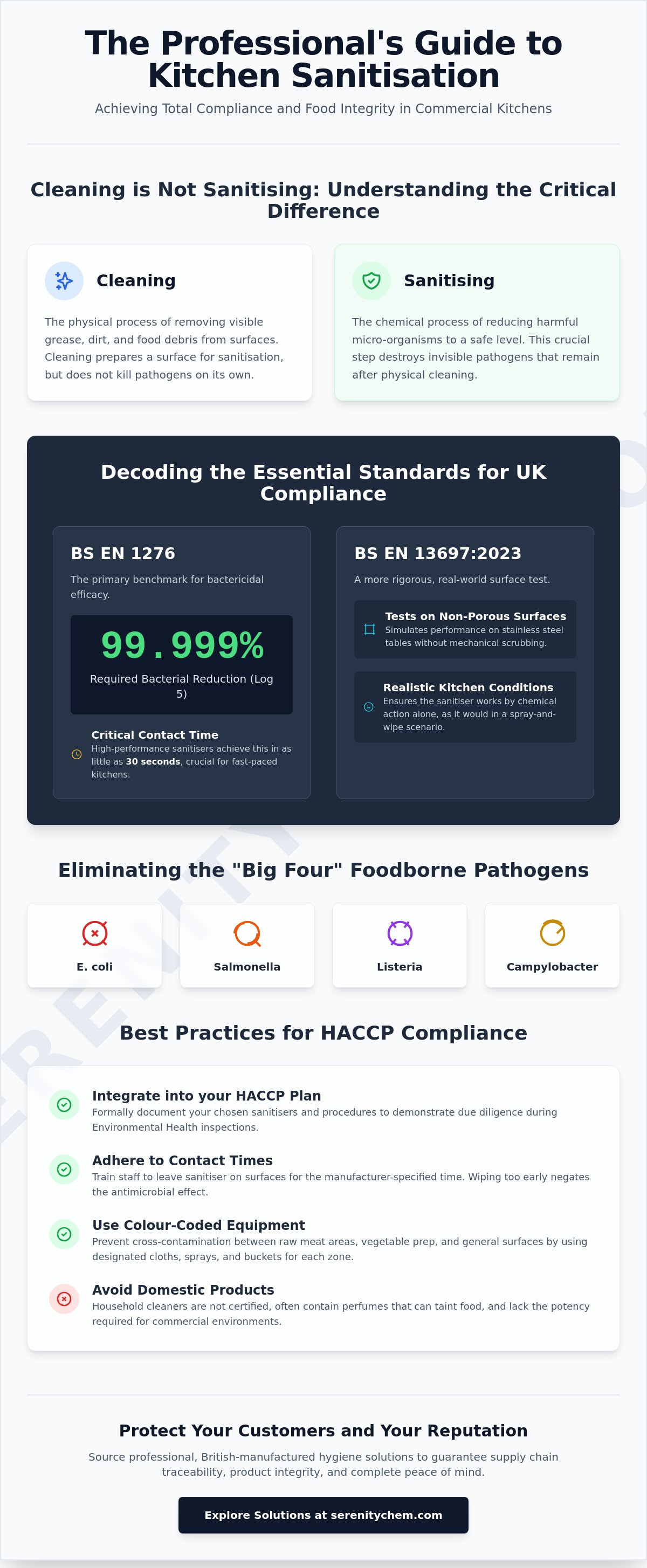
In a professional catering environment, a sanitiser isn't just another cleaning fluid; it's a critical safety barrier. A professional food safe sanitiser for commercial kitchens is defined as a non-tainting, fragrance-free antimicrobial solution designed to reduce micro-organisms to a safe level. Unlike general-purpose cleaners, these products specifically target the "Big Four" foodborne pathogens: E. coli, Salmonella, Listeria, and Campylobacter. These bacteria are the primary culprits behind food poisoning outbreaks in the UK, making their elimination a top priority for any kitchen manager.
It's vital to distinguish between the acts of cleaning and sanitising. Cleaning involves the physical removal of grease, dirt, and food debris. Sanitising, however, is the chemical process of destroying pathogens that remain on a surface after it physically looks clean. To understand the broader context of these chemical agents, one might ask, What is a Food Safe Sanitiser for Commercial Kitchens? In technical terms, it is a specialist disinfectant formulated to be safe for surfaces that come into direct contact with ingredients, ensuring that no harmful residues are left behind.
Domestic cleaning products consistently fail to meet the rigour of a high-volume professional kitchen. Household sprays often rely on high water content and pleasant fragrances that can easily migrate into food, ruining the flavour profile of your menu. Professional solutions, such as Serenity Kitchen Sanitiser, are engineered for high-frequency use where speed and antimicrobial reliability are paramount. They provide the concentrated power needed to maintain safety without the risk of "chemical taint" that lesser products often cause.
The Difference Between Sanitisers and Standard Disinfectants
Standard disinfectants often rely on strong scents or heavy chemical dyes to signal "cleanliness" to the user. In a commercial kitchen, these traits are liabilities. A true food-safe formulation is often "rinse-free," allowing chefs to wipe down prep stations and continue working immediately. This efficiency is essential in fast-paced environments. Because these sanitisers leave only non-toxic residues, they ensure that food integrity is never compromised, even during the busiest service periods.
Why "Food Safe" is a Non-Negotiable Standard
UK food law is uncompromising regarding chemical safety. Using non-compliant chemicals isn't just a risk to public health; it's a legal liability that can lead to heavy fines or immediate closure. During an EHO inspection, the officer will verify that your chemicals meet specific EN standards. By using a dedicated food safe sanitiser for commercial kitchens, you demonstrate a principled "due diligence" defence. This choice shows you've taken every professional step to protect your customers and your brand's reputation.
Essential Standards: Understanding EN 1276 and EN 13697
Selecting a food safe sanitiser for commercial kitchens involves looking beyond the marketing claims on the bottle. You must verify that the product meets specific European and British standards to ensure it actually performs under pressure. According to the Food Standards Agency, Essential Standards: Understanding EN 1276 and EN 13697 are the pillars of effective hygiene management. BS EN 1276 is the primary benchmark, requiring a product to achieve a 99.999% reduction in bacteria (known as a Log 5 reduction) within a specified contact time.
Contact time is the duration the chemical must remain wet on the surface to be effective. Whilst some sanitisers require five minutes, high-performance formulations often achieve results in just 30 seconds. This difference is vital for kitchen throughput. If your staff wipe a surface too early, they've only cleaned it, not sanitised it. For a food safe sanitiser for commercial kitchens to be truly effective, it must be used in strict accordance with the manufacturer's tested contact times.
BS EN 13697:2023 provides a more rigorous assessment than suspension tests alone. This standard evaluates how the chemical performs on non-porous surfaces, such as stainless steel prep tables, without any scrubbing or mechanical action. It's a realistic simulation of how a spray actually sits on a surface during a busy shift. Relying on products that pass both EN 1276 and EN 13697 ensures that your sanitisation routine is backed by the highest level of laboratory verification.
Deciphering Efficacy Ratings for Catering Environments
When checking product labels, look for testing under "dirty conditions." These tests prove the sanitiser works even when traces of organic matter are present, whereas "clean conditions" assume a perfect pre-clean. EN 1276 is the benchmark for chemical performance in UK kitchens. If you are reviewing your current protocols and need advice on standard compliance, you can contact our technical team for a detailed specification review.
The Critical Importance of Fragrance-Free Formulations
A common mistake in professional catering is using scented disinfectants. Fragrances like lemon or pine contain volatile compounds that chemically migrate into high-fat foods such as butter, cream, or fresh fish. This olfactory taint can ruin the sensory quality of your dishes and lead to customer complaints. Serenity sanitisers are formulated to be completely odourless, ensuring that the only thing your customers smell is the food you've prepared. This commitment to purity protects both the integrity of your menu and your brand's reputation for quality.
Comparing Sanitisation Methods: Concentrates vs. Ready-to-Use
Choosing the most effective format for your food safe sanitiser for commercial kitchens depends on the specific demands of your workspace. Ready-to-use (RTU) trigger sprays are excellent for high-turnover prep stations and immediate spot-cleaning. They remove the risk of incorrect dilution, which is a common reason for failed hygiene audits. For large-scale tasks like cleaning floors or tiled walls, concentrated solutions provide a more logical choice. They offer a higher degree of flexibility for different cleaning intensities whilst keeping stock levels manageable.
Handling undiluted concentrates requires a disciplined approach to safety. These chemicals are highly potent and must be managed under strict COSHH guidelines to protect your team. We recommend using dedicated decanting areas and clear labelling to prevent accidents. Integrating a professional no-rinse food-safe sanitiser into these systems ensures that your workflow remains efficient, as these products are designed to be safe for food-contact surfaces without the need for a secondary water wash.
In a busy environment, the convenience of a pre-mixed spray can't be overstated. It allows chefs and kitchen porters to react instantly to spills or between different food prep tasks. However, the economic benefits of concentrates are significant for back-of-house deep cleaning. By using both formats strategically, you can maintain a high standard of hygiene without overstretching your cleaning budget or compromising on safety protocols.
The Efficiency of No-Rinse Solutions
No-rinse technology is a significant asset in a busy catering environment. It halves the time required for sanitising surfaces because there's no need to rinse with potable water after the chemical has been applied. This saves labour and reduces water consumption. Surfaces can be left to air-dry, which is often safer than using potentially contaminated cloths. This approach supports a robust "clean-as-you-go" policy, ensuring work surfaces remain bacteriologically safe throughout the day.
Cost-Effectiveness and Environmental Impact
The economic profile of concentrates is compelling for larger operations. When you compare the price-per-litre of a diluted concentrate to a pre-filled spray, the savings are substantial. Bulk buying also has a positive environmental impact; it reduces plastic waste and the carbon footprint of frequent shipping. To maximise results, follow the Food Standards Agency guidance on effective cleaning. Using automatic dosing systems can prevent chemical wastage, ensuring every drop of your food safe sanitiser for commercial kitchens is used correctly. This methodical approach to chemical management supports both your budget and your commitment to high hygiene standards.
Best Practices for Kitchen Sanitisation and HACCP Compliance
Integrating your food safe sanitiser for commercial kitchens into a formal HACCP plan is a legal necessity under UK law. This isn't just about having the right chemicals on the shelf. It's about documenting exactly where, when, and how they're applied to control biological hazards. Environmental Health Officers expect to see that your sanitisation procedures are a deliberate part of your food safety management system. This includes maintaining up-to-date Safety Data Sheets (SDS) for every product in your store cupboard. These documents must be easily accessible to all staff to ensure they understand the hazards and first-aid measures associated with the chemicals they use daily. Proper SDS management ensures you're prepared for emergency situations, providing peace of mind for both management and the team.
Practical organisation is equally important. Colour-coded cleaning equipment is the most effective way to prevent cross-contamination between high-risk areas like raw meat prep and low-risk zones like the pass. By assigning specific colours to different zones, you create a visual system that's easy for staff to follow even during the busiest shifts. This reduces the cognitive load on your team and ensures that a cloth used in the washroom never finds its way onto a food preparation surface.
Two-Stage Cleaning: The Industry Gold Standard
The Food Standards Agency (FSA) emphasises a two-stage approach to surface hygiene. You can't sanitise a surface that's physically dirty. First, use a heavy-duty degreaser to remove grease, proteins, and organic matter. Grease acts as a physical shield for bacteria, protecting them from the sanitiser's active ingredients. Once the surface is visibly clean and rinsed, you then apply your food safe sanitiser for commercial kitchens. This second stage is what actually kills the remaining pathogens and ensures the surface is bacteriologically safe for food preparation.
Contact Time: The Most Overlooked Factor in Food Safety
Contact time, or dwell time, is the period a sanitiser must remain wet on a surface to achieve its certified kill rate. A common mistake is the "spray and wipe" method, where the chemical is removed almost immediately. This behaviour often fails to kill resilient pathogens like Listeria. To ensure compliance, implement a simple verification checklist:
- Identify the specific contact time on the product label before starting.
- Use a timer or "count-down" method for high-risk prep surfaces.
- Train staff to recognise that a sanitiser only works if it remains wet on the surface for its certified duration.
If you need help developing a compliant cleaning schedule for your facility, you can request a consultation with our hygiene experts to review your current documentation and chemical requirements.
Sourcing Kitchen Sanitisers from a UK Manufacturer
Sourcing your food safe sanitiser for commercial kitchens directly from a UK manufacturer like Serenity Chemicals provides a level of traceability that third-party distributors often cannot match. By choosing British-made solutions, you significantly reduce the carbon footprint associated with international shipping whilst ensuring a more resilient supply chain. In an era where global logistics can be unpredictable, having a domestic source for your essential hygiene chemicals provides operational security. It allows you to focus on your culinary service rather than worrying about stock shortages or delayed imports.
Our commitment to quality extends beyond mere antimicrobial efficacy. Every product in our range is developed with a sense of ethical responsibility, focusing on cruelty-free formulations that don't compromise on professional strength. This principled approach ensures that your kitchen's hygiene standards align with modern ethical expectations. It protects your brand's integrity alongside your customers' health, providing a transparent audit trail from the laboratory to your prep station.
The Benefits of Direct Supply and Technical Expertise
Direct sourcing removes the unnecessary markups associated with middlemen, offering better value for your hygiene budget. It also grants you direct access to the technical experts who understand the chemical properties of the products best. This is invaluable when you require specific COSHH support or advice on which food safe sanitiser for commercial kitchens is best suited for specific high-grade surfaces. As a seasoned authority in the industry, we provide the documentation and guidance needed to navigate complex safety regulations with quiet confidence.
Ensuring Long-Term Hygiene Partnership
Transitioning from a transactional buyer to a strategic hygiene partner allows for more cohesive safety management across your entire facility. This partnership extends beyond surface care to encompass total kitchen hygiene, including the provision of alcohol-free hand sanitisers that protect staff skin health during frequent washing cycles. By consolidating your supplies with a single trusted manufacturer, you ensure consistency in both application methods and safety documentation. This methodical approach simplifies training and guarantees that your hygiene standards remain impeccable year after year. View the Serenity Kitchen Sanitiser range here to begin building a more reliable and responsible hygiene protocol for your business.
Securing the Future of Your Kitchen Hygiene
Maintaining a professional kitchen requires a meticulous balance of speed and safety. You've learned that true hygiene isn't just about a surface looking clean; it's about the verified bactericidal performance of your chemicals. By adhering to the rigorous BS EN 13697:2023 standards and implementing a disciplined two-stage cleaning routine, you protect both your customers and your business's reputation. Selecting a high-quality food safe sanitiser for commercial kitchens ensures that you meet these legal obligations without risking the flavour integrity of your menu.
Our UK-manufactured formulations are specifically designed for the catering industry, offering EN 1276 certification and fragrance-free peace of mind. These solutions provide the technical reliability you need to pass Environmental Health inspections with confidence. If you're ready to upgrade your hygiene protocols with ethical, high-performance chemicals, we're here to help you make the transition. Browse our range of professional food-safe sanitisers at Serenity Chemicals to find the right solution for your facility. We look forward to supporting your commitment to excellence in food safety.
Frequently Asked Questions
Is it safe to use a kitchen sanitiser on food preparation surfaces without rinsing?
Yes, provided the product is specifically labelled as a "no-rinse" formulation. These professional solutions are designed to air-dry, leaving only non-toxic residues that don't compromise the safety or integrity of your ingredients. You must ensure the surface is physically clean and free of grease before application for the sanitiser to be effective.
What is the difference between a detergent and a food-safe sanitiser?
A detergent is a cleaning agent designed for the physical removal of grease, dirt, and organic matter. It doesn't have the chemical properties required to kill bacteria. In contrast, a food safe sanitiser for commercial kitchens is formulated specifically to reduce micro-organisms to a safe level. For total hygiene, you must use a detergent to clean the surface first, followed by a sanitiser to disinfect it.
Does a food-safe sanitiser kill viruses like Norovirus and SARS-CoV-2?
Many kitchen sanitisers are primarily bactericidal, meaning they're tested against pathogens like E. coli and Salmonella. To confirm efficacy against viruses, you must check the label for the EN 14476 standard. Whilst a standard EN 1276 sanitiser is essential for food safety, a viricidal product is required if your objective is to eliminate viral hazards specifically.
How often should I sanitise high-touch surfaces in a commercial kitchen?
High-touch surfaces such as fridge handles, taps, and light switches should be sanitised at least every four hours. During peak service times, increasing this frequency is a principled step to prevent cross-contamination. Your specific sanitisation intervals should be clearly documented in your HACCP plan to demonstrate due diligence during inspections.
Can I use the same sanitiser for both front-of-house and back-of-house areas?
You can certainly use a high-quality kitchen sanitiser for front-of-house surfaces like dining tables and bar tops. Because these products are fragrance-free, they won't leave behind chemical scents that interfere with the customer's dining experience. It's often more efficient to use a single, high-specification product across all food-contact areas to simplify staff training.
What should I look for on a label to ensure a sanitiser is EN 1276 compliant?
Look for the "EN 1276" mark alongside a specified contact time, such as 30 seconds or 60 seconds. The label should also confirm a 99.999% bacterial kill rate, often referred to as a Log 5 reduction. Verified compliance ensures the product has passed rigorous suspension tests using common foodborne pathogens in a laboratory environment.
Will using a food-safe sanitiser affect the taste or smell of my food?
A professional food safe sanitiser for commercial kitchens is specifically formulated to be non-tainting and odourless. Unlike domestic cleaners that use heavy perfumes like lemon or pine, these products won't leach volatile organic compounds into high-fat foods. This protects the sensory quality of your dishes whilst maintaining the highest hygiene standards.
How do I store commercial kitchen sanitisers safely according to COSHH?
Store all chemicals in a dedicated, secure area that's separate from food storage and preparation zones. Keep containers tightly sealed and ensure they're stored at a height that prevents accidental spills from contaminating other supplies. You must also keep the relevant Safety Data Sheets (SDS) in a folder nearby so they're immediately accessible for staff training or in an emergency.

Hand Hygiene in Food Preparation Areas: The 2026 Professional Guide
The Food Standards Agency estimates that foodborne illness costs the UK economy approximately £9 billion every year, with a s...

Sanitising Commercial Kitchen Hard Surfaces: The Professional UK Guide (2026)
Did you know that the average fine for food hygiene offences in the UK has more than tripled since 2016, now reaching over £7...