

To meet the rigorous BS EN 1276 standard, a professional disinfectant must eliminate 99.999% of bacteria within a five-minute contact time, yet many people wipe surfaces dry in just seconds. This common mistake often leaves invisible pathogens behind, creating a false sense of security in your workplace. You likely want to maintain the highest hygiene standards, but the fear of using harsh chemicals that might damage delicate equipment can make the process feel like a minefield. It's exhausting to manage frequent cleaning schedules whilst worrying if your efforts are truly effective or merely surface-level.
Mastering how to disinfect high-touch surfaces doesn't have to be a source of stress. By following a principled two-step method, you can ensure a safe, compliant environment that protects both people and property. This guide provides a clear, repeatable protocol for identifying critical touchpoints and explains exactly which UK standards, such as the new August 2026 CLP labelling requirements, you should look for on your product labels. We'll walk you through a structured approach to reduce cross-contamination risks and streamline your hygiene routine for professional results.
Key Takeaways
- Identify critical communal touchpoints like lift buttons and door handles by assessing contact frequency and user volume within your facility.
- Master the professional two-step method to ensure organic matter is removed before disinfection for a truly hygienic and compliant finish.
- Learn how to disinfect high-touch surfaces using solutions that comply with BS EN 1276 standards for verified bactericidal activity.
- Establish effective protocols including frequency cycles and colour-coded equipment to eliminate the risk of cross-contamination between different zones.
- Find out how professional-grade products like Serenity Antibacterial Surface Spray provide rapid and reliable protection in demanding commercial environments.
Identifying High-Touch Surfaces in Your Environment
Effective hygiene protocols begin with a thorough audit of your surroundings. A "high-touch" surface is defined by both the frequency of contact and the volume of different individuals handling it. Whilst a personal laptop might be touched hundreds of times a day, it's generally lower risk than a communal lift button used by fifty different people. Identifying these hotspots is the essential first step in learning how to disinfect high-touch surfaces with professional precision.
Common communal touchpoints include door handles, light switches, and lift buttons. These are the primary transit points for pathogens in any building. Beyond these obvious areas, shared technology presents a unique challenge. Keyboards, mice, touchscreen interfaces, and desk phones often harbour significant bio-burden because they're handled frequently but often overlooked during routine cleaning. In kitchens and washrooms, kettle handles, taps, and soap dispensers are critical hotspots that require consistent attention to prevent the rapid spread of germs across an entire team or household.
Categorising Surfaces by Risk Profile
Not all surfaces carry the same level of risk, and your protocol should reflect that. Personal workstations don't usually require the same disinfection frequency as communal transit zones or shared breakrooms. You should also look for "hidden" high-touch areas that people handle unconsciously, such as cupboard handles, chair arms, and the edges of shared tables. The material of the surface also dictates the approach. Non-porous materials like stainless steel or plastic allow a Disinfectant to remain wet on the surface for the required contact time, ensuring maximum efficacy.
High-Touch Points in Commercial vs Domestic Settings
The environment dictates the disinfection schedule. In a commercial setting, you must focus on shared printers, meeting room tables, and vending machines. These items see high turnover and require a protocol that matches the volume of foot traffic. For instance, in healthcare or high-traffic office environments, professional standards suggest high-touch surfaces should be addressed every two to four hours to maintain safety.
In domestic settings, the focus shifts to items like remote controls, fridge handles, and stair banisters. Whilst the user volume is lower, the frequency of contact remains high, making them key targets for cross-contamination. Regardless of the setting, the goal is to create a repeatable routine. Matching your disinfection frequency to the actual usage cycles of the room ensures you're protecting users without wasting time on low-risk areas.
The Professional Two-Step Method: Clean First, Disinfect Second
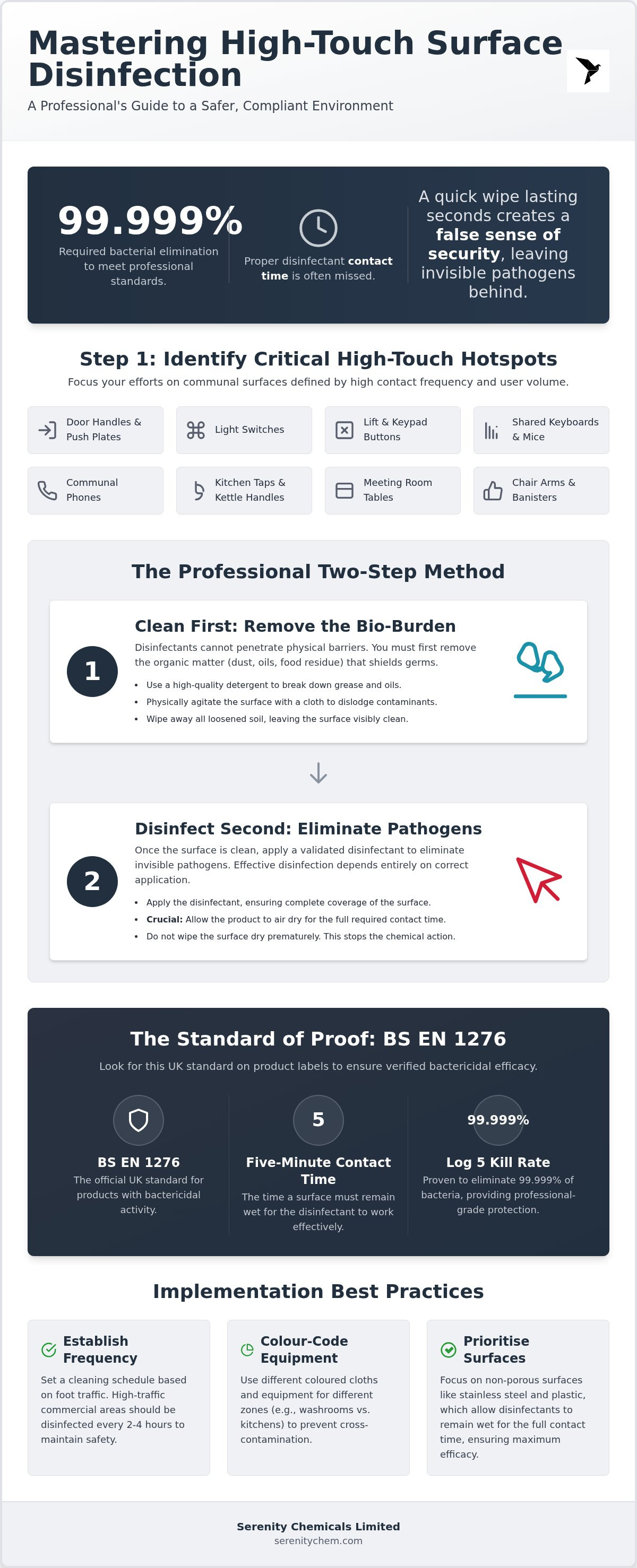
Disinfection is only as effective as the preparation preceding it. If you apply antimicrobial agents to a surface covered in dust, skin oils, or food residue, you're essentially wasting your resources. This layer, known as "bio-burden," acts as a physical shield that allows pathogens to survive underneath the chemical application. To truly master how to disinfect high-touch surfaces, you must adopt the professional two-step method: cleaning first to remove soil, followed by disinfection to eliminate germs.
Detergents are essential in this first stage because they break down the oils and organic matter that water alone cannot shift. By removing this barrier, you ensure that the disinfectant makes direct contact with the surface material. This approach is supported by the CDC guide to cleaning and disinfecting, which emphasises that physical cleaning reduces the microbial load and prepares the area for effective sanitisation. Following a structured workflow is the most reliable way to maintain safety:
- Apply a high-quality cleaner to the target area.
- Agitate the surface with a cloth to dislodge contaminants.
- Wipe away the loosened soil and any remaining residue.
- Apply the validated disinfectant and allow it to air dry for the full contact time.
Step 1: Removing Visible Soil and Bio-Burden
For the initial cleaning phase, using a professional product like Serenity Multi-Surface Cleaner ensures that grease and grime are lifted efficiently. Mechanical action is vital here; you shouldn't rely on a simple "spray and wipe" technique for heavily used areas. Scrubbing the surface physically dislodges stubborn biofilms that can harbour bacteria. Once the surface is visually clean and free from tactile residue, it's ready for the antimicrobial step.
Step 2: Applying Validated Disinfection
After cleaning, apply your dedicated disinfectant, ensuring you cover the entire touchpoint including edges and undersides. The most critical factor in this step is "wet time" or contact time. For a product to meet BS EN 1276 standards, it must typically remain wet on the surface for five minutes to achieve a 99.999% kill rate. If you're unsure which protocol suits your specific facility, you can contact our technical team for tailored guidance on professional hygiene standards.
Selecting the Right Disinfectant: Efficacy Standards and EN Codes
Choosing a chemical solution requires looking past the front-of-pack marketing. In the UK, the efficacy of a disinfectant is determined by specific European Norm (EN) standards. These codes provide a technical guarantee that a product will perform as claimed under specific conditions. Understanding these codes is a vital part of learning how to disinfect high-touch surfaces to a professional standard, ensuring you aren't relying on products that offer only a superficial level of protection.
A "99.9% of germs" claim is often a marketing term rather than a technical benchmark. In a professional environment, you should look for a 5-log reduction, which is the 99.999% kill rate required by the BS EN 1276 standard. This standard measures bactericidal activity in food, industrial, domestic, and institutional areas. Whilst a 99.9% kill rate might leave 1,000 viable bacteria behind from a million-count sample, the EN 1276 standard ensures only 10 remain. For viral protection, BS EN 14476 is the essential standard, verifying efficacy against enveloped viruses.
Understanding Virucidal vs Bactericidal Efficacy
It is a common misconception that all disinfectants kill all types of pathogens. Some formulations are strictly bactericidal, meaning they're effective against bacteria but may leave viruses completely untouched. For public spaces and shared transit zones, a broad-spectrum approach is necessary. You must verify that your chosen solution carries both EN 1276 and EN 14476 certifications to ensure it addresses the full range of microbial threats. Always check the back label for these specific codes before approving a product for use in your facility.
The Advantage of Residual Antibacterial Surface Sprays
High-traffic touchpoints, such as lift buttons or vending machine interfaces, can become re-contaminated seconds after they've been wiped. This is where residual protection becomes a significant advantage. Some advanced formulations continue working after they have dried, providing an ongoing barrier against microbial growth between cleaning cycles. Serenity Antibacterial Surface Spray is engineered as a professional-grade solution that provides this reliable, rapid disinfection. Using a product with residual properties reduces the pressure on your cleaning staff whilst maintaining a higher baseline of safety for everyone in the building. It represents a principled choice for those who value long-term protection over short-term results.
Implementation and Best Practices for High-Traffic Areas
Success in hygiene management relies on consistent execution. Once you have identified your hotspots and selected the correct chemicals, you must establish a disinfection frequency that reflects your building's usage cycles. In high-traffic environments like commercial offices or healthcare facilities, professional standards suggest that touchpoints should be addressed every two to four hours. Maintaining a detailed disinfection log is not just a best practice; it's a vital component for compliance under the Health and Safety at Work Act 1974, providing a clear audit trail of your safety measures.
To maintain a principled approach, your team must use colour-coded cloths to prevent cross-contamination between different zones. Using the same equipment for a washroom tap and a kitchen kettle handle is a significant risk. A standard system often uses red for high-risk sanitary areas, yellow for clinical or food preparation zones, and blue for general office spaces. Training staff on these protocols, alongside the correct use of Personal Protective Equipment (PPE), ensures that the process of how to disinfect high-touch surfaces remains safe for the operative and effective for the building occupants.
Contact Time: The Most Overlooked Factor
The most common error in professional hygiene is failing to respect "dwell time". This is the duration a disinfectant must remain visibly wet on a surface to achieve its laboratory-tested kill rate. If a product is wiped away immediately, it won't meet the BS EN 1276 standard of a 99.999% bacterial reduction. You should always consult the professional product data sheets to find the exact required contact time for your specific solution. Most professional-grade sanitisers require between one and five minutes of undisturbed contact to be fully effective.
Preventing Cross-Contamination During the Process
Your wiping technique is just as important as your chemical choice. You should use an "S-shape" motion, moving from the cleanest part of the touchpoint to the dirtiest without overlapping. This prevents you from re-depositing pathogens onto areas you've already treated. It's also essential to switch to a fresh microfibre cloth or disposable wipe as soon as the current one becomes soiled. Managing the hygiene of the tools themselves is the final step; reusable cloths must be laundered at high temperatures to ensure they don't become a breeding ground for bacteria between shifts.
If you require assistance in developing a bespoke hygiene plan for your facility, please get in touch with our specialist team today.
Professional Hygiene Solutions from Serenity Chemicals
The success of any hygiene protocol depends entirely on the reliability of the chemical solutions you employ. Serenity Chemicals provides a comprehensive range of professional-grade products specifically engineered for the rigorous management of high-touch surfaces. Our formulations are developed with a focus on both technical efficacy and ethical responsibility, ensuring that you can maintain a sterile environment without compromising the integrity of your equipment or the well-being of your staff. When you're implementing a strategy for how to disinfect high-touch surfaces, the choice of chemical is the foundation of your safety framework.
Our range is designed to facilitate the professional two-step method with maximum efficiency. Serenity Multi-Surface Cleaner serves as the essential first step, lifting the oils, dust, and bio-burden that can shield pathogens from disinfection. For the critical second step, Serenity Antibacterial Surface Spray offers rapid, broad-spectrum protection. Because we're a UK-based manufacturer, we provide a level of supply chain reliability that imported alternatives often struggle to match. This local presence ensures that your facility maintains consistent stock levels, allowing your hygiene schedules to remain uninterrupted regardless of global logistics challenges.
Why UK Businesses Trust Serenity Chemicals
Our position as a principled expert in the chemical industry is rooted in a commitment to high-performance formulations and transparent safety standards. We support national businesses across diverse sectors, including commercial offices, industrial centres, and institutional facilities, by offering dependable wholesale and direct supply routes. This accessibility, combined with our technical expertise, helps UK businesses navigate their legal duties under the Health and Safety at Work Act 1974. We don't just sell products; we provide the peace of mind that comes from using solutions that are both effective and responsibly manufactured.
Integrating Serenity Products into Your Hygiene Protocol
Integrating Serenity solutions into your daily workflow allows for a more streamlined and manageable approach to workplace safety. Our multi-surface sanitisers are designed for high-performance across various materials, reducing the complexity of your chemical inventory whilst ensuring you meet all relevant UK hygiene regulations. This versatility is particularly beneficial for high-traffic zones where speed and thoroughness are equally important. By choosing our UK-manufactured range, you're opting for a protocol that values long-term trust and consistent results over short-term fixes. Explore our professional range of surface sanitisers to discover how our solutions can enhance your facility's hygiene standards.
Elevating Your Facility's Hygiene Standards
Maintaining a safe environment requires more than a quick wipe. It demands a principled approach that prioritises both people and property. By mastering how to disinfect high-touch surfaces through the professional two-step method, you eliminate the bio-burden that often shields pathogens from view. True efficacy is defined by rigorous EN standards and respected contact times rather than vague marketing claims. Implementing these structured protocols ensures your workplace remains compliant with UK safety regulations whilst providing genuine peace of mind for everyone who enters.
Serenity Chemicals supports your hygiene goals with a comprehensive range of antibacterial and multi-surface solutions. As a trusted UK manufacturer with national delivery, our products are formulated to meet professional EN efficacy standards. This ensures you have the reliable tools needed for high-performance maintenance across all communal touchpoints. Browse our professional range of UK-manufactured cleaning chemicals to find the right fit for your facility. With the right knowledge and professional-grade solutions, you can create a consistently hygienic environment that stands the test of daily usage.
Frequently Asked Questions
What is the difference between cleaning and disinfecting high-touch surfaces?
Cleaning is the physical removal of visible soil, dust, and organic matter, whilst disinfecting uses chemical agents to eliminate 99.999% of pathogens. You must clean before you disinfect because dirt acts as a shield for germs, rendering antimicrobial agents less effective. Using a product like Serenity Multi-Surface Cleaner ensures the area is physically clear before a dedicated sanitiser is applied to complete the hygiene process safely.
How often should high-touch surfaces be disinfected in a busy office?
In a high-traffic workplace, you should aim to disinfect communal touchpoints every two to four hours. The exact frequency depends on your specific foot traffic and usage cycles throughout the day. High-risk areas like washroom door handles or shared kitchen kettles require more frequent attention than individual workstations. Mastering how to disinfect high-touch surfaces involves matching your schedule to the volume of people using the space.
Does alcohol-free disinfectant work on high-touch surfaces?
Alcohol-free formulations are highly effective provided they meet the relevant British Standards for efficacy. These products are often preferred for surfaces that might be damaged by harsh solvents or in environments where skin sensitivity is a concern. Products like Serenity Alcohol Free Hand Sanitiser demonstrate that high-level protection doesn't always require alcohol. For surfaces, always look for validated EN codes to ensure the formulation provides the necessary protection.
Which EN standards should I look for when buying a surface disinfectant?
You should prioritise products that carry BS EN 1276 for bactericidal activity and BS EN 14476 for virucidal efficacy. These certifications guarantee the solution has been laboratory tested to eliminate 99.999% of pathogens within a specific timeframe. Checking for these codes on labels ensures you aren't relying on vague marketing claims. It's a critical step in selecting professional-grade solutions that meet the legal requirements for UK workplace hygiene.
Can I use the same disinfectant for all high-touch surfaces?
Most high-performance disinfectants are versatile, but specific zones benefit from tailored solutions. For instance, food preparation areas require a food-safe solution like Serenity Kitchen Sanitiser to prevent chemical contamination. Similarly, delicate surfaces like glass or mirrors might need Serenity Glass & Mirror Cleaner to avoid streaking. Always check the manufacturer instructions to ensure the chemical is compatible with the material you're treating, especially for porous or sensitive items.
What is the correct contact time for a surface disinfectant to be effective?
Contact time, or "dwell time", is the duration the disinfectant must remain wet on the surface to kill germs. For most professional products, this is between one and five minutes. Wiping the surface dry too quickly is a common mistake that prevents the chemical from reaching its full efficacy. You'll find the specific requirement on the technical data sheet or the product label, which must be followed strictly.
How can I prevent cross-contamination when cleaning shared touchpoints?
Preventing cross-contamination requires a combination of colour-coded equipment and correct wiping techniques. Using a red cloth for washrooms and a blue cloth for general office areas stops pathogens from moving between zones. You should also use the S-shape wiping method, moving from clean to dirty areas without re-tracing your steps. This ensures you're removing contaminants rather than simply spreading them across different high-traffic touchpoints in the building.
Are professional cleaning chemicals safe for use on electronic equipment?
Many professional chemicals are safe if applied correctly, but you should never spray them directly onto screens or keyboards. Instead, apply the solution to a microfibre cloth first and then wipe the device. This prevents liquid from seeping into internal components. For sensitive interfaces, choose non-corrosive formulations that provide rapid disinfection without leaving a residue that could interfere with touch sensitivity or damage hardware over time.

How to Prevent Cross-Contamination in a Commercial Kitchen: A Professional Guide
A single lapse in hygiene isn't just a mistake; it's a direct threat to your business's survival and your customers' health. ...

Developing a Robust Workplace Hand Hygiene Policy in the UK: A 2026 Guide
In 2025, minor illnesses and infectious diseases accounted for nearly half of the 148.8 million working days lost across the ...