

A single lapse in hygiene isn't just a mistake; it's a direct threat to your business's survival and your customers' health. In a high-pressure catering environment, understanding how to prevent cross-contamination in a commercial kitchen is the difference between a glowing hygiene rating and a devastating FSA inspection. You likely already feel the weight of responsibility that comes with managing a busy line, where the distinction between "clean" and "sanitised" often becomes blurred under the heat of service.
It's understandable that keeping up with shifting regulations and staff compliance feels like a constant uphill battle. This guide provides a clear, professional framework to master the essential protocols and chemical standards required for full HACCP compliance. We'll explore why your choice of professional sanitiser matters, how to establish easy-to-follow routines for your team, and the specific steps needed to eliminate risks at every touchpoint. By the end, you'll have the practical tools to create a safer environment that protects both your professional reputation and your patrons.
Key Takeaways
- Identify the four primary vectors of contamination to recognise hidden risks before they compromise your food safety standards.
- Understand the legal distinction between cleaning and sanitising to ensure your two-stage process meets mandatory UK hygiene requirements.
- Implement a robust colour-coding and zoning system to create effective physical barriers against pathogens and allergens.
- Discover how to prevent cross-contamination in a commercial kitchen by managing high-touch points and enforcing rigorous staff hand-washing protocols.
- Streamline your HACCP compliance by auditing your chemical inventory and selecting professional-grade, food-safe formulations.
Understanding the Four Types of Cross-Contamination in Catering
Cross-contamination represents a fundamental risk to any catering operation. It involves the unintentional transfer of biological pathogens, hazardous chemicals, or allergens from one source to another. To effectively manage a safe environment, you must first understand the primary vectors of transmission. Following established food safety principles is the only way to protect your customers and maintain your business's integrity.
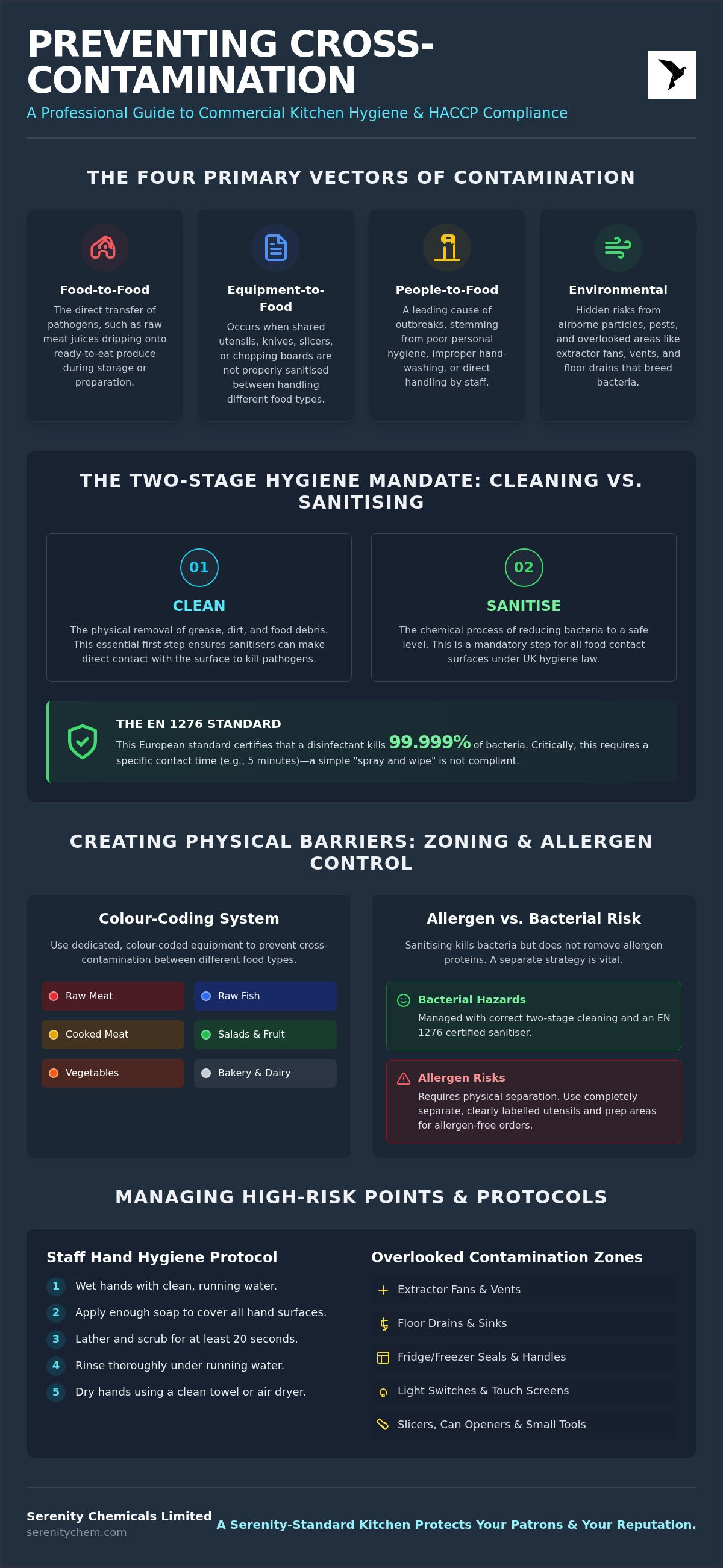
The most direct route is food-to-food transfer. This often happens in storage, where raw meat juices might drip onto ready-to-eat produce. Equipment-to-food contamination is equally prevalent; it occurs when shared utensils, such as knives or slicers, aren't thoroughly sanitised between tasks. Finally, people-to-food transfer remains a leading cause of outbreaks, usually stemming from poor hand hygiene or improper handling techniques by kitchen staff. Mastering how to prevent cross-contamination in a commercial kitchen requires a vigilant, methodical approach to each of these categories.
The Hidden Risk: Environmental Contamination
Bacteria don't only exist on worktops. Airborne particles, dust, and pests can carry pathogens into your prep areas. High-risk zones that are often overlooked include extractor fans, vents, and floor drains. These areas accumulate grease and moisture, creating an ideal breeding ground for bacteria. A systematic approach to cleaning non-food contact surfaces is vital. Utilising a professional solution like Serenity Heavy Duty Degreaser ensures that even these "hidden" areas don't become a reservoir for contamination that could eventually reach the food line.
Allergen Cross-Contamination vs. Bacterial Transfer
It's vital to distinguish between biological hazards and allergen risks. Whilst sanitising a surface may kill bacteria like Salmonella, it won't necessarily remove microscopic protein traces from allergens like peanuts or shellfish. A surface that looks perfectly clean can still trigger a severe reaction in a sensitive customer. To manage this risk, your strategy for how to prevent cross-contamination in a commercial kitchen must include dedicated equipment and separate prep zones for allergen-free orders. Relying on a single set of tools for all dishes is a gamble that professional kitchens cannot afford to take. Consistency in your cleaning routines ensures that these invisible risks are managed as strictly as the visible ones.
The Science of Sanitisation: Cleaning vs. Disinfecting for HACCP
Effective hygiene isn't just about appearances. In a professional environment, a surface that looks spotless may still harbour millions of invisible pathogens. Understanding the distinction between cleaning and sanitising is a core component of how to prevent cross-contamination in a commercial kitchen. Cleaning refers to the physical removal of grease, dirt, and food debris. Sanitising, however, is the chemical process of reducing bacteria to levels that are safe for human consumption.
Under UK law, a two-stage cleaning process is mandatory for all food contact surfaces. This involves an initial clean to remove organic matter, followed by the application of a disinfectant that meets the EN 1276 standard. This European specification ensures the product is capable of killing 99.999% of bacteria within a specific timeframe, typically five minutes or less. Many kitchen teams fail this standard by using a "spray and wipe" technique. Without allowing for the correct contact time, the chemical cannot effectively penetrate the cell walls of pathogens, leaving the surface contaminated.
Choosing a Food-Safe Kitchen Sanitiser
Selecting the right chemical is vital for maintaining integrity. A food safe sanitiser for commercial kitchens must be non-tainting, ensuring it doesn't alter the flavour or aroma of the dishes you serve. Modern, professional formulations often feature no-rinse properties, which streamline workflows whilst ensuring compliance with Food Standards Agency (FSA) guidelines. These products provide peace of mind, knowing that your surfaces are biologically safe without adding unnecessary complexity to your team's routine. Following the Four key steps to food safety ensures that sanitisation remains a consistent pillar of your operation.
The Role of Heavy-Duty Degreasers
Sanitisers cannot work through a layer of grease. If a surface has a visible or tacky film, the disinfectant will simply sit on top of the soil rather than reaching the bacteria underneath. This is where a high-performance solution like Serenity Heavy Duty Degreaser becomes essential. By stripping away carbonised grease and heavy oils from extraction systems and prep areas, you create a pristine surface for the sanitiser to act upon. This synergy between degreasing and sanitisation is the only way to achieve true HACCP compliance. If you need assistance in selecting the right chemical balance for your site, you can speak with our technical team for tailored advice.
Zoning and Colour-Coding: Physical Barriers to Pathogens
Creating physical boundaries is a cornerstone of effective site management. Whilst chemical solutions eliminate pathogens, zoning prevents them from moving across your workspace in the first place. Implementing a robust zoning strategy is one of the most effective ways to understand how to prevent cross-contamination in a commercial kitchen. By treating different areas of your kitchen as isolated environments, you reduce the reliance on human memory and replace it with a visual, fail-safe system.
The UK standard colour-coding system for chopping boards and cleaning equipment is the industry benchmark for this approach. Adhering to these colours ensures that tools used for high-risk ingredients never come into contact with ready-to-eat foods:
- Red: Raw meat
- Blue: Raw fish
- Yellow: Cooked meat
- Green: Salads and fruit
- Brown: Vegetables
- White: Dairy and bakery products
This logic should extend beyond the prep bench. Storage hierarchy is equally vital; raw meat must always be stored on the bottom shelf of refrigeration units to prevent juices from dripping onto other items. Coupled with a strict "clean-as-you-go" policy, these physical barriers ensure that waste and bacteria don't accumulate during a busy service shift.
Chemical Zoning and Storage
Physical separation must also apply to your cleaning inventory. Kitchen chemicals should be stored in a dedicated, lockable area away from food preparation and storage zones. This prevents accidental chemical taints or ingestion. Staff should be trained to use the correct professional cleaning chemicals list for specific tasks, ensuring that a floor cleaner never ends up on a food-contact surface. Controlled dispensing systems further mitigate risk by ensuring accurate dilution and reducing the chance of spills in sensitive areas.
Managing Shared Equipment
Complex machinery represents a significant hygiene challenge. Items like meat slicers, mixers, and vacuum pack machines often have intricate parts where food debris can hide. If these aren't stripped down and sanitised regularly, they can develop "biofilms". These are resilient clusters of bacteria that anchor themselves to surfaces, becoming resistant to standard cleaning. To manage how to prevent cross-contamination in a commercial kitchen effectively, you must establish a frequency of sanitisation for shared equipment that matches its usage. High-traffic machinery should be cleaned after every use and undergo a deep-clean at the end of every shift to ensure no pathogens remain dormant in hard-to-reach gaskets or blades.
Staff Hygiene Protocols and High-Touch Point Management
Even with perfect zoning and the right chemicals, the human element remains the most volatile factor in any professional kitchen. Managing staff behaviour is a critical pillar of how to prevent cross-contamination in a commercial kitchen. Pathogens are frequently introduced through poor hand hygiene or contaminated clothing, making rigorous personal protocols non-negotiable for every member of the team. A safe kitchen culture starts with the understanding that every touchpoint is a potential risk.
Mandatory hand-washing must take place for at least 20 seconds using warm water and antibacterial soap. This isn't just a requirement for the start of a shift; it's essential during every transition. Staff must wash their hands after handling raw ingredients, touching waste, taking breaks, or even using the telephone. Personal Protective Equipment (PPE) such as disposable gloves and clean aprons adds a necessary layer of protection. However, gloves must be changed as frequently as hands are washed to prevent people-to-food transfer. Clean aprons should be swapped immediately if they become soiled with raw meat juices or other contaminants.
Beyond the prep surfaces discussed in previous sections, "hot spots" require specific attention. Door handles, fridge seals, and tap levers are touched hundreds of times during a single service. If these high-traffic areas aren't managed, they become bridges for bacteria to travel between different zones. Identifying these spots and including them in a daily cleaning schedule is vital for maintaining a sterile environment.
The Advantage of Alcohol-Free Hand Sanitiser
In a catering environment, alcohol free hand sanitiser UK businesses choose offers distinct advantages over traditional ethanol-based gels. Alcohol vapours can occasionally taint sensitive food items, and the frequent use of high-alcohol products often leads to dry, cracked skin. These cracks provide microscopic refuges for bacteria to hide, making them much harder to wash away. Alcohol-free formulations maintain skin integrity whilst providing high-level protection, ensuring staff are more likely to comply with sanitisation protocols throughout a long shift without discomfort.
Touch-Point Sanitisation Schedules
To maintain a safe environment, you should implement an hourly checklist for sanitising high-traffic surfaces. Using a product like Serenity Antibacterial Surface Spray allows for rapid, effective disinfection of "hot spots" without disrupting the flow of service. It's vital that staff understand the difference between hand washing and hand sanitising. Washing removes physical soil and grease, whilst sanitising reduces the microbial load. One cannot replace the other; they must work in tandem as part of a robust training schedule for all new kitchen personnel to ensure how to prevent cross-contamination in a commercial kitchen becomes second nature.
If you're looking to upgrade your staff hygiene station with food-safe solutions, contact our specialists for a hygiene audit to ensure your facility meets the highest standards.
Implementing a Serenity-Standard Kitchen Hygiene Plan
A successful strategy for how to prevent cross-contamination in a commercial kitchen relies on a rigorous audit of your existing inventory. You should begin by evaluating every chemical currently in use against your Hazard Analysis and Critical Control Points (HACCP) requirements. It's not enough to have a shelf full of products; they must be the correct formulations for the specific risks your site faces. This audit ensures that your cleaning team isn't just moving dirt around but is actually eliminating pathogens at a microbial level.
Sourcing your supplies from a cleaning products manufacturer UK businesses trust provides significant logistical stability. Working directly with a manufacturer ensures a consistent supply chain and access to technical expertise that generic retailers cannot offer. This relationship allows you to standardise your hygiene plan, ensuring that every shift uses the same high-performance chemicals to achieve predictable, safe results. To maintain this standard, your hygiene plan must be structured into clear daily, weekly, and monthly deep-clean schedules. Daily tasks should focus on high-touch points and food-contact surfaces, whilst weekly and monthly routines address harder-to-reach areas like floor drains and high-level shelving.
To ensure your kitchen is always ready for an unannounced inspection, use this final checklist:
- Up-to-date temperature logs for all refrigeration units.
- Signed cleaning schedules for every zone and piece of equipment.
- Correct chemical storage with clearly visible Safety Data Sheets (SDS).
- Evidence of recent staff training on how to prevent cross-contamination in a commercial kitchen.
- Organised colour-coded equipment stored in dedicated zones.
Bulk Sourcing and Chemical Efficiency
Professional kitchens benefit greatly from concentrated formulas. These products reduce plastic waste and significantly lower the cost-per-use compared to ready-to-use alternatives. However, efficiency must never compromise safety. Ensuring full COSHH compliance is mandatory; every chemical must have a corresponding SDS available for staff to reference. Direct supply from a manufacturer provides the peace of mind that your documentation is always current and your team has the technical support needed to handle chemicals responsibly.
Continuous Improvement and Monitoring
Verification is the final step in a principled hygiene plan. You shouldn't wait for an inspection to find a weakness in your system. Many high-standard kitchens now use ATP testing to verify cleaning efficacy in real-time. This provides immediate, data-driven feedback on whether a surface is truly sanitised. As food safety legislation evolves, your protocols must be updated to remain compliant. Ensure your kitchen meets the highest standards with Serenity Kitchen Sanitiser, a formulation designed for the rigours of professional catering environments.
Securing Your Kitchen's Reputation Through Rigorous Hygiene
Mastering how to prevent cross-contamination in a commercial kitchen is a continuous commitment to professional excellence. By moving beyond basic cleaning to a science-led, two-stage sanitisation process, you ensure every surface is biologically safe for food preparation. Implementing physical barriers through colour-coding and managing high-touch points creates a resilient environment where human error is minimised and safety is prioritised. It's about building a culture where hygiene is second nature to every member of the team.
Serenity Chemicals provides the foundation for this success with our UK manufactured, HACCP-compliant formulations. Whether you're managing a single site or a large-scale operation, our bulk wholesale distribution ensures your catering environment remains stocked with the precise tools needed for full compliance. Explore our range of professional kitchen sanitisers and ensure your facility meets the highest standards today. With the right protocols and professional-grade solutions in place, you can serve every plate with total confidence.
Frequently Asked Questions
What are the 4 main types of cross-contamination in a kitchen?
The four primary types are:
- Food-to-food: Raw ingredients touching ready-to-eat items.
- Equipment-to-food: Contamination via shared utensils or boards.
- People-to-food: Driven by poor hygiene or improper handling.
- Environmental: Airborne pathogens, dust, or pests.
Recognising these vectors is the first step in learning how to prevent cross-contamination in a commercial kitchen and ensuring a safe catering environment for every customer you serve.
How often should kitchen surfaces be sanitised?
Kitchen surfaces must be sanitised after every specific task and immediately after contact with raw ingredients. For high-traffic areas and "hot spots" like door handles or fridge seals, an hourly sanitisation schedule is recommended. This frequency ensures that bacteria don't have the opportunity to multiply to dangerous levels. Using a professional product like Serenity Antibacterial Surface Spray provides a rapid way to maintain these standards throughout a busy service shift.
Is it better to use blue roll or reusable cloths for cleaning?
Disposable blue roll is significantly safer than reusable cloths in a professional kitchen. Reusable cloths can harbour bacteria even after a wash, often spreading pathogens from one surface to another. By using single-use paper towels, you'll eliminate the risk of carrying contaminants across different zones. This practice is a simple yet effective component of how to prevent cross-contamination in a commercial kitchen and is highly favoured by inspectors during audits.
Why is colour-coding important for preventing cross-contamination?
Colour-coding provides a vital visual fail-safe that transcends language barriers and prevents human error. By assigning specific colours to different food groups, such as red for raw meat and green for salad, you create a clear physical boundary. This ensures that a knife or board used for high-risk ingredients never touches ready-to-eat produce. It's a fundamental industry standard that provides peace of mind for both management and kitchen personnel.
Can I use the same sanitiser for food prep areas and front-of-house?
You can use the same sanitiser if the formulation is certified as food-safe and non-tainting. Serenity Kitchen Sanitiser is designed for food-contact surfaces but is equally effective on front-of-house tables and counters. This consistency simplifies your chemical inventory and ensures that every area of your business meets a professional hygiene standard. Always check that the product is suitable for the specific surface material, particularly on delicate front-of-house finishes or fabrics.
What is the difference between a detergent and a sanitiser?
A detergent is designed to remove visible dirt, grease, and food debris from a surface. It doesn't kill bacteria or viruses. A sanitiser, however, is a chemical agent that reduces the number of microorganisms to safe, manageable levels. In a professional kitchen, you must use both in a two-stage process. First, use a detergent to clean the surface, then apply a sanitiser to disinfect it, ensuring full HACCP compliance and safety.
How does an alcohol-free hand sanitiser help in a catering environment?
Alcohol-free hand sanitisers are ideal for catering because they don't produce flammable vapours or risk tainting sensitive food items with alcohol scents. Products like Serenity Alcohol Free Hand Sanitiser are gentler on the skin, which encourages staff to sanitise their hands more frequently. Maintaining skin integrity is vital; cracked or dry skin can harbour bacteria that are difficult to wash away, creating an unnecessary hygiene risk during food preparation and service.
What documents do I need to prove my kitchen is safe from cross-contamination?
To prove compliance, you'll need a comprehensive HACCP plan, signed daily cleaning schedules, and accurate temperature logs. You must also maintain staff training records and up-to-date Safety Data Sheets (SDS) for all chemicals in use. These documents provide a clear audit trail for FSA inspectors. They demonstrate that you've implemented a structured approach to safety and are actively monitoring your kitchen's hygiene standards to protect your customers and your business.

How to Prevent Cross-Contamination in a Commercial Kitchen: A Professional Guide
A single lapse in hygiene isn't just a mistake; it's a direct threat to your business's survival and your customers' health. ...

Developing a Robust Workplace Hand Hygiene Policy in the UK: A 2026 Guide
In 2025, minor illnesses and infectious diseases accounted for nearly half of the 148.8 million working days lost across the ...