

Did you know that the average cost of an industrial spill cleanup for a UK business can reach £30,000 once fines and production losses are factored in? It's a staggering figure that highlights why a quick mop-up isn't enough. Most facilities managers understand the frustration of an industrial grease spill cleanup where, despite your best efforts, a treacherous, invisible film remains on the floor. This residual grease doesn't just look unprofessional; it's a primary cause of slip-and-fall accidents and can lead to severe penalties under the Environmental Protection Act 1990.
You deserve a response strategy that prioritises both safety and efficiency. This guide will help you master the selection and application of industrial chemicals to ensure thorough, safe, and compliant spill restoration. We'll examine how to navigate UK-specific regulations, such as the Water Industry Act 1991, whilst establishing a clear standard operating procedure for your team. From choosing high-performance degreasers to achieving a truly residue-free finish, you'll gain the expertise needed to maintain a principled and protected workplace.
Key Takeaways
- Learn why physical absorbents alone leave dangerous residues and how specialist emulsifiers are required to restore total floor safety.
- Identify the specific chemical solutions needed for different spill types, ensuring you use the correct formulations for oils, lubricants, or food-grade hazards.
- Ensure your industrial grease spill cleanup remains fully compliant with UK safety standards by integrating COSHH requirements and Safety Data Sheets into your protocol.
- Implement a clear, step-by-step response plan that covers containment, precise chemical application, and final rinsing to eliminate slip risks.
- Recognise the logistical and quality benefits of partnering with a UK-based chemical manufacturer for consistent supply and expert technical guidance.
The Science of Industrial Grease Spill Cleanup: Why Absorbents Aren’t Enough
Effective industrial grease spill cleanup involves more than just soaking up the liquid volume. Whilst clay granules and absorbent pads are excellent for initial containment, they often leave behind a microscopic "ghost" film. This thin layer of grease remains bonded to the floor surface, maintaining a high level of lubricity that can lead to slips. The science of oil spills and industrial leaks shows that grease molecules have a high affinity for surfaces, particularly porous ones like concrete. Without chemical intervention, these molecules stay put, creating a hazard that persists long after the visible mess is gone.
Whilst concrete appears solid to the naked eye, it's actually a porous substrate. In industrial settings, floors often feature microscopic pits and fissures where grease can hide. When a spill occurs, the weight of the liquid forces these contaminants deep into the surface. Physical tools like scrapers and absorbent granules only address the surface level, leaving the substructure saturated. To truly restore a safe working environment, you must use specialist emulsifiers that break these molecular bonds and lift the contamination out of the floor's pores.
The Limitations of Physical Absorption
Mechanical removal fails to address molecular adhesion. In high-traffic zones, these "invisible" grease layers are arguably more dangerous than the original spill because staff may believe the area is safe. Complete remediation is the total removal of both volume and residue.
Primary Functions of Post-Spill Chemicals
Chemical remediation relies on two primary mechanisms to ensure the floor is safe for use. First, surfactants lower the surface tension of the cleaning solution, allowing it to penetrate the floor's texture. Second, emulsification suspends the grease in water, making it easy to rinse away. This dual action is essential for several reasons:
- Suspending grease: It prevents re-deposition on the floor surface during the cleaning process.
- Deep cleaning: It reaches lubricants that have wicked into the concrete pores.
- Restoring traction: It returns the floor to its original coefficient of friction.
Returning a surface to its safe state is vital for forklift stability and pedestrian safety. Using a professional-grade solution like Serenity Heavy Duty Degreaser ensures that the chemical action is powerful enough to handle stubborn industrial lubricants without damaging the underlying surface. This methodical approach transforms a temporary fix into a permanent restoration of safety.
Essential Categories of Chemical Solutions for Industrial Spills
Selecting the right chemical for an industrial grease spill cleanup is as critical as the speed of the response itself. Standard janitorial cleaners often lack the concentration needed to emulsify heavy lubricants. Instead, facilities managers must categorise spills into specific risk profiles. For heavy oils, a degreaser is the primary tool. For organic spills in sensitive areas, a sanitiser is required. Having a clear inventory of these solutions ensures your response aligns with UK spill control procedures and maintains a safe, compliant site.
Heavy-Duty Degreasers for Lubricant and Oil Removal
When dealing with mechanical lubricants or hydraulic fluids, the chemical must break the high-viscosity bond between the oil and the floor. Serenity Heavy Duty Degreaser utilises advanced surfactants to lower surface tension, allowing the solution to get underneath the grease. A common mistake in spill remediation is rushing the process. Allowing for "dwell time", typically 5 to 10 minutes, gives the chemical the opportunity to penetrate cold-pressed or aged oils that have begun to harden. If you're looking for a reliable commercial floor cleaner supplier, choosing one that manufactures these industrial-strength formulations in the UK ensures consistent quality.
Sanitisers for Biological and Organic Industrial Spills
Spills in canteens, laboratories, or food processing areas introduce biological risks that a standard degreaser won't address. In these environments, you should deploy a professional antibacterial surface spray to eliminate pathogens whilst cleaning the grease. Serenity Hard Surface Sanitiser is particularly effective here, offering a high-performance solution that meets EN 1276 standards. Alcohol-free formulations are often preferred for these tasks. They're safer for use around sensitive electronic equipment and won't cause the rapid evaporation that can limit effective contact time on the surface.
For minor, non-hazardous spills in offices or reception areas, a Serenity Multi-Surface Cleaner provides a versatile option that won't damage delicate finishes. However, for more complex accidents involving acids or alkalis, specialist neutralisers must be kept on-site. Choosing the correct chemical category ensures you don't just move the mess around, but actually eliminate the hazard. If you need assistance selecting the right formulations for your industrial grease spill cleanup or specific site risks, feel free to speak with our technical team for guidance.
Compliance and Safety Standards in the UK
Conducting an industrial grease spill cleanup requires more than just technical skill; it demands strict adherence to UK safety legislation. Under the Environmental Protection Act 1990, businesses have a legal "duty of care" to manage waste in a way that prevents harm to human health and the environment. This responsibility extends to the chemicals used during remediation. Using unverified or improperly documented cleaning agents can lead to regulatory scrutiny, particularly if a spill reaches controlled waters or public sewers.
Adhering to COSHH During Spill Response
The Control of Substances Hazardous to Health (COSHH) regulations mandate that any chemical used in the workplace must be part of a formal risk assessment. When preparing your spill response plan, you must integrate the specific remediation chemicals you intend to use. This ensures that staff are aware of the risks before an emergency occurs. Key focus areas include:
- Safety Data Sheets (SDS): Always keep a physical or digital copy of the SDS for Serenity Heavy Duty Degreaser and other cleaners in an accessible location.
- Proper Labelling: Don't store concentrated industrial cleaners in unlabelled containers. This prevents accidental misuse or hazardous mixing.
- PPE Requirements: Ensure your team has access to the correct personal protective equipment, such as nitrile gloves and eye protection, as specified in the chemical's SDS.
Environmental Responsibility in Industrial Cleaning
Modern industrial standards in the UK are shifting toward ethical responsibility. The Water Industry Act 1991 makes it a criminal offence to discharge substances into public sewers that could interfere with their operation. Failing to prevent grease or harsh chemical runoff from entering the drainage system can result in fines of up to £50,000 in a Magistrates' Court. Choosing biodegradable and low-VOC (Volatile Organic Compound) options allows you to meet these environmental obligations without sacrificing performance.
Compliance also involves verifying the efficacy of your sanitisers. If you're remediating a spill in a food-processing area, your chemicals should meet British Standards such as EN 1276. Serenity Hard Surface Sanitiser is formulated to meet these rigorous requirements, providing peace of mind that the surface is biologically safe. By selecting UK-manufactured solutions that prioritise both safety and integrity, you ensure your facility remains a principled and protected environment.
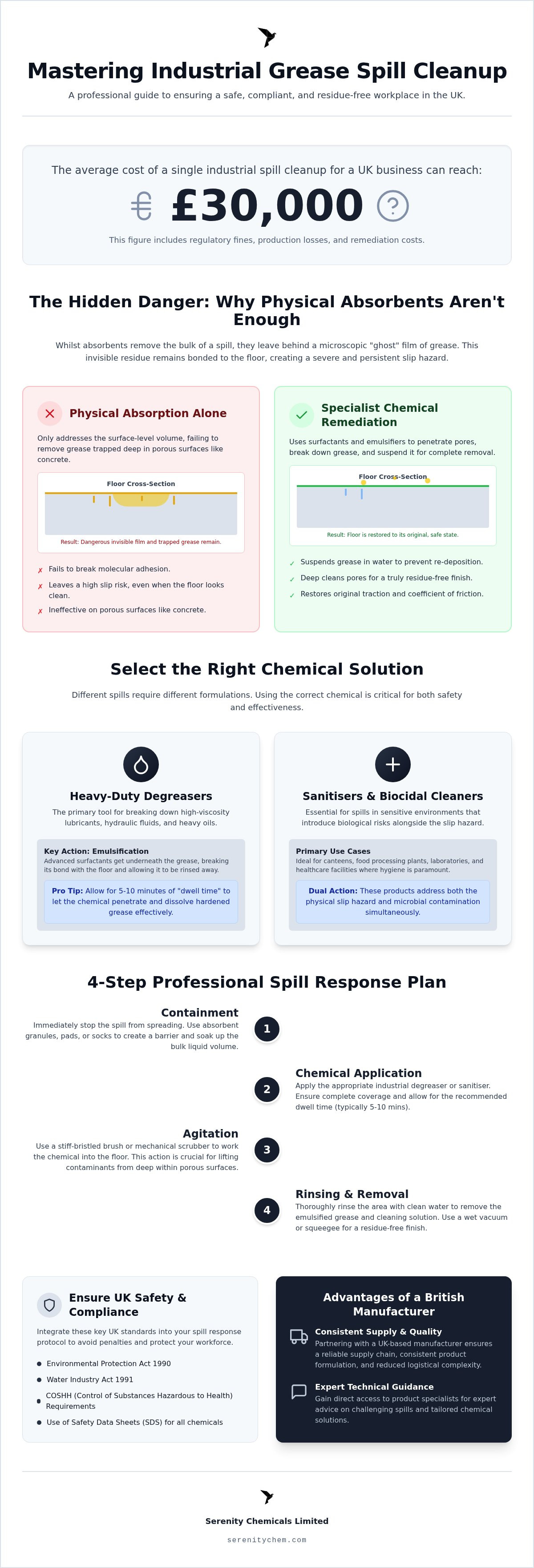
Step-by-Step Professional Response: From Containment to Final Rinse
Executing a professional industrial grease spill cleanup follows a precise sequence to ensure the surface is returned to a safe state. The process begins with immediate containment using booms or absorbent granules to prevent the liquid from spreading or entering drains. Once the bulk volume is removed, the focus shifts to chemical remediation. This stage is where the molecular bond between the grease and the flooring is actually broken, a step that simple mechanical mopping cannot achieve on its own.
Success depends on choosing the correct dilution for the specific grease type. For heavy hydraulic oils or aged lubricants, a concentrated application of Serenity Heavy Duty Degreaser is required. Once applied, you must allow for adequate dwell time. This period of 5 to 10 minutes allows the surfactants to penetrate the grease layer. Following this, agitation with a deck brush or industrial scrubber helps lift the suspended particles from the floor's pores before they can settle back into the substrate.
The Restoration Phase: Eliminating Stubborn Residues
In high-traffic warehouses or manufacturing plants, using a walk-behind floor scrubber is the most efficient way to apply industrial-grade chemicals. These machines provide the mechanical force needed to scrub away "ghosting" or staining that often occurs on porous concrete and epoxy coatings. A thorough final rinse is essential to remove emulsified grease and chemical surfactants that would otherwise leave the floor dangerously slick. Verification of the surface involves checking for any remaining rainbow-like sheen when the floor is wet, which indicates that residual oil is still present.
Preventing Long-term Damage to Industrial Flooring
Whilst aggressive cleaning is necessary, you must match the chemical to the flooring material to avoid permanent degradation. High-pH alkaline degreasers are excellent for grease but can sometimes strip protective sealants or dull certain vinyl finishes if used at incorrect concentrations. Ensuring your chemical choice is compatible with concrete, metal, or epoxy is vital for maintaining the floor's integrity. Regular maintenance with a solution like Serenity Floor Cleaner can also simplify future spill responses by keeping the surface sealed and less prone to deep wicking.
Establishing a clear standard operating procedure for these steps protects your staff and your infrastructure. If you need to stock up on professional-grade formulations for your spill kits, you can order bulk industrial degreasers directly from our UK facility.
The Advantages of Sourcing Chemicals from a British Manufacturer
Sourcing your remediation chemicals from a domestic blender offers advantages that extend beyond simple logistics. When an emergency occurs, you need a supply chain that won't buckle under international shipping delays or fluctuating customs regulations. A UK-based manufacturer provides the consistency required for effective industrial grease spill cleanup, ensuring that the high-performance degreasers you rely on are always in stock. This proximity also allows for better technical oversight and a direct line to the experts who formulated the products.
The Benefits of Buying Bulk Chemicals Direct
For large-scale warehouses and manufacturing plants, procurement efficiency is a major operational factor. Buying directly from a cleaning products manufacturer UK allows you to access concentrated formulations that significantly reduce cost-per-use. These professional-grade concentrates mean you aren't paying to ship water, which lowers your transport costs and environmental impact. Sourcing in larger volumes also helps reduce plastic waste, as fewer individual bottles are required for daily maintenance and spill response. It's a principled approach that aligns financial savings with environmental integrity.
Why Serenity Chemicals is Your Partner in Industrial Safety
Serenity Chemicals operates with a commitment to professional reliability and technical excellence. Our industrial range is specifically designed to meet the rigorous demands of UK facilities managers. Whether you need the high-alkaline power of Serenity Heavy Duty Degreaser for mechanical lubricants or the biological protection of Serenity Hard Surface Sanitiser, our formulations provide peace of mind. We don't just sell products; we offer solutions tailored to your specific site risks. Our team provides the technical support needed to ensure your staff can handle any industrial grease spill cleanup with confidence.
Supporting the UK economy by choosing a local manufacturer also helps reduce your facility's carbon footprint. Shorter delivery distances mean lower transport emissions, contributing to your corporate sustainability goals. This local partnership ensures you receive the technical support needed for complex cleanup scenarios, such as treating porous concrete or managing chemical runoff. By choosing a manufacturer that values ethical responsibility as much as efficacy, you ensure your spill response plan is both robust and responsible. It's about building a long-term trust that guarantees your facility remains safe, compliant, and efficient.
Securing Your Facility with Professional Remediation Standards
Mastering an industrial grease spill cleanup means moving beyond physical containment to embrace total chemical restoration. You've learned how emulsifiers break the molecular bonds that cause slip hazards and why adhering to UK safety legislation like COSHH is a non-negotiable duty of care. By matching the correct chemical to your specific surface and grease type, you protect both your staff and your infrastructure from long-term damage.
Partnering with a UK-based manufacturer ensures you have access to proprietary formulations and expert technical support for UK facilities whenever an incident occurs. We provide COSHH-compliant safety data sheets and high-performance solutions designed for the toughest environments. Contact our experts to discuss your industrial chemical requirements and ensure your site remains safe, compliant, and efficient. Taking these principled steps today provides the peace of mind you need for tomorrow's challenges.
Frequently Asked Questions
What is the most effective chemical for cleaning up oil spills in a warehouse?
A high-performance, heavy-duty degreaser is the most effective choice for warehouse spills. Serenity Heavy Duty Degreaser is specifically formulated for industrial grease spill cleanup, as it emulsifies lubricants and lifts them from the floor's pores. It's more effective than standard soaps because it breaks the molecular bond between the grease and the substrate. This ensures a residue-free finish that restores the floor's traction and safety.
Can I use general-purpose detergents for industrial grease spill cleanup?
No, general-purpose detergents usually lack the concentration required for a successful industrial grease spill cleanup. Whilst they might remove surface liquid, they often leave a slippery "ghost" film behind. Industrial-grade formulations contain advanced surfactants that penetrate thick grease layers to lift contaminants. Using the wrong chemical can actually spread the hazard rather than remediating it, which significantly increases the risk of workplace slip-and-fall accidents.
What safety precautions should I take when using industrial degreasers?
You must always wear the personal protective equipment (PPE) specified in the product's Safety Data Sheet (SDS). This typically includes nitrile gloves, eye protection, and sometimes respiratory masks in poorly ventilated areas. Ensure the area is cordoned off to prevent unauthorised access during the cleaning process. Always follow the manufacturer's dilution instructions carefully to avoid creating hazardous fumes or damaging the underlying floor surface through the use of overly aggressive concentrations.
How do I ensure my spill cleanup chemicals are COSHH compliant?
To ensure compliance, you must integrate the chemicals into your workplace COSHH risk assessment. This involves obtaining the Safety Data Sheet (SDS) from your supplier, such as Serenity Chemicals Limited, and documenting how the substance is stored, used, and disposed of safely. Staff must be trained on these specific procedures. Keeping clear, up-to-date records of these assessments is a legal requirement under the Control of Substances Hazardous to Health regulations.
Are there eco-friendly chemicals available for industrial grease remediation?
Yes, many modern industrial cleaners are formulated to be biodegradable and low-VOC to minimise environmental impact. Selecting UK-manufactured products often means the formulation adheres to strict environmental standards whilst reducing transport emissions. Serenity Chemicals prioritises ethical responsibility by offering high-performance solutions that don't rely on ozone-depleting solvents. This allows you to meet your "duty of care" under the Environmental Protection Act 1990 without sacrificing the industrial strength needed to handle heavy lubricants.
Why is a sanitiser necessary after cleaning up a non-biological spill?
A sanitiser like Serenity Hard Surface Sanitiser is vital if the spill occurred in a food-processing or laboratory environment. Even if the grease itself isn't biological, the spill event can introduce or spread bacteria across the surface through foot traffic or equipment. Using a sanitiser that meets EN 1276 standards ensures the area is hygienically safe for operations. This is particularly important for maintaining compliance with health and safety audits in sensitive sectors.
How long should I leave a degreaser to dwell on a stubborn grease spill?
Most heavy-duty degreasers require a dwell time of between 5 and 10 minutes to work effectively. This period allows the surfactants to penetrate the grease layer and break the bond with the floor. Don't allow the solution to dry completely on the surface, as this can make the residue harder to remove. For aged or cold-pressed oils, a slightly longer dwell time combined with mechanical agitation from a deck brush usually yields the best results.
What is the difference between an absorbent and a remediation chemical?
An absorbent, such as clay granules or pads, is designed for the initial containment and removal of liquid volume. In contrast, a remediation chemical like Serenity Heavy Duty Degreaser is used to eliminate the microscopic residue left behind. Whilst absorbents handle the bulk of the spill, only chemical action can restore the floor's original coefficient of friction. A professional response requires using both to ensure a truly safe and residue-free environment.

How to Prevent Cross-Contamination in a Commercial Kitchen: A Professional Guide
A single lapse in hygiene isn't just a mistake; it's a direct threat to your business's survival and your customers' health. ...

Developing a Robust Workplace Hand Hygiene Policy in the UK: A 2026 Guide
In 2025, minor illnesses and infectious diseases accounted for nearly half of the 148.8 million working days lost across the ...