

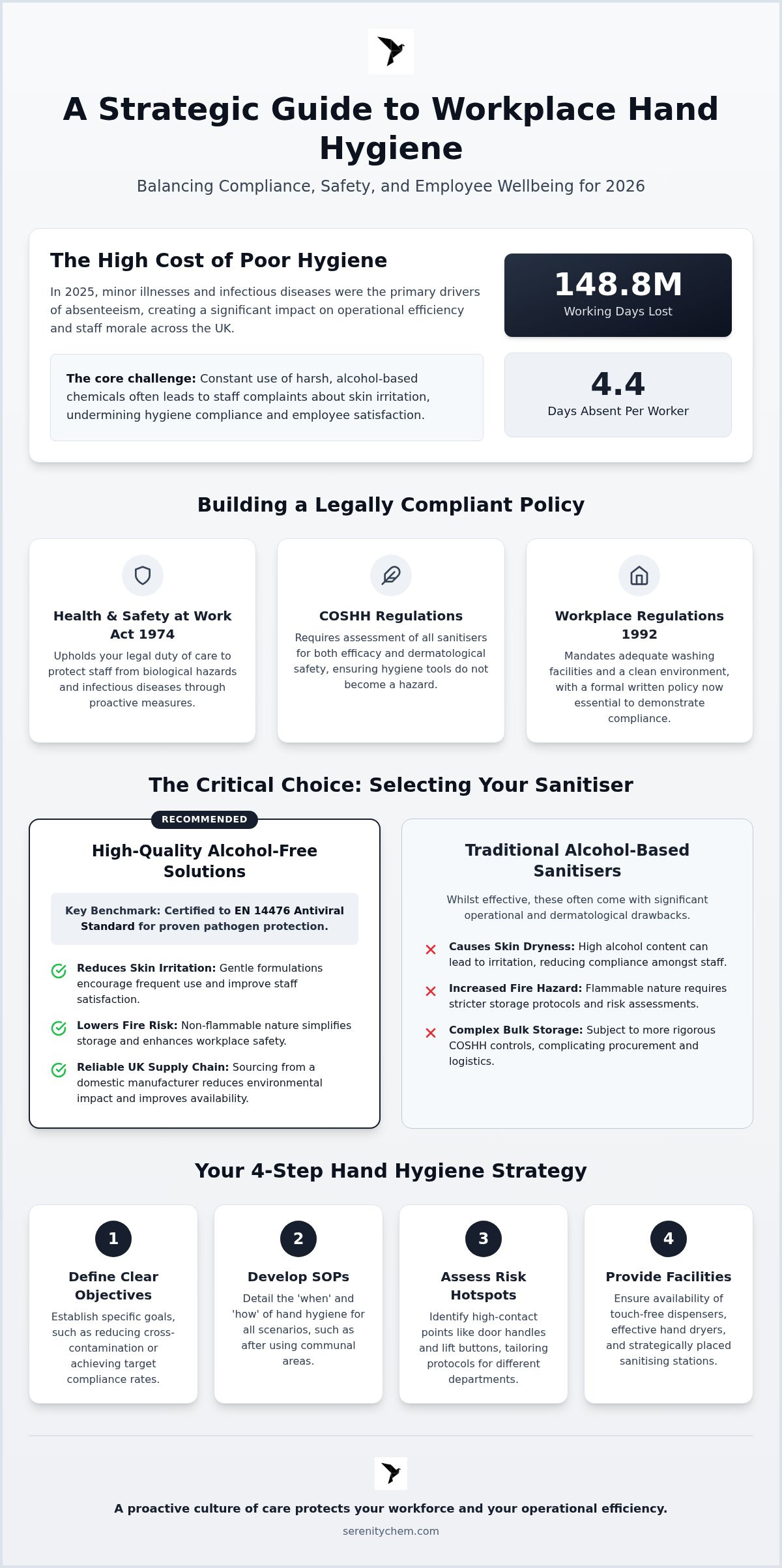
In 2025, minor illnesses and infectious diseases accounted for nearly half of the 148.8 million working days lost across the country. It's a frustrating cycle for many managers; you want to maintain high standards, yet constant use of harsh chemicals often results in staff complaints about skin irritation. By developing a clear workplace hand hygiene policy UK, you can move beyond simple compliance to create a culture of care that actually reduces absenteeism. This 2026 guide provides the framework you need to draft, implement, and maintain a policy that balances rigorous pathogen control with dermatological safety.
You likely agree that keeping your team healthy is a constant challenge that requires more than just a box-ticking exercise. This article promises to teach you how to draft a compliant policy that meets the latest HSE and COSHH requirements without compromising on skin health. We will preview the essential steps for selecting effective alcohol-free solutions, managing 2026 Statutory Sick Pay reforms, and ensuring your hygiene standards remain consistent amongst all staff members. By the end of this guide, you'll have the tools to protect both your workforce and your operational efficiency.
Key Takeaways
- Understand how to align your workplace hand hygiene policy UK with the Health and Safety at Work Act 1974 and current COSHH regulations to ensure full legal compliance.
- Discover why the EN 14476 antiviral standard is the critical benchmark for selecting sanitisers that offer proven protection against pathogens.
- Learn how to reduce employee skin irritation and improve staff satisfaction by transitioning to high-quality, alcohol-free formulations.
- Identify the operational advantages of alcohol-free solutions, including reduced fire safety risks and simplified bulk storage requirements.
- Explore the strategic benefits of sourcing hygiene products directly from a UK-based manufacturer to enhance supply chain reliability and reduce your environmental footprint.
The Legal and Operational Necessity of a Workplace Hand Hygiene Policy
For any private sector business, implementing a workplace hand hygiene policy UK is no longer an optional extra; it is a fundamental component of a modern risk management strategy. Under the Health and Safety at Work Act 1974, every employer has a legal duty of care to ensure the health, safety, and welfare of their employees. This obligation extends to protecting staff from biological hazards and infectious diseases that spread through surface contact or poor hand cleanliness. By formalising these protocols, you move from reactive measures to a proactive stance on health and safety.
Adhering to global hand hygiene standards is a key part of meeting these legal requirements. When you integrate hand hygiene into your formal COSHH (Control of Substances Hazardous to Health) assessments, you aren't just looking at the chemicals used for cleaning. You're also evaluating the safety and efficacy of the sanitisers provided to your team. Choosing products that avoid skin irritation whilst maintaining high pathogen control is a central part of this ethical responsibility, ensuring that your hygiene tools don't become a hazard themselves.
Legislative Framework for UK Businesses
The Workplace (Health, Safety and Welfare) Regulations 1992 require employers to provide adequate washing facilities and maintain a clean environment. Whilst verbal instructions might have sufficed in previous years, the standards for 2026 demand a formal, written document to demonstrate compliance. A written workplace hand hygiene policy UK ensures that both the employer and the employee understand their specific responsibilities. While you must provide the necessary supplies and training, employees have a duty to cooperate with these health and safety measures. This clarity prevents confusion and ensures that hygiene remains a priority even during busy operational periods.
The Business Case for Hygiene Excellence
The financial impact of poor hygiene is substantial. In 2025, the UK saw an estimated 148.8 million working days lost due to sickness, with minor illnesses and infectious diseases being the primary causes. For the average worker, this resulted in roughly 4.4 days of absence per year. A visible and robust policy doesn't just reduce this absenteeism; it builds long-term trust. When clients and visitors see a well-managed hygiene protocol, it reflects a culture of integrity and professional care. This approach boosts morale, as staff feel their wellbeing is truly valued by the organisation, leading to improved satisfaction and reduced staff turnover.
Core Components of a Comprehensive 2026 Hand Hygiene Strategy
A successful workplace hand hygiene policy UK starts with a clear set of objectives. It isn't enough to simply state that hands should be clean. You must define what your policy aims to achieve, such as a specific reduction in cross-contamination risks or a target for staff compliance rates. Standard Operating Procedures (SOPs) should then detail the exact 'when' and 'how' of hand hygiene. This includes mandatory washing after using communal facilities and the regular use of sanitisers between tasks, especially in shared office environments or high-contact retail spaces where equipment is frequently swapped amongst team members.
Risk Assessment and Critical Control Points
Every building has 'hotspots' where pathogens are most likely to spread. Communal kitchens, lift buttons, and door handles require specific attention within your strategy. Integrating these steps with HSE safe working practices ensures that your policy remains grounded in current regulatory expectations. You should also tailor protocols to different departments. For instance, a warehouse team handling external packaging may require more frequent sanitisation than staff in a front-office setting. A thorough COSHH assessment of your chosen sanitisers is essential to ensure they're safe for high-frequency use without causing skin degradation.
Facility Standards and Provision
Effective hygiene depends on the availability of the right tools. Your facilities should meet minimum standards, including touch-free soap dispensers and efficient hand-drying options like high-velocity air dryers or sustainably sourced paper towels. Strategically placing sanitising stations at all entrances and exits encourages 'entry and exit' hygiene habits amongst staff and visitors alike. It's vital that these stations aren't just installed but maintained. An empty dispenser represents a failure in the policy, so your strategy must include a clear schedule for refilling and equipment checks to ensure consistent protection.
Reliable supply chain management is the final pillar of a robust strategy. Working with a UK-based manufacturer ensures you won't face international shipping delays that could leave your team unprotected. If you need assistance tailoring these components to your specific industry requirements, you can speak with our technical team for expert guidance on product selection and station placement.
Selecting the Right Sanitisers: Alcohol-Based vs. Alcohol-Free Solutions
Selecting the correct chemical formulation is a pivotal decision for any workplace hand hygiene policy UK. Whilst alcohol-based gels were once the default choice, the 2026 market offers sophisticated alternatives that address common operational drawbacks. You must weigh the immediate virucidal speed against long-term skin health and facility safety. For broader context, the UK government infection control guidance provides a baseline for when specific interventions are necessary, but corporate environments often require more nuanced solutions than clinical settings.
Efficacy and Certification Standards
Professional hygiene products must meet rigorous European testing standards to ensure they actually kill the pathogens they claim to target. EN 1500 is the benchmark for hand rubs used in clinical and high-risk environments. EN 14476 is the specific European standard for virucidal activity. Understanding the difference between immediate kill and residual protection is vital for 2026 policies. Unlike alcohol, which evaporates almost instantly, certain advanced formulations provide a thin barrier on the skin that continues to inhibit microbial growth for several hours after application. This longevity is particularly useful in offices where staff frequently touch shared surfaces like printers or kitchen appliances.
Dermatological Health and Staff Compliance
Staff compliance is the most significant hurdle in maintaining a robust hygiene culture. When sanitisers cause dryness, cracking, or contact dermatitis, employees often develop hygiene fatigue and begin to avoid using the provided stations. This avoidance creates gaps in your infection control strategy. Switching to an alcohol free hand sanitiser UK formulation can significantly improve adherence rates by prioritising skin integrity. These solutions are generally non-flammable and lack the harsh smell associated with traditional gels, making them more pleasant for high-frequency use throughout the working day. Maintaining skin health is a direct investment in the success of your policy.
Beyond skin health, you must consider the logistical impact of your choices. Storing large quantities of alcohol-based products requires specific fire safety measures and risk assessments under the Regulatory Reform (Fire Safety) Order 2005. Alcohol-free alternatives eliminate these flammable risks, simplifying your storage requirements and reducing the burden on your facilities management team. By choosing a balanced formulation, you protect your staff's hands whilst simultaneously enhancing the overall safety profile of your premises.
Implementing Your Policy: Training, Signage, and Behavioural Change
Transforming a workplace hand hygiene policy UK from a static document into a living culture requires a structured rollout. It isn't enough to simply email a PDF to your team. You must engage with them. Start by consulting with staff representatives to identify potential barriers to compliance. This collaboration ensures the policy is grounded in the reality of your specific environment. Once the framework is agreed upon, the next step is procurement. Sourcing certified, high-quality products from a reliable UK manufacturer guarantees that your team has the tools they need to stay safe without interruption.
Installation and education follow procurement. You should place clear, instructional signage at every washroom and entry point. Launching short, practical training sessions allows you to demonstrate correct techniques and explain the "why" behind the rules. Finally, establish a regular review cycle. This ensures your protocols stay effective against seasonal risks or changes in government health guidance.
Effective Communication and Visual Aids
Visual cues are powerful tools for behavioural change. Standardised signage that illustrates the correct "7-step" handwashing technique helps to reinforce habits without constant verbal reminders. You can also utilise nudge theory to improve compliance rates. By placing sanitising stations directly in the natural flow of foot traffic, you make the correct behaviour the easiest choice for staff. For workforces with diverse primary languages, rely on clear, high-contrast icons to ensure the message is universal and immediate.
Monitoring Compliance and Feedback
A policy only works if it is followed. Regular hygiene audits help you monitor whether stations are being utilised and if stock levels are being maintained. However, monitoring should be a two-way street. Establishing a feedback loop allows staff to report issues, such as skin irritation from specific formulations or dispenser malfunctions. This data is invaluable for the long-term success of your strategy. If you find that certain areas have low engagement, you can adjust your signage or station placement to better suit the daily habits of your team.
Maintaining a safe environment is an ongoing commitment that requires the right technical support. If you're ready to select the formulations that best fit your new policy, you can contact our specialists for a wholesale consultation to ensure your supply chain is as robust as your protocols.
Sourcing Ethical and Effective Hygiene Solutions from a UK Manufacturer
Transitioning your workplace hand hygiene policy UK from a draft to an active operation requires a partner that understands the specific demands of the British market. Sourcing your supplies directly from a domestic manufacturer provides a layer of security that international distributors cannot match. This approach ensures that your supply chain remains resilient against global shipping disruptions whilst significantly lowering the carbon footprint associated with long-distance haulage. It's about more than just logistics; it's about ensuring that your hygiene stations are never left empty due to customs delays or port congestion.
When you buy direct, you also gain transparency. You know exactly where your products are formulated and the standards they are held to. This level of integrity is vital for businesses that want to demonstrate a genuine commitment to ethical sourcing and environmental responsibility. By choosing a UK-based partner, you're not just buying a product; you're securing a reliable supply of professional-grade chemicals that are designed to perform in high-traffic commercial environments.
Why a UK-Based Supplier Matters
Navigating the post-Brexit regulatory environment requires precise alignment with UK REACH and the latest 2026 chemical labelling regulations. Working with a cleaning products manufacturer UK ensures that your Safety Data Sheets (SDS) and technical specifications are always accessible and compliant with local health and safety executive standards. Having a local point of contact means you can receive technical support and product guidance in real-time. This proximity supports the domestic economy and guarantees that the products you use are formulated specifically for high-frequency use in British workplaces.
The Serenity Alcohol-Free Advantage
Serenity Chemicals specialises in bridging the gap between high-level pathogen control and dermatological health. Our Serenity Alcohol Free Hand Sanitiser is designed for teams that require frequent sanitisation without the risk of skin degradation, cracking, or flammability issues. By integrating our solutions into your professional cleaning chemicals list, you create a cohesive hygiene strategy that protects both your premises and your people. Our formulations meet the EN 14476 antiviral standards discussed earlier, providing peace of mind through proven efficacy. These products don't just kill germs; they protect the skin's natural barrier, ensuring that staff remain comfortable and compliant throughout their shift.
Moving to a more sustainable and skin-friendly hygiene model is a strategic investment in your workforce's future. It demonstrates a commitment to ethical sourcing and employee wellbeing that pays dividends in staff loyalty and reduced absenteeism. As you finalise your policy, remember that the quality of your chemicals is just as important as the clarity of your instructions. Choosing a UK manufacturer like Serenity Chemicals means you're investing in a partnership that values integrity, protection, and the long-term health of your organisation.
Future-Proofing Your Business with Strategic Hand Hygiene
Developing a robust workplace hand hygiene policy UK is a vital step in protecting both your employees and your operational continuity. By formalising your approach, you move beyond simple compliance to create a culture of care that prioritises long-term skin health alongside rigorous pathogen control. A written policy ensures that every team member understands their role in maintaining a safe, productive environment, ultimately reducing the impact of preventable illness on your business.
Success depends on choosing high-performance products that staff actually want to use. Our UK-manufactured formulations provide EN 14476 certified antiviral efficacy and are trusted by businesses nationwide for their reliability and gentle skin care. To ensure your organisation is equipped with the best tools for 2026, browse our range of professional hygiene solutions at Serenity Chemicals. Establishing these standards today creates a safer, more resilient workplace for everyone involved.
Frequently Asked Questions
Is a written hand hygiene policy a legal requirement for UK small businesses?
Under the Health and Safety at Work Act 1974, every employer has a duty of care to protect staff from health risks. Whilst the law doesn't explicitly name a "hand hygiene document" for every micro-firm, 2026 standards strongly recommend a written workplace hand hygiene policy UK to demonstrate compliance. If you have five or more employees, you're legally required to record your significant risk assessment findings and the measures you've taken to control them.
What is the difference between EN 1500 and EN 14476 certifications?
EN 1500 is a standard that tests how effectively a hand rub reduces transient microbial flora during actual use on skin. In contrast, EN 14476 is the specific European standard for virucidal activity, proving a formulation can kill viruses in a laboratory setting. For a robust policy, you should select products that meet both benchmarks. This ensures your team has protection that's been verified for both general microbial reduction and specific viral control.
Can I use alcohol-free hand sanitiser and still be compliant with UK health standards?
Yes, you can remain fully compliant whilst using alcohol-free sanitisers, provided they meet relevant efficacy standards like EN 14476. UK health standards focus on the effectiveness of the pathogen control rather than the specific chemical base. Many organisations now prefer alcohol-free options because they're gentler on the skin and eliminate the flammability risks associated with traditional gels. This choice often improves staff compliance by reducing the likelihood of skin irritation and dryness.
How often should a workplace hand hygiene policy be reviewed?
You should review your policy at least annually or whenever there's a significant change in your operations or national health guidance. The 2026 Statutory Sick Pay reforms are a prime example of a regulatory change that might prompt a review of your hygiene standards. Regular audits ensure that your protocols remain effective against seasonal risks and that your supply chain, such as your UK-based chemical manufacturer, continues to meet your volume requirements.
Do I need to provide hand sanitiser if I already have hand-washing facilities?
While hand washing with soap and water is the primary defence, sanitisers are essential for hygiene at the point of use where sinks aren't available. Placing sanitising stations at entrances, lift buttons, and communal kitchens helps maintain standards between thorough washes. A comprehensive workplace hand hygiene policy UK integrates both methods. This ensures that high-touch surfaces don't become cross-contamination hotspots during a busy working day when staff are moving amongst different departments.
How do I handle staff who refuse to follow the hand hygiene policy?
You should treat a refusal to follow hygiene protocols as a health and safety matter rather than a personal preference. Start with an informal conversation to understand their concerns, such as skin sensitivity to certain chemicals. If the issue persists, you may need to follow your formal disciplinary procedure. Providing skin-friendly, alcohol-free alternatives often resolves resistance, as it demonstrates that you're prioritising employee wellbeing alongside your legal duty of care.
What are the fire safety regulations for storing alcohol-based sanitisers in an office?
Storing bulk quantities of alcohol-based sanitiser is governed by the Regulatory Reform (Fire Safety) Order 2005 due to its high flammability. You must conduct a specific fire risk assessment and store supplies in a cool, well-ventilated area away from ignition sources. Many UK managers switch to alcohol-free formulations to bypass these complex storage requirements. This reduces the overall fire load within the premises and simplifies the responsibilities of your facilities management team.
Are there specific hand hygiene rules for communal staff kitchens?
Communal kitchens are high-traffic hotspots that require strict hygiene protocols within your policy. You should mandate hand washing or sanitising before and after using shared equipment like kettles, microwaves, and fridges. It's also vital to provide certified antibacterial sprays for surface cleaning. Clear signage in these areas helps reinforce these behaviours amongst staff. This ensures that food preparation spaces don't become a primary source of illness transmission that could lead to increased absenteeism.

How to Prevent Cross-Contamination in a Commercial Kitchen: A Professional Guide
A single lapse in hygiene isn't just a mistake; it's a direct threat to your business's survival and your customers' health. ...

Developing a Robust Workplace Hand Hygiene Policy in the UK: A 2026 Guide
In 2025, minor illnesses and infectious diseases accounted for nearly half of the 148.8 million working days lost across the ...