

Can you truly achieve a 99.99% kill rate on viruses without exposing children to the harsh fumes of traditional bleach? For many educators and parents, the search for a child safe surface cleaner UK manufactured and professionally tested often feels like a compromise between safety and efficacy. You shouldn't have to choose between a non-toxic environment and one that's free from harmful pathogens. It's a common frustration to find "natural" products that smell pleasant but fail to meet the rigorous BS EN 1276 standards required for public health.
We understand that maintaining clinical-grade hygiene in nurseries and play areas is a significant responsibility. This guide provides the technical clarity you need to maintain food-safe surfaces whilst ensuring full COSHH compliance. You'll discover how advanced, alcohol-free formulations provide a superior alternative to aggressive chemicals, offering a reliable way to protect both the surfaces and the children who use them. We'll examine the latest 2026 regulatory updates and show you how to identify high-performance, non-irritant solutions that simplify your hygiene protocols without any hidden risks.
Key Takeaways
- Identify a genuine child safe surface cleaner UK by prioritising alcohol-free and bleach-free formulations that protect respiratory health.
- Learn to verify technical efficacy standards, ensuring your cleaning solutions meet EN 1276 and EN 14476 requirements for bacterial and viral control.
- Understand why professional-grade sanitisers provide more reliable protection for high-traffic educational settings than traditional natural cleaning methods.
- Master the "Clean, Disinfect, Protect" workflow to maintain hygiene across critical hotspots whilst minimising chemical exposure.
- Discover the logistical and safety benefits of sourcing non-toxic hygiene products directly from a specialist UK chemical manufacturer.
What Defines a Child Safe Surface Cleaner in the UK?
In the professional hygiene sector, the term "child safe" describes a precise balance between high-level antimicrobial efficacy and low-hazard chemical profiles. A genuine child safe surface cleaner UK formulation must address three critical areas: non-toxicity, minimal Volatile Organic Compound (VOC) emissions, and high skin compatibility. Whilst many consumer products claim safety, professional-grade solutions are defined by their ability to achieve a 99.99% kill rate without relying on caustic ingredients that could harm a developing immune system.
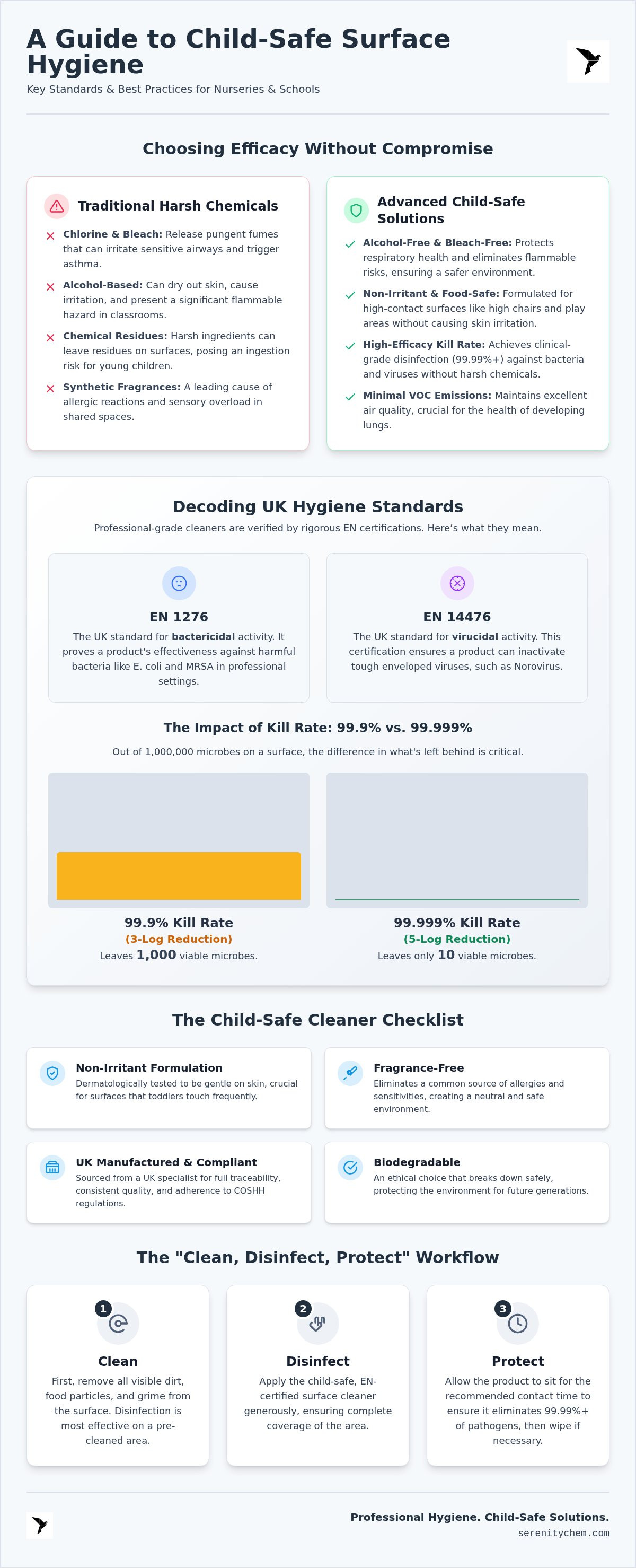
There is a common misconception that "natural" ingredients are inherently superior. However, in a school or nursery environment, a cleaner must do more than just remove visible dirt; it must eliminate pathogens like Norovirus or E. coli. Relying solely on domestic pantry staples often fails to meet the rigorous BS EN 1276 standards required for public health. By following Green cleaning principles, professional UK manufacturers create alcohol-free and bleach-free solutions that provide clinical-level protection whilst remaining gentle enough for areas where toddlers crawl and play.
The Problem with Traditional Harsh Chemicals
Traditional disinfectants often rely on chlorine or bleach, which release pungent fumes that can irritate sensitive airways. This is particularly concerning for children with asthma or other respiratory conditions. Beyond the air quality, chemical residues left on high-contact surfaces like high chairs, teething toys, and desks present an ingestion risk. Because of these factors, many UK educational settings are actively phasing out alcohol-based products. These traditional cleaners can dry out skin and create a flammable hazard in busy classrooms, leading to a shift toward safer, water-based technologies.
Key Attributes of a Safe Formulation
A high-quality child safe surface cleaner UK manufactured solution, such as Serenity Multi-Surface Cleaner, prioritises the following safety features:
- Non-Irritant Properties: The formulation should be dermatologically tested to ensure it doesn't cause rashes or irritation amongst toddlers who have frequent skin-to-surface contact.
- Fragrance-Free Composition: Synthetic fragrances are a leading cause of allergic reactions. Removing them ensures the environment remains neutral and safe for all users.
- UK Manufacturing Transparency: Sourcing directly from a UK manufacturer ensures full traceability. Under the GB CLP Regulation, every batch is monitored for consistency, ensuring the safety profile never wavers between orders.
- Biodegradability: Ethical manufacturing ensures the product breaks down safely after use, protecting the wider environment that the next generation will inherit.
Choosing a professional solution ensures that your facility remains compliant with COSHH regulations whilst providing a sanctuary of safety for the children in your care. It's about moving beyond simple "cleaning" and adopting a disciplined approach to hygiene that values long-term health as much as immediate disinfection.
The Science of Safety: Understanding UK Efficacy Standards
Establishing a baseline for hygiene in early years environments requires moving past vague marketing claims. In the United Kingdom, professional-grade surface cleaners are judged by rigorous European Norm (EN) standards. Finding a reliable child safe surface cleaner UK manufactured involves checking for EN 1276 and EN 14476 certifications. These aren't just labels; they represent a product's ability to eliminate specific pathogens under laboratory conditions. Whilst a "natural" cleaner might remove visible grease, it often lacks the technical formulation to disrupt the cellular structure of bacteria or the protein coat of a virus.
The distinction between a 99.9% and a 99.999% kill rate is significant in a professional context. A 99.9% rate (a 3-log reduction) can still leave thousands of viable microbes on a surface, whereas the 99.999% reduction required by EN 1276 ensures a much higher level of safety. This technical superiority is achieved through precise chemical blending that targets pathogens without requiring the caustic pH levels found in bleach. Following the UK guidance on cleaning in childcare settings ensures that your facility remains compliant with health protection standards whilst protecting children from unnecessary chemical exposure.
EN 14476: Protecting Against Norovirus and Flu
Viral protection is critical in settings where children congregate, as respiratory and gastrointestinal viruses spread rapidly through surface contact. Serenity formulations are engineered to meet EN 14476, the standard for virucidal efficacy. This ensures the solution is effective against enveloped viruses, including seasonal flu and Norovirus. Achieving this level of protection without alcohol or chlorine provides peace of mind for staff, knowing that the environment is clinically clean but remains safe for immediate contact by toddlers.
Alcohol-Free Technology: The New Standard
The mechanism of action in a Serenity child safe surface cleaner UK relies on advanced antimicrobial agents that remain active on the surface longer than alcohol. Alcohol-based sprays evaporate almost instantly, providing no residual protection. In contrast, our alcohol-free technology creates a microscopic barrier that continues to inhibit microbial growth between scheduled cleans. This approach offers several practical benefits in educational buildings:
- Non-Flammable: Eliminates the fire risk associated with bulk-storing alcohol-based sanitisers in classrooms.
- Skin Integrity: Prevents the drying and cracking of skin that often leads to contact dermatitis amongst staff and children.
- Reduced Ingestion Risk: Removes the hazard of accidental alcohol poisoning, a primary concern in nursery risk assessments.
If you require detailed technical data sheets to support your facility's COSHH risk assessments, please contact our technical team for comprehensive documentation.
Comparing Child Safe Cleaners: Natural vs Professional-Grade
Choosing between a household remedy and a dedicated child safe surface cleaner UK manufactured solution often involves a choice between perceived simplicity and verified protection. Whilst vinegar and plant-based mixtures are popular amongst home users, they often lack the technical muscle required for commercial infection control. In professional settings like nurseries or schools, the priority is a guaranteed kill rate that protects vulnerable groups from resilient pathogens. A professional solution provides the peace of mind that a surface isn't just visually clean, but hygienically safe.
Why Vinegar and Water Often Fail
The primary issue with using vinegar or basic plant-based cleaners is their inconsistent efficacy against viruses and bacteria. Acetic acid, the active component in vinegar, is unable to neutralise many of the resilient pathogens found in high-traffic child environments, such as Norovirus or E. coli. Using these methods creates a false sense of security; surfaces may look clean, but they remain biologically contaminated. Professional alternatives use specialised surfactants and antimicrobial agents that provide total disinfection whilst remaining non-toxic. These formulations are specifically engineered to penetrate biofilms that household acids simply can't touch.
Professional Bulk Supply: Efficiency for Business
For educational facilities and businesses, the shift towards a commercial multi surface cleaner sourced directly from a manufacturer offers significant operational advantages. Purchasing in volume allows for a more disciplined approach to hygiene management.
- Cost-Efficiency: Buying bulk containers is far more economical than purchasing individual ready-to-use bottles from retail outlets. It reduces the per-litre cost and ensures you never run out of essential supplies during peak illness seasons.
- Sustainability: Larger volume containers and refill systems drastically reduce plastic waste. This helps schools and businesses meet their environmental targets without compromising on hygiene.
- Regulatory Compliance: Every professional product comes with a comprehensive Safety Data Sheet (SDS). This documentation is essential for COSHH risk assessments, providing a level of transparency and legal protection that home-made solutions cannot offer.
Consistency is another major factor. Sourcing from a dedicated UK chemical manufacturer ensures that every room across multiple sites maintains the same high hygiene standard. This reliability is vital for maintaining trust with parents and meeting the expectations of health inspectors. It's about building a robust system that values both safety and efficacy, ensuring that the environments where children learn and play are as secure as possible.
Best Practices for Maintaining Safe Surfaces in Nurseries and Schools
Implementing a robust hygiene protocol in early years settings requires more than just the right product; it requires a disciplined, structured approach. Using a professional child safe surface cleaner UK manufactured solution ensures that high-traffic "hotspots" remain secure without disrupting the daily learning environment. Key areas requiring the most frequent attention include door handles, light switches, shared tablets, and changing mats. These surfaces should be addressed multiple times a day to break the chain of infection.
We recommend a three-step workflow for maximum efficacy: Clean, Disinfect, Protect. First, remove visible soil or organic matter with a standard detergent. Second, apply your sanitiser to eliminate microscopic pathogens. Third, allow the product to air-dry, which enables the residual protection technology to bond with the surface. This method ensures that the environment isn't just visually tidy but remains biologically safe for hours after the initial application.
Sanitising Play Areas and Equipment
Learning aids and toys move between many hands, making them primary vectors for cross-contamination. Using an antibacterial multi surface spray on these items is a vital part of the daily routine. For hard plastic toys, a simple spray-and-wipe method is sufficient. For more complex equipment or textured surfaces, ensuring the correct contact time is essential for the antimicrobial agents to work effectively. No-rinse formulations are a time-saving essential for busy staff, as they remove the need for a secondary wipe with water, allowing toys to return to the play area almost immediately.
Kitchen and Dining Area Hygiene
Dining and food preparation areas are high-risk zones that demand food-safe standards without the introduction of harsh chemical odours. Strong fragrances can interfere with a child's appetite and may cause discomfort for those with sensory sensitivities. Using a fragrance-free child safe surface cleaner UK ensures prep benches and high chairs are sanitised without leaving a tainted residue. For comprehensive details on maintaining these specific areas, you can refer to our professional food safe sanitiser reference guide.
Effective scheduling is the final component of a safe environment. Deep cleaning tasks are best performed after hours, whilst "touch-point" sanitising should be integrated into natural transition periods, such as nap times or when children are outdoors. This prevents children from being in the immediate vicinity of cleaning activities, even when using non-toxic solutions. If you need help tailoring a bulk supply schedule for your school or nursery group, contact our support team for a professional consultation regarding your specific requirements.
Why UK Businesses Choose Serenity for Child Safe Hygiene
UK facilities managers face the constant challenge of balancing strict hygiene budgets with the ethical duty to protect the health of children. Choosing a child safe surface cleaner UK manufactured solution from Serenity ensures that this balance is maintained without compromise. Our approach is rooted in the belief that professional disinfection shouldn't require aggressive or hazardous chemistry. By focusing on alcohol-free, non-irritant formulations since 2020, we've established ourselves as a dependable authority for schools, nurseries, and commercial play centres across the country.
We believe that a "principled expert" approach to hygiene involves more than just selling a product. It's about providing a comprehensive safety solution that includes technical guidance and reliable supply. Our UK-based manufacturing allows us to maintain total control over our formulations, ensuring that every batch meets the high standards your facility requires for daily operations.
Direct-from-Manufacturer Reliability
One of the primary reasons organisations partner with us is the stability offered by our local production. By buying direct from a UK chemical manufacturer, you eliminate the uncertainty of international supply chains and the hidden costs of intermediaries. This direct relationship provides facilities managers with immediate access to technical expertise and comprehensive safety documentation. Whether you need specific COSHH guidance or bespoke volume pricing for a multi-site organisation, our technical team is available to provide precise, professional support. This level of transparency is essential for maintaining compliance with the latest GB CLP Regulations and ensuring that your hygiene protocols are both effective and legally sound.
A Principled Approach to Disinfection
Serenity Multi-Surface Cleaner represents the ultimate balance of technical power and user protection. Whilst traditional cleaners focus solely on the kill rate, we prioritise the long-term well-being of the end-user. Our formulations are developed to be cruelty-free and ethically manufactured, reflecting the values of the modern educational sector. Switching to alcohol-free hygiene protocols isn't just about safety; it's about creating a more comfortable, non-irritant environment for staff and children alike. Using a high-performance child safe surface cleaner UK solution ensures that your cleaning standards remain beyond reproach whilst protecting the delicate skin and respiratory health of toddlers.
Our commitment to integrity means we don't use hyperbolic marketing. Instead, we rely on verified EN standards and proprietary chemical blending to deliver results that you can trust. We invite you to explore our professional-grade range and see how our UK-based expertise can simplify your hygiene management. View our full range of child-safe cleaning solutions to find the right technical fit for your facility.
Securing the Future of Childcare Hygiene
Maintaining a clinical-grade environment doesn't have to come at the expense of child safety or air quality. By prioritising technical efficacy through EN 14476 compliant solutions and alcohol-free formulations, you can achieve a superior level of protection that remains gentle on developing immune systems. Moving away from harsh traditional chemicals toward a specialised child safe surface cleaner UK manufactured solution allows your facility to meet modern safety standards whilst protecting the well-being of staff and toddlers alike.
Sourcing your hygiene supplies from a dedicated UK manufacturer ensures that you have the technical support and supply chain reliability needed for professional settings. This shift simplifies your COSHH compliance and provides peace of mind that every surface is truly safe for contact. If you're ready to upgrade your hygiene protocols with solutions designed for the highest safety standards, we're here to help you make the transition. It's about creating a space where children can thrive in safety and health.
Browse our professional range of child-safe surface cleaners to find the ideal technical fit for your school or nursery.
Frequently Asked Questions
Is it safe to use antibacterial spray on children’s toys?
Yes, provided the spray is non-toxic and alcohol-free. Serenity Antibacterial Surface Spray is specifically designed for these high-contact items. You should spray the toy and allow it to air-dry to ensure full disinfection. For food-contact toys or those toddlers might put in their mouths, choosing a fragrance-free, no-rinse formulation is essential. This prevents chemical residue whilst ensuring the toy is free from harmful bacteria and viruses, providing peace of mind for both staff and parents.
What is the difference between a baby-friendly and a child-safe cleaner?
These are often marketing terms rather than formal regulatory classifications. "Baby-friendly" usually implies a focus on skin sensitivity and the absence of harsh fragrances or dyes. "Child-safe" often refers to a broader profile, including non-toxicity and lower VOC emissions. However, for a professional child safe surface cleaner UK manufactured solution, the most important factor is the technical efficacy standard, such as EN 1276, alongside a non-irritant, alcohol-free chemical profile that protects respiratory health.
Do child-safe surface cleaners kill 99.9% of germs?
Many do, but professional-grade solutions target a higher 99.99% or 99.999% kill rate. Whilst "99.9%" sounds impressive, it can leave behind a significant number of pathogens in high-risk areas. Serenity formulations are engineered to meet EN 1276 and EN 14476 standards, ensuring they neutralise a much wider spectrum of bacteria and viruses. This higher threshold is vital for maintaining hygiene in environments where children congregate and share equipment, as it provides a more robust barrier against infection.
Can I use professional-grade cleaners in a home with toddlers?
You can certainly use these products at home to achieve clinical-grade hygiene. Professional-grade cleaners like Serenity Multi-Surface Cleaner are formulated for high-traffic commercial settings, meaning they are often more efficient and cost-effective than retail alternatives. Because they are alcohol-free and non-toxic, they provide a safer environment for toddlers who spend time playing on the floor or touching various surfaces throughout the day. It's an excellent way to maintain professional standards in a domestic setting.
Why should I avoid bleach-based cleaners in a nursery?
Bleach releases strong fumes that can irritate a child's sensitive respiratory system and potentially trigger asthma attacks. It's also a corrosive substance that can cause chemical burns if a child comes into contact with wet surfaces or residues. Using a non-toxic child safe surface cleaner UK manufactured alternative eliminates these risks entirely. It provides a safer atmosphere for both children and staff whilst delivering the same, if not better, level of disinfection without the hazardous side effects.
Are alcohol-free surface cleaners as effective as traditional ones?
Alcohol-free cleaners are often more effective for long-term protection because they don't evaporate instantly. Traditional alcohol-based sprays work quickly but lose efficacy the moment they dry. Modern alcohol-free technology, such as that used by Serenity Chemicals, stays active on the surface longer, providing residual antimicrobial protection. They are also non-flammable and won't dry out the skin, making them a much more practical and safer choice for busy educational environments where accidental contact is frequent.
What UK standards should I look for when buying child-safe cleaners?
Look for BS EN 1276 for antibacterial efficacy and BS EN 14476 for virucidal protection. These standards confirm that the product has been laboratory-tested to kill 99.99% of pathogens within a specific contact time. Additionally, ensure the product complies with the GB CLP Regulation for classification and labelling. Sourcing from a UK-based manufacturer ensures that these safety standards are consistently met and that technical data sheets are readily available for your facility's COSHH risk assessments.
How often should high-contact surfaces in schools be disinfected?
High-contact surfaces like door handles, shared desks, and light switches should be disinfected at least twice daily. In nurseries, changing mats and high chairs require sanitisation after every single use to prevent cross-contamination. Implementing a structured schedule helps prevent the spread of seasonal illnesses. Using a professional-grade spray with residual protection properties ensures that surfaces remain hostile to microbial growth between these scheduled cleans, providing an extra layer of safety for the entire school community.

How to Prevent Cross-Contamination in a Commercial Kitchen: A Professional Guide
A single lapse in hygiene isn't just a mistake; it's a direct threat to your business's survival and your customers' health. ...

Developing a Robust Workplace Hand Hygiene Policy in the UK: A 2026 Guide
In 2025, minor illnesses and infectious diseases accounted for nearly half of the 148.8 million working days lost across the ...