

Why do standard cleaning routines fail to shift those unsightly black streaks? Most warehouse managers treat rubber deposits as simple surface dirt, but they are actually complex polymer bonds that require a specific chemical state-change to remove. If you've spent hours scrubbing only to find the marks remain, you're likely wondering how to remove forklift tyre marks from concrete without stripping your expensive sealants or damaging the paint. It's a common frustration that can quickly lead to failed health and safety audits and increased slip hazards for your team.
We understand that maintaining a professional, safe facility is a matter of both pride and ethical responsibility. This guide provides a masterclass in the science and technique of lifting stubborn rubber deposits whilst protecting your concrete integrity. You'll learn a repeatable, COSHH-compliant process that moves beyond guesswork. We'll examine the professional choice for breaking down rubber polymers, the essential tools for the job, and the maintenance protocols required to keep your warehouse floors in peak condition year-round.
Key Takeaways
- Understand the science of "frictional melting" and use the Water Drop Test to determine your floor's porosity before beginning any treatment.
- Discover how to remove forklift tyre marks from concrete using a methodical process that breaks down stubborn polymer bonds while protecting the underlying surface.
- Ensure your cleaning protocols are fully COSHH-compliant by implementing the correct safety standards and PPE requirements for industrial-strength solutions.
- Identify the specific equipment and professional-grade degreasers needed to achieve a clean, professional-looking floor that passes safety audits.
- Learn long-term prevention strategies, including the benefits of non-marking tyres and establishing a repeatable maintenance schedule with a trusted supplier.
The Science of Rubber Transfer: Why Tyre Marks Bond to Concrete
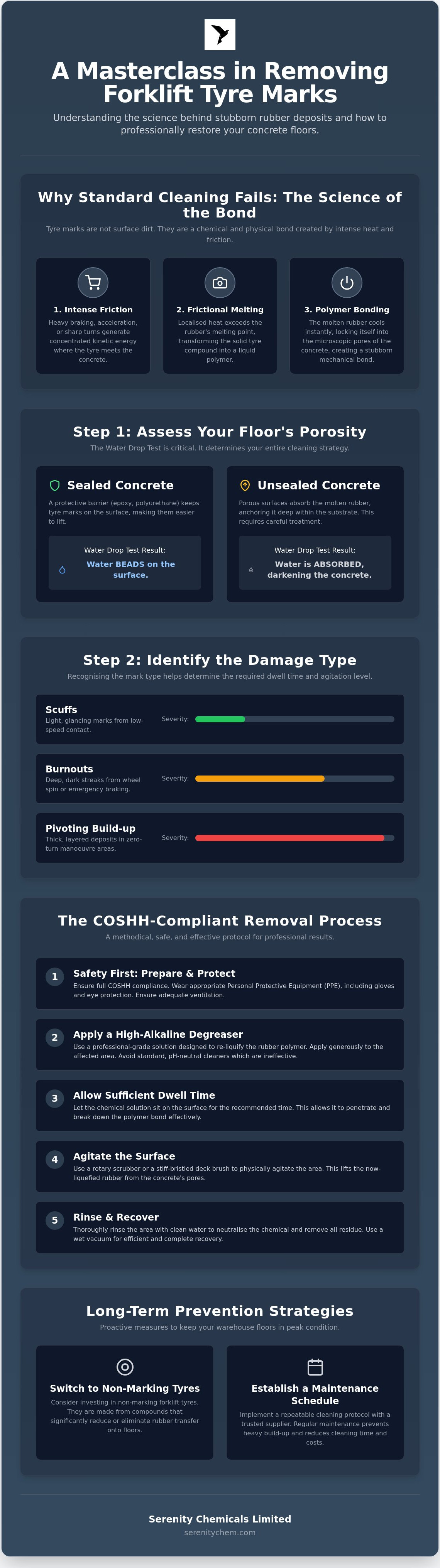
Tyre marks are more than just surface stains; they represent a physical change in the state of the rubber itself. When a heavy forklift accelerates, brakes, or turns sharply, the kinetic energy produced is concentrated into the small area where the tyre meets the floor. This process, known as frictional melting, generates enough localised heat to transform solid rubber into a liquid polymer in a fraction of a second. Understanding this molecular bond is the first step in learning how to remove forklift tyre marks from concrete effectively.
As the forklift moves away, the liquefied rubber cools almost instantly. This rapid temperature drop "locks" the polymer into the microscopic pores and fissures of the concrete surface. Because concrete is naturally porous, the rubber doesn't just sit on top; it becomes mechanically anchored within the substrate. Traditional floor cleaning methods that rely on simple surfactants often fail because they aren't formulated to break these specific polymer bonds. Instead, they merely wash over the surface, leaving the embedded rubber untouched.
The Role of Friction and Heat
Heavy braking and tight manoeuvres can create temperatures that exceed the melting point of industrial rubber compounds. Whilst it might seem counterintuitive, smooth, power-floated concrete floors often suffer the worst damage. The increased surface area contact between the tyre and the polished floor creates more friction, leading to higher heat and more significant rubber transfer. Frictional transfer is the mechanical bonding of heated polymers to a substrate. This bond is particularly stubborn in high-traffic zones, such as loading bays or narrow aisles, where repeated heat cycles bake the rubber deeper into the floor over time.
Chemical Inertness of Industrial Tyres
Industrial tyres are engineered for durability, often containing carbon black and specialised synthetic polymers designed to resist wear. These materials are chemically inert, meaning they don't react to mild, pH-neutral cleaners or standard floor soaps. To address this, a professional approach requires a high-alkaline solution like Serenity Heavy Duty Degreaser. These formulations are specifically designed to re-liquify the rubber deposit, breaking the mechanical anchor and allowing the material to be lifted safely from the concrete pores without damaging the underlying surface.
When assessing your floor, you'll likely encounter three distinct types of rubber contamination:
- Scuffs: Light, glancing marks caused by low-speed contact or sliding.
- Burnouts: Deep, dark streaks resulting from wheel spin or sudden emergency braking.
- Pivoting Build-up: Thick, layered deposits that accumulate in areas where forklifts perform zero-turn manoeuvres.
Identifying which type of mark you're dealing with is essential for choosing the right dwell time and agitation level during the cleaning process. By treating the removal as a chemical state-change rather than a simple scrubbing task, you ensure a more thorough result whilst protecting the integrity of your warehouse floor.
Surface Assessment: Sealed vs. Unsealed Concrete
Before choosing a chemical solution, you must identify the specific characteristics of your warehouse floor. This step is critical because the method for how to remove forklift tyre marks from concrete changes significantly depending on whether the surface is sealed or unsealed. Treating a porous floor as if it were epoxy-coated can lead to the "porosity trap," where liquified rubber is pulled deeper into the concrete, creating a permanent shadow that no amount of scrubbing can fix.
The simplest way to evaluate your surface is the Water Drop Test. Pour a small amount of clean water onto several areas of the floor, particularly in high-traffic aisles. If the water beads and remains on the surface, the concrete is likely sealed with a topical coating. If the water is absorbed within minutes, darkening the concrete as it sinks in, you are dealing with a porous, unsealed surface. This distinction dictates your entire cleaning strategy.
Permanent seals like epoxy or polyurethane provide a protective barrier that keeps rubber deposits on the surface. Whilst this makes removal easier, these coatings are susceptible to chemical etching. In contrast, some facilities use sacrificial waxes in high-turn areas. These waxes are designed to be worn away by forklift activity and replaced periodically, acting as a buffer that prevents the rubber from ever reaching the concrete substrate.
Managing Porous Concrete
When working with unsealed concrete, the "Pre-Wet" technique is your most effective tool. By saturating the area with clean water before applying a degreaser, you fill the concrete's microscopic pores. This prevents the liquified rubber and cleaning chemicals from being sucked into the substrate. You must also manage your dwell time carefully amongst porous surfaces; the goal is to keep the solution active on the surface without allowing it to dry out and redeposit the rubber.
Protecting Floor Coatings
If your floor is painted or resin-coated, you must ensure your cleaner is compatible with the finish. High-alkaline solutions are effective, but they can dull or strip certain sealants if left for too long. Always perform a patch test in an inconspicuous corner to check for any softening or discolouration of the coating. This careful approach ensures you know how to remove forklift tyre marks from concrete without compromising the long-term protection of your facility's floor. If you are unsure about the chemical resistance of your specific floor finish, it is best to consult with a technical expert for tailored advice on application rates.
Professional Removal Process: A Step-by-Step Guide
Removing bonded rubber requires a methodical approach that combines chemical energy with mechanical force. To master how to remove forklift tyre marks from concrete, you must first gather the correct tools for the task. For a professional-grade result, you will need industrial floor scrapers, stiff-bristled deck brushes, and a high-performance solution like Serenity Heavy Duty Degreaser. For larger facilities, a ride-on scrubber-dryer is essential to maintain efficiency and consistency across the floor surface.
The process begins by applying the concentrated degreaser directly to the affected areas. Dwell time is the most critical phase of this process; the solution requires 10 to 15 minutes to penetrate the microscopic pores of the concrete and re-liquify the hardened polymers. If the solution dries out during this time, it will redeposit the rubber, so you may need to apply a light mist of water or more degreaser to keep the surface active. Once the chemical has softened the deposit, use a floor scraper to lift thick build-up, followed by vigorous agitation with a stiff brush—such as those available from J Racenstein—to break the remaining bond.
Spot Cleaning vs. Large Scale Restoration
In tight corners or between racking aisles, hand-scrubbing is often the only viable option. Use a concentrated mix of degreaser and focus on small sections to ensure the rubber is fully emulsified before it can settle. For expansive warehouse floors, ride-on scrubber-dryers equipped with aggressive pads or brushes provide the necessary downward pressure to lift scuffs and burnouts across thousands of square metres. This automated approach ensures a uniform finish and significantly reduces the labour hours required for facility-wide restoration.
The Rinsing Phase
Once the rubber has been agitated, the resulting slurry must be extracted immediately. Leaving emulsified rubber on the floor will create a significant slip hazard and lead to a dull, tacky finish. Thorough rinsing is vital for maintaining the floor's slip-resistance (CoF) and ensuring a safe working environment. This final stage is the definitive answer to how to remove forklift tyre marks from concrete whilst ensuring the floor remains safe for foot traffic. We recommend a final pass using a pH-neutral Serenity Floor Cleaner to neutralise any remaining alkaline residue and ensure a streak-free finish.
Safety and Environmental Standards for Industrial Cleaning
Mastering how to remove forklift tyre marks from concrete involves more than just selecting the right chemical; it requires a commitment to rigorous safety and environmental standards. In the UK, all industrial cleaning activities must adhere to the Control of Substances Hazardous to Health (COSHH) regulations. These legal frameworks ensure that risks are identified and mitigated, protecting both the workforce and the facility's long-term integrity. Operating with a principled approach to safety provides peace of mind and ensures your maintenance routines stand up to the scrutiny of health and safety audits.
When handling industrial-strength degreasers, the correct Personal Protective Equipment (PPE) is non-negotiable. At a minimum, operators should be equipped with chemical-resistant gloves, eye protection, and ensure the work area has adequate ventilation. Choosing a reputable cleaning products manufacturer UK ensures that you receive high-quality, biodegradable formulations that meet modern safety benchmarks. These professional-grade products are designed to deliver results without the unnecessary risks associated with unverified or aggressive solvents.
Safe Chemical Handling
Every cleaning protocol should begin with a thorough review of the Material Safety Data Sheet (MSDS). This document provides essential guidance on storage, handling, and emergency procedures. It's also vital to respect specified dilution ratios. A common misconception in warehouse maintenance is that a higher concentration will work faster; however, over-concentrating a solution can create slippery residues and potentially damage floor sealants. Precision in application ensures both safety and cost-efficiency.
Waste Management
Environmental responsibility extends to the disposal of the resulting slurry after the cleaning process. The grey water produced contains liquified rubber polymers and chemical surfactants, which are regulated under environmental protection laws. You must ensure that this effluent is disposed of through correct drainage systems or collected for treatment. Contaminating local water courses is a serious legal offence; therefore, implementing a robust waste management plan is a critical component of knowing how to remove forklift tyre marks from concrete responsibly.
If you require specific documentation or advice on integrating these safety protocols into your facility's cleaning schedule, please contact our technical support team for expert guidance on COSHH compliance and chemical application.
Prevention and Long-Term Floor Maintenance
Whilst mastering how to remove forklift tyre marks from concrete is essential for facility restoration, the most efficient long-term strategy is to reduce the rate of rubber transfer at the source. Prevention is a proactive investment in your facility's operational efficiency. By combining technical upgrades with behavioural changes, you can maintain a professional floor surface with significantly less labour. A clean floor is not just about aesthetics; it is a fundamental component of a safe and compliant industrial environment.
Creating a barrier between the tyre and the substrate is the most effective way to prevent permanent bonding. High-quality concrete sealants, such as silane or siloxane-based penetrants, densify the concrete and close the microscopic pores that would otherwise anchor liquified rubber. When these sealants are paired with a consistent schedule from a trusted commercial floor cleaner supplier, the effort required for spot cleaning is drastically reduced.
Tyre Selection Strategies
The chemical composition of your forklift tyres is the primary factor in mark frequency. Standard black rubber tyres contain carbon black for durability, which is the main culprit for dark, stubborn streaks. Upgrading to non-marking tyres, typically made from specialised silica-based rubber or polyurethane compounds, can virtually eliminate dark scuffs. Whilst these tyres often carry a higher initial purchase price, a thorough cost-benefit analysis usually reveals significant savings in reduced cleaning labour and chemical consumption over the tyre's lifespan. Polyurethane tyres are particularly effective on smooth, power-floated floors where traction and minimal marking are both priorities.
Creating a Maintenance Plan
A structured maintenance protocol prevents rubber deposits from curing and hardening over time. When rubber is left on the floor, it undergoes further oxidation and becomes increasingly difficult to shift. Implementing a routine that includes daily dust mopping and weekly mechanical scrubbing ensures that light scuffs are removed before they become deep-set burnouts. Using a professional-grade heavy duty floor cleaner during these scheduled cleans keeps the surface tension low and prevents the "frictional melting" deposits from anchoring.
Finally, do not overlook the human element. Operator training plays a vital role in floor preservation. Aggressive manoeuvres, such as rapid acceleration, harsh braking, and high-speed pivoting, are the primary causes of the heat-induced transfer discussed in earlier sections. By encouraging smoother driving habits and documenting ongoing performance, you address the root cause of floor damage. This holistic approach ensures that you spend less time worrying about how to remove forklift tyre marks from concrete and more time focused on your core operations.
Maintaining a Safer, More Professional Warehouse Environment
Restoring your warehouse floor is a technical challenge that requires an understanding of polymer bonding and surface porosity. By moving away from standard cleaning soaps and adopting a methodical approach, you can effectively lift stubborn rubber deposits whilst protecting the integrity of your concrete. Mastering how to remove forklift tyre marks from concrete is a vital skill for any facility manager, as it directly impacts operational safety, professional appearance, and compliance with COSHH standards.
This commitment to a professional appearance often extends beyond the facility to the company's vehicles; for example, businesses in Ontario might look to mobile car detailing Dufferin County to ensure their fleet remains as pristine as their floors.
A clean floor is the result of combining high-performance industrial formulations with a consistent maintenance protocol. We take pride in our British-manufactured quality and our ability to provide reliable UK-wide distribution for all your industrial floor care needs. Transitioning to a proactive cleaning schedule and considering upgrades to non-marking tyres will ensure your facility remains in peak condition for the long term.
If you are ready to implement a more effective cleaning strategy, Explore Serenity’s range of industrial degreasers for professional floor care. Our technical experts are here to help you achieve a pristine, safe working environment with confidence.
Frequently Asked Questions
Can I use a pressure washer to remove forklift tyre marks?
Pressure washing alone is generally ineffective and can potentially damage the concrete substrate if the pressure is too high. Whilst high-pressure water can lift loose debris, it cannot break the molecular bond created by frictional melting. To effectively use this method, you must first apply a professional degreaser to emulsify the rubber, then use a low-pressure rinse to extract the resulting slurry without forcing water and contaminants deeper into the concrete pores.
Will bleach or vinegar remove rubber marks from warehouse floors?
Household agents like bleach or vinegar are not suitable for removing industrial rubber deposits. Bleach lacks the specific chemical properties required to break down synthetic polymers, and vinegar's acidic nature can etch the concrete surface, making it more porous and prone to future staining. Instead, you should utilise a high-alkaline industrial cleaner that is specifically formulated to re-liquify vulcanised rubber whilst remaining safe for the floor's integrity.
How long should I leave the degreaser on the marks before scrubbing?
You should typically allow a professional degreaser to dwell on the marks for 10 to 15 minutes before beginning mechanical agitation. This time is essential for the chemical to penetrate the concrete and break the polymer bond. It is vital to ensure the solution does not dry out during this period; if it begins to dry, apply a light mist of water or more product to keep the chemical active. This is a critical step in learning how to remove forklift tyre marks from concrete effectively.
Are non-marking forklift tyres really effective at preventing marks?
Non-marking tyres are highly effective at preventing the unsightly black streaks caused by carbon black. These tyres use silica or polyurethane compounds that do not leave dark carbon deposits, though they can still leave "clear" or light-coloured imprints due to heat transfer. Whilst these imprints are still present, they are significantly easier to remove during routine maintenance and do not impact the professional appearance of the facility as severely as standard black tyres.
What is the best chemical for removing stubborn rubber build-up?
A high-alkaline industrial degreaser, such as Serenity Heavy Duty Degreaser, is the professional choice for breaking down stubborn rubber build-up. These British-manufactured formulations are specifically engineered to target the complex polymers found in industrial tyres. When applied with the correct dwell time, these chemicals re-liquify the deposit, allowing it to be agitated and rinsed away. This approach is much more effective than using standard floor soaps which cannot penetrate the rubber bond.
Is it possible to remove tyre marks from painted or epoxy floors without stripping the paint?
Yes, you can remove tyre marks from epoxy or painted floors without stripping the finish, provided you use the correct chemical dilution. High-performance degreasers are designed to lift the rubber without reacting with the resin-based coatings. However, you must avoid using overly aggressive abrasive pads or wire brushes that could mechanically strip the paint. Always perform a patch test in an inconspicuous area to ensure the cleaner does not dull or soften your specific floor coating.
How often should a warehouse floor be cleaned to prevent permanent staining?
To prevent permanent staining, warehouse floors should be dust-mopped daily and mechanically scrubbed at least once per week. Regular cleaning ensures that rubber deposits are lifted before they have the opportunity to cure and harden within the concrete pores. Implementing a consistent schedule with a professional-grade cleaner is the most reliable way to maintain floor integrity. This routine maintenance is the definitive answer for how to remove forklift tyre marks from concrete before they become a permanent fixture of your facility.

Hand Sanitiser for Frequent Use: Professional UK Guide 2026
The very product you use to protect your health might be the primary cause of your skin's deterioration. While alcohol-based ...

Food Safe Antibacterial Spray UK: The Professional 2026 Hygiene Guide
Using the wrong disinfectant in a commercial kitchen isn't just a minor oversight; it's a direct threat to your Food Hygiene ...