

Treating an industrial oil spill as a simple cleaning task rather than a chemical process of emulsification is a mistake that often leads to permanent floor damage. You likely recognise the frustration of watching a dark patch spread despite your team's best efforts to scrub it away. Beyond the unsightly appearance, these marks represent serious slip hazards and can lead to failed safety inspections if they aren't addressed correctly. Learning how to remove oil stains from concrete warehouse floor areas is essential for any facility manager who values both operational efficiency and the long-term integrity of their infrastructure.
It's vital to ensure your cleaning regime doesn't inadvertently damage the concrete's porosity or fall foul of the updated 2026 GB CLP hazard standards. This guide provides the professional techniques and chemical protocols you need to eliminate stubborn industrial oil stains and restore a safe, slip-resistant environment. We'll walk you through a repeatable maintenance protocol, detail the latest COSHH compliance requirements, and explain how a principled approach to heavy-duty degreasing can keep your facility compliant and your team protected.
Key Takeaways
- Understand how the porous nature of concrete draws hydrocarbons deep into the slab, making surface-level scrubbing insufficient for permanent removal.
- Follow a structured four-step protocol for immediate spill containment, prioritising professional-grade sorbents over traditional, dusty alternatives.
- Master professional techniques like poultice cleaning and hot water pressure washing to learn how to remove oil stains from concrete warehouse floor areas when the oil is deeply ingrained.
- Maintain full compliance with the latest COSHH regulations and GB CLP hazard standards through principled chemical selection and safe storage practices.
- Establish a repeatable maintenance routine with high-performance degreasers to ensure a clean, slip-resistant environment and protect your facility's long-term safety.
Why Oil Stains are Difficult to Remove from Concrete Warehouse Floors
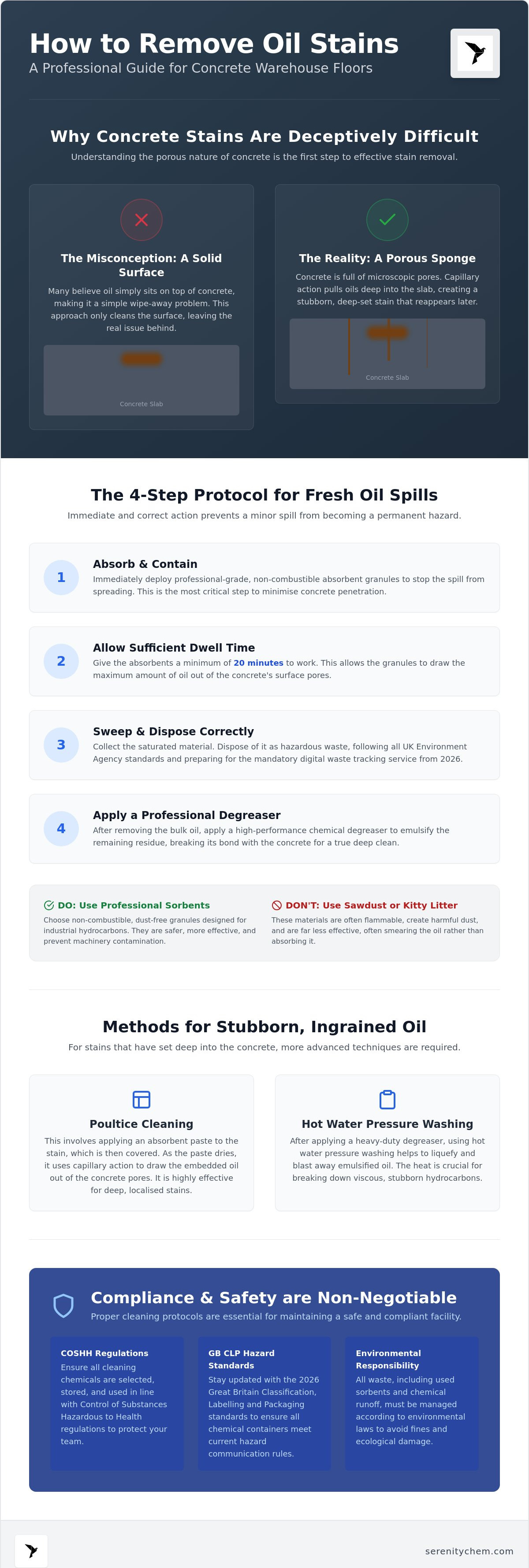
Concrete is often perceived as a solid, impenetrable mass, but this is a misconception that frequently hinders effective cleaning. In reality, it's a naturally porous substrate, functioning much like a hard sponge. When oil is spilled, it doesn't simply rest on the surface; it's drawn deep into the slab through a network of microscopic pores and canals. This physical reality is the primary reason why understanding the science of stain removal is critical before attempting to clean industrial spills.
Capillary action acts as a relentless force, pulling hydrocarbons downward into the concrete matrix. Whilst surface-level cleaning might remove the visible pool of oil, it does nothing to address the reservoir of liquid trapped centimetres below the surface. Over time, industrial oils, which frequently contain complex additives, can chemically discolour the concrete matrix. This results in the "shadow" effect. You might scrub the floor until it looks pristine, only to find the stain has migrated back to the surface weeks later as the concrete breathes and the oil wicks upward.
The Role of Concrete Porosity
The microscopic structure of concrete is defined by "voids" created during the hydration and curing process. These tiny pockets trap contaminants, protecting them from standard floor scrubbers. The depth of a stain is often dictated by the floor's finish. A power-trowelled floor has a denser surface than a brushed finish, yet it's still susceptible to deep penetration if the oil isn't contained immediately. In a warehouse setting, heavy traffic from forklifts and reach trucks compounds the issue. The weight of these vehicles literally presses the oil deeper into the pores, making the task of how to remove oil stains from concrete warehouse floor areas significantly more complex than in a domestic setting, where professional hard floor and surface care insights from rutlandcleaning.co.uk are frequently utilised.
Chemical Bonding of Hydrocarbons
Effective removal isn't just about physical extraction; it's about overcoming chemical adhesion. Oil molecules don't just sit in the voids; they often adhere to the calcium silicate hydrate, which is the primary "glue" that holds concrete together. This bond creates a hydrophobic barrier. Because oil and water don't mix, standard water-based cleaning solutions cannot penetrate this barrier to lift the contaminant. To achieve a deep clean, you must use a solution that breaks the surface tension and emulsifies the hydrocarbons. This process allows the oil to be suspended in liquid and extracted from the slab's interior rather than just smeared across the surface.
The 4-Step Protocol for Fresh Oil Spill Management
Speed is the deciding factor in whether a spill becomes a permanent mark. When an oil leak occurs, the immediate priority is containment. You must prevent the liquid from spreading across the warehouse centre or reaching drainage points. This isn't just about aesthetics; it's about adhering to safety standards and environmental responsibility. Following a structured approach is the most reliable way to learn how to remove oil stains from concrete warehouse floor slabs before they become deep-seated problems.
Absorption and Containment
The first stage of any response is physical removal. You shouldn't reach for a mop immediately, as this often spreads the contaminant further. Instead, follow these steps:
- Step 1: Deploy non-combustible absorbent granules. Avoid using sawdust or domestic-grade "solutions" like kitty litter. These materials are often flammable and create excessive dust, which can interfere with warehouse machinery.
- Step 2: Allow a minimum dwell time of 20 minutes. This ensures maximum uptake of the pooling oil, pulling it away from the concrete surface.
- Step 3: Sweep the saturated granules. Disposal must be handled with care. As of 2026, UK businesses are required to use the mandatory digital waste tracking service for hazardous materials. While we often look to EPA Oil Pollution Prevention regulations for high-level guidance on spill prevention, your local disposal must comply with current UK Environment Agency standards.
Initial Chemical Application
Once the bulk oil is removed, a residue will likely remain within the top layer of the concrete. This is where chemical intervention becomes necessary. If you are unsure about which protocol suits your specific floor finish, you can speak with our technical team for tailored guidance.
Step 4: Apply a professional solution like Serenity Heavy Duty Degreaser to the affected area. This British-manufactured formulation is specifically designed to penetrate the concrete's pores and emulsify the hydrocarbons. You shouldn't just let the chemical sit; scrubbing with a stiff nylon brush is essential. This mechanical agitation helps break the surface tension we discussed in the previous section, allowing the degreaser to reach the oil trapped in the voids.
Finally, focus on extraction. Don't simply wash the residue into your floor drains. Use a wet-vacuum or a clean, absorbent mop to lift the emulsified oil out of the slab. We recommend a "rinse and repeat" method. If a "rainbow" sheen is still visible when you apply clean water, the pores still contain oil. Continue the process until the water remains clear, ensuring a clean and slip-resistant finish.
Professional Methods for Removing Stubborn, Ingrained Oil
When oil has been allowed to sit for weeks or months, it's no longer a surface contaminant. It has migrated deep into the concrete matrix through the capillary action discussed earlier. In these instances, a standard mop and bucket won't suffice. To successfully address how to remove oil stains from concrete warehouse floor areas with heavy, aged contamination, you must employ methods that prioritise deep extraction over surface abrasion. This requires a combination of heat, chemistry, and patience.
The Poultice Technique for Deep Stains
Poultice cleaning is the professional secret for drawing out "wicked" oil stains that refuse to budge. A poultice is a paste created by mixing an absorbent powder, such as diatomaceous earth or technical-grade talc, with a high-performance degreaser. This paste is applied over the stain in a layer approximately 5mm thick and covered with plastic sheeting to slow the evaporation process.
The science behind this method relies on wicking. As the degreaser breaks down the oil, the absorbent powder draws the liquid upward out of the concrete pores and into the paste. For heavy industrial contamination, we recommend a dwell time of 12 to 24 hours. Once the paste is completely dry, it can be swept away, taking the ingrained oil with it. This method is far more effective for large-scale warehouse maintenance than domestic DIY suggestions like baking soda, which lacks the chemical strength to handle industrial hydrocarbons.
Industrial Degreasers vs. Household Detergents
It's a common mistake to assume that household dish soap is a suitable substitute for professional chemicals. Whilst dish soap is designed to break down animal fats at a sink, it's insufficient for the complex, long-chain hydrocarbons found in machinery oil and hydraulic fluids. Professional surfactants, such as those found in Serenity Floor Cleaner, are engineered to organise themselves at a molecular level. They surround oil molecules, lifting them from the concrete's calcium silicate hydrate "glue" and holding them in suspension so they can be rinsed away.
For large-scale floor maintenance, using concentrated, British-manufactured formulas ensures both efficacy and cost-efficiency. These products are designed to work in conjunction with industrial floor scrubbers, providing the mechanical agitation needed to ensure the chemical reaches the full depth of the concrete's porosity.
What Not to Use: Protecting Your Infrastructure
Maintaining a principled approach to cleaning means knowing which substances to avoid. Some online resources suggest using gasoline, bleach, or strong acids. These are dangerous and counterproductive for the following reasons:
- Gasoline: This creates an extreme fire hazard and is entirely non-compliant with UK health and safety standards. It also leaves its own residue behind.
- Bleach: Whilst it may lighten the colour of a stain, bleach does not degrease. It simply masks the problem whilst potentially reacting with other warehouse chemicals.
- Acid-Based Cleaners: Acids etch the concrete, opening the pores further and making the floor even more susceptible to future staining. They also weaken the structural integrity of the slab's surface.
COSHH Compliance and Environmental Safety in Industrial Cleaning
Managing industrial spills is as much a matter of legal duty as it is of facility maintenance. Under the Control of Substances Hazardous to Health (COSHH) Regulations 2002, employers are responsible for protecting staff from the risks associated with hazardous chemicals. Understanding how to remove oil stains from concrete warehouse floor areas requires more than just mechanical knowledge; it demands a thorough grasp of chemical safety and environmental responsibility. Compliance is non-negotiable. Neglecting these standards doesn't just risk staff health; it exposes your business to significant financial penalties.
Regulatory Compliance for UK Warehouses
Every cleaning agent used in a professional setting must be accompanied by an up-to-date Safety Data Sheet (SDS). This document is the cornerstone of your risk assessment. By August 15, 2026, all cleaning chemicals used in UK facilities must comply with the updated GB CLP (Classification, Labelling and Packaging) hazard standards. It's essential to review your inventory to ensure your degreasers meet these criteria.
Training is equally vital. Staff should be proficient in correct dilution ratios to prevent chemical wastage and avoid damaging the concrete's surface. We recommend maintaining a digital record of all cleaning schedules and COSHH assessments. This transparency is invaluable during safety audits and ensures your facility operates with integrity. If you need assistance aligning your cleaning protocols with current safety standards, you can request a consultation for your facility with our technical experts.
Eco-Friendly Disposal of Contaminants
Environmental protection is a core component of principled warehouse management. You must never allow oil-contaminated runoff to enter the drainage system. As of April 2026, the national digital waste tracking service is mandatory in the UK. This system creates a permanent record of waste from the moment it's produced until its final disposal.
- Legal Disposal: All oil-saturated absorbents and contaminated waste water must be handled by licensed waste carriers.
- Financial Risk: The Environment Agency can issue hourly charges of £118 to non-compliant businesses to cover investigation costs, alongside standard fines.
- Chemical Selection: Opting for biodegradable solutions like Serenity Heavy Duty Degreaser helps reduce your environmental footprint whilst maintaining high efficacy.
Finally, ensure all staff are equipped with the correct Personal Protective Equipment (PPE). This typically includes chemical-resistant gloves, eye protection, and, in some cases, respiratory protection if the cleaning process involves high-pressure misting. Safety is the foundation of any successful maintenance protocol.
Long-term Maintenance and Prevention with Serenity Solutions
Transitioning from reactive spill management to a proactive maintenance culture is the most effective way to protect your facility's infrastructure. Whilst the previous sections detailed how to remove oil stains from concrete warehouse floor areas using intensive methods, the ultimate goal is to prevent hydrocarbons from ever reaching the concrete's interior matrix. A clean, well-maintained floor doesn't just look professional; it significantly improves light reflectivity and staff morale whilst ensuring a slip-resistant environment for your team.
Preventative Floor Care Strategies
Consistency is the foundation of effective floor care. We recommend scheduling weekly mechanical cleans with a trusted commercial floor cleaner supplier to ensure your team always has the necessary tools at hand. Using a scrubber-dryer with a no-rinse formulation for daily maintenance can save significant operational time. This routine removes minute oil droplets and dust before they can be ground into the slab by heavy forklift traffic, preventing the "shadow" effect from developing over time.
Another critical preventative measure is the application of concrete densifiers and sealers. These treatments react chemically with the concrete to close off the pores we discussed in section one. By creating a hydrophobic barrier, you significantly increase the dwell time available for your team to contain a spill before it begins to wick into the slab. To support this, every high-risk zone, such as forklift charging stations or loading bays, should be equipped with a dedicated "Spill Kit" station for immediate response.
The Serenity Advantage for Industrial Facilities
Sourcing your chemical solutions direct from a cleaning products manufacturer UK based like Serenity Chemicals provides several operational advantages. Our proprietary formulations, such as Serenity Heavy Duty Degreaser, are engineered for both precision spot cleaning and large-scale use in industrial scrubber-dryers. Buying in bulk ensures that your facility is never without essential supplies, maintaining the integrity of your cleaning programme without interruption.
Operating with a principled expert by your side means you have access to direct-from-manufacturer support for technical application queries. Whether you're dealing with a particularly stubborn ingrained stain or need guidance on how to remove oil stains from concrete warehouse floor slabs with specific finishes, our team is here to help. By implementing these long-term maintenance protocols, you move beyond simple cleaning and toward a comprehensive strategy of facility protection and safety compliance.
Securing the Future of Your Warehouse Infrastructure
Establishing a professional floor care regime is a fundamental component of responsible facility management. We have detailed the chemical principles of emulsification and the importance of adhering to the latest UK safety standards to protect both your staff and the environment. By implementing a structured response to spills and utilising deep-extraction techniques, you now have a repeatable protocol for how to remove oil stains from concrete warehouse floor areas that maintains the slab's long-term integrity. Transitioning from reactive cleaning to a preventative maintenance culture ensures your warehouse remains a high-performance environment.
Serenity Chemicals operates as a principled partner for industrial facilities across the country. As a UK-based manufacturer, we provide professional-grade industrial formulations that are trusted by UK warehouse managers for high-traffic floor care. Our solutions are engineered to deliver thorough results whilst maintaining full compliance with evolving regulatory requirements. To equip your team with the right tools for the job, you can order Serenity Heavy Duty Degreaser direct from our UK factory. Investing in the correct chemistry today ensures a safer, cleaner, and more efficient workspace for years to come.
Frequently Asked Questions
Can you really get old oil stains out of concrete?
Yes, old oil stains can be removed through the wicking process of a professional poultice or a deep-penetrating degreaser. Whilst these stains are difficult because they've migrated into the concrete's pores, a slow-drying paste effectively draws the hydrocarbons back to the surface. It's a matter of patience and chemistry rather than just brute scrubbing, which only addresses the top layer of the slab.
Will pressure washing damage my warehouse floor?
Pressure washing won't damage your floor if you use the correct PSI and nozzle distance. However, using a narrow, high-pressure stream too close to the surface can etch the concrete, making it more porous and susceptible to future staining. It's safer to use a lower pressure setting combined with hot water and a professional degreaser to lift the oil without compromising the slab's integrity.
Is it safe to use bleach on concrete oil stains?
Bleach is not a safe or effective solution for removing oil from concrete. It's an oxidiser that might lighten the colour of the mark, but it lacks the surfactants needed to break down and lift grease. Bleach can also react dangerously with other warehouse chemicals, creating toxic fumes that pose a serious health and safety risk to your staff.
What is the best degreaser for a concrete warehouse floor?
The most effective solution is a concentrated, surfactant-based industrial formula like Serenity Heavy Duty Degreaser. When researching how to remove oil stains from concrete warehouse floor surfaces, it's vital to select a product that emulsifies hydrocarbons rather than just moving them. This ensures the oil is suspended in the cleaning solution and can be fully extracted from the concrete's microscopic voids.
How long should I leave a degreaser to sit on a stain?
Standard applications usually require a dwell time of 15 to 20 minutes to allow the chemical to penetrate the surface. For deeply ingrained oil, a poultice application should be left for 12 to 24 hours to ensure the wicking process is complete. You shouldn't let the product dry out during the initial application, as the liquid state is necessary for the emulsification of the oil.
Do I need to seal my warehouse floor after cleaning it?
Sealing your warehouse floor after a deep clean is highly recommended to prevent future contamination. Applying a concrete densifier or sealer creates a hydrophobic barrier that keeps spills on the surface, allowing for much easier containment and removal. This preventative step protects the concrete's porosity and helps maintain a slip-resistant environment for your machinery and staff.
How do I dispose of oil-contaminated cleaning water in the UK?
You must dispose of all contaminated waste water through a licensed carrier to remain compliant with UK environmental regulations. As of April 2026, businesses are required to use the mandatory digital waste tracking service for all hazardous materials. Discharging oil-contaminated water into the public drainage system is a serious breach of the "duty of care" and can result in heavy fines.
What PPE is required when using industrial degreasers?
Staff should wear chemical-resistant gloves, safety goggles, and non-slip waterproof boots during any deep-cleaning operation. If the cleaning process involves high-pressure spraying, respiratory protection may also be necessary to prevent the inhalation of mist. Always check the Safety Data Sheet (SDS) provided by your manufacturer to ensure your team is following the specific safety protocols for the chemicals being used.

Hand Sanitiser for Frequent Use: Professional UK Guide 2026
The very product you use to protect your health might be the primary cause of your skin's deterioration. While alcohol-based ...

Food Safe Antibacterial Spray UK: The Professional 2026 Hygiene Guide
Using the wrong disinfectant in a commercial kitchen isn't just a minor oversight; it's a direct threat to your Food Hygiene ...