

If you treat industrial cleaning as a mere chore rather than a vital maintenance strategy, you're likely shortening the lifespan of your most expensive assets. Many factory managers feel the daily pressure of rising downtime and the complexity of finding a reliable factory degreaser for heavy machinery that meets the latest 2026 COSHH updates. It's frustrating when a cleaner meant to help actually causes corrosion on sensitive aluminium components or degrades rubber seals. You need a solution that works effectively without compromising safety or equipment integrity.
Selecting the right product is no longer just about removing stubborn grease; it's about precision and protection. This guide will help you master the selection and application of industrial degreasers to protect your machinery, ensure operator safety, and maintain peak factory efficiency. We'll explore how to manage updated safety standards, avoid common chemical pitfalls, and implement a cleaning regime that ensures full health and safety compliance on the shop floor.
Key Takeaways
- Learn how to distinguish between standard detergents and high-performance industrial formulas that use advanced emulsification to lift carbonised grease.
- Discover how to select the optimal factory degreaser for heavy machinery by assessing specific soiling types and environmental drainage requirements.
- Understand the critical importance of 2026 COSHH compliance and the correct lock-out tag-out (LOTO) procedures to ensure operator safety during maintenance.
- Evaluate the technical differences between caustic and non-caustic formulations to prevent chemical corrosion on sensitive aluminium components and seals.
- Gain insights into how professional-grade solutions reduce cleaning time whilst extending the operational lifespan of your expensive factory assets.
What is a Factory Degreaser for Heavy Machinery?
A factory degreaser for heavy machinery is a high-performance chemical formulation engineered specifically to penetrate and emulsify the most stubborn industrial contaminants. Unlike standard household detergents, which merely surface-clean, these specialised industrial agents are designed to break the molecular bonds of carbonised grease, bitumen, and hydraulic oils. In a manufacturing environment, these substances often bake onto metal surfaces due to high operating temperatures, making them almost impossible to remove with simple soap and water.
Relying solely on mechanical cleaning, such as scraping or wire brushing, is often insufficient and potentially damaging to your assets. These methods can score precision-engineered components or push abrasive grit deeper into bearings and seals. By utilising a professional-grade degreaser, you ensure that contaminants are lifted safely without the need for excessive physical force. Understanding the technical Solvent degreasing process is essential for any facility manager looking to maintain asset integrity whilst minimising physical wear on equipment.
Beyond cleanliness, degreasing serves as a critical diagnostic tool. A clean machine is a transparent machine. When layers of grime are removed, maintenance teams can easily spot early signs of stress fractures, hydraulic leaks, or overheating components that were previously hidden. It's a proactive step that prevents minor issues from escalating into catastrophic failures.
Once surfaces are thoroughly decontaminated, applying advanced protection can further extend the life of your equipment; for instance, you can explore Ceramic Graphene Shield Coating to safeguard high-value components against future corrosion and grime buildup.
The Impact of Grease Accumulation on Machinery
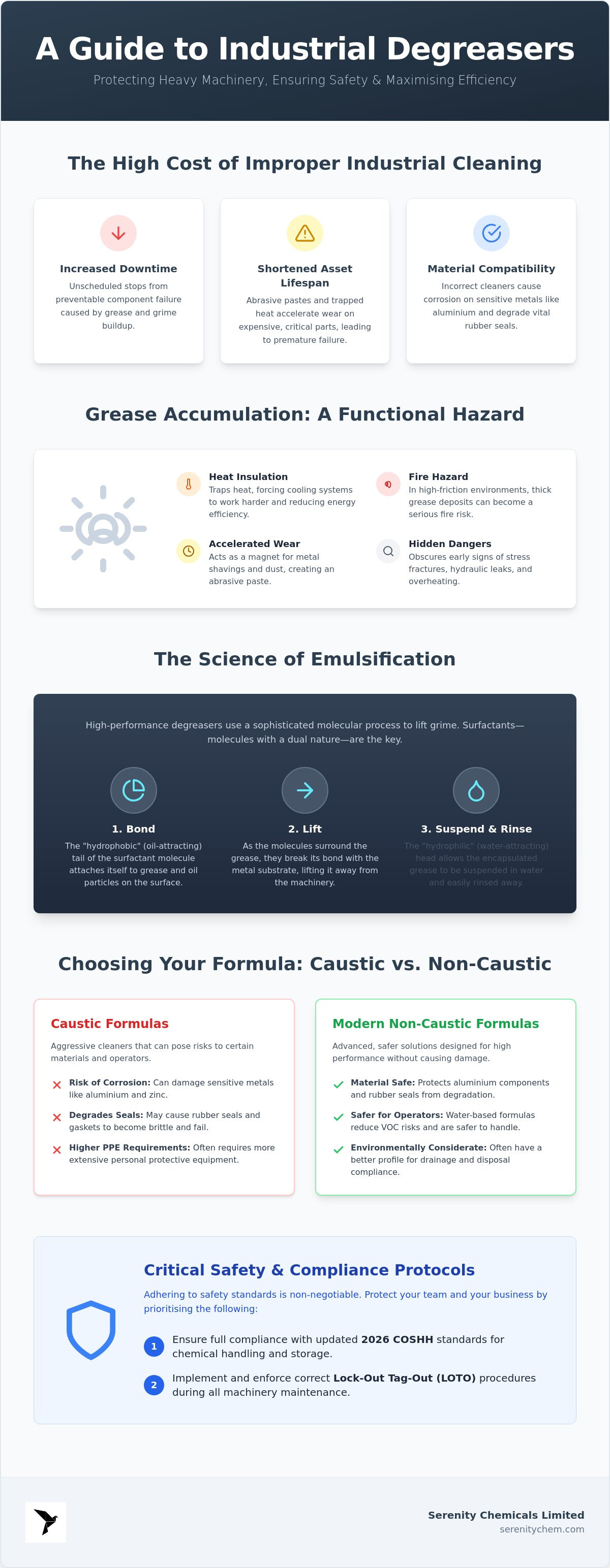
Grease is more than just an aesthetic issue; it's a functional hazard. It acts as an insulator, trapping heat and forcing cooling systems to work harder, which reduces overall energy efficiency. In high-friction environments, thick grease deposits can become fire hazards. Perhaps most dangerously, grease acts as a magnet for metal shavings and atmospheric dust. This creates an abrasive paste that rapidly accelerates the wear of moving parts and bearings.
Key Applications in the Industrial Sector
The versatility of a factory degreaser for heavy machinery makes it indispensable across various sectors. It's commonly used for:
- Static Production Lines: Keeping conveyor systems and automated assembly arms free from lubrication buildup to prevent belt slippage.
- Mobile Plant Machinery: Maintaining the articulation points and hydraulic rams of excavators, cranes, and forklifts.
- Workshop Floors: Removing heavy oil spillages to ensure a safe, slip-free environment for the factory floor team.
Using a UK-manufactured solution like Serenity Heavy Duty Degreaser from Serenity Chemicals Limited ensures that your facility remains compliant with local safety standards whilst delivering the chemical strength required for these demanding environments.
In more specialised industrial sectors, such as oil and gas, maintenance extends to the reclamation of process chemicals; learn more about TEG Reclamation Services to see how glycol reconditioning helps maintain dehydration performance alongside physical cleaning regimes.
The Science of Industrial Degreasing: How Formulas Work
Chemistry drives performance. While heat and pressure play their part, the chemical composition of a factory degreaser for heavy machinery determines how effectively grime is lifted without damaging the underlying substrate. Professional-grade formulas don't just "dissolve" grease; they use a sophisticated molecular process to detach it from the metal. This scientific approach ensures that even carbonised oils, which have been baked onto engine blocks or hydraulic rams, can be removed without aggressive scrubbing.
The choice between water-based and solvent-based mediums is a critical first step. Traditional solvent degreasers are often highly effective on petroleum-based greases but come with higher VOC (Volatile Organic Compound) risks and stricter storage requirements. Modern water-based alternatives, like Serenity Heavy Duty Degreaser, have become the industry standard. These formulas utilise water as a carrier for powerful active ingredients, offering a safer profile for both the operator and the environment whilst maintaining the strength needed for heavy-duty applications.
Emulsifiers and Surfactants Explained
Surfactants are the "engine" of any degreasing formula. These molecules possess a dual nature: a hydrophobic tail that attaches to oil and a hydrophilic head that bonds with water. When applied to a greasy surface, these molecules wedge themselves between the oil and the metal. Emulsification is the chemical process where surfactants surround oil particles to break their bond with a surface, allowing them to be suspended in water for easy removal.
For heavy machinery, "cling time" is a vital factor. If a degreaser is too thin, it will simply run off vertical surfaces before the surfactants can work. High-quality industrial formulas are engineered with the right viscosity to dwell on the surface, ensuring the chemical reaction has sufficient time to penetrate thick layers of sludge. If you're unsure which viscosity suits your specific equipment, it's often best to consult with a technical expert regarding your application methods.
Protecting Sensitive Metals and Alloys
One of the most common mistakes in factory maintenance is using a highly caustic cleaner on sensitive metals. Caustic degreasers, often containing sodium hydroxide, are excellent for heavy steel but can be disastrous for aluminium or soft alloys. These chemicals can cause "etching," a process that leaves the metal surface dull, pitted, or structurally weakened. This is why non-caustic, pH-balanced formulas are increasingly favoured for modern machinery that incorporates multiple material types.
Precision components also rely on rubber seals and gaskets to maintain pressure and prevent leaks. A degreaser with an extreme pH level or harsh solvents can cause these seals to swell, crack, or become brittle over time. By selecting a formula designed with material compatibility in mind, you protect the longevity of these small but critical parts, ensuring that your cleaning routine doesn't inadvertently lead to mechanical failure.
Choosing the Right Degreaser for Your Factory Environment
Selecting a factory degreaser for heavy machinery requires a clear understanding of your specific work environment. A solution that works for an excavator in a quarry might be entirely inappropriate for a stationary conveyor in a food production plant. You first need to identify the primary contaminant. Petroleum-based soiling, such as bitumen or hydraulic fluid, requires high-performance surfactants that can break down complex hydrocarbons. In contrast, organic fats and vegetable oils found in food processing demand a different chemical profile to ensure effective removal without leaving residues that could contaminate the product stream.
Environmental responsibility is no longer optional in 2026. Facility managers must consider the biodegradability of their chemicals and how they interact with factory drainage systems. Using a water-based, biodegradable formula reduces the risk of breaching environmental regulations whilst simplifying the waste disposal process. You should also check for compatibility with your existing maintenance equipment. Most modern industrial degreasers are designed to work seamlessly with pressure washers and steam cleaners, which can significantly reduce the amount of chemical required by adding mechanical energy to the cleaning process.
Food-Safe vs. Industrial-Grade Formulas
Machinery used in food production must meet stringent hygiene standards to prevent cross-contamination. If your equipment handles consumables, you must use a non-tainting, food-grade solution. These formulas are specifically engineered to be odourless and leave no chemical trace that could affect the taste or safety of food. For broader hygiene requirements in these environments, many managers refer to a professional food safe sanitiser for commercial kitchens to maintain a sterile workspace alongside their heavy-duty degreasing tasks.
Concentration and Dilution Strategies
The most cost-effective way to manage factory hygiene is by using concentrated formulas. Buying in bulk allows you to tailor the dilution rate to the severity of the grime: a 1:10 ratio for heavy engine degreasing, and perhaps 1:50 for light floor maintenance. This flexibility ensures you don't waste product on simpler tasks. Sourcing these chemicals directly from a cleaning products manufacturer UK based, such as Serenity Chemicals Limited, provides better value and ensures a reliable supply chain. It's often helpful to use dedicated mixing stations to ensure consistent dilution, which prevents over-usage and keeps your maintenance budget under control.
Safe Application and COSHH Compliance
Safety in an industrial environment isn't just about following rules; it's about protecting your team and your capital investments. Before applying any factory degreaser for heavy machinery, you must ensure the equipment is properly prepared. The most critical step is the implementation of lock-out tag-out (LOTO) procedures. This ensures that the machinery cannot be accidentally energised whilst maintenance staff are working in close proximity to moving parts or electrical systems. Once the machine is isolated, remove any loose debris manually to allow the chemical to work directly on the bonded grease.
The application method should be chosen based on the component's accessibility and the severity of the grime. Spray application is highly efficient for large, external surfaces like chassis or static frames. For intricate parts or heavy buildup around bearings, manual brushing allows for targeted agitation. In some workshops, immersion or "dip tanks" are used for removable components, allowing the parts to soak in a concentrated solution. Regardless of the method, you must manage runoff carefully. Industrial sites should utilise interceptor tanks to capture chemical waste and prevent it from entering the main water system. A final post-cleaning inspection is essential to ensure no chemical residue remains, as dried surfactants can sometimes attract new dust or interfere with future lubrication.
Essential PPE and Operator Safety
Handling heavy-duty chemicals requires a disciplined approach to personal protective equipment (PPE). At a minimum, operators should wear chemical-resistant gloves, safety goggles, and protective aprons. If you're degreasing in confined spaces or using high-pressure sprayers that create a fine mist, respiratory protection is necessary to prevent the inhalation of vapours. Always ensure that Material Safety Data Sheets (MSDS) are not just filed away in an office but are physically accessible on the factory floor. This ensures that in the event of accidental contact, the correct first-aid measures can be taken immediately.
Navigating COSHH on the Factory Floor
Under the Control of Substances Hazardous to Health (COSHH) regulations, employers have a legal duty to assess the risks associated with every chemical used on-site. When conducting a COSHH assessment for a factory degreaser for heavy machinery, consider the concentration of the product, the duration of exposure, and the ventilation of the work area. Training is a vital component of this compliance; staff must understand the specific hazards and the correct dilution rates to work safely. For audit purposes, it's helpful to maintain an ultimate professional cleaning chemicals list. This central record simplifies the process of reviewing safety protocols and ensures that your facility remains fully compliant with 2026 standards.
If you require specific guidance on conducting risk assessments for your equipment, you can contact our technical team for support regarding safe chemical application.
Why Serenity Heavy Duty Degreaser is the Industry Choice
Selecting a factory degreaser for heavy machinery involves more than just raw chemical strength; it requires a formula that aligns with the operational values of a modern facility. Serenity Heavy Duty Degreaser has become a preferred solution because it embodies the balance between high-performance cleaning and ethical manufacturing. Engineered specifically to exceed UK industrial safety requirements, this product provides facility managers with the peace of mind that their maintenance protocols are both effective and responsible. It represents the practical application of the science discussed earlier, delivering the emulsification power needed for the most demanding environments.
By choosing a product from Serenity Chemicals Limited, you aren't just purchasing a chemical; you're entering a direct partnership with a UK-based manufacturer. This eliminates the uncertainty of international supply chains and ensures that technical support is always available from experts who understand the nuances of the British regulatory landscape. Whether you manage a single workshop or multiple industrial sites, having a reliable, high-specification degreaser is fundamental to maintaining equipment longevity and protecting your capital investments.
Reliability and Ethical Manufacturing
Consistency is the hallmark of professional maintenance. Serenity Chemicals Limited maintains rigorous quality control standards to ensure that every batch of Serenity Heavy Duty Degreaser performs with the same efficacy. This level of reliability is particularly critical for automated cleaning systems, where fluctuations in chemical concentration can lead to nozzle blockages or inconsistent results. Our focus on ethical manufacturing means that while the formula remains aggressive against industrial grime, it is developed with a commitment to user safety and environmental integrity. This approach supports a sustainable future for UK industry whilst providing the results that factory managers expect.
Ordering and Technical Support
We understand that large-scale operations require flexible procurement options. Serenity Chemicals Limited provides comprehensive bulk wholesale solutions to ensure your facility is never without the necessary supplies for its maintenance schedule. Our team also offers tailored technical support to help you determine the most effective dilution rates and application methods for your specific machinery, ensuring you get the most value from every litre. If you want to refine your maintenance strategy with a high-performance, UK-made solution, we invite you to enquire about Serenity Heavy Duty Degreaser for your facility today and discover how a principled approach to hygiene can improve your factory efficiency.
Optimising Your Machinery Maintenance for 2026
Efficient factory operations rely on more than just high-quality equipment; they require a disciplined approach to chemical maintenance. By understanding the science of emulsification and the critical need for material compatibility, you can prevent unnecessary wear on sensitive alloys and gaskets. Selecting the right factory degreaser for heavy machinery is a strategic decision that directly impacts your facility's productivity and long-term asset health. Ensuring full compliance with the latest 2026 COSHH standards protects your workforce whilst maintaining the highest level of operational integrity.
At Serenity Chemicals, we're committed to providing the technical expertise and high-performance solutions your environment demands. Our UK-based manufacturing ensures guaranteed quality and a reliable supply chain, whilst our specialised formulations are engineered to meet professional UK safety standards. If you're ready to enhance your cleaning regime and protect your machinery, we're here to help you make an informed choice.
Explore our range of industrial-grade degreasers at Serenity Chemicals today. We look forward to supporting your maintenance goals with solutions you can trust.
Frequently Asked Questions
What is the best way to degrease heavy machinery without a pressure washer?
The most effective method for degreasing without a pressure washer involves applying a concentrated factory degreaser for heavy machinery and using manual agitation with stiff brushes. This physical action helps the surfactants penetrate thick sludge that a simple spray might miss. Once the grease is lifted, you can wipe the surface clean with industrial cloths or rinse with a low-pressure hose to remove the emulsified residue.
Is heavy-duty degreaser safe to use on aluminium engine parts?
Safety on aluminium depends entirely on the chemical's pH level and whether it is a non-caustic formulation. Caustic degreasers containing sodium hydroxide can cause rapid chemical etching and surface pitting on soft alloys like aluminium. You should always select a pH-balanced solution, such as Serenity Heavy Duty Degreaser, which is engineered to be effective on iron and steel whilst remaining gentle enough for sensitive alloy components and seals.
How often should factory machinery be degreased for optimal performance?
Most industrial environments require a deep degreasing cycle every three to six months, though high-usage equipment may need attention monthly. Regular cleaning prevents the buildup of heat-trapping sludge and allows maintenance teams to identify leaks or stress fractures early. Establishing a routine based on your specific machine's operating hours ensures that a factory degreaser for heavy machinery is used proactively rather than as a reactive fix for mechanical failure.
Can I use a factory degreaser on electrical components?
You shouldn't apply liquid degreasers directly to electrical components, wiring, or open control panels due to the risk of short circuits and corrosion. If cleaning is necessary around these areas, ensure the power is isolated via LOTO procedures and use specialised contact cleaners or damp cloths for precision work. Always protect sensitive electrical housings with plastic sheeting before using spray or pressure-wash application methods on the surrounding machinery frame.
What is the difference between a solvent and a water-based degreaser?
Solvent-based degreasers utilise chemical hydrocarbons to break down petroleum oils, but they often carry higher VOC risks and flammability concerns. Water-based degreasers use advanced surfactants and emulsifiers to lift grease from the surface so it can be rinsed away with water. Modern water-based formulas are now the preferred choice for many UK factories because they offer a safer profile for operators whilst maintaining high cleaning efficacy on heavy industrial grime.
How do I dispose of degreaser runoff in compliance with UK law?
UK law requires that all chemical runoff containing oils and surfactants is captured and treated before entering the drainage system. You should never allow degreasing waste to enter surface water drains or open ground. Most industrial sites utilise oil-water interceptors or specialised sumps to separate contaminants. It's your responsibility to ensure that any waste collected is disposed of via a licensed waste carrier in accordance with environmental regulations.
Does Serenity Heavy Duty Degreaser require rinsing after application?
Rinsing is a necessary step to ensure that the suspended grease and chemical surfactants are completely removed from the machine's surface. If left to dry, the emulsified residue can attract new dust and grit, potentially creating an abrasive paste that damages moving parts. A thorough rinse with clean water ensures a neutral, residue-free finish, leaving the machinery ready for re-lubrication and inspection after the cleaning cycle is complete.

Hand Sanitiser for Frequent Use: Professional UK Guide 2026
The very product you use to protect your health might be the primary cause of your skin's deterioration. While alcohol-based ...

Food Safe Antibacterial Spray UK: The Professional 2026 Hygiene Guide
Using the wrong disinfectant in a commercial kitchen isn't just a minor oversight; it's a direct threat to your Food Hygiene ...