

What if the "clean" shine on your kitchen floor is actually a hidden safety hazard? Many operators don't realise that standard detergents often leave behind a microscopic chemical film that traps grease within floor textures. Finding an effective non slip floor cleaner for restaurants is about more than just surface appearance; it is about ensuring your floor maintains the 0.42 Dynamic Coefficient of Friction (DCOF) required to keep your team safe during a hectic service.
It's a constant struggle to manage grease build-up in floor pits whilst trying to avoid the high costs of ineffective chemicals or the threat of a failed safety inspection. You deserve peace of mind and a floor that provides genuine traction. We will show you how to choose a professional-grade solution that eliminates slippery residues and meets 2026 safety expectations. This guide explores the transition from SCOF to DCOF standards and the essential role that high-quality degreasing plays in a modern slip-prevention programme.
Key Takeaways:
- Understand how microscopic grease films fill floor textures, significantly reducing traction and increasing the risk of accidents in high-pressure kitchens.
- Learn to identify a professional non slip floor cleaner for restaurants by looking for advanced surfactants that effectively emulsify stubborn oils.
- Discover the importance of no-rinse chemical strategies that save valuable time whilst maintaining the floor's original slip-resistant properties and Pendulum Test Value.
- Balance operational efficiency with safety by choosing COSHH-compliant solutions that offer high dilution ratios for a lower cost per wash.
- Explore how Serenity Floor Cleaner and Serenity Heavy Duty Degreaser work together as a complete system to protect your staff and ensure long-term floor integrity.
The Science of Friction: Why Restaurant Floors Become Hazards
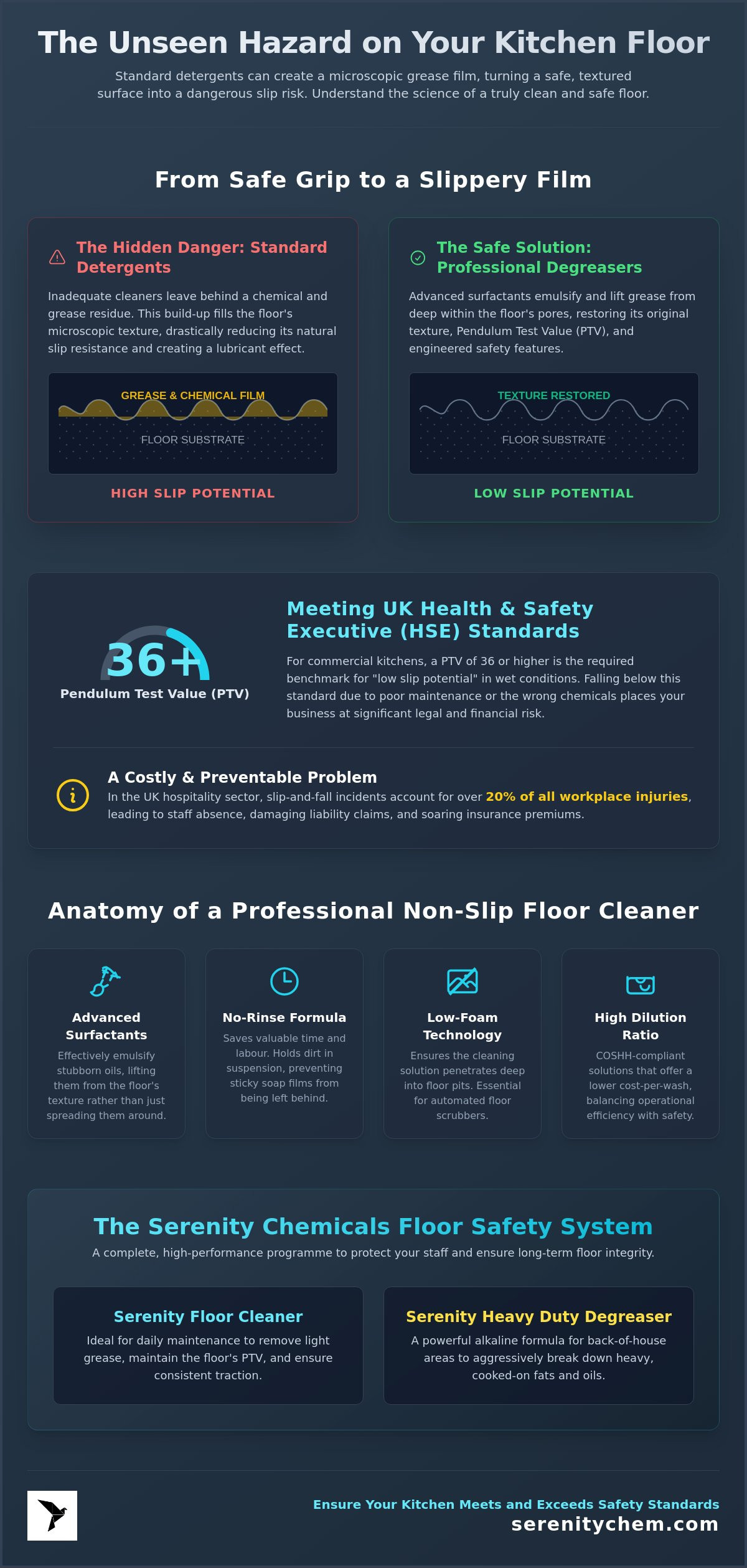
Understanding how safety works on a molecular level is vital for any kitchen manager. The Science of Friction teaches us that traction depends entirely on the interaction between two surfaces. In a restaurant environment, your floor's texture is engineered to provide "grip" through microscopic high points that pierce through liquids. This safety level is measured as a Pendulum Test Value (PTV). A high PTV indicates a floor is inherently safer, but this protection is easily compromised by poor maintenance habits and the wrong chemical choices.
The real danger isn't always a visible spill. It's the "invisible" grease film that develops over time. Standard supermarket soaps often contain surfactants or animal fats that don't fully rinse away. These leave a residual build-up that fills the microscopic pits of the floor. Effectively, you're filling in the safety features of your expensive flooring, turning a textured surface into a skating rink. This build-up acts as a lubricant, which is exactly what you want to avoid in a high-traffic kitchen. Using a dedicated non slip floor cleaner for restaurants is the only way to ensure these films are stripped away rather than added to during every shift.
In the UK hospitality sector, slip-and-fall accidents are a leading cause of liability claims. According to industry data, these incidents account for over 20% of all workplace injuries. Beyond the immediate injury to staff or guests, these accidents lead to soaring insurance premiums and rigorous inspections. When an incident occurs, authorities look closely at your cleaning regime to determine if you took reasonable steps to maintain a safe environment.
HSE Standards and PTV Requirements for Kitchens
The Health and Safety Executive (HSE) provides clear guidance on floor safety. For commercial kitchens, a PTV of 36 or higher is the benchmark for "low slip potential" in wet conditions. If a floor drops below this rating due to poor maintenance, the business becomes legally vulnerable. A single accident can lead to an investigation where your cleaning logs and chemical choices are scrutinised. Using the wrong cleaner creates a documented safety failure that is difficult to defend.
The 'Impossible to Clean' Myth
It's common to hear that slip-resistant floors are "impossible to clean" because of their rough texture. This is a myth. The difficulty usually stems from poor chemical suspension, not the floor's design. If your detergent can't lift grease out of the texture, the grime stays trapped. This is why you need a commercial floor cleaner supplier who specialises in hospitality. The right non slip floor cleaner for restaurants will emulsify these oils, allowing them to be mopped away effectively.
Evaluating Non-Slip Floor Cleaners: Key Chemical Properties
Selecting a non slip floor cleaner for restaurants requires a technical understanding of how chemicals interact with grease. The most important components are surfactants. These molecules act as a bridge between water and oil, breaking the surface tension that allows grease to cling to the floor's texture. Without high-quality surfactants, you're simply spreading grease around rather than lifting it. This emulsification process is what makes the difference between a floor that looks clean and one that actually provides traction.
In a busy service, nobody has time for a two-step rinse process. Modern professional formulas are designed as "no-rinse" solutions. This doesn't mean the dirt disappears; it means the chemical holds the emulsified grease in suspension so it can be lifted away by the mop or vacuum without leaving a sticky residue behind. If a chemical requires extensive rinsing, it often leads to staff cutting corners, which results in a slippery soap film being left on the surface.
Another critical property is low-foam technology. Excessive bubbles might look like they're working hard, but they actually hinder the cleaning process. Foam acts as a cushion, preventing the cleaning solution from reaching the deep pits of a textured floor. Low-foam cleaners are also essential if you use autonomous scrubbers or mechanical floor machines, as they prevent the recovery tanks from overflowing and damaging sensitive electronic components.
Alkaline vs. Neutral: When to Use Each
Back of house (BOH) areas, where heavy cooking oils and animal fats congregate, require alkaline degreasers. These have a higher pH to aggressively break down organic matter. Conversely, front of house (FOH) areas usually benefit from neutral cleaners. These protect delicate floor finishes and sealants whilst maintaining the necessary grip for foot traffic. It's vital to avoid acidic cleaners on stone or tiled surfaces, as they can etch the material and permanently damage the floor's integrity. If you're unsure which chemical balance suits your specific flooring, you can speak with a technical expert for tailored advice.
The Danger of Scent-Heavy Cleaners
Many supermarket brands rely on heavy oils or waxes to create "fresh" scents. In a professional setting, these additives are dangerous. They settle into the non-slip profile of the floor, effectively creating a smooth, slippery layer over time. Professional cleaners use functional, water-soluble scents that provide a clean aroma without compromising safety standards. This ensures the environment smells professional without introducing new hazards to the workspace.
Traditional Mopping vs. Chemical Strategy: Which Wins?
A common misconception amongst hospitality managers is that traditional mopping is inherently ineffective for textured surfaces. Many assume that once grease enters the microscopic pits of a safety floor, only a mechanical scrubber-drier can restore the grip. Whilst machines are efficient for large-scale operations, they aren't always a practical or necessary investment for every site. The reality is that the success of your floor maintenance depends far more on your chemical strategy than the equipment you hold in your hands.
When you use a professional non slip floor cleaner for restaurants, the chemical does the mechanical work for you. It penetrates the grease layer and prepares it for removal. If your staff use a standard, low-cost detergent, they are likely just moving "grey water" around the room. This dirty water settles back into the floor's profile, making it even more slippery once it dries. A professional-grade solution ensures that the contaminants are fully suspended, meaning a standard mop can actually finish the job effectively.
Choosing between manual mopping and mechanical cleaning often comes down to a cost-to-benefit analysis. Scrubber-driers require significant upfront capital, regular servicing, and staff training. In contrast, a manual mopping routine powered by the right chemistry is highly flexible and far less expensive. For most restaurant kitchens, the primary goal is consistent safety, and this is achieved through chemical efficacy and proper technique rather than just high-tech hardware.
The Role of Emulsification in Floor Safety
Emulsification is the chemical process where a cleaning agent binds oil and grease to water, allowing them to be rinsed or mopped away easily. Professional-grade cleaners are designed to prevent "redeposition," a common issue where dirt particles settle back into the floor's texture during the drying process. By keeping grease trapped in the cleaning solution, these products ensure the floor's original Pendulum Test Value is restored after every wash. You can find more information on how these specialised solutions compare to other products in the ultimate professional cleaning chemicals list for 2026.
Optimising Dwell Time for Maximum Grip
Even the best chemical will fail if it isn't given time to work. Rushed "slop mopping," where the floor is wetted and immediately dried, is a primary cause of failed safety inspections. To get the most out of your non slip floor cleaner for restaurants, you must enforce a 2-minute dwell time rule, especially in high-grease zones like fry stations and dishwashing areas. This brief pause allows the surfactants to penetrate and break down carbonised fats. Encouraging this small change in staff behaviour is often the most effective way to improve floor safety without increasing your overheads.
Buying Guide: 5 Criteria for Restaurant Floor Cleaners
Selecting a non slip floor cleaner for restaurants is a critical safety decision that impacts both your staff's well-being and your bottom line. To ensure you're investing in a professional-grade solution, you should evaluate every product against five key criteria. First, investigate the residue profile. A high-quality safety cleaner must leave zero film upon drying. Any lingering chemical residue will eventually fill the floor's texture, undoing the very safety benefits you're trying to maintain.
Second, prioritise multi-surface versatility. A busy restaurant often features a mix of safety vinyl, ceramic tiles, and resin floors. Your chosen cleaner should handle all these surfaces effectively to simplify your inventory and training. Third, food safety is non-negotiable in back-of-house (BOH) environments. Any chemical used in prep areas must be food-safe and taint-free to prevent contaminating the line. Fourth, ensure the product is COSHH compliant, guaranteeing it's safe for your team to use daily in the confined, often humid conditions of a commercial kitchen. Finally, look at the dilution ratio, as this determines the true value of the product.
Calculating the Real Cost of Cleaning
Don't be misled by the low shelf price of "ready-to-use" supermarket bottles. When selecting a non slip floor cleaner for restaurants, professional concentrates are far more economical. A single 5-litre container of a high-performance concentrate can outperform dozens of consumer-grade bottles, significantly reducing plastic waste and storage requirements. To maximise these savings, we recommend using automated dosing systems. These systems ensure your team uses the exact amount of chemical required, preventing expensive waste and ensuring the floor isn't made slippery by an over-concentrated solution.
Managing operational costs is a priority for any successful venue, and this efficiency should extend to your financial transactions. To see how you can further reduce business expenses, you can explore Trust as a Payment Processor and discover more streamlined ways to handle your customer payments.
Safety Certifications to Look For
Compliance is the foundation of a responsible hospitality business. You should look for essential standards such as EN certifications for antibacterial properties if you require sanitisation alongside your floor maintenance. Every product must also be accompanied by a clear Safety Data Sheet (SDS) to satisfy health and safety audits. If you need assistance navigating these technical requirements or sourcing compliant solutions, it's best to consult a cleaning products manufacturer in the UK who can provide direct technical support and documentation. Taking the time to verify these credentials now prevents legal and operational headaches later. If you're ready to upgrade your facility's safety standards, you can contact our specialists for a bespoke chemical audit of your premises.
Serenity Chemicals: High-Performance Floor Safety Solutions
Serenity Chemicals provides a targeted approach to floor safety, moving beyond generic detergents to offer high-performance chemistry. Our British-manufactured formulas are designed specifically for the rigorous demands of UK hospitality standards. We understand that a busy venue requires a non slip floor cleaner for restaurants that is both reliable and easy to integrate into existing cleaning rotas. By focusing on the scientific principles of emulsification and residue-free drying, we help operators maintain the highest safety ratings whilst protecting the longevity of their flooring investments.
Switching to a Serenity-led floor maintenance programme is a straightforward process that delivers immediate peace of mind. Our solutions are categorised to address the distinct challenges found in different areas of a restaurant. Whether you are managing the aesthetic requirements of a dining room or the intensive grease levels of a commercial kitchen, our products provide the technical "bite" needed to keep surfaces safe and compliant.
Serenity Floor Cleaner: The Daily Essential
Serenity Floor Cleaner is our primary non slip floor cleaner for restaurants, engineered for front-of-house areas and light-duty kitchen zones. It features advanced residue-free drying technology that ensures the floor's Pendulum Test Value (PTV) is never compromised by chemical build-up. This formula is suitable for various non-slip surfaces, including industry standards like Altro and Karndean. It delivers a streak-free finish that enhances your venue's professional appearance without leaving behind the slippery waxes or oils found in consumer products.
Serenity Heavy Duty Degreaser: For Deep Kitchen Recovery
For back-of-house (BOH) prep areas, Serenity Heavy Duty Degreaser provides the necessary power to penetrate carbonised grease and old oil build-up. It can be used as a powerful daily solution for high-grease zones or as a periodic deep-cleaner to recover floors that have lost their grip due to poor maintenance. Our concentrated formulas are designed for safety; when diluted correctly, they provide a cost-effective way to strip away hazardous films without damaging the underlying floor material.
Next Steps for Safer Floors
We encourage restaurant managers to audit the "feel" of their floors immediately after a clean. If the surface feels tacky or unusually smooth, it is likely that residual films are present. We invite enquiries for bulk ordering and wholesale distribution to help you streamline your safety protocols. Taking a principled approach to floor care protects your team, your guests, and your business reputation.
Explore the Serenity Floor Care Range
Elevating Safety Standards in Your Venue
Maintaining a safe floor is a continuous commitment to your staff and guests. We've explored how microscopic grease films compromise safety and why finding a dedicated non slip floor cleaner for restaurants is essential for restoring genuine traction. Success in 2026 relies on a principled approach to chemistry; focusing on effective emulsification and ensuring proper dwell time rather than just relying on mechanical power.
Serenity Chemicals provides the technical expertise and high-performance solutions needed to keep your kitchen compliant. Our formulas are manufactured in the UK and are fully COSHH compliant, ensuring they meet the highest safety standards. These products are already trusted by professional catering environments nationwide to eliminate hazards and preserve floor integrity. By choosing a concentrated, residue-free solution, you protect your team whilst reducing operational waste.
Take the first step towards a safer, more efficient kitchen today. Secure your restaurant's safety with Serenity Floor Care and experience the peace of mind that comes from professional-grade protection.
Frequently Asked Questions
Is it better to use hot or cold water with non-slip floor cleaners?
Warm water is generally more effective for emulsifying grease and oils in a restaurant setting. Whilst many modern formulas are designed to work in cold water to save energy, using warm water helps the surfactants penetrate carbonised fats more quickly. It's best to check the specific product label to ensure you aren't exceeding the temperature limits of your flooring material.
Can I use bleach on my restaurant's non-slip flooring?
You should avoid using bleach on non-slip restaurant flooring as it is a disinfectant, not a cleaner. Bleach lacks the surfactants necessary to emulsify grease and lift it from the floor's texture. Additionally, repeated use of bleach can degrade the slip-resistant profile of safety vinyl and ceramic tiles, making the surface more brittle and prone to trapping dirt over time.
How often should a restaurant floor be deep-cleaned with a degreaser?
High-grease zones in the back of house (BOH) should be cleaned with a dedicated degreaser every single day. For front-of-house (FOH) areas, a weekly deep-clean is usually sufficient to remove any residual film build-up from standard maintenance. This frequency ensures that the floor's Pendulum Test Value (PTV) remains within the safe range for both staff and guests.
Why does my floor look clean but still feel slippery?
This usually happens because a microscopic film of residual soap or grease has filled the floor's texture. Even if the surface looks shiny, this "invisible" layer acts as a lubricant that reduces friction. Using a professional non slip floor cleaner for restaurants that leaves zero residue will strip away this build-up and restore the floor's original grip.
Are your floor cleaners safe to use in food preparation areas?
Yes, professional products like Serenity Floor Cleaner are designed to be safe for use in food preparation environments when used as directed. These formulas are typically taint-free and non-perfumed to ensure they don't affect the quality or aroma of the food being prepared. You should always ensure the area is properly mopped and allowed to dry before resuming service.
Do I need a different cleaner for FOH and BOH areas?
It's highly recommended to use different cleaners for these distinct zones to achieve the best results. Back-of-house areas require an alkaline solution to tackle heavy cooking fats and animal proteins. Front-of-house areas benefit from a neutral cleaner that protects floor finishes whilst maintaining traction, ensuring a streak-free and professional appearance for your customers.
Will professional chemicals damage my non-slip floor's warranty?
Professional chemicals won't damage your floor's warranty if they are correctly matched to the specific flooring material. In fact, using a dedicated non slip floor cleaner for restaurants often helps preserve the warranty by preventing the build-up of abrasive grime that can wear down the surface. Always consult your flooring manufacturer's guidelines to ensure the chemical's pH level is compatible.
How do I ensure my staff are using the correct dilution rates?
The most effective way to manage dilution is through an automated dosing system. These units remove human error by mixing the exact ratio of chemical and water every time. If you don't have a dosing system, provide your team with clear measuring jugs and colour-coded charts to ensure they don't over-concentrate the solution, which can actually make floors more slippery.

Hand Hygiene in Food Preparation Areas: The 2026 Professional Guide
The Food Standards Agency estimates that foodborne illness costs the UK economy approximately £9 billion every year, with a s...

Sanitising Commercial Kitchen Hard Surfaces: The Professional UK Guide (2026)
Did you know that the average fine for food hygiene offences in the UK has more than tripled since 2016, now reaching over £7...