

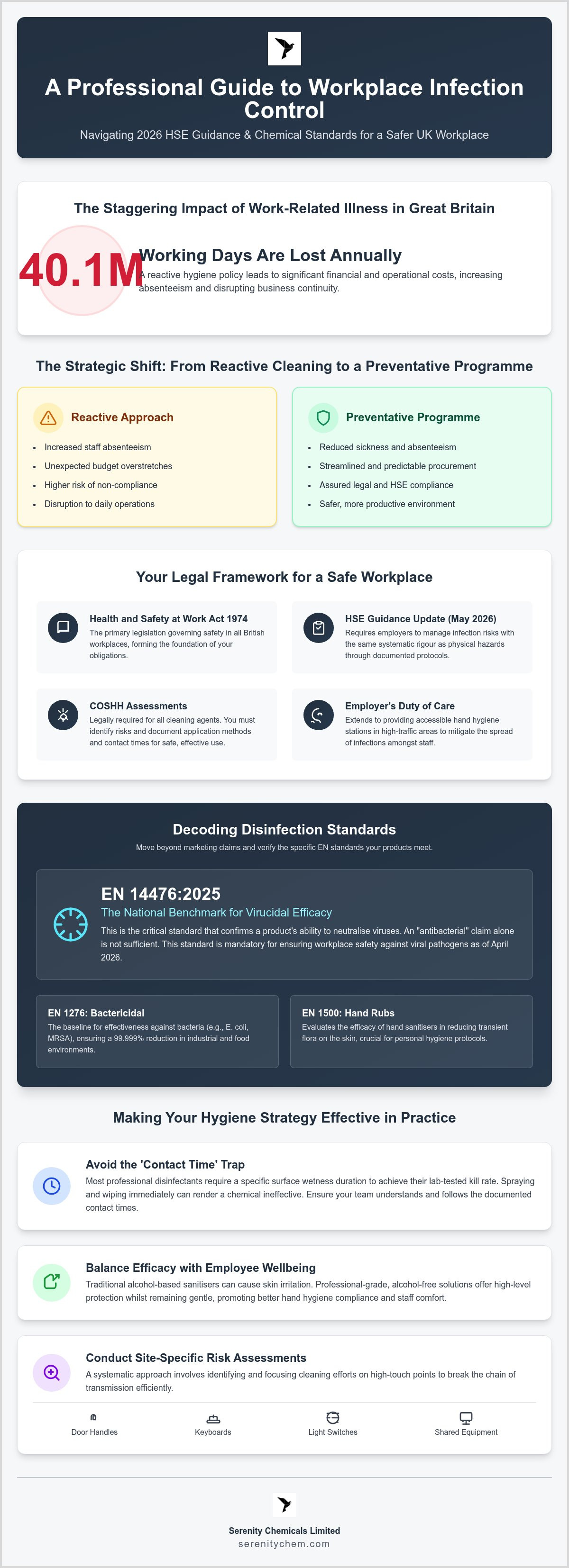
With 40.1 million working days lost annually in Great Britain due to work-related illness, the financial and operational cost of a reactive hygiene policy has never been higher. You're likely feeling the pressure of keeping up with the May 2026 HSE guidance updates whilst trying to protect your staff from the skin-irritating effects of traditional alcohol-based sanitisers. It's a difficult balance to strike, especially when you need to maintain high standards without overstretching your budget.
This professional guide simplifies infection control in the workplace uk by breaking down the latest legal requirements, including the transition to the EN 14476:2025 virucidal benchmark. We'll show you how to implement a high-performance hygiene strategy that prioritises both efficacy and employee wellbeing through the use of professional-grade, alcohol-free chemical solutions. You'll learn how to move from reactive cleaning to a preventative programme that reduces absenteeism and streamlines your procurement process, ensuring your business remains compliant, safe, and cost-efficient throughout 2026.
Key Takeaways
- Understand your legal obligations under the Health and Safety at Work Act 1974 and the latest 2026 HSE guidance to ensure full compliance.
- Learn why EN 14476:2025 has become the essential benchmark for verifying the antiviral efficacy of your cleaning chemicals.
- Discover how to balance high hygiene standards with employee skin health by using professional-grade, alcohol-free sanitisers.
- Master a systematic approach to infection control in the workplace uk by conducting site-specific risk assessments and identifying high-touch points.
- Explore the advantages of sourcing hygiene solutions directly from a UK manufacturer to improve supply chain reliability and product traceability.
Navigating UK Workplace Infection Control Regulations and HSE Guidelines
The Health and Safety at Work etc. Act 1974 remains the primary legislation governing safety in the British workplace. In 2026, its application has evolved to meet modern biological challenges. The Health and Safety Executive (HSE) updated its guidance in May 2026, requiring employers to treat infection risks with the same systematic rigour as mechanical or electrical hazards. This shift means that infection control in the workplace uk is no longer a matter of simple housekeeping; it's a legal obligation to manage invisible risks through documented protocols.
Effective Infection prevention and control principles involve a structured approach to breaking the chain of pathogen transmission. Whilst basic cleaning removes visible dirt, it's often insufficient for managing modern biological hazards. A professional strategy focuses on the destruction of pathogens through chemical efficacy and scheduled intervention. Without this systematic approach, businesses remain vulnerable to outbreaks that disrupt operations and impact staff health.
The Importance of COSHH Assessments in 2026
A COSHH assessment is the foundation of workplace chemical safety. These regulations require you to identify the risks associated with every cleaning agent used on your premises. When you utilise professional solutions like Serenity Antibacterial Surface Spray, you must document the application methods and contact times required to achieve total disinfection. This documentation ensures that your hygiene team operates safely whilst achieving the high standards demanded by current UK regulations. It's about protecting the person using the chemical as much as the person using the workspace.
Employer Duties and Employee Welfare
The duty of care extends beyond the provision of basic facilities. Employers are legally required to provide accessible hand hygiene stations in high-traffic areas to mitigate the spread of respiratory and gastrointestinal infections amongst the workforce. We're seeing a significant shift towards "hygiene-first" designs in UK offices and warehouses. These environments integrate sanitisation points into the daily flow of movement, making it easier for staff to maintain high standards of personal hygiene. By managing these risks proactively, you don't just stay compliant; you build a culture of safety that values the long-term wellbeing of every employee.
Understanding Disinfection Standards: EN 14476 and Beyond
Selecting the correct chemical solutions is the most technical aspect of infection control in the workplace uk. It requires moving beyond marketing claims to verify the specific British and European (EN) standards a product meets. Since April 2026, EN 14476:2025 has served as the national benchmark for virucidal efficacy. This standard is critical because it confirms a product's ability to neutralise viruses, whereas a standard "antibacterial" label only guarantees effectiveness against bacteria like E. coli or MRSA. When evaluating your procurement options, you must verify these claims via the Safety Data Sheet (SDS). As of August 2026, all UK businesses must ensure their SDS documentation complies with the latest GB Classification, Labelling and Packaging (CLP) hazard standards to maintain legal safety records.
Key Standards for Surface and Hand Hygiene
Professional hygiene protocols rely on a hierarchy of testing standards. EN 1276 is the baseline for bactericidal activity in industrial and food environments, ensuring a 99.999% reduction in bacteria. For hand hygiene, EN 1500 evaluates the efficacy of hand rubs in reducing transient skin flora. At Serenity, we develop formulations that don't just meet these baselines but exceed them. For example, our Serenity Alcohol Free Hand Sanitiser is designed to provide high-level protection whilst remaining gentle on the skin, bridging the gap between clinical efficacy and user comfort.
Contact Times and Efficacy
One of the most common failures in workplace hygiene is the "contact time" trap. Most disinfectants aren't instant; they require a specific duration of surface wetness to neutralise pathogens. If a cleaning operative sprays a surface and wipes it immediately, the chemical may fail to achieve its lab-tested kill rate. Professional-grade chemicals are formulated to work rapidly, but a product is only as effective as its application method and contact duration. Ensuring your team understands these technical requirements is vital for a robust hygiene strategy. If you're unsure which standards apply to your specific environment, you can speak with our technical team for guidance on compliant chemical selection.
Surface vs. Skin: Strategic Hygiene Protocols for UK Businesses
A high-performance hygiene protocol requires a dual-track approach that simultaneously addresses environmental contamination and personal hand hygiene. For infection control in the workplace uk to be truly effective, you must identify and prioritise high-touch points (HTPs). These are the surfaces that facilitate the rapid spread of pathogens amongst staff, such as door handles, lift buttons, shared keyboards, and kettle handles in communal kitchens. By focusing your most potent chemical interventions on these specific areas, you create a more efficient and cost-effective cleaning schedule.
Success depends on staff adherence. If a protocol is uncomfortable or difficult to follow, compliance will inevitably drop. This is why balancing the efficacy of your chemicals with user comfort is a strategic necessity rather than a luxury. When employees trust that the products provided won't damage their skin or cause respiratory irritation, they're far more likely to integrate hygiene practices into their daily work routines.
The Evolution of Hand Hygiene: Alcohol-Free Benefits
Traditional alcohol-based rubs are often the primary cause of occupational dermatitis in professional settings. This has led many UK businesses to switch to formulations that are widely considered the best hand sanitiser for eczema and sensitive skin. Alcohol-free solutions, such as Serenity Alcohol Free Hand Sanitiser, provide a gentler alternative that doesn't strip the skin of its natural oils. Unlike alcohol, which evaporates almost instantly, these advanced formulations often provide residual protection that continues to inhibit pathogen growth long after application.
Beyond skin health, there are significant operational advantages to removing bulk alcohol from your procurement list. Alcohol-based products are classified as highly flammable, requiring specialised storage areas and complex fire risk assessments. By opting for alcohol-free alternatives, you simplify your health and safety compliance whilst maintaining a secure environment for your workforce.
Professional Surface Disinfection
Breaking the chain of infection requires the correct use of antibacterial surface spray UK standards. It's vital to distinguish between general cleaning and targeted sanitisation. For routine maintenance, Serenity Multi-Surface Cleaner is ideal for removing organic matter. However, for HTPs where pathogen transmission is a high risk, Serenity Hard Surface Sanitiser provides the heavy-duty protection required to meet rigorous EN standards.
Your team should also be trained on specific application techniques. Whilst "spray and wipe" is suitable for removing visible grime, "spray and walk away" is often the superior method for disinfection. This allows the chemical to remain in contact with the surface for the full duration required to neutralise pathogens. This methodical approach ensures your hygiene strategy is both visible and scientifically effective.
Implementing a Sustainable Infection Control Strategy
A successful approach to infection control in the workplace uk requires more than just high-quality chemicals; it demands a structured, repeatable process. Businesses that move away from ad-hoc cleaning toward a documented strategy see more consistent results and higher staff confidence. To implement this effectively, we recommend a five-step framework:
- Step 1: Conduct a site-specific hygiene risk assessment. Identify high-traffic zones and high-touch points specific to your layout and staff movement patterns.
- Step 2: Define cleaning frequencies. Set schedules based on actual footfall and usage rather than arbitrary time intervals.
- Step 3: Standardise chemical procurement. Use a consistent set of professional-grade products to ensure predictable efficacy and simplified COSHH management.
- Step 4: Train staff on correct usage. Ensure every team member understands contact times, application methods, and safety requirements.
- Step 5: Monitor and audit standards. Use regular inspections or hygiene audits to verify that protocols are being followed and remain effective.
Creating a "Hygiene Culture" Amongst Employees
Technical protocols only work if people follow them. To encourage frequent hand sanitisation without causing "hygiene fatigue", make the process as frictionless as possible. Placing visible sanitisation stations at natural transition points, such as entrance ways and lift lobbies, serves as a gentle reminder. Using non-drying, alcohol-free sanitisers is a key part of this strategy; staff are far more likely to comply when the products provided are comfortable and maintain skin health. Clear, professional signage also reinforces the message without being intrusive, helping hygiene become a natural part of the working day.
Procuring for Performance and Value
Effective procurement is about balancing upfront costs with long-term performance. Whilst "supermarket grade" cleaners might seem cheaper, they often lack the technical efficacy and concentration required for a commercial environment. By selecting products from a professional cleaning chemicals list and buying in bulk, you improve cost-efficiency whilst ensuring every surface is properly disinfected. A professional supplier should also provide full technical support, Safety Data Sheets, and guidance on meeting the latest 2026 standards. If you need assistance in tailoring a chemical protocol for your facility, contact our specialist team today for a professional consultation.
Sourcing High-Performance Hygiene Solutions from a UK Manufacturer
Sourcing your hygiene supplies directly from a UK manufacturer offers a level of supply chain security that generic retailers simply cannot match. When you're managing infection control in the workplace uk, reliability and traceability are paramount. By shortening the supply chain, you reduce the risk of stock shortages and ensure that every batch of chemical solution is manufactured to the same exacting standards. UK-based blending and manufacturing also mean that our products are formulated specifically to comply with the latest British safety standards, including the 2026 HSE updates and EN 14476:2025 virucidal benchmarks. We operate as a principled expert, focusing on formulations that prioritise both safety and efficacy, providing you with peace of mind that your hygiene standards are beyond reproach.
The Serenity Advantage: Alcohol-Free and Effective
Our approach prioritises the health of the end-user without compromising on pathogen neutralisation. Serenity Alcohol Free Hand Sanitiser is a child-safe and skin-friendly alternative to harsh, flammable rubs. It's particularly effective in environments where frequent use is required, as it maintains the skin's natural barrier whilst providing high-level protection. For environmental hygiene, the versatility of Serenity Multi-Surface Cleaner makes it a staple for various workplace settings, from high-traffic office lobbies to industrial warehouses. We're committed to providing the comprehensive technical data and Safety Data Sheets required for your COSHH files, ensuring your documentation is always audit-ready and compliant with August 2026 GB CLP standards.
Partnering for Long-Term Workplace Safety
Deciding on your supply partner is more than a simple procurement task; choosing a cleaning products manufacturer in the UK is a strategic business decision. It provides you with a direct line to technical expertise and a partner who understands the nuances of 2026 hygiene regulations. We act as a service-oriented guide, helping you navigate the complexities of chemical selection and application protocols to ensure your facility remains a safe environment for all. We invite you to review your current infection control in the workplace uk protocol with our expert team to identify areas for improvement in both safety and cost-efficiency. By choosing a partner dedicated to integrity and protection, you're investing in the long-term wellbeing of your workforce and the operational resilience of your business.
Future-Proofing Your Workplace Hygiene Strategy
Managing infection control in the workplace uk effectively requires a shift from reactive cleaning to a systematic, chemical-led protocol. By aligning your operations with the EN 14476:2025 standards and prioritising alcohol-free formulations, you protect your staff's health whilst ensuring full regulatory compliance. A robust strategy isn't just about meeting HSE guidelines; it's about building a culture of safety that reduces absenteeism and supports long-term operational resilience. You've now seen how the right products, backed by technical data and consistent application, can transform your environment into a safer workspace.
As a dedicated UK manufacturer and alcohol-free specialist, we provide high-performance solutions that meet the most rigorous benchmarks without compromising on skin health. Our EN 14476 compliant formulations ensure your business remains at the forefront of hygiene technology throughout 2026. If you're ready to streamline your procurement and implement a more effective hygiene protocol, explore our range of professional infection control chemicals or speak with our technical team today. We look forward to helping you create a safer, more productive environment for your entire workforce.
Frequently Asked Questions
What are the minimum legal requirements for workplace infection control in the UK?
Under the Health and Safety at Work etc. Act 1974, employers have a legal duty to protect staff from biological hazards. The 2026 HSE updates require a documented risk assessment and the provision of adequate hand hygiene facilities. You must ensure that all cleaning chemicals are used according to COSHH regulations. This involves maintaining up-to-date Safety Data Sheets and ensuring staff are trained in the correct application of disinfectants to maintain legal safety standards.
Is alcohol-free hand sanitiser as effective as alcohol-based versions?
Modern alcohol-free sanitisers are highly effective and often provide longer-lasting residual protection than alcohol-based rubs. Alcohol evaporates quickly, whilst solutions like Serenity Alcohol Free Hand Sanitiser remain active on the skin for longer. These formulations are specifically designed for sensitive skin and eczema, reducing the risk of occupational dermatitis. They also eliminate the fire safety risks and specialised storage requirements associated with bulk alcohol, making them a safer choice for professional environments.
How often should high-touch surfaces be disinfected in a busy office?
Disinfection frequency should be determined by a site-specific risk assessment rather than a fixed schedule. In a busy office, high-touch points like door handles and kettle buttons often require sanitisation at least twice daily or after peak usage periods. Since the May 2026 HSE guidance update, businesses are encouraged to move toward a preventative cleaning model. This involves monitoring footfall data and increasing frequencies in communal areas during periods of high occupancy to maintain consistent safety.
What does EN 14476 mean on a cleaning product label?
EN 14476 is the European and British standard for virucidal efficacy in chemical disinfectants. If a product carries this label, it has been laboratory-tested to prove it can neutralise at least 99.99% of viruses. The 2025/2026 update to this standard is the current national benchmark for infection control in the workplace uk. It's vital to check this certification when sourcing chemicals to ensure your facility is protected against both enveloped and non-enveloped viruses.
Can I use the same antibacterial spray for both kitchen and office surfaces?
Whilst some multi-surface cleaners are versatile, it's best practice to use specialised formulations for different zones. Serenity Kitchen Sanitiser is specifically tested to be food-safe and effective against food-borne pathogens, whereas a general Serenity Antibacterial Surface Spray is optimised for office high-touch points. Using zone-specific chemicals ensures you meet the specific EN standards required for food preparation areas whilst maintaining high hygiene levels in communal workspaces without the risk of cross-contamination.
What should be included in a workplace hygiene risk assessment?
A comprehensive assessment must identify all high-touch points and communal areas where pathogens could spread. You should document the footfall patterns, the specific chemicals used, and the required contact times for effective disinfection. The assessment must also consider the welfare of staff, including the risk of skin irritation from cleaning agents. This document forms the legal basis for your infection control in the workplace uk and should be reviewed whenever your working practices or occupancy levels change.
How do I ensure my cleaning chemicals are COSHH compliant?
To ensure compliance, you must maintain a folder containing current Safety Data Sheets (SDS) for every chemical on-site. As of August 2026, these documents must align with the latest GB CLP hazard standards. You are required to document how each product is stored, diluted, and applied, whilst providing staff with any necessary personal protective equipment. Regular training sessions are essential to ensure your team understands the hazards and follows the safe working practices outlined in your assessments.
What is the best way to prevent the spread of norovirus in a communal workplace?
Norovirus is a non-enveloped virus that is notoriously difficult to neutralise with standard alcohol-based sanitisers. The most effective prevention strategy involves using professional-grade disinfectants that meet the EN 14476 standard for virucidal activity. Encouraging thorough handwashing with soap and water, supplemented by alcohol-free hand sanitisers, provides a robust defence. You should also implement a "spray and walk away" protocol on communal surfaces to ensure chemicals have sufficient contact time to destroy the virus particles completely.

Hand Hygiene in Food Preparation Areas: The 2026 Professional Guide
The Food Standards Agency estimates that foodborne illness costs the UK economy approximately £9 billion every year, with a s...

Sanitising Commercial Kitchen Hard Surfaces: The Professional UK Guide (2026)
Did you know that the average fine for food hygiene offences in the UK has more than tripled since 2016, now reaching over £7...