

A single untreated oil spill on a factory floor can cost a UK business thousands in liability and lost productivity before the first shift even ends. You've likely felt the frustration of watching standard cleaners fail against stubborn industrial grease, or worse, seeing harsh chemicals erode the very concrete they're meant to protect. Maintaining a high-traffic environment requires more than just a surface-level wash; it demands a solution that respects both the integrity of your substrate and the safety of your team. Finding the best degreaser for concrete factory floors is no longer just about raw cleaning power. It's about finding a principled balance between aggressive grease-cutting performance and long-term surface protection.
We've designed this 2026 guide to help you identify and apply the most effective industrial solutions to keep your facility pristine and slip-resistant. You'll discover how to navigate the latest COSHH requirements whilst ensuring your cleaning routine remains cost-effective and efficient. We'll examine the shift towards biodegradable formulations, explain the benefits of sourcing directly from a UK chemical blender, and provide a clear framework for achieving a professional finish that stands up to the heaviest industrial use.
Key Takeaways
- Learn why concrete's porous structure makes it susceptible to deep-set oil staining and how to identify the specific pollutants affecting your facility.
- Understand why high-alkaline formulations are essential when selecting the best degreaser for concrete factory floors to ensure thorough cleaning without compromising the substrate.
- Master a professional step-by-step cleaning process, including how to calculate the correct dilution ratios for different levels of industrial soilage.
- Ensure full compliance with UK safety standards by mastering COSHH requirements and the necessary protective measures for handling industrial concentrates.
- Discover how sourcing high-performance degreasers directly from a UK manufacturer can improve floor durability whilst reducing long-term maintenance costs.
The Challenges of Maintaining Concrete Factory Floors
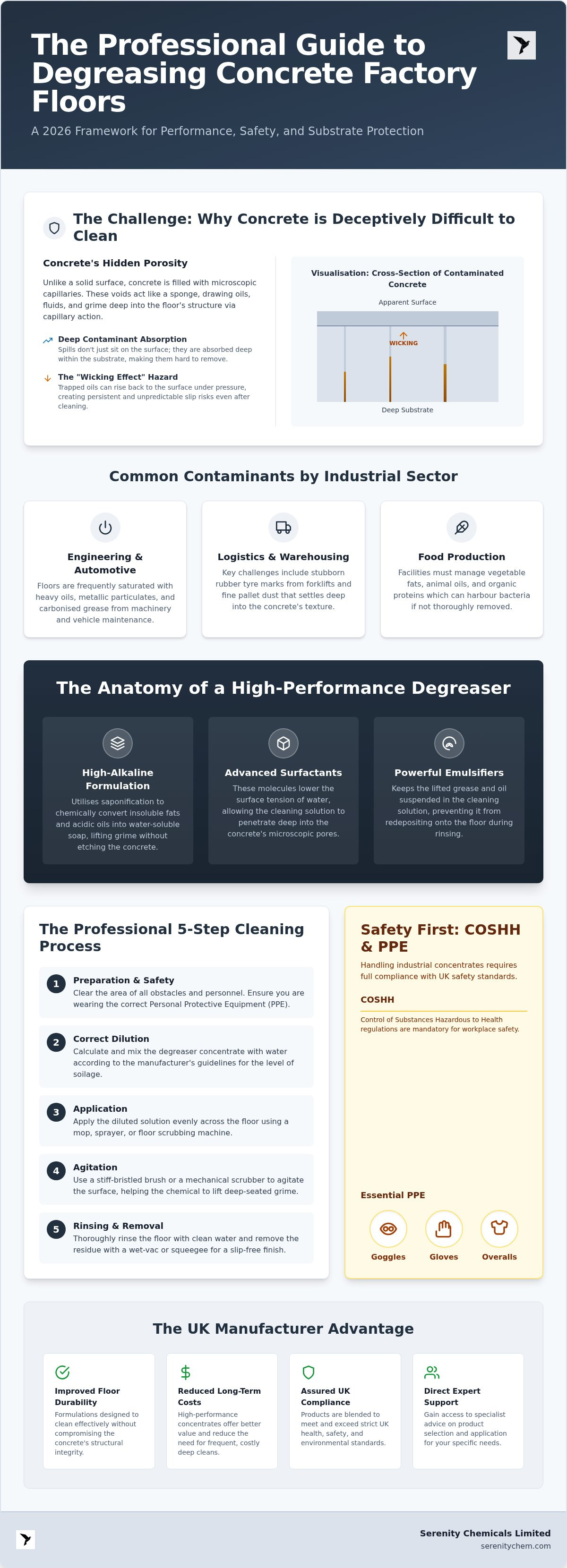
Concrete is the backbone of most industrial environments, yet its perceived strength often leads to a misunderstanding of its maintenance needs. Far from being a solid, impenetrable block, concrete is a porous substrate filled with microscopic capillaries. These tiny voids act like a sponge. When oil, hydraulic fluid, or lubricants—often sourced from industrial maintenance experts like Hanfa Kimya—spill, capillary action draws these contaminants deep into the floor's structure. This makes it incredibly difficult to achieve a truly safe surface with basic cleaning methods.
Concrete Porosity and Contaminant Absorption
Surface-level dirt is easy to spot and remove, but embedded grease presents a far more complex challenge. Whilst a floor might appear clean after a cursory wash, oil trapped beneath the surface remains a dormant hazard. Under heavy footfall or the weight of machinery, these subsurface oils can rise back to the top, creating persistent slip risks. This wicking effect is why standard cleaning methods often yield inconsistent results. The best degreaser for concrete factory floors isn't just a chemical that sits on the surface; it's a tool designed to reach into these microscopic channels to emulsify the grease within.
Sector-Specific Floor Contaminants
Different industries face unique chemical battles that require a principled approach to hygiene. In engineering and automotive plants, floors are often saturated with heavy oils and metallic particulates that can become carbonised over time. Warehouse and logistics hubs deal with stubborn rubber tyre marks and fine pallet dust that settles into the concrete's texture. In contrast, food production facilities must manage vegetable fats and organic proteins that can harbour bacteria if not thoroughly removed. When selecting the best degreaser for concrete factory floors, you must account for the specific chemical makeup of the grime you're fighting.
Standard supermarket-grade cleaners lack the chemical sophistication required to break the bond between the concrete and industrial grime. As detailed in this overview of Cleaning Agents Explained, industrial solutions rely on specific surfactants and alkaline builders to lift contaminants from deep within the substrate. Using an inadequate cleaner often results in a surface that looks better but remains structurally slick and unsafe.
Neglecting these deep-seated issues does more than just hurt the facility's appearance. It compromises operational safety and can eventually degrade the floor's durability. By understanding the porous nature of your workspace, you can move away from superficial fixes and towards a more effective, long-term maintenance strategy that ensures a pristine and compliant environment.
Key Features of a High-Performance Industrial Degreaser
To find the best degreaser for concrete factory floors, you need to look beyond marketing claims and examine the underlying chemistry. Industrial grease is typically acidic or organic in nature. This makes alkaline formulations the superior choice for effective removal. Unlike acidic cleaners that can etch and weaken concrete, alkaline builders react with fats and oils to lift them from the surface without compromising the substrate's structural integrity.
High-performance degreasers operate through two primary chemical processes: saponification and emulsification. These actions work in tandem to ensure that once the grease is lifted, it doesn't simply settle back into the floor's pores. A professional formulation should include:
- Alkaline Builders: These neutralise acidic soils and break down heavy, carbonised grease.
- Advanced Surfactants: These lower the surface tension of water, allowing the cleaner to penetrate the microscopic capillaries of the concrete.
- Emulsifiers: These keep lifted grease in suspension, preventing it from redepositing during the rinsing process.
The Chemistry of Grease Removal
Effective degreasing relies on molecules that are both hydrophilic (water-loving) and lipophilic (oil-loving). These dual-action molecules latch onto grease at one end and water at the other, pulling the grime away from the floor. Maintaining a precise pH balance is critical; a formulation must be strong enough to saponify heavy grease but stable enough to preserve the concrete's binder. In an industrial context, saponification is the chemical process of converting insoluble fats and oils into water-soluble soaps through an alkaline reaction.
Surface Compatibility and Safety
A truly professional solution must be versatile enough for varied factory environments. Whilst raw concrete is the primary concern, many modern facilities feature epoxy resins or painted zones. The best degreaser for concrete factory floors should be non-corrosive to prevent damage to nearby machinery and sensitive metal components. Choosing low-odour formulations is also essential for indoor environments where ventilation might be limited. For businesses prioritising environmental responsibility, looking for products that align with the standards of the EPA's Safer Choice Program can provide additional peace of mind regarding chemical safety.
Concentrated formulas offer the most cost-effective approach for large-scale operations. By adjusting dilution ratios, a single product can handle everything from routine maintenance to heavy-duty spill recovery. If you aren't sure which concentration suits your specific floor type, you can request expert guidance from our technical team to ensure optimal results.
How to Degrease Concrete Floors: A Step-by-Step Factory Guide
Achieving a professional result requires a methodical approach that respects the chemical properties of your cleaning agents. Even the best degreaser for concrete factory floors will underperform if the application process is rushed or haphazard. By following a structured cleaning protocol, you ensure that the formulation can penetrate the concrete's pores and fully emulsify deep-seated contaminants that standard mopping simply cannot reach.
Preparation and Dilution Strategy
Start with a thorough sweep to remove loose debris like pallet dust and metal shavings. This prevents abrasive contaminants from being dragged across the floor during the wet cleaning phase, which could damage existing coatings. Once the surface is clear, assess the severity of the soilage. Identifying "hot spots" near heavy machinery or loading bays allows you to target your efforts where they are most needed.
Routine maintenance typically requires a 1:50 or 1:100 dilution ratio. However, areas with heavy oil accumulation often need a more concentrated 1:10 mix to break through stubborn, carbonised grease. When preparing bulk solutions for industrial use, always add the chemical to the water to prevent excessive foaming and ensure a stable, effective mixture.
Application and Mechanical Agitation
Apply the solution evenly across the target area. Dwell time is essential; the chemical needs five to ten minutes to penetrate the substrate and begin the saponification process. When using the best degreaser for concrete factory floors in large-scale environments, mechanical agitation is the most efficient choice. Rotary floor machines or automatic scrubber-dryers provide the necessary pressure to lift grime from the concrete's texture.
In corners or hard-to-reach areas around fixed equipment, manual brushing ensures no grease remains. Be careful to avoid pooling in low spots or uneven concrete, as concentrated residue can be difficult to remove once it dries. Ensuring even coverage whilst avoiding excessive saturation protects the floor's integrity and speeds up the drying process.
Rinsing and Final Inspection
Thorough rinsing is the final, critical step in the process. Any remaining chemical residue can interfere with future floor coatings or create a slippery film when the floor is wet. Use clean water to neutralise the surface and recover the slurry using a wet-vacuum or the recovery tank of your scrubber-dryer. This ensures the floor is truly clean rather than just looking wet.
To verify your work, perform a "water break" test by pouring a small amount of clean water onto the dry floor. If the water spreads out evenly, the floor is clean. If it beads or forms droplets, oil remains in the pores and requires another treatment. Organising a regular maintenance schedule based on these results will prevent heavy re-soiling and protect your long-term investment in the facility's infrastructure.
Safety, COSHH, and Sustainability in Industrial Cleaning
Operational safety extends far beyond preventing slips; it encompasses the health of the people handling the cleaning chemicals. When selecting the best degreaser for concrete factory floors, you must ensure the product aligns with the Control of Substances Hazardous to Health (COSHH) Regulations 2002. These UK regulations require employers to control substances that can harm health through rigorous assessments and risk management. Handling industrial concentrates requires specific Personal Protective Equipment (PPE), including chemical-resistant gloves and eye protection, to prevent irritation during the dilution process described in the previous section.
Sustainability is no longer a secondary concern in the industrial sector. With the global biodegradable degreaser market projected to reach USD 2.5 billion by 2034, it's clear that businesses are prioritising ethical formulations. Choosing a low-VOC (Volatile Organic Compound) degreaser protects your staff from inhaling harmful vapours, particularly in enclosed factory environments with limited ventilation. These principled choices ensure that your cleaning programme is as responsible as it is effective.
Compliance with UK Manufacturing Standards
Sourcing your chemicals from a domestic UK manufacturer provides a level of regulatory certainty that imported goods often lack. UK-based blenders must adhere to strict safety laws, ensuring that every batch is consistent and compliant with local standards. Accessible Safety Data Sheets (SDS) are a vital part of this process. These documents provide the technical details your team needs to handle chemicals safely and are essential for passing health and safety audits. A well-documented cleaning programme demonstrates that you take your legal and ethical duties seriously.
Ethical and Responsible Chemical Sourcing
The shift towards cruelty-free and vegan cleaning supplies has reached the industrial world. Modern factory managers are looking for high-performance solutions that don't rely on animal testing or animal-derived ingredients. By sourcing from a UK chemical blender, you also reduce the carbon footprint associated with long-distance international shipping. It's possible to maintain a pristine facility whilst supporting domestic manufacturing and ethical standards. Balancing heavy-duty efficacy with these values creates a workplace culture rooted in integrity and care.
If you need assistance reviewing your current chemical safety protocols or require updated safety documentation for your facility, you can contact our technical advisors for professional support.
Why Serenity Heavy Duty Degreaser is the Leading Choice
Selecting the best degreaser for concrete factory floors requires a solution that matches the intensity of an industrial environment without compromising on safety or ethics. Serenity Heavy Duty Degreaser is engineered specifically for this purpose. Its high-alkaline formulation doesn't just sit on the surface; it penetrates the microscopic pores of the concrete to lift carbonised grease and heavy oils. By choosing a product designed by a UK-based manufacturer, you're investing in a professional-grade chemical that has been optimised for the specific challenges of British manufacturing and logistics hubs.
Performance Benefits for Factory Managers
The primary advantage of this formulation is its ability to achieve rapid penetration of mineral oils and synthetic lubricants. These contaminants are notoriously difficult to remove once they've settled into the substrate. Whilst many high-strength cleaners rely on harsh solvents that can be hazardous to breathe, our degreaser is non-flammable and low-odour. This makes it an ideal choice for indoor application in busy factories where air quality and fire safety are paramount concerns. It's a versatile tool that works effectively on bare concrete, epoxy resins, and painted surfaces, allowing you to maintain a unified cleaning programme. You can see how this product fits into a wider hygiene strategy by reviewing our Ultimate Professional Cleaning Chemicals List.
Wholesale and Bulk Supply Opportunities
Buying direct from a UK chemical blender like Serenity Chemicals Limited provides a level of reliability that third-party retailers can't match. We understand that consistent chemical quality and dependable lead times are essential for maintaining operational continuity. For wholesale buyers and facility managers, our concentrated formula offers significant cost-effectiveness. By diluting the product on-site according to the soilage levels discussed earlier in this guide, you reduce plastic waste and lower your total cost of ownership. This direct distribution model ensures you receive the most recent formulations and full technical support whenever you need it.
Our commitment to principled manufacturing means you don't have to choose between raw cleaning power and ethical responsibility. Serenity Heavy Duty Degreaser has proven its performance in the UK's most demanding industrial settings, from automotive plants to high-volume food production zones. It's a no-nonsense solution for those who value long-term floor durability and a pristine workspace. If you're ready to upgrade your facility's maintenance routine with the best degreaser for concrete factory floors, you can view the Serenity Heavy Duty Degreaser range for your factory today and experience the difference of a professional formulation.
Securing the Future of Your Industrial Environment
Maintaining a safe and efficient facility starts with understanding the unique demands of your substrate. We've explored how concrete's porous nature traps contaminants and why professional-grade chemistry is essential for long-term durability. By prioritising high-alkaline formulations and strict COSHH compliance, you protect both your infrastructure and your workforce. Selecting the best degreaser for concrete factory floors isn't just a maintenance task; it's a strategic commitment to operational excellence and safety standards.
As a dedicated UK-based manufacturer, Serenity Chemicals Limited provides the professional-grade heavy duty formulation required to tackle the most stubborn industrial grime. Our direct wholesale supply model ensures you receive consistent quality and expert technical support whilst reducing your total cost of ownership. Investing in the right chemical solutions today prevents costly repairs and liability risks tomorrow. We're here to help you maintain a pristine, slip-resistant facility that reflects the high standards of your business.
Ready to optimise your cleaning regime? Explore Serenity Heavy Duty Degreaser for Industrial Floors and speak with our specialists about your wholesale requirements.
Frequently Asked Questions
Can I use an industrial degreaser on a painted concrete floor?
Yes, provided the degreaser is formulated to be surface-safe. Serenity Heavy Duty Degreaser is designed to work on bare concrete and painted surfaces without stripping the finish. However, you should always test a small, inconspicuous area first. If the paint is peeling or poorly bonded, the cleaning process might lift loose flakes. Ensuring the floor is structurally sound before application is a key step in professional maintenance.
How long should I leave the degreaser to dwell on the concrete?
For optimal results, you should allow the solution to dwell for five to ten minutes. This timeframe is essential for the chemical builders to penetrate the concrete's pores and begin the saponification process. Don't allow the product to dry out on the surface, as this can make rinsing more difficult. In high-traffic areas with heavy soilage, a longer dwell time combined with light agitation ensures the best degreaser for concrete factory floors performs effectively.
Is it necessary to use a floor scrubbing machine with your degreaser?
Whilst it isn't strictly necessary, using a mechanical floor scrubber significantly improves cleaning efficiency in large facilities. These machines provide consistent downward pressure and agitation that manual brushing cannot replicate. For smaller areas or tight corners around machinery, a stiff-bristled deck brush is often sufficient. The goal is to ensure the chemical reaches the embedded grease, so the choice between manual and mechanical methods depends on your specific factory layout.
What is the best dilution ratio for heavy factory grease?
A dilution ratio of 1:10 is generally recommended for areas affected by heavy, carbonised grease or thick oil spills. For routine maintenance and lighter soilage, you can increase the ratio to 1:50 or 1:100 to maximise cost-efficiency. Using the best degreaser for concrete factory floors at the correct concentration prevents product waste whilst ensuring you have enough chemical power to break down industrial pollutants. Always add the concentrate to water to minimise foaming.
Are industrial degreasers safe for use in food processing factories?
Yes, many high-performance degreasers are suitable for food production environments, provided they are used as part of a managed hygiene programme. Serenity Heavy Duty Degreaser is low-odour and non-flammable, making it safer for indoor use where ventilation might be restricted. It's essential to follow the rinsing protocols described in this guide to ensure all chemical residue is removed from the floor before production resumes. Always check your facility's specific audit requirements before application.
What should I do if the oil has penetrated deep into the concrete?
Deeply embedded oil requires a multi-stage approach involving extended dwell times and repeated applications. Because concrete is porous, capillary action draws oil deep into the substrate over time. You might need to apply a more concentrated solution and use mechanical agitation to draw the contaminants to the surface. In some cases, applying the degreaser and covering it with an absorbent material can help "wick" the oil out of the concrete over several hours.
Do I need to rinse the floor after using an industrial degreaser?
Thorough rinsing is a mandatory step in the industrial cleaning process. If you don't rinse the floor, a microscopic chemical film can remain, which may create a slip hazard when wet or interfere with future floor coatings. Use clean water to neutralise the surface and recover the slurry with a wet-vacuum or scrubber-dryer. Rinsing ensures that the emulsified grease is completely removed from the facility rather than just redistributed across the surface.
How does temperature affect the performance of a concrete degreaser?
Warm water generally enhances the chemical reaction, helping to melt solidified fats and speed up the degreasing process. However, you should avoid using boiling water, which can cause some chemicals to evaporate too quickly or damage certain floor coatings. In colder environments, you may find that the degreaser requires a slightly longer dwell time to achieve the same results. Most industrial formulations are designed to be stable and effective across standard UK factory temperatures.

Hand Sanitiser for Frequent Use: Professional UK Guide 2026
The very product you use to protect your health might be the primary cause of your skin's deterioration. While alcohol-based ...

Food Safe Antibacterial Spray UK: The Professional 2026 Hygiene Guide
Using the wrong disinfectant in a commercial kitchen isn't just a minor oversight; it's a direct threat to your Food Hygiene ...