

What if your current cleaning budget is actually masking hidden costs in lost productivity and administrative friction? It's a common frustration for many workplace leads who find themselves stuck with ineffective products that require excessive scrubbing or sanitisers that cause skin irritation. When you're tasked with convincing your boss to switch cleaning suppliers, the challenge isn't just about hygiene; it's about demonstrating how a strategic shift can protect your team and your bottom line simultaneously.
You likely agree that managing multiple disparate vendors and complex COSHH folders is a drain on your time that could be better spent elsewhere. This guide promises to show you how to build a robust, data-driven business case for upgrading your workplace supplies without increasing your budget. We'll explore how to leverage direct manufacturer pricing, simplify your procurement process, and prepare for the 2026 increase in HSE site inspections to create a safer, more efficient environment for everyone.
Key Takeaways
- Identify hidden operational costs, such as surface damage and poor chemical efficacy, to build a business case focused on long-term value rather than just the initial price per unit.
- Master the strategic pitch by gathering staff feedback and conducting controlled performance tests when convincing your boss to switch cleaning suppliers.
- Simplify your administrative burden and ensure COSHH compliance by consolidating your inventory into a streamlined range of high-performance multi-surface cleaners.
- Discover how to leverage direct-from-manufacturer wholesale pricing to upgrade your workplace hygiene standards without exceeding your existing budget.
- Prioritise staff well-being and skin health by switching to ethical, alcohol-free sanitisers that offer a safer alternative to traditional chemical formulations.
The Business Case for Switching Cleaning Suppliers
A periodic review of hygiene partners isn't just a box-ticking exercise; it's a fundamental pillar of modern facility management. Effective managers recognise that strategic sourcing is about more than finding the lowest unit price. It's about securing a supply chain that supports operational continuity and protects the physical assets of the business. When you're convincing your boss to switch cleaning suppliers, you should shift the conversation from the price per bottle to the Total Cost of Ownership.
Poor-quality chemicals often carry hidden expenses that don't appear on a purchase order. For instance, overly acidic or alkaline cleaners can gradually strip the protective finishes from expensive flooring or corrode stainless steel fixtures in commercial kitchens. Replacing these surfaces is a capital expense that far outweighs any minor savings on cleaning fluids. Additionally, inferior products frequently require more physical effort. If a cleaning team has to scrub a surface three times rather than once, your labour costs effectively triple for that task. High-performance formulations, such as those produced by UK-based manufacturers, ensure the job is done correctly the first time.
Recognising the Signs of an Inadequate Supplier
The first step in convincing your boss to switch cleaning suppliers is identifying where the current service is failing. Unreliable delivery schedules and frequent stock-outs disrupt daily operations, forcing staff to use inappropriate substitutes. You might also notice inconsistent chemical formulations that vary in colour or efficacy between batches. From a compliance perspective, a major red flag is the presence of outdated safety data sheets or a lack of technical support. In an environment where HSE site inspections are increasing, having accessible, accurate documentation is a legal necessity, not a luxury.
The Impact on Staff Well-being and Morale
The human cost of inadequate supplies is often the most persuasive argument. Harsh, alcohol-based sanitisers are notorious for causing skin irritation and contact dermatitis amongst employees who use them frequently. Similarly, strong chemical fumes in enclosed spaces like washrooms or small offices can lead to respiratory discomfort and headaches. When a team is provided with professional-grade tools that are safe and effective, it signals that the organisation values their well-being. Switching to specialised alcohol-free formulations, such as Serenity Alcohol Free Hand Sanitiser, provides peace of mind whilst maintaining the high standards of hygiene required in a modern workplace.
Evaluating Efficiency: Performance vs Purchase Price
The initial purchase price of a cleaning chemical is often the most misleading metric in procurement. When convincing your boss to switch cleaning suppliers, it's essential to demonstrate that a cheaper bottle often results in higher overall spend. Low-cost, pre-diluted products are mostly water, meaning you're paying for the shipping and storage of liquid you could have added yourself. By partnering with a cleaning products manufacturer UK businesses can access concentrated formulations that significantly reduce plastic waste and transport emissions whilst lowering the cost-per-use. This data-driven approach is a powerful tool for convincing your boss to switch cleaning suppliers by focusing on long-term fiscal responsibility.
Measuring cleaning performance requires looking at the "dilution to use" ratio rather than the sticker price. A single five-litre container of a high-quality concentrate might produce hundreds of trigger sprays, whereas a cheap alternative might only produce fifty. This efficiency removes the middleman mark-up and simplifies inventory management, ensuring you aren't overpaying for diluted solutions.
Performance Metrics for Cleaning Chemicals
Efficacy is measured by more than just a visual shine. Consider these three critical factors when auditing your current supplies:
- Contact time: High-performance sanitisers work rapidly. If a product requires a ten-minute contact time to kill pathogens, it's likely being wiped away too soon in a busy office, leaving the surface contaminated.
- Residual protection: Some advanced formulations provide a bacteriostatic effect, helping surfaces stay cleaner for longer between scheduled cleaning intervals.
- Versatility: Inventory bloat is a common issue. A single professional multi-surface cleaner can often replace several niche products, reducing the training burden on staff and the risk of chemical mixing errors.
The ROI of High-Performance Degreasers and Floor Care
Using the wrong chemical is an expensive mistake. pH-neutral solutions are vital for protecting delicate flooring assets, such as natural stone or treated timber, which can be permanently etched by harsh, budget cleaners. In industrial settings, advanced degreasers reduce heavy-duty scrubbing time, allowing your team to cover more area in less time. Non-corrosive choices also minimise wear-and-tear on cleaning equipment like scrubber-dryers and vacuum components. If you're ready to see how these efficiencies look in practice, you can request a consultation with our technical team to discuss your specific site requirements and potential savings.
Safety and Compliance: The COSHH Advantage
Ensuring workplace safety is a non-negotiable duty of care for any facility manager. When you're convincing your boss to switch cleaning suppliers, highlighting the administrative ease of modern COSHH compliance is a persuasive angle. Traditional chemicals often come with dense, outdated safety data sheets that make workplace risk assessments a time-consuming chore. By switching to a UK-based manufacturer, you ensure that every product aligns with the latest GB CLP regulations and UK REACH standards. This transition doesn't just improve safety; it simplifies your documentation, as modern formulations often carry fewer hazard warnings than their legacy counterparts.
Choosing ethical products also reflects a company's commitment to corporate social responsibility. Opting for cruelty-free and vegan cleaning supplies allows your business to maintain high hygiene standards whilst supporting ethical manufacturing practices. This principled approach to procurement builds long-term trust with both employees and clients who value sustainable business operations. For those managing facility assets like swimming pools, the same move toward chemical-free solutions can be seen with the technology at bionizer.com.au, which replaces traditional chlorine with eco-friendly ionisation.
A significant trend in 2026 is the widespread adoption of alcohol free hand sanitiser UK wide. Unlike traditional alcohol-based gels, these formulations are non-flammable and non-toxic, which drastically reduces the fire risk in your storage areas. This is a crucial point when convincing your boss to switch cleaning suppliers, as it can potentially simplify fire safety audits and storage requirements. From a dermatological perspective, alcohol-free options are far gentler on the skin. They help maintain skin integrity for staff who must wash or sanitise their hands dozens of times a day, reducing the risk of contact dermatitis and improving overall employee comfort.
Understanding EN Standards and Efficacy
It's easy to get lost in the chemistry, but your boss only needs to know that the products actually work. You should look for two specific standards to ensure professional-grade protection:
- EN 1276: This is the European standard for the bactericidal activity of chemical disinfectants. It proves the product can kill 99.999% of bacteria within a specific timeframe, which is a much higher threshold than standard high-street cleaners.
- EN 14476: This is the virucidal standard. Ensuring your sanitisers meet this antiviral benchmark is essential for protecting against enveloped viruses in shared office spaces.
A "99.9%" claim is often a marketing generalisation that doesn't specify which pathogens are being targeted. A professional supplier provides technical support to explain exactly how their chemistry protects your specific environment. This level of expert guidance ensures that your hygiene protocols aren't just compliant, but genuinely effective against the latest biological threats.
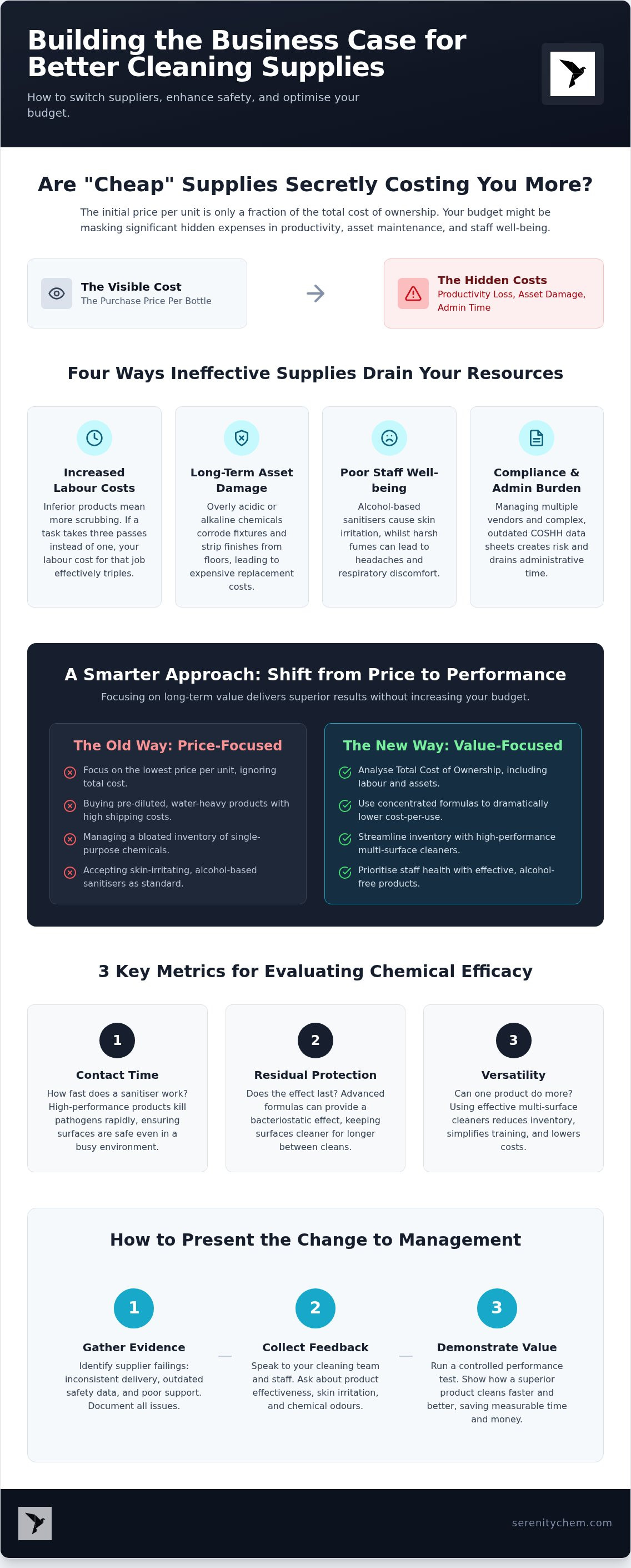
The Strategic Pitch: How to Present the Change
Success in convincing your boss to switch cleaning suppliers depends on the quality of your initial preparation. You shouldn't lead with a subjective opinion. Instead, document specific instances where current products have failed to meet professional standards. This might include logs of staff complaints regarding skin irritation from harsh sanitisers or photos of surfaces that have been dulled by inappropriate chemicals. Gathering this evidence transforms a simple request into a robust, professional business case that aligns with the company's broader goals.
Once you've identified these gaps, request samples for a controlled "blind test". Conduct this in a specific zone, such as a single breakroom or washroom, and compare the results against your existing inventory over a week. This provides objective proof of efficacy that is hard to ignore. Simultaneously, prepare a cost-comparison spreadsheet. Ensure this includes delivery fees and, crucially, the dilution rates of concentrated products. A single five-litre concentrate often produces hundreds of litres of ready-to-use solution, making the unit price far lower than pre-diluted alternatives. Highlighting the security of a reliable UK supply chain provides the peace of mind that decision-makers value in a volatile market.
Framing the Conversation for Different Bosses
Tailor your message to the specific priorities of your manager. If you're speaking to a finance director, focus on the long-term bulk savings and the reduction in labour hours achieved through faster-acting chemicals. For HR leads, prioritise the dermatological benefits of alcohol-free formulations and the overall improvement in workplace safety. Operations managers will likely be most interested in supply reliability and the efficiency of a simplified inventory. By speaking their language, you demonstrate that you've considered the impact on the entire organisation, not just your own department.
Handling Common Objections
Resistance often stems from a fear of administrative disruption. Address the "Too Much Hassle" myth by presenting a clear, phased transition plan that minimises downtime. When faced with the "Too Expensive" objection, use your spreadsheet to demonstrate the lower cost-per-use of professional concentrates compared to pre-diluted alternatives. You can also reassure them about compliance burdens by explaining how easily COSHH folders can be updated using manufacturer-provided data sheets. If you need help building your specific business case, you can contact our experts for a tailored cost-savings report to present to your board.
Partnering with Serenity Chemicals: A Seamless Transition
Choosing a new partner is the final hurdle in convincing your boss to switch cleaning suppliers. At Serenity Chemicals, we understand that a transition must be as frictionless as it is effective. We position ourselves as a "Principled Expert", meaning our relationship with your business is built on transparency, technical accuracy, and ethical manufacturing. We don't just ship bottles. We provide a complete hygiene infrastructure that supports your operational goals whilst protecting your staff and assets.
Our UK-based manufacturing facility ensures supply chain security, removing the anxiety of stock-outs or long lead times. For organisations with multiple sites across the country, we provide dedicated account managers who oversee the technical transition. This includes assisting with the migration of safety documentation and ensuring your new COSHH folders are fully compliant with 2026 standards. This level of support is vital when convincing your boss to switch cleaning suppliers, as it removes the administrative burden from your internal team.
A Comprehensive Product Range for Every Sector
We've engineered our range to meet the specific demands of diverse environments. Having a single point of contact for all your chemical needs simplifies procurement and ensures consistent quality across your site. Our specialised formulations include:
- Hospitality: Serenity Kitchen Sanitiser and Serenity Heavy Duty Degreaser provide food-safe, high-performance solutions for busy commercial kitchens.
- Healthcare and Education: Our Serenity Alcohol Free Hand Sanitiser and Serenity Floor Cleaner offer gentle yet effective protection for sensitive environments.
- Industrial: Serenity Carpet Shampoo and Serenity Hard Surface Sanitiser maintain standards in high-traffic areas without compromising on material safety.
Next Steps for Your Organisation
The process of convincing your boss to switch cleaning suppliers is made significantly easier when you have a clear implementation roadmap. We recommend starting with a professional site audit. Our technical team can evaluate your current chemical usage and identify opportunities for consolidation using our multi-surface formulations, such as Serenity Multi-Surface Cleaner. This audit often reveals significant waste that can be eliminated through better product selection.
You can also request product samples to conduct the controlled performance tests mentioned earlier in this guide. Setting up a wholesale account gives your business direct access to manufacturer pricing, bypassing the mark-ups of traditional distributors. This ensures you get the best possible value for your hygiene budget whilst benefiting from our ongoing technical support. Secure your workplace by partnering with a reliable UK manufacturer committed to safety, efficacy, and ethical integrity. Contact our team today to begin your transition to a cleaner, safer workspace.
Elevating Your Workplace Hygiene Standards
Transitioning to a more effective hygiene strategy is a vital step toward operational excellence. By focusing on the total cost of ownership rather than just the initial purchase price, you'll secure a cleaner environment whilst protecting your organisation's physical assets. The process of convincing your boss to switch cleaning suppliers is most successful when you lead with data, such as the efficiency of concentrated formulations and the health benefits of modern sanitisers. As a dedicated UK manufacturer, we provide the technical expertise and COSHH compliant formulations needed to ensure your transition is both safe and seamless.
Our status as alcohol-free specialists allows us to offer solutions that prioritise staff skin health and fire safety. You now have the tools to present a compelling, evidence-based case that balances fiscal responsibility with a high standard of care. Upgrade your workplace hygiene: contact Serenity Chemicals for a wholesale consultation today. Taking this proactive approach will help you build a safer, more sustainable workplace for your entire team.
Frequently Asked Questions
How do I tell my boss we need to change cleaning suppliers?
You should approach the conversation with a portfolio of evidence that demonstrates current operational failings. Start by highlighting specific issues like surface damage or staff complaints regarding skin irritation. When convincing your boss to switch cleaning suppliers, present a clear comparison of performance metrics and safety standards. Focus on how a new partner will improve workplace efficiency and reduce administrative friction amongst your team through better COSHH support and reliable UK-based manufacturing.
Is it cheaper to buy cleaning chemicals in bulk from a manufacturer?
Buying directly from a manufacturer is generally more cost-effective because it removes the distributor's mark-up. You'll benefit from wholesale pricing and access to professional-grade concentrates that offer a much lower cost-per-use than pre-diluted high-street alternatives. These formulations reduce transport costs and storage requirements, as a single five-litre container can often produce hundreds of ready-to-use trigger sprays. This direct relationship also ensures better supply chain security and technical support for your specific site requirements.
What are the legal requirements for switching cleaning chemicals at work?
The primary legal requirement is ensuring compliance with the Control of Substances Hazardous to Health (COSHH) regulations. When you introduce new chemicals, you must obtain up-to-date Safety Data Sheets (SDS) from the supplier and update your workplace risk assessments. It's essential to verify that products meet specific British standards, such as EN 14476 for virucidal efficacy. Proper training must also be provided to any staff members who will be handling the new formulations to ensure safe application.
Why should we switch to alcohol-free hand sanitiser in the office?
Switching to alcohol-free formulations improves both staff well-being and facility safety. Traditional alcohol-based gels often cause contact dermatitis and skin irritation when used frequently throughout the working day. Alcohol-free alternatives are non-flammable and non-toxic, which simplifies your fire safety risk assessments and storage protocols. These products maintain high hygiene standards whilst being far gentler on the skin. This makes them a more inclusive choice for diverse office environments where hand health and comfort are workplace priorities.
How can I prove that a more expensive cleaning product actually saves money?
You can prove financial savings by calculating the "dilution to use" ratio rather than comparing the initial purchase price. A high-performance concentrate often lasts significantly longer than a cheaper, pre-diluted product, resulting in a lower price per litre of ready-to-use solution. Additionally, effective chemicals reduce the labour time required for heavy-duty scrubbing and prevent expensive long-term damage to flooring assets. This approach is fundamental when convincing your boss to switch cleaning suppliers for long-term value.
What should be included in a cleaning supplier review?
A comprehensive review should evaluate three core pillars: product performance, safety compliance, and supply chain reliability. You should audit the efficacy of the current range against specific EN standards and check if the supplier provides adequate technical support and updated COSHH documentation. Assess their delivery consistency and stock availability to ensure operational continuity. Finally, consider the ethical impact of their manufacturing processes, such as their commitment to vegan, cruelty-free, and UK-produced formulations that support local industry.
How often should a business review its cleaning product contracts?
Most businesses should conduct a formal review of their cleaning product contracts every twelve to twenty-four months. This frequency allows you to stay updated with regulatory changes, such as the 2026 updates to COSHH workplace exposure limits, and take advantage of new chemical technologies. Regular reviews ensure you're still receiving the best wholesale value and that your supplier's performance hasn't slipped. It also provides a valuable opportunity to consolidate your inventory and further simplify your procurement processes.
Can switching cleaning suppliers improve our sustainability rating?
Switching to a modern, responsible supplier can significantly enhance your company's sustainability profile. By choosing concentrated formulations, you drastically reduce plastic waste and the carbon footprint associated with transporting heavy, water-based products. Partnering with a UK-based manufacturer further shortens your supply chain and ensures adherence to high environmental standards. Opting for ethical, vegan, and cruelty-free products also aligns your procurement strategy with corporate social responsibility goals, which is increasingly important for your brand's reputation. To ensure your digital identity matches these high professional standards, you can discover Safi.io for premium domain name assets.

Hand Sanitiser for Frequent Use: Professional UK Guide 2026
The very product you use to protect your health might be the primary cause of your skin's deterioration. While alcohol-based ...

Food Safe Antibacterial Spray UK: The Professional 2026 Hygiene Guide
Using the wrong disinfectant in a commercial kitchen isn't just a minor oversight; it's a direct threat to your Food Hygiene ...