

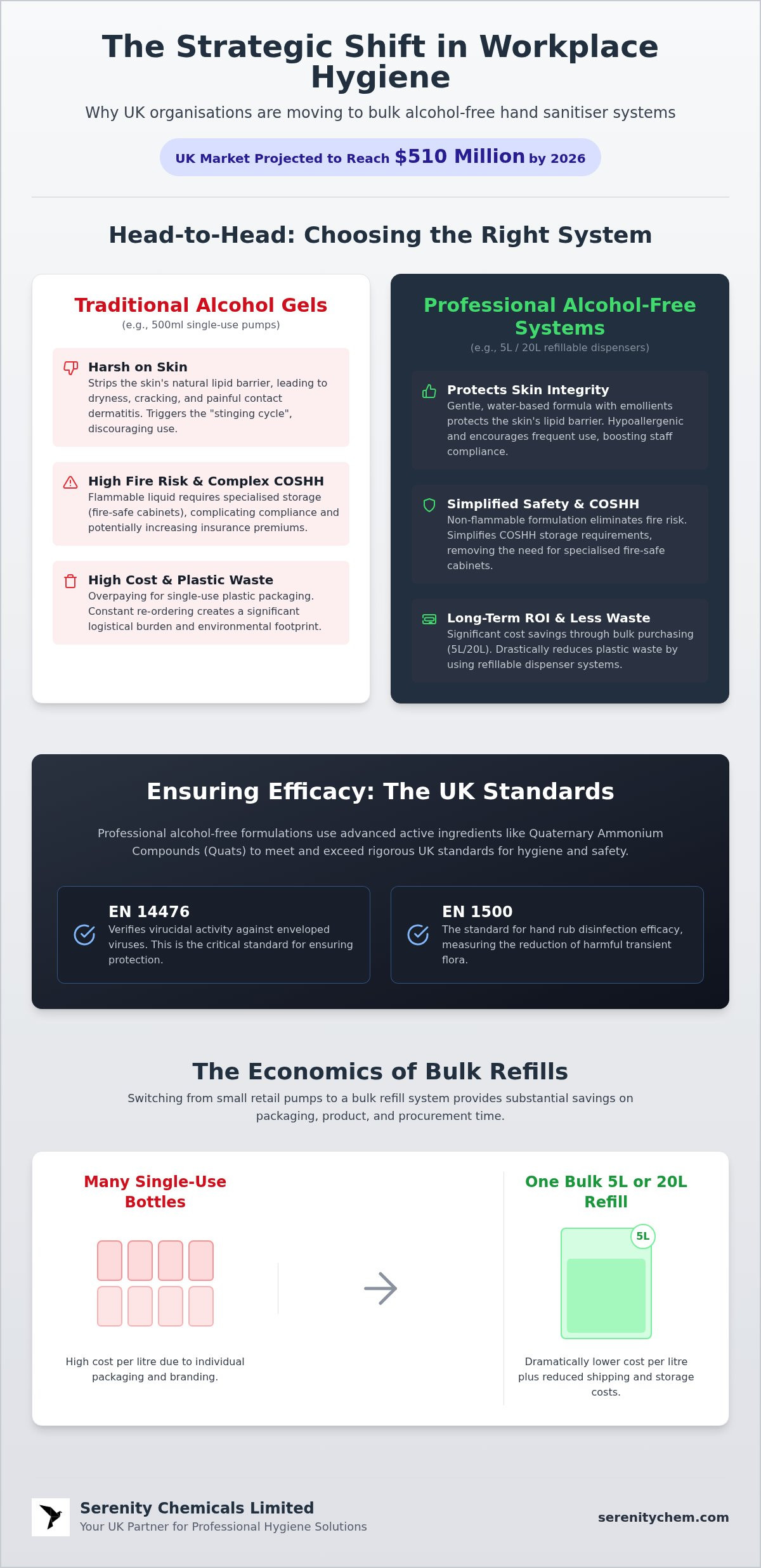
With the UK hand sanitiser market projected to reach a value of USD 510 million by the end of 2026, the sheer volume of plastic waste and procurement spend is forcing a radical rethink of workplace hygiene. If your organisation still relies on individual 500ml pump bottles, you're likely overpaying for packaging whilst managing the logistical burden of flammable liquid storage. Transitioning to a high-performance bulk alcohol free hand sanitiser system isn't just about switching products; it's a strategic move to simplify your COSHH compliance and reduce your environmental footprint.
We recognise that procurement leaders are often caught between the need for rigorous efficacy and the reality of staff complaints regarding dry, cracked skin. It's a difficult balance to strike. This 2026 guide will show you how to reduce operational costs and improve workplace safety by adopting professional-grade, refillable systems designed for high-frequency use. We'll preview the latest regulatory updates from the Health and Safety Executive and provide a clear framework for selecting formulations that meet EN 14476 standards without the harsh side effects of traditional gels.
Key Takeaways
- Understand the shift from reactive pandemic buying to strategic procurement, focusing on the logistical benefits of non-flammable storage and COSHH compliance.
- Learn how to break the "stinging cycle" and improve staff compliance by choosing a bulk alcohol free hand sanitiser that protects the skin's natural lipid barrier.
- Calculate the long-term ROI of switching from 500ml retail pumps to 5L or 20L refills, especially when paired with high-efficiency foam dispensing systems.
- Discover best practices for implementing refillable systems, including how to maintain hygiene standards during the refilling process to prevent cross-contamination.
- Recognise the value of a direct-from-manufacturer UK supply chain in ensuring consistent quality and avoiding common logistics delays.
Why UK Organisations are Switching to Bulk Alcohol-Free Hand Sanitiser
Bulk alcohol-free hand sanitiser is a water-based antimicrobial solution typically supplied in volumes of 5 litres or more for the purpose of refilling high-capacity dispensers. In 2026, the procurement landscape has moved beyond the reactive, emergency purchasing seen during the pandemic. Organisations now prioritise strategic, long-term hygiene solutions that address more than just immediate pathogen control. This shift is driven by a need to reduce operational complexity and improve staff wellbeing. Moving away from single-use 500ml plastic pumps to centralised refill systems also supports the environmental imperative to reduce plastic waste across the supply chain.
Alcohol vs. Alcohol-Free: The Workplace Comparison
The primary reason staff compliance often falters is the physical discomfort caused by traditional alcohol-based gels. Repeated exposure to high concentrations of ethanol or isopropanol strips away the skin's natural lipid barrier, leading to painful contact dermatitis. When hands are sore, employees are less likely to sanitise. Alcohol-free alternatives are gentler, encouraging more frequent use without the risk of skin damage or irritation amongst staff who use the product multiple times a day.
Beyond skin health, the flammability of alcohol presents a significant logistical challenge. Storing large quantities of flammable liquids requires specialised fire-safe cabinets and can impact insurance premiums. By contrast, water-based hand sanitizer formulations are non-flammable, simplifying COSHH storage requirements and eliminating fire risks in the workplace. Additionally, whilst alcohol evaporates almost instantly, many alcohol-free alternatives provide a degree of residual protection that continues to work after the liquid has dried on the skin.
The 2026 Standards for Antiviral Efficacy
Procurement professionals must ensure their chosen bulk alcohol free hand sanitiser meets rigorous UK safety standards. The most critical of these is EN 14476, which verifies virucidal activity against enveloped viruses. It's a common misconception that removing alcohol reduces efficacy; instead, these products utilise advanced active ingredients like Quaternary Ammonium Compounds, often referred to as Quats, to achieve high kill rates. These compounds are highly effective at low concentrations and remain stable over time.
Choosing a product manufactured in the UK ensures that these standards are strictly adhered to. It also provides peace of mind regarding the supply chain and chemical integrity. EN 1500 is the standard for hand rub disinfection efficacy. By selecting products that meet these specific benchmarks, organisations can maintain a safe environment without the drawbacks of traditional alcohol gels.
The Science of Skin Integrity: Why Alcohol-Free is the Professional Choice
Maintaining skin health is a critical component of any workplace hygiene strategy. When staff are required to sanitise their hands multiple times per hour, the chemical composition of the product becomes as important as its antimicrobial efficacy. Traditional alcohol-based gels work by dissolving the lipid membranes of pathogens, but they don't distinguish between bacteria and the protective oils in human skin. This repeated stripping of the natural lipid barrier leads to trans-epidermal water loss, causing the skin to become dry, cracked, and susceptible to contact dermatitis.
This biological damage often triggers the "stinging cycle." Once the skin's surface is compromised, the application of alcohol causes intense discomfort. To avoid this pain, employees frequently stop using the provided sanitiser altogether, which creates a significant gap in your organisation's infection control measures. While CDC hand sanitizer guidelines provide essential context for clinical settings, professional procurement for high-frequency environments must prioritise products that encourage rather than discourage use. A high-quality bulk alcohol free hand sanitiser addresses this by utilising advanced emollients and humectants that actively promote skin hydration whilst killing germs.
This commitment to dermatological wellbeing is shared by skincare specialists like Alvenia Beauty, whose curated range of products focuses on nourishing the skin and preventing the irritation often caused by frequent sanitisation and environmental factors.
High-Frequency Use in Industrial and Educational Settings
In schools and nurseries, the safety profile of a sanitiser is paramount. Alcohol-free options eliminate the risks associated with accidental ingestion or the intentional misuse of flammable liquids. In industrial settings, workers often sanitise dozens of times per shift. For these users, the psychological benefit of a non-sticky, foam-based formulation cannot be overstated. A foam that feels like a luxury skin product rather than a harsh chemical treatment quickly becomes a workplace favourite, leading to higher compliance rates and a safer environment for everyone.
Dermatological Testing and Certification
When evaluating suppliers, it is vital to scrutinise the Safety Data Sheet (SDS) for dermatological credentials. Look for formulations that have undergone rigorous testing to confirm they are non-irritating and safe for prolonged use. Professional procurement requires more than just a "skin-friendly" label; it demands evidence of efficacy and safety. For a deeper dive into the technical specifications required for the UK market, you can consult our alcohol-free hand sanitiser UK: the professional guide. Ensuring your bulk alcohol free hand sanitiser is backed by these standards protects both your staff and your organisation's liability. If you need assistance reviewing your current safety protocols or want to discuss specific formulation requirements, feel free to speak with our technical team today.
Calculating the ROI: The Economics of Bulk Buying
For procurement professionals, the transition to a bulk alcohol free hand sanitiser system is often driven by a fundamental shift in how hygiene costs are calculated. Rather than focusing on the unit price of individual bottles, savvy organisations look at the total cost of ownership. A standard 500ml retail pump bottle carries a significant premium for its packaging and the logistical overhead of handling small units. By moving to 5-litre or 20-litre bulk containers, you immediately strip away these unnecessary costs, allowing your budget to go much further whilst maintaining the same level of protection.
Efficiency also comes from how the product is delivered to the user. Foam dispensers represent a significant leap in dose efficiency compared to traditional gel pumps. A gel dispenser often provides more liquid than is necessary for a single application, much of which ends up on the floor or wasted. In contrast, foam dispensers aerate the liquid, creating a larger volume of product from a smaller amount of liquid. This means a single 5-litre refill lasts considerably longer than the equivalent volume in gel form, reducing the frequency of orders and the volume of liquid you need to store on-site.
Labour costs are another critical factor in the ROI equation. Facilities teams spend a substantial amount of time checking and replacing small bottles. By installing professional dispensers with larger reservoirs, you reduce the maintenance interval significantly. This frees up your team for more technical tasks. Additionally, there are hidden financial benefits to consider, such as reduced insurance premiums. Because alcohol-free formulations are non-flammable, they don't contribute to the fire load of a building, potentially lowering the risk profile of your premises in the eyes of insurers.
The Refill Economy and Sustainability Goals
Sustainability is no longer a secondary concern; it's a core component of ESG (Environmental, Social, and Governance) targets. Switching to 20-litre drums or even 1000-litre IBCs (Intermediate Bulk Containers) dramatically reduces the amount of single-use plastic entering your waste stream. Professional wall-mounted dispensers are built for longevity, often lasting years longer than the flimsy disposable pump heads found on retail bottles. This move toward a circular refill economy demonstrates a principled commitment to environmental responsibility that resonates with both staff and stakeholders.
Supply Chain Security with a UK Manufacturer
Buying direct from a UK blender like Serenity Chemicals Limited provides a level of supply chain security that imported products cannot match. By eliminating international shipping, you avoid the risks of port delays and quality variance that often plague global logistics. Dealing with a local manufacturer ensures shorter lead times and a more transparent relationship. If you're currently reviewing your suppliers, understanding how to find the right partner is essential. We've put together a guide on choosing a cleaning products manufacturer in the UK to help you navigate the technical and ethical requirements of professional procurement.
Implementation Guide: Storage, Dispensing, and Safety
Transitioning to a bulk alcohol free hand sanitiser system involves more than just selecting a high-quality product; it requires a structured approach to logistics and facility management. The choice between manual and automatic (no-touch) dispensers depends on the specific needs of your environment. Automatic dispensers are preferred in high-hygiene areas like medical facilities or food preparation zones to minimise touchpoints. Manual dispensers are robust and cost-effective for general office or warehouse use, provided they are included in regular cleaning schedules to prevent the build-up of residue on the lever.
Safety during the refilling process is paramount to maintaining product integrity. Facilities teams should avoid the habit of "topping up" dispensers. Instead, wait until the reservoir is nearly empty, then clean and dry the unit before refilling from the bulk supply. This prevents the potential for cross-contamination or the growth of biofilm within the dispenser. Under UK safety regulations, any secondary containers or smaller refill bottles must be clearly labelled. This labelling should include the product name, the manufacturer's details, and any relevant safety instructions to ensure all staff are aware of the contents and correct usage.
One of the most significant advantages of water-based systems is the simplification of COSHH (Control of Substances Hazardous to Health) assessments. Because these liquids aren't classified as flammable, you don't need to implement the stringent fire safety measures required for bulk ethanol storage. This reduces the administrative burden on health and safety officers and simplifies your workplace risk profiles.
Strategic Placement for Maximum Compliance
To ensure high compliance, dispensers should be located at "hygiene hubs" where hand hygiene is most logical. These include main entry points, lift lobbies, and the entrances to communal areas like canteens. Clear signage is essential; it acts as a visual prompt for both visitors and staff. A simple maintenance checklist for facilities teams should include:
- Daily level checks to ensure no dispenser runs dry.
- Weekly nozzle cleaning to prevent foam blockages.
- Monthly battery inspections for automatic units.
Storage and Shelf Life
When managing bulk alcohol free hand sanitiser inventory, containers should be stored in a cool, dry environment away from direct sunlight to preserve the efficacy of the active ingredients. It's important to distinguish between the manufacture expiry date and the "Period After Opening" (PAO). Whilst the sealed drum might have a two-year shelf life, the PAO is typically 12 months once the seal is broken. Storing non-flammable liquids near heat sources or electrical equipment significantly reduces the risk of accidental ignition compared to alcohol-based alternatives. If you need assistance planning your dispenser layout or reviewing your storage protocols, you can consult with our technical experts for a tailored implementation plan.
Sourcing Professional Bulk Solutions from Serenity Chemicals Limited
Serenity Chemicals Limited stands as a dedicated UK manufacturer of high-performance hygiene solutions. Our 2026 range of Serenity Alcohol Free Hand Sanitiser is the result of meticulous research into both viral efficacy and dermatological safety. By buying direct from our UK blending facility, organisations eliminate middleman markups and avoid the supply chain volatility often associated with imported chemicals. Whether your facility requires 5-litre refills for a small office or 1000-litre IBCs for national distribution, our production capacity scales to meet your specific requirements without compromising on lead times.
We believe that being a "Principled Expert" means providing more than just a product. We support our partners with comprehensive technical documentation, including up-to-date Safety Data Sheets (SDS) and detailed COSHH data. This ensures that your health and safety officers have the exact information they need to conduct thorough risk assessments and maintain compliance with UK regulations. We don't just ship containers; we provide a service-oriented guide to workplace safety. This includes assisting with the integration of our bulk alcohol free hand sanitiser into your existing hygiene protocols to ensure maximum efficacy across your site.
The Serenity Difference: Efficacy Meets Comfort
Our formulations are engineered to provide maximum protection without compromising the user's comfort. We focus on antiviral efficacy that meets EN 14476 standards, whilst incorporating skin-conditioning agents that prevent the dryness associated with high-frequency use. This balanced approach is what makes Serenity Chemicals Limited the preferred choice for sectors where hygiene is non-negotiable but staff comfort is a priority. Our ethical blending process ensures that every batch produced in our UK facility meets stringent quality controls. For those managing broader facility requirements, we also maintain the ultimate professional cleaning chemicals list to help streamline your entire procurement process with a single, trusted manufacturer.
Get a Bespoke Bulk Quote
Every organisation has unique logistical needs. Our technical team is available to discuss volume-based pricing, pallet rates, and customisation options for large-scale institutional contracts. We provide transparent, honest advice to ensure you select the most efficient bulk alcohol free hand sanitiser system for your specific site. Whether you're looking to transition an entire hospital trust or a single school, we can provide a scalable solution that fits your budget. To discuss your requirements or to request a tailored proposal based on your annual usage, you can contact Serenity Chemicals Limited for bulk hand sanitiser pricing today.
Future-Proofing Your Workplace Hygiene Strategy
Choosing a bulk alcohol free hand sanitiser is a strategic decision that balances operational efficiency with the physical wellbeing of your workforce. By moving away from the high costs and skin-irritation risks of traditional gels, you're investing in a system that encourages compliance whilst simplifying your safety protocols. The transition to refillable, water-based solutions doesn't just lower your procurement spend; it actively supports your environmental targets by reducing plastic waste and eliminating the need for fire-safe storage cabinets.
Our Serenity range is proudly UK Manufactured, EN 14476 Compliant, and both Non-Flammable & COSHH Safe. These technical standards provide the peace of mind required when managing high-traffic professional environments. If you're ready to optimise your facility management for 2026, our technical team is here to help you navigate the transition with confidence.
Secure your organisation's hygiene with Serenity Bulk Sanitisers. We look forward to helping you create a safer, more sustainable environment for your team.
Frequently Asked Questions
Is alcohol-free hand sanitiser as effective as alcohol-based versions?
Alcohol-free hand sanitiser is as effective as alcohol-based versions when it meets the required EN standards for virucidal and bactericidal activity. Formulations like Serenity utilise advanced active ingredients that offer comparable kill rates to ethanol. These products are rigorously tested against EN 14476 and EN 1276 to ensure they provide a high level of protection in professional settings.
Can I use alcohol-free sanitiser in my existing gel dispensers?
You cannot typically use liquid alcohol-free sanitiser in standard gel dispensers without a compatible foam pump. Most alcohol-free formulations are thin liquids that require aeration to create a usable foam. Using them in a gel dispenser will result in the liquid leaking or spraying uncontrollably. It's best to install dedicated foam dispensers designed to handle water-based antimicrobial solutions.
What is the shelf life of a 5L or 20L bulk sanitiser container?
The shelf life of a bulk alcohol free hand sanitiser container is typically 24 months from the date of manufacture if the seal remains intact. Once the container is opened, it's recommended to use the product within 12 months to ensure maximum efficacy. Always store bulk containers in a cool, dry place away from direct sunlight to preserve the integrity of the active ingredients.
Does alcohol-free hand sanitiser kill 99.99% of bacteria and viruses?
Professional-grade alcohol-free sanitisers are formulated to kill 99.99% of common bacteria and enveloped viruses. This efficacy is verified through independent laboratory testing according to British and European standards. When sourcing bulk supplies, always check that the manufacturer provides clear evidence of EN 14476 and EN 1276 compliance to guarantee the product's performance in your workplace.
Is it safe to use alcohol-free sanitiser on children's hands in schools?
Alcohol-free sanitiser is considered the safest option for use on children's hands in educational environments. It eliminates the risks associated with accidental ingestion or the misuse of flammable liquids. Additionally, the non-drying formulation is much gentler on young, sensitive skin, reducing the likelihood of irritation or dermatitis that often occurs with repeated alcohol exposure.
What are the COSHH requirements for storing bulk alcohol-free sanitiser?
COSHH requirements for alcohol-free sanitisers are significantly less stringent than those for flammable, alcohol-based liquids. Because the product is water-based and non-flammable, you don't require specialised fire-safe storage cabinets. However, you must still maintain an up-to-date Safety Data Sheet (SDS) and ensure that all secondary containers are clearly labelled according to workplace safety regulations.
Why is foam sanitiser considered more economical than gel for bulk use?
Foam sanitiser is more economical because the aeration process allows a smaller amount of liquid to cover a larger surface area on the hands. A single 5L refill of foam liquid typically provides significantly more applications than a 5L container of gel. This dose efficiency reduces the frequency of refills and lowers the total cost of ownership for high-traffic organisations.
Can I buy direct from the manufacturer for bulk orders in the UK?
You can buy direct from UK manufacturers like Serenity Chemicals to secure the best rates for bulk alcohol free hand sanitiser orders. Purchasing directly from the blender ensures a more transparent supply chain and faster lead times. This approach also allows you to access technical support and volume-based pricing that is often unavailable through third-party distributors or retail channels.

Hand Sanitiser for Frequent Use: Professional UK Guide 2026
The very product you use to protect your health might be the primary cause of your skin's deterioration. While alcohol-based ...

Food Safe Antibacterial Spray UK: The Professional 2026 Hygiene Guide
Using the wrong disinfectant in a commercial kitchen isn't just a minor oversight; it's a direct threat to your Food Hygiene ...