

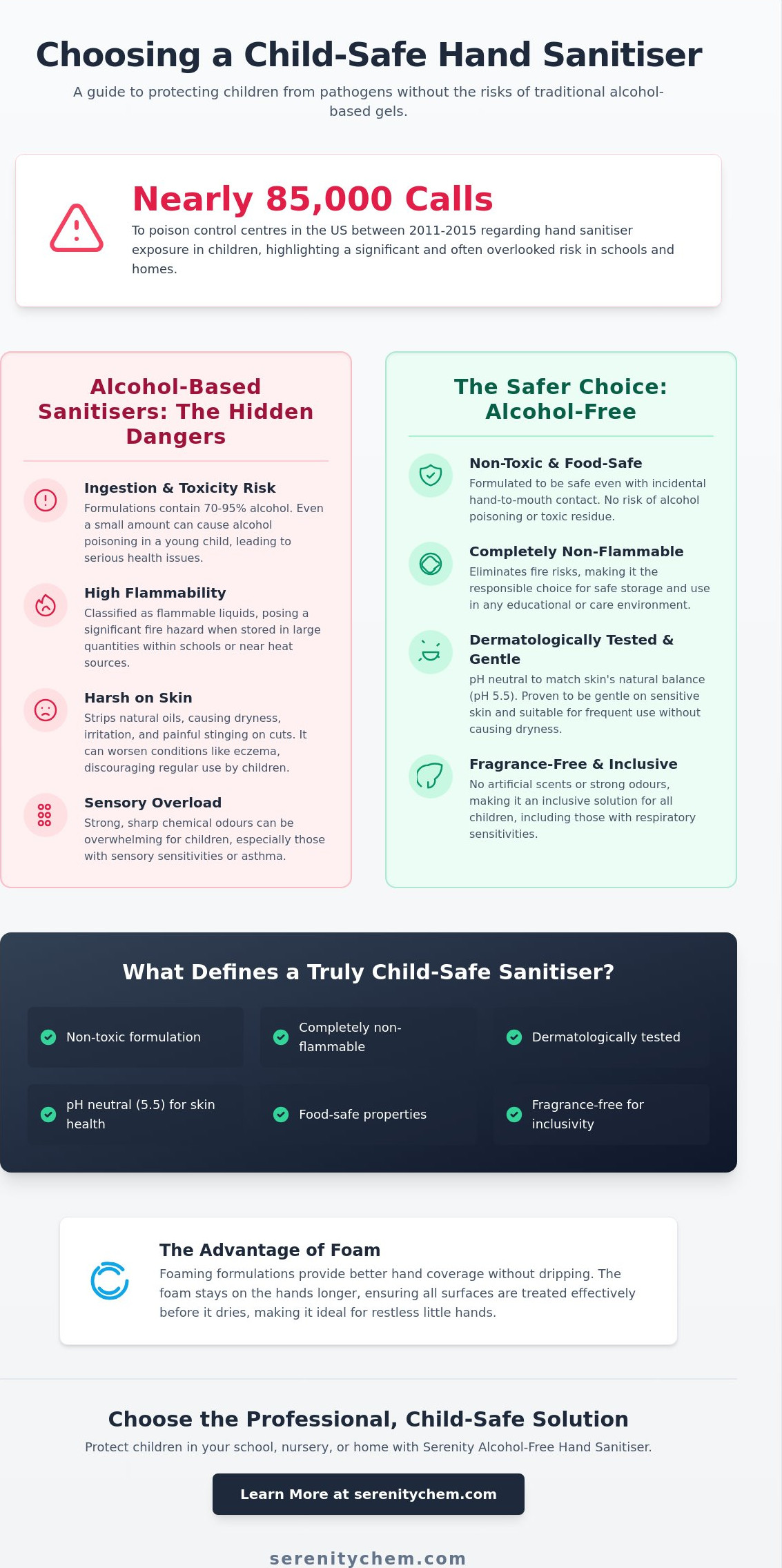
Between 2011 and 2015, poison control centres handled nearly 85,000 calls related to hand sanitiser exposure in children, highlighting a significant risk in our daily hygiene routines. Most parents and teachers want the highest level of protection against pathogens, yet the stinging, flammability, and toxicity of traditional gels often cause more worry than relief. Finding a truly child safe hand sanitiser shouldn't mean compromising on efficacy or risking a painful flare-up of sensitive eczema.
We understand that your priority is a non-toxic environment that doesn't sacrifice safety for speed. This guide will show you how to protect children from pathogens without the risks of alcohol-based gels through science-backed, gentle sanitisation. We'll examine how advanced quaternary ammonium compounds, like those found in Serenity Alcohol Free Hand Sanitiser, provide lasting protection whilst remaining compliant with UK health and safety standards. From classroom safety to caring for delicate skin, you'll learn why moving away from volatile alcohols is the most responsible choice for your school or home in 2026.
Key Takeaways
- Identify the essential criteria that define a child safe hand sanitiser, focusing on non-toxic, non-flammable, and food-safe properties for younger children.
- Understand the serious safety implications of storing alcohol-based products in schools, from fire risks to the danger of accidental ingestion.
- Examine the science behind non-alcohol active ingredients that disrupt pathogen membranes whilst remaining gentle on skin prone to eczema.
- Gain practical advice on organising hygiene stations and using touchless dispensers to maintain high standards in nurseries and play centres.
- Learn why fragrance-free, professional-grade formulations like Serenity Alcohol Free Hand Sanitiser provide a more reliable and inclusive solution for high-traffic environments.
What Defines a Truly Child-Safe Hand Sanitiser?
A truly child safe hand sanitiser must do more than simply kill bacteria; it must protect the integrity of a child's delicate skin and ensure safety in high-traffic environments. In 2026, the definition of "safe" has evolved beyond basic efficacy. Professional-grade solutions are now expected to meet several specific criteria to be considered suitable for paediatric environments:
- Non-toxic: The formulation must be safe if a child accidentally touches their mouth or eyes shortly after application.
- Non-flammable: Removing alcohol eliminates significant fire risks in classrooms and storage cupboards.
- Dermatologically tested: Products should be proven gentle on sensitive skin through rigorous testing.
- pH Neutral: Formulations should match the skin’s natural 5.5 pH level to avoid stripping essential moisture.
One of the most critical factors for parents and early-years educators is "food-safe" properties. Younger children frequently engage in hand-to-mouth behaviour. Using a sanitiser that leaves toxic residues or bitter chemicals behind is an unnecessary risk. Additionally, a child's skin barrier is significantly thinner than an adult's. Products that are too acidic or alkaline can lead to painful dryness and long-term irritation. This technical precision is why many UK schools have shifted toward alcohol-free mandates, prioritising long-term skin health and classroom safety over traditional high-ethanol gels.
Understanding hand sanitizer effectiveness and risks is essential for making an informed choice. Whilst alcohol is a common disinfectant, its volatility and the potential for toxicity if ingested make it less suitable for unsupervised or frequent use amongst children. By choosing a child safe hand sanitiser that relies on advanced, non-volatile compounds, schools can maintain high hygiene standards without the associated hazards of traditional products.
The Problem with "One Size Fits All" Hygiene
Adult-grade sanitisers often contain between 70% and 95% ethanol. These formulations are far too aggressive for younger users. They evaporate quickly but often cause a sharp stinging sensation on small cuts or grazes, which discourages children from wanting to clean their hands. Strong chemical odours also present sensory challenges, particularly for neurodivergent children who may find the sharp scent of alcohol overwhelming. Transitioning to a foaming formulation rather than a liquid or gel provides better coverage. Foam stays on the hands longer without dripping, ensuring that every finger and palm surface is treated before it dries.
Key Safety Certifications to Look For
When selecting a hygiene solution, look for dermatological approval specifically for paediatric use. In the current market, "alcohol-free" has become the primary marker for safety. It eliminates the risk of alcohol poisoning and removes flammability concerns in the workplace. Fragrance-free options are also preferable. Artificial scents are common allergen triggers; a neutral, unscented product ensures that the sanitisation routine remains inclusive for children with asthma or sensitive respiratory systems. Professional reliability comes from choosing products that prioritise these ethical and safety standards over cheap, high-alcohol alternatives.
The Hidden Risks of Alcohol-Based Sanitisers for Children
The prevalence of alcohol-based gels in public spaces has led to a misplaced sense of security regarding their safety for younger users. Whilst these products are effective at killing certain pathogens, they introduce a range of hazards that often outweigh their benefits in a classroom or nursery. The primary concern for many health professionals is the risk of accidental ingestion. Between 2011 and 2015, U.S. poison control centres received nearly 85,000 calls related to hand sanitiser exposure in children. Even a small amount of 70% ethanol gel can cause alcohol poisoning in a toddler, leading to lethargy or vomiting.
Beyond ingestion, flammability remains a critical issue. Storing large quantities of high-alcohol liquids in educational settings carries significant risks. According to FDA safety guidelines for hand sanitizer, these products are classified as flammable and should be kept away from heat or open flames. In a school environment, where science labs or kitchen facilities are present, the presence of volatile vapours can be dangerous. There's also the "sting factor" to consider. Alcohol causes intense pain on small cuts or grazes. This often discourages children from sanitising their hands, undermining the very hygiene routine you're trying to establish.
Physiological Impact on Young Skin
Children possess a significantly thinner epidermis than adults, making their skin far more permeable. Repeated application of alcohol-based products strips the natural lipid barrier, causing chronic dryness and irritation. For those already struggling with skin conditions, this can be devastating. Finding the best hand sanitiser for eczema becomes a priority when traditional gels trigger painful flare-ups. In infants, there's even a documented risk of transdermal absorption of isopropyl alcohol, which can enter the bloodstream through their delicate skin. Using a dedicated child safe hand sanitiser avoids these systemic risks whilst maintaining a high level of hygiene.
Safety Concerns in Educational Settings
From a regulatory perspective, schools must consider the Control of Substances Hazardous to Health (COSHH) implications of their hygiene choices. High-alcohol sprays can create a "vapour cloud" effect in poorly ventilated areas, which may trigger respiratory distress in asthmatic pupils. There's also the social risk of intentional misuse or "dares" amongst older students, which is a growing concern for secondary school administrators. Providing a non-toxic alternative ensures that hygiene remains a health benefit rather than a safety liability. If you're reviewing your school's safety protocols, you can speak with our technical team for guidance on alcohol-free transitions.
The Science of Alcohol-Free Efficacy: How It Protects Children
To understand why an alcohol-free approach is superior for younger users, we must look at the underlying chemistry. Most traditional sanitisers rely on high concentrations of ethanol to dissolve the outer layer of germs. Whilst effective in the short term, this process is volatile and temporary. A modern child safe hand sanitiser typically utilises Benzalkonium Chloride (BAC) as its active agent. This compound works by disrupting the lipid membrane of pathogens. It essentially punctures the fatty outer shell of bacteria and viruses, causing them to collapse and die. It's a mechanical kill that doesn't require the harsh, corrosive environment created by 70% alcohol.
One of the most significant scientific advantages of this method is the residual effect. Alcohol only disinfects whilst it's wet on the skin. The moment it evaporates, which usually takes less than twenty seconds, the hands are vulnerable to immediate re-contamination. In contrast, alcohol-free formulations continue to provide protection long after they've dried. They leave a microscopic, non-toxic barrier on the skin that remains active against pathogens for several hours. This is particularly valuable in a school setting where children move rapidly between shared toys, desks, and play equipment.
There's also a persistent myth that only alcohol can tackle serious viruses like the flu or Norovirus. Scientific testing proves otherwise. When formulated correctly, alcohol-free solutions provide a broad spectrum of protection that matches or exceeds the performance of traditional gels. They achieve this without the risk of toxicity or the "sting" that often makes children avoid hand hygiene altogether.
Understanding BS EN Standards for Child Safety
When evaluating hygiene products for schools or nurseries, you should look for specific British Standards to ensure efficacy. EN 1276 is the bactericidal standard, confirming the product kills 99.999% of bacteria. This is essential for canteen hygiene and food-preparation areas. For viral protection, EN 14476 is the benchmark. It ensures the sanitiser is effective against enveloped viruses, providing reassurance to parents during the cold and flu season. It's vital to remember that "alcohol-free" doesn't mean "chemical-free." Instead, it represents a shift toward "safe-chemical" engineering, where the ingredients are chosen for their low toxicity and high compatibility with human skin.
Why Foam is Superior for Child Compliance
The physical format of the sanitiser plays a huge role in how well children use it. Liquid gels are often slippery and difficult for small hands to control, frequently ending up on the floor and creating slip hazards. Foam is far more manageable. It has a higher surface area, allowing it to be easily spread amongst small fingers, nail beds, and palms. This ensures better coverage and more effective sanitisation. For nurseries and play centres, foam dispensers are also more cost-efficient. They deliver a controlled dose that goes significantly further than liquid equivalents, reducing waste in high-volume environments.
Organising Safe Hygiene in Schools, Nurseries, and Play Centres
Managing hygiene for hundreds of children requires a structured approach that goes beyond providing individual bottles. For educational institutions, the infrastructure of cleanliness is just as important as the formulation itself. Wall-mounted touchless dispensers are the most effective way to prevent cross-contamination in high-traffic areas. These units eliminate the need for children to touch a shared pump, which can often become a breeding ground for pathogens. By placing these dispensers at key "Sanitisation Stations" located at entrances, canteen exits, and play areas, schools can ensure that hand hygiene becomes a seamless part of the daily routine.
Teaching the correct "Palm-to-Palm" technique is also vital. Using a non-stinging, foaming child safe hand sanitiser allows educators to demonstrate thorough cleaning without causing discomfort. Children are more likely to engage with the process when the product doesn't sting small cuts or have an overwhelming chemical scent. For administrators managing tight educational budgets, the logistics of bulk hand sanitiser UK procurement are essential. Moving to high-volume refills rather than single-use plastic bottles provides a more sustainable and cost-effective solution for large-scale environments.
Creating a Culture of Cleanliness
Habit formation is easier when the experience is positive. Foaming textures are often perceived as "fun" by younger children, which encourages them to participate in sanitisation without constant prompting. Teachers can supervise these moments with total peace of mind, knowing that the non-toxic nature of the product removes the risk of alcohol poisoning mentioned previously. It's also helpful to install dispensers at child-height levels. This promotes independence amongst pupils and ensures they can access hygiene solutions whenever they feel their hands are dirty after outdoor play or messy activities.
Procurement and Safety Compliance
When selecting a supplier, always review the Safety Data Sheets (SDS) to verify child-safe credentials. Look for products manufactured by a UK-based company to ensure supply chain reliability and adherence to local health standards. Transitioning from individual desk bottles to centralised, refillable systems significantly reduces plastic waste and simplifies the inventory process. This methodical approach ensures that your facility remains compliant whilst providing a safe environment for every child. To discuss your specific requirements, you can contact our technical support team for a school hygiene consultation.
Serenity: The Professional Choice for Child-Safe Sanitisation
Serenity Alcohol Free Hand Sanitiser represents the pinnacle of hygiene engineering for environments where children learn and play. As a premier UK-manufactured solution, we've focused on eliminating the inherent hazards of traditional gels whilst maintaining uncompromising efficacy. Our formulation is entirely non-flammable and non-toxic. It provides peace of mind for headteachers and parents who are rightly concerned about the safety profile of the chemicals used in their buildings. By removing fragrances and dyes, we ensure our range remains inclusive for those with respiratory sensitivities or allergies.
Efficiency is a core pillar of our design. Our high-yield foaming technology ensures that every litre of product provides significantly more applications than a standard liquid gel. This reduces the frequency of refills and lowers the overall cost per use, which is a vital consideration for public sector budgets. We are committed to the highest alcohol free hand sanitiser UK professional standards, ensuring that our products meet rigorous bactericidal and virucidal requirements without compromising the skin's natural barrier. Choosing a dedicated child safe hand sanitiser means you don't have to choose between protection and safety.
Manufactured with Integrity in the UK
Our production processes are defined by meticulous attention to detail. Every batch of child safe hand sanitiser undergoes rigorous testing to verify its efficacy against pathogens and its safety on delicate skin. We operate with a "Principled Expert" philosophy. This means we prioritise technical reliability over marketing gimmicks or seasonal trends. By supplying UK schools and nurseries directly through our wholesale channels, we provide a reliable supply chain that institutions can depend on year-round. This direct relationship allows us to offer technical guidance that helps organisations maintain the highest safety standards without unnecessary complexity.
Next Steps for Your Organisation
If your facility still relies on alcohol-based products, now is the time to review your current COSHH assessments. Consider the risks of storing flammable liquids amongst children and the potential for accidental ingestion. Transitioning to a safer, more gentle hygiene protocol is a straightforward process that protects both your pupils and your staff. We provide the documentation and support needed to make this shift seamless and compliant. It's a responsible step toward a healthier, more secure learning environment. You can explore our child-safe sanitiser range today to find the right solution for your specific environment.
Securing a Safer Future for School Hygiene
Transitioning to a modern hygiene protocol is a significant step toward protecting both the physical health and the safety of children in your care. By prioritising a child safe hand sanitiser, you eliminate the risks of accidental alcohol poisoning and fire hazards whilst ensuring that even the most sensitive skin remains healthy and hydrated. This approach moves beyond simple germ-killing to provide a comprehensive safety solution for high-traffic educational environments.
Serenity Alcohol Free Hand Sanitiser provides a dependable solution that is UK Manufactured and fully BS EN 1276 & EN 14476 Certified. Our non-flammable and non-toxic formulation ensures that your facility meets the highest professional standards without compromise. It's an investment in long-term wellness that respects the delicate nature of young skin and the complex needs of a busy classroom. We're here to support your transition to a superior standard of care.
Switch to Serenity Child-Safe Alcohol-Free Sanitiser Today. We look forward to helping you create a gentler, more secure environment for the next generation.
Frequently Asked Questions
Is alcohol-free hand sanitiser actually safe for babies and toddlers?
Alcohol-free formulations are significantly safer for babies and toddlers because they remove the risk of alcohol poisoning and transdermal absorption. Whilst health authorities suggest handwashing with soap is the priority, a non-toxic sanitiser is a reliable alternative for when you're on the move. These products don't contain the volatile ethanol found in traditional gels, making them suitable for younger children who frequently put their hands in their mouths.
Can child-safe hand sanitiser kill 99.9% of viruses and bacteria?
Yes, a high-quality child safe hand sanitiser is engineered to meet the same rigorous efficacy standards as adult products. You should look for formulations that are certified to BS EN 1276 and EN 14476 standards. These certifications prove the product is effective against a broad spectrum of pathogens, including common school-age illnesses like the flu, whilst remaining gentle enough for daily use on sensitive skin.
What happens if a child accidentally licks their hands after using sanitiser?
If you're using a non-toxic, alcohol-free product, a small amount of residue from a lick is unlikely to cause harm. Unlike traditional gels, which can contain up to 95% ethanol and pose an immediate risk of intoxication, alcohol-free versions are formulated with safety in mind. However, you should always supervise children during application and store the product out of reach to prevent any intentional ingestion of large quantities.
Is foaming hand sanitiser better for children than traditional gel?
Foam is generally superior for children because it offers better physical control and more consistent coverage. Gels are often slippery and can easily drip onto clothes or floors, creating mess and slip hazards in a busy classroom. Foam stays on the palms and is easier for small fingers to spread into nail beds and crevices. It's also more cost-effective for schools, as each pump delivers a controlled, high-yield dose.
Does child-safe sanitiser help with school-age skin conditions like eczema?
It helps by preserving the skin's natural defences rather than stripping them away. Traditional alcohol-based products can trigger painful eczema flare-ups by drying out the epidermis and causing cracks. Using a child safe hand sanitiser that is pH neutral and alcohol-free allows children with sensitive skin to participate in hygiene routines without discomfort. This ensures that protecting against germs doesn't come at the cost of skin health.
How often should children use hand sanitiser throughout the school day?
Children should use sanitiser at key transition points to minimise the spread of pathogens. This typically includes when they arrive at school, before and after eating lunch, and after returning from outdoor play. It's a practical solution for quick cleans between lessons when handwashing facilities aren't immediately available. However, if hands are visibly dirty or greasy from art projects or snacks, soap and water should always be the first choice.
Are there any UK regulations regarding hand sanitiser in nurseries?
Nurseries must follow COSHH and Health and Safety Executive (HSE) guidelines when managing hygiene products. This involves conducting a risk assessment for any hazardous substances, including flammable alcohol gels. Many early-years settings now opt for alcohol-free solutions to simplify their safety compliance and remove the need for lockable storage cabinets. It's also common for nurseries to require written parental permission before a child uses any topical sanitisation product.
Can I buy child-safe hand sanitiser in bulk for my business?
Yes, Serenity provides professional-grade alcohol-free solutions in bulk quantities for schools, nurseries, and play centres. Purchasing in larger volumes is a more sustainable choice that helps reduce plastic waste through the use of refillable dispensers. It also ensures a reliable supply for high-traffic environments whilst remaining cost-effective. You can choose between various sizes to suit your facility's specific storage and usage requirements.

Hand Hygiene in Food Preparation Areas: The 2026 Professional Guide
The Food Standards Agency estimates that foodborne illness costs the UK economy approximately £9 billion every year, with a s...

Sanitising Commercial Kitchen Hard Surfaces: The Professional UK Guide (2026)
Did you know that the average fine for food hygiene offences in the UK has more than tripled since 2016, now reaching over £7...