

Did you know that nearly 85% of workers' compensation claims are attributed to employees slipping on slick floor surfaces? When a leak occurs in a busy warehouse or workshop, knowing exactly how to clean oil spill on concrete floor isn't just about aesthetics; it's a critical safety priority. Concrete is naturally porous, meaning every second an oil spill sits, it's soaking deeper into the substrate. This creates permanent staining and a significant liability for your team's well-being whilst increasing the risk of accidents.
It's frustrating to manage cleanup processes that feel like a waste of time when using inferior products. You deserve a method that ensures workplace safety and COSHH compliance without the guesswork. This guide provides a professional roadmap to restoring your surfaces. You'll learn how to combine rapid molecular encapsulation with deep degreasing to achieve a clean, slip-free finish. We'll also highlight cost-effective bulk solutions, such as using a Serenity Heavy Duty Degreaser, to keep your operations running smoothly and safely.
Key Takeaways
- Learn the two-stage professional method of molecular encapsulation followed by deep degreasing to restore the structural integrity of your floor.
- Understand how to clean oil spill on concrete floor whilst maintaining full compliance with UK workplace safety and COSHH regulations.
- Discover the technical differences between traditional clay granules and modern Super Absorbent Polymers for significantly faster liquid containment.
- Identify the essential components of a professional spill station, including how to select the correct kit size for your specific facility needs.
- Master the application of high-performance solutions like Serenity Heavy Duty Degreaser to lift deep-seated residues from porous concrete slabs.
Why Oil Spills on Concrete Require Professional Management
Managing oil spills in a professional environment requires more than a bucket of soapy water. Industrial concrete floors, whilst appearing solid, are actually complex networks of microscopic pores. When a leak occurs, the clock starts ticking. Understanding how to clean oil spill on concrete floor effectively begins with recognising that the oil isn't just sitting on top; it's actively moving. Without the right intervention, what starts as a surface puddle quickly becomes a deep-seated structural issue. Serenity Chemicals Limited advocates for a proactive approach that prioritises both structural integrity and workplace safety.
The Porous Nature of Concrete Surfaces
Concrete acts like a hard sponge. Through capillary action, liquids are pulled deep into the slab's internal structure. If left untreated, the oil migrates so far down that surface-level scrubbing won't reach it. This leads to "shadowing," where a dark stain remains even after the floor feels dry. The Science of Sorbents explains how professional materials utilise adsorption to trap these hydrocarbons before they settle. Immediate response is the only way to prevent permanent discolouration and structural degradation. Once oil penetrates the top few millimetres, it can weaken the bond of the concrete over time, leading to surface scaling or "spalling."
Workplace Safety and Liability
In the UK, the Health and Safety at Work etc. Act 1974 places a clear duty on employers to ensure a safe environment. Oil is a primary cause of slips and falls, which account for a vast majority of workplace injuries. Beyond just putting out a "Caution: Wet Floor" sign, you must have a documented process for hazardous substance management. This falls under COSHH (Control of Substances Hazardous to Health) regulations. A truly safe facility integrates these cleanup procedures into their broader professional hand sanitiser protocols and general hygiene standards to ensure employee well-being is protected from every angle.
Environmental risks are equally significant. Under UK law, it's an offence to allow oil or chemicals to enter the surface water drainage system or local watercourses. Traditional cleanup methods like sawdust or sand are no longer considered best practice in modern industrial settings. Sawdust is highly flammable when soaked in oil, creating a secondary fire risk. Sand is often inadequate because it fails to encapsulate the liquid, leaving a slippery residue behind that continues to pose a hazard. Modern industrial standards demand absorbents that lock the oil away and high-performance degreasers that break the molecular bond between the hydrocarbon and the concrete surface.
Effective management protects your slab, your staff, and your legal standing. By moving away from domestic-grade hacks and adopting industrial-strength solutions, you ensure that a minor leak doesn't turn into a major liability or a permanent scar on your facility floor. Knowing how to clean oil spill on concrete floor correctly is the difference between a quick fix and a lasting professional standard maintained by Serenity Chemicals Limited.
The Science of Absorption: Granules vs. Polymers
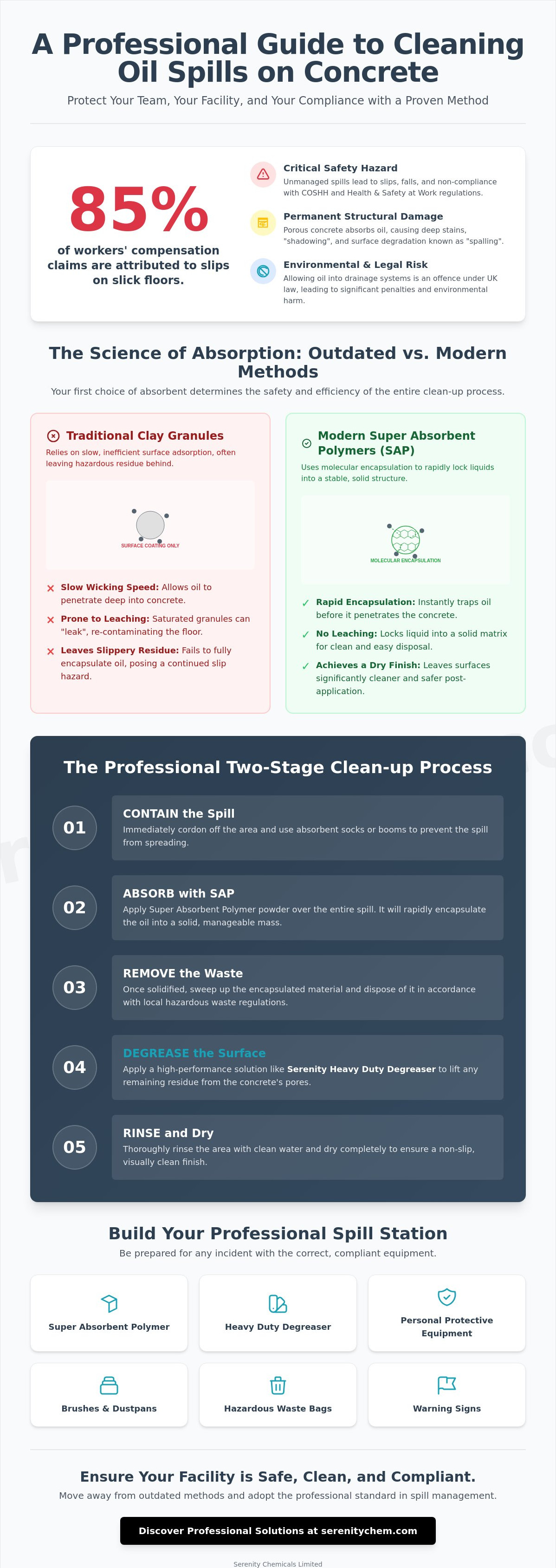
The first tool you grab determines how much labour you'll spend on the back end when considering how to clean oil spill on concrete floor. Traditional clay granules work through surface adsorption. The oil simply sticks to the outside of the mineral particles. This is often a slow and inefficient process for heavy lubricants or hydraulic fluids. Modern Super Absorbent Polymer (SAP) technology represents a significant leap forward in facility maintenance. Instead of just coating the granules, SAP materials encapsulate the liquid, locking it within a stable chemical structure. This prevents the "leaking" or leaching often seen when saturated clay is moved across a warehouse floor.
Wicking speed is another critical factor. This refers to the rate at which a material draws liquid into its core. For heavy oils, clay is notoriously sluggish. This delay allows the oil more time to penetrate deep into the concrete pores, leading to the shadowing mentioned in the previous section. Advanced powders have a much higher wicking speed. They catch the spill before it migrates, ensuring a more thorough initial lift. Choosing eco-friendly, non-hazardous granules also ensures that your cleanup process doesn't introduce new respiratory risks or chemical sensitivities to your team.
How Spill Absorb Powder Outperforms Clay
Using Spill Absorb Liquid Absorbent Powder fundamentally changes the physics of the cleanup. Unlike clay, which often creates a heavy, messy sludge that is difficult to sweep, these powders turn liquids into manageable, dry solids. This is vital for workplace safety. A dry solid is easier to remove and leaves the concrete surface significantly less slick. Because these high-capacity materials absorb more liquid per gram than traditional kitty litter, you use less product overall. This reduces your total waste volume and significantly lowers your disposal costs. It's a more efficient, principled approach for any high-traffic maintenance bay. You can find these specialised tools in our spill control absorbents collection.
Hydrophobic vs. Universal Absorbents
Not all absorbents treat all liquids equally. Hydrophobic technology allows certain pads and socks to repel water whilst aggressively soaking up hydrocarbons. These "Oil Only" products are essential for outdoor loading docks or concrete floors that are frequently damp. If you use a universal absorbent in a wet area, it will fill up with water before it ever touches the oil. In contrast, universal absorbents are the workhorse of the internal workshop. They manage oils, coolants, and solvents simultaneously. Selecting the right material ensures you don't waste resources or leave a hazardous residue behind when you're looking at how to clean oil spill on concrete floor effectively.
Choosing the Right Equipment for Oil Spill Control
Preparation is the foundation of any professional spill response. If you are only considering how to clean oil spill on concrete floor after a drum has split, you're already losing valuable time. Effective management requires having the correct capacity and format of equipment within reach. A well-equipped facility doesn't just have "a spill kit"; it has a strategically placed station designed for the specific volume of risk present in that area. This proactive approach minimises the time oil has to penetrate the porous concrete slab and reduces the total footprint of the hazard.
Spill Kits: 25L vs. 50L General Purpose Solutions
Selecting the right kit size is a balance between mobility and containment capacity. For smaller workshops or individual maintenance bays, a 25Ltr General Purpose Emergency Spill Kit is often the most efficient choice. These are compact enough to be wall-mounted or kept in vehicle cabs, ensuring they are available for immediate deployment. They contain high-wicking pads and basic PPE, which are essential for managing the initial 30 seconds of a leak.
In high-risk areas, such as fuel delivery points or large machinery zones, scaling up to a 50Ltr General Purpose Emergency Spill Kit is necessary. These larger kits provide a higher volume of absorbents and more robust disposal bags to handle the saturated material. Regardless of size, a professional kit should always include:
- Nitril gloves and safety goggles to meet COSHH standards.
- Absorbent socks for perimeter containment.
- High-visibility disposal bags for hazardous waste marking.
- Instruction cards for staff training and compliance.
Pads, Rolls, and Booms: A Format Guide
The format of your absorbent determines how effectively you can isolate a spill. Premium Oil Absorbent Pads are the workhorse of the workshop. They are designed for rapid placement under machinery leaks or to wipe down surfaces after the bulk of a liquid has been lifted. For larger volumes, you must think about perimeter control. This is where Premium Oil Absorbent Booms become critical. By placing these around the edge of a spill, you prevent the oil from reaching warehouse drains or migrating under heavy racking where it becomes nearly impossible to clean.
Absorbent rolls offer a different kind of utility. They can be cut to length and used to line walkways or workbenches where minor drips are a persistent issue. This preventative use keeps the concrete surface clean and slip-free from the start. To maintain a truly professional standard, always use colour-coded cleaning tools. Using the same mop or brush for oil spills and general floor cleaning is a common mistake that spreads hydrocarbons across the entire facility. Dedicated, clearly marked equipment ensures that oil stays contained within the spill zone, making the final degreasing stage much more effective when you're finalising how to clean oil spill on concrete floor properly.
Step-by-Step: How to Clean Oil from Concrete Floors
Mastering how to clean oil spill on concrete floor requires a disciplined, multi-stage approach. You can't simply scrub the surface and assume the hazard is gone. A professional cleanup ensures that the oil is contained, encapsulated, and then lifted from deep within the concrete pores. This method protects your facility's infrastructure whilst maintaining a safe, slip-free environment for your staff. The following steps outline the most effective industrial process for managing spills of any size.
Containment and Bulk Absorption
The first priority is stopping the spread. You should "circle" the spill using absorbent socks or booms, starting from the outside and working inwards. This prevents the oil from reaching expansion joints or warehouse drains. If oil enters an expansion joint, it can migrate to the sub-base, leading to long-term structural issues and environmental non-compliance. Once the perimeter is secure, you can focus on lifting the bulk liquid.
Applying Spill Absorb Powder is the most efficient way to achieve a slip-free finish. Unlike traditional clay, these polymers require a short "wait time" to work effectively. Give the powder approximately 2 to 5 minutes to fully encapsulate the hydrocarbons. You'll see the material change texture as it turns the liquid into a manageable dry solid. This encapsulation makes the final sweep-up much cleaner and ensures no oily residue is smeared across the floor during removal.
Deep Cleaning and Residue Removal
After the bulk material is swept away, you must address the oil trapped in the concrete's pores. Apply a Serenity Heavy Duty Degreaser to the affected area. This chemical stage is vital; it breaks the molecular bond between the oil and the concrete. Use a stiff brush to agitate the solution, forcing the degreaser into the substrate to lift "shadowing" stains. For large-scale industrial areas, using a Buffalo Kentucky Bucket & Wringer allows for efficient rinsing without spreading contaminated water to clean zones.
The final mop-up should be done with a high-quality head, such as the Biofresh T1 D Socket Mop, which provides antibacterial protection and superior pick-up. Ensure the floor is completely dry before removing any safety barriers or "Caution" signs. Finally, dispose of all saturated absorbents and PPE in accordance with local UK hazardous waste regulations. Never wash oily residue into standard grit traps or sewers. Following this principled process ensures you know exactly how to clean oil spill on concrete floor whilst staying on the right side of COSHH and environmental laws.
Equip your facility with professional-grade tools by exploring our full range of spill control absorbents.
Essential Products for a Safe and Clean Facility
Achieving a professional standard in 2026 requires a toolkit that matches the intensity of industrial environments. Knowing how to clean oil spill on concrete floor is only half the battle; the other half is having a reliable supply chain for high-performance absorbents. This final stage of facility management focuses on the specific inventory required to maintain a safe, compliant work floor. By moving away from generic alternatives and adopting specialised solutions, you ensure that your cleanup process is both repeatable and effective.
Serenity Spill Absorb represents the pinnacle of this approach, offering an eco-friendly solution for instant liquid encapsulation. For rapid response, pre-packed, high-visibility Emergency Spill Kits are indispensable, ensuring that everything from PPE to disposal bags is available in one place. When managing specific fuel or lubricant leaks, Oil-Only Absorbents provide the hydrophobic properties needed to target hydrocarbons without wasting material on water. Finally, the decontamination process is only as good as the tools used to finish it. Heavy-duty buckets and antibacterial mops ensure that every trace of residue is removed from the concrete surface.
Why UK Businesses Choose Serenity Chemicals Limited
Reliability is the cornerstone of our service. As a direct-from-manufacturer provider, Serenity Chemicals Limited ensures that every product meets the rigorous demands of UK industrial and commercial use. This direct relationship allows us to maintain high performance whilst offering competitive pricing for bulk requirements. Our commitment to safety standards is absolute, mirroring the high benchmarks found in our food-safe kitchen hygiene reference. Whether you're managing a warehouse or a commercial kitchen, the principle remains the same: effective chemistry combined with responsible application.
Building Your Custom Spill Response Station
A proactive safety culture begins with a thorough facility audit. Identify high-risk zones such as delivery bays, fluid storage areas, and machinery lines. Placing a dedicated spill station in these locations drastically reduces response times. It's also vital to maintain a consistent stock level. Bulk-buying absorbent refills ensures your team is never caught unprepared when they need to know how to clean oil spill on concrete floor under pressure. Constant readiness is the most cost-effective way to prevent slip injuries and environmental fines.
Secure your facility today and ensure full compliance with current safety regulations by browsing our full Spill Control & Absorbents collection. Serenity Chemicals Limited is here to help you select the right configuration for your specific operational needs, providing peace of mind through professional-grade solutions.
Securing Your Industrial Workspace for the Future
Managing a high-traffic facility requires a commitment to both operational efficiency and ethical safety. By mastering how to clean oil spill on concrete floor using these professional methods, you protect your infrastructure from permanent damage and your team from preventable accidents. The transition from traditional clay granules to advanced Super Absorbent Polymer technology ensures that leaks are encapsulated instantly, leaving your surfaces dry and secure. This methodical approach to spill control is the most effective way to maintain COSHH compliance whilst reducing long-term maintenance costs.
As a UK-based manufacturer and specialist supplier, Serenity Chemicals Limited provides the high-performance tools needed to meet these standards. Our full range of COSHH-compliant spill kits is designed for the specific rigours of the British industrial landscape. Whether you are managing a small maintenance bay or a large-scale distribution centre, having the right equipment on hand is a principled choice for any responsible operator. You can Shop the Professional Spill Control & Absorbents Collection today to ensure your facility is prepared for any eventuality. Taking these proactive steps now creates a cleaner, safer, and more productive environment for everyone.
Frequently Asked Questions
What is the best absorbent for a large oil spill on concrete?
High-performance Super Absorbent Polymers (SAP) are the most effective choice for large spills. Unlike traditional clay, these materials lock the liquid inside their chemical structure, preventing leaching whilst the material is being moved. This technology is superior for large-scale containment because it turns the liquid oil into a stable, dry solid. This process makes the final sweep much faster and prevents the hydrocarbon from spreading further across the porous concrete slab.
How do I dispose of oil-soaked absorbent pads in the UK?
You must dispose of oil-soaked materials as hazardous waste in accordance with the Hazardous Waste (England and Wales) Regulations 2005. Saturated pads and granules cannot enter your standard general waste stream or drainage systems. You should store them in clearly marked, high-visibility disposal bags within a dedicated hazardous waste container until a licensed waste carrier can collect them for professional processing and legal disposal.
Can I use a regular mop to clean up an oil spill?
You shouldn't use a regular mop for oil cleanup because it often spreads the hydrocarbons across a wider area rather than lifting them. Standard mops are designed for water-based dirt and lack the capacity to draw heavy oils out of concrete pores. Instead, use a dedicated industrial mopping system with a heavy-duty degreaser. This ensures the oil is chemically broken down and removed rather than being redistributed into clean zones of your facility.
What is the difference between "Oil-Only" and "General Purpose" spill kits?
The main difference lies in liquid selectivity. Oil-Only kits contain hydrophobic materials that repel water whilst aggressively soaking up fuels and lubricants, making them ideal for outdoor use or damp environments. General Purpose kits are universal and will absorb almost any non-aggressive liquid, including water, coolants, and solvents. Choosing the correct kit depends on whether your spill is likely to be mixed with water or other common workshop fluids.
Do oil absorbent pads work on wet concrete floors?
Specialist "Oil-Only" absorbent pads are specifically designed to work on wet concrete floors. Because they are hydrophobic, they will float on water or sit on a damp surface whilst only drawing in the oil. This is a critical feature for loading docks or areas exposed to the elements. General purpose pads would simply soak up the water first, leaving the oil behind to cause a persistent and dangerous slip hazard for your employees.
How do I remove an old, dried oil stain from concrete?
Removing an old stain requires a professional-grade degreaser and mechanical agitation. When considering how to clean oil spill on concrete floor residues that have dried, you must allow the degreaser to dwell for at least 15 to 20 minutes. This gives the chemicals time to penetrate the pores and break the molecular bond. Scrubbing with a stiff-bristled brush followed by a thorough rinse with an industrial mopping system is the most reliable way to lift stubborn "shadow" marks.
Is it mandatory to have a spill kit in a UK warehouse?
Yes, having a spill kit is a requirement under the Health and Safety at Work etc. Act 1974 and various environmental regulations. UK businesses must have "appropriate measures" in place to prevent pollution and manage workplace risks. Failing to provide a kit can lead to significant fines from the Environment Agency if oil enters the drainage system. It's an essential part of your COSHH and general safety management plan for any facility storing hazardous liquids.
How long do professional absorbent granules take to work?
High-performance absorbent granules typically take between 2 and 5 minutes to fully encapsulate a spill. Whilst traditional clay might appear to work instantly, it often leaves an oily residue that requires further scrubbing. Modern polymers need those few minutes to chemically lock the liquid into a solid state. Once the material has changed texture and looks dry, you can safely sweep it away, ensuring the floor is clean and the process of how to clean oil spill on concrete floor is handled correctly.

Hand Hygiene in Food Preparation Areas: The 2026 Professional Guide
The Food Standards Agency estimates that foodborne illness costs the UK economy approximately £9 billion every year, with a s...

Sanitising Commercial Kitchen Hard Surfaces: The Professional UK Guide (2026)
Did you know that the average fine for food hygiene offences in the UK has more than tripled since 2016, now reaching over £7...