

Why does a freshly cleaned mirror often look more clouded than when you started? It's a common frustration to spend several minutes buffing away smudges only to find a new layer of lint and hazy residue staring back at you. Achieving a professional finish isn't about scrubbing harder; it's about understanding how to get mirrors streak free through a combination of chemical evaporation control and mechanical lint reduction. If you've been relying on cheap supermarket sprays and paper towels, you're likely fighting an uphill battle against chemical film and persistent debris.
We recognise that your time is valuable and that a smeary reflection is a nuisance you'd rather avoid. This guide will help you master the professional techniques and chemical secrets required to achieve a flawless, crystal-clear finish on any glass surface. We'll explore the specific tools that eliminate lint, the benefits of biodegradable, non-smear solutions like Serenity Glass & Mirror Cleaner, and the simple, repeatable routine that ensures your reflective surfaces stay clean for longer. By the end of this article, you'll have the practical knowledge to maintain a pristine home with minimal effort and total peace of mind.
Key Takeaways
- Identify the three primary causes of mirror cloudiness, including the role of unevaporated solution and redistributed oils in creating persistent streaks.
- Understand why flat-weave microfibre cloths are the professional choice for a lint-free finish whilst paper towels often leave behind unwanted debris.
- Learn the essential "dry dust" and "pre-treat" phases of the professional method for how to get mirrors streak free.
- Recognise how common mistakes, such as over-saturating the surface or using contaminated cloths, can compromise your cleaning results.
- Explore the benefits of using a high-quality, UK-manufactured solution like Serenity Glass & Mirror Cleaner to maintain a crystal-clear reflection.
Understanding Why Mirrors Streak and Smudge
A streak on a mirror is rarely just dirt. In professional cleaning terms, it is typically a layer of unevaporated cleaning solution or redistributed oils that have been spread across the glass rather than fully removed. To understand how to get mirrors streak free, you must first identify the three primary obstacles: chemical residue from previous cleaning attempts, the use of inappropriate tools, and the presence of environmental dust. These culprits work in tandem to ruin the reflective quality of the glass. For example, environmental dust often mixes with residues to create a "mud-smear" effect that only worsens as you continue to buff the surface.
When you observe "ghosting", which is that hazy appearance that returns shortly after wiping, you're seeing moisture clinging to a microscopic film of surfactants. This is where the science of cleaning agents becomes vital. Many supermarket products leave behind a thin layer of soap that attracts dust and binds with humidity. Bathroom mirrors are especially prone to this because they regularly encounter aerosolised hairspray, toothpaste splatter, and oils carried by steam. These substances require a specific chemical breakdown rather than a simple wipe with a damp cloth. Without the correct solvent to lift these oils, you are simply redistributing the mess.
The Problem with Common Household "Hacks"
Whilst many suggest using old newspapers, modern printing methods have changed. The ink used today can easily transfer to the glass, leaving a greyish smudge that is difficult to buff out. Similarly, whilst vinegar is praised for its acidity, that property can seep behind the edges of a mirror and degrade the silvering over time. All-purpose cleaners are also a mistake; they contain heavy surfactants that are far too dense for glass surfaces and lead to instant smearing.
Environmental Factors in Your Home or Office
External conditions play a significant role in your results. In the UK, high humidity levels can slow down evaporation, giving fluids more time to settle into streaks. It is also a professional standard to clean mirrors last in any room. If you clean them first, airborne particulates from dusting other surfaces will quickly settle on the glass. Finally, avoid cleaning in direct sunlight, as the heat causes liquid to "flash dry" and leave stubborn marks. Understanding these variables is the first step in mastering how to get mirrors streak free and maintaining a professional standard of clarity.
Selecting Professional Tools for a Crystal Clear Finish
Professional results are rarely the product of effort alone; they depend heavily on the quality of your equipment. Whilst many homeowners reach for whatever rag is nearest, industry experts understand that the hierarchy of cleaning cloths is the foundation of how to get mirrors streak free. The gold standard is the flat-weave microfibre cloth. Unlike plush microfibre used for dusting, which can trap and then redistribute debris, flat-weave variants are designed specifically for glass. They possess a unique ability to lift oils without leaving behind the tiny fibres that ruin a reflection. In fact, high-quality microfibre can absorb up to seven times its weight in water, making it incredibly efficient at removing moisture before it has a chance to evaporate into a streak.
Paper towels are often the primary enemy of a flawless finish. Despite their convenience, they are held together by glue binders that can break down when wet, leaving behind a fine layer of lint and chemical residue. For a truly professional standard, you must also consider the "purity" of your cleaning agents. A professional formulation is designed to evaporate quickly and leave zero surfactants behind. To maintain this level of excellence, organise your kit to prevent cross-contamination. Never use the same cloth for your mirrors that you have used for greasy kitchen surfaces or dusty skirting boards, as even a small amount of transferred oil will compromise your work.
The Anatomy of a Perfect Glass Cloth
When selecting your tools, pay attention to the GSM (grams per square metre). For mirrors, a lower GSM of around 200 to 300 with a tight weave is ideal. You should always operate with a two-cloth system: one cloth for the initial "wet" wipe to lift dirt, and a second, bone-dry cloth for immediate buffing. To keep these tools effective, wash them separately from other laundry and strictly avoid fabric softeners. Softeners coat the fibres in a waxy layer, which is a guaranteed way to cause smearing during your next cleaning session.
Chemical Composition: Professional vs. Domestic
The difference between domestic and professional cleaners often lies in the evaporation rate. Professional solutions utilise fast-acting solvents that disappear almost instantly, leaving no time for streaks to form. For those managing high-traffic environments, these low-residue formulas are essential for maintaining clarity throughout the day. Following established tips for cleaning glass without streaks will help you maximise the efficacy of these specialised products. If you are unsure which formulation best suits your specific environment, you can always speak with our technical team for tailored guidance on professional-grade hygiene solutions.
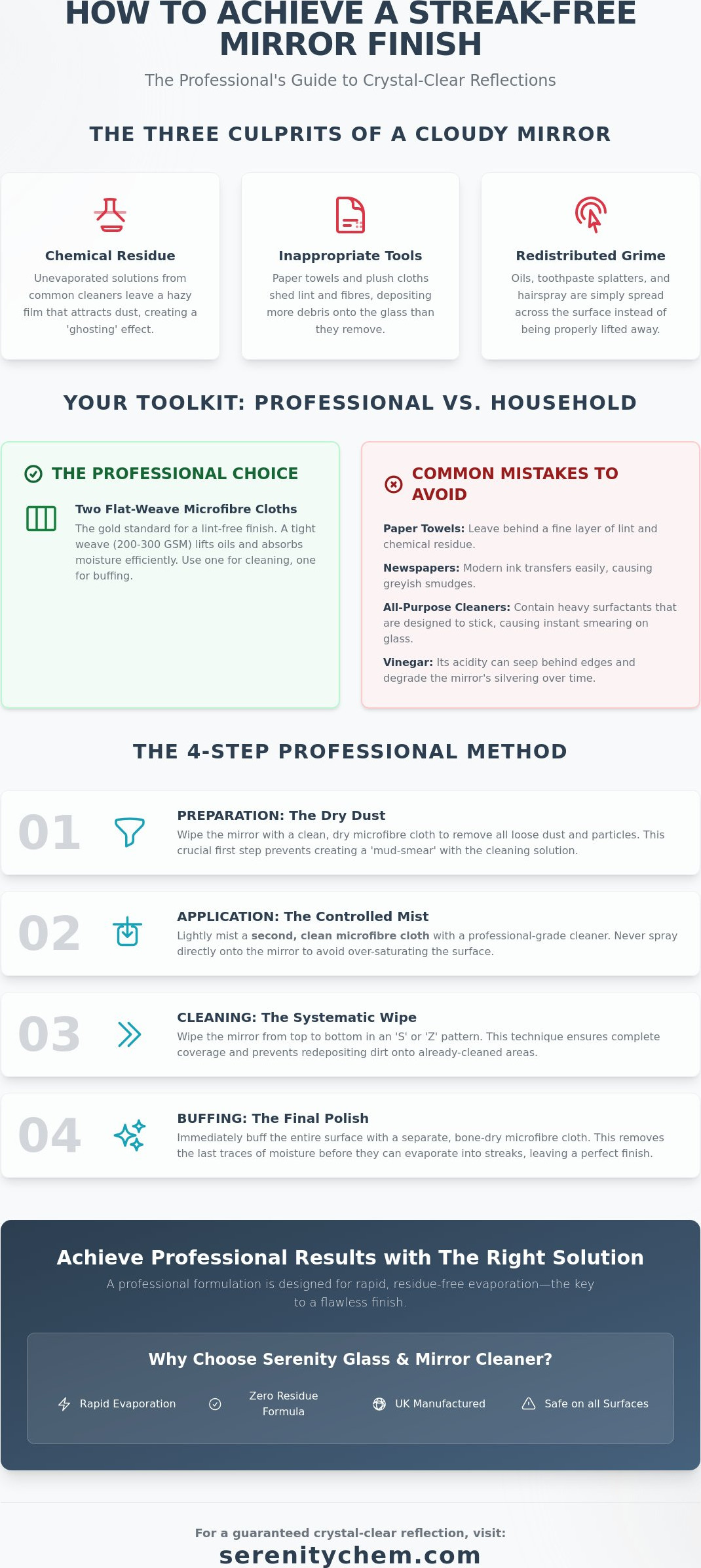
The Professional Method: How to Get Mirrors Streak Free Step-by-Step
Achieving a professional result requires a disciplined order of operations. Many people fail because they jump straight to the wet cleaning phase without addressing surface contaminants first. To master how to get mirrors streak free, you must begin with dry preparation. Use a clean, dry microfibre cloth to wipe away loose dust, lint, and hair. This simple step prevents the formation of a grey slurry once the cleaning solution is applied. Next, inspect the glass for stubborn deposits such as toothpaste, hairspray, or makeup. Pre-treat these spots by applying a small amount of cleaner directly to a cloth and gently rubbing the specific area until it is clear. This ensures that you aren't dragging heavy grime across the entire surface during the main cleanse. With professional chemicals, less is always more; excessive product is the primary cause of unevaporated residue.
Stage 1: The Initial Cleanse
Mist your flat-weave cloth rather than the mirror itself. Saturating the glass directly can lead to liquid seeping behind the frame, which causes "black edge" or desilverisation. This is a common issue in humid UK bathrooms where mirrors are often frameless. Once the cloth is damp, use the "S-pattern" technique. Start at the top left corner and move horizontally to the right, then swoop down and back to the left in a continuous zig-zag. This mechanical movement ensures total coverage without redistributing dirt into areas you've already cleaned. Pay particular attention to the corners; use your finger behind the cloth to ensure every millimetre of the glass is reached without leaving pools of liquid at the base.
Stage 2: The Final Buffing
Timing is critical for the final polish. Whilst the surface is still slightly damp, switch to your second, completely dry flat-weave cloth. Use firm, circular motions to buff the glass. This friction helps evaporate any remaining solvent and removes the last traces of moisture. To verify your work, perform a "light test". Step to the side and view the mirror from an angle. This change in perspective reveals smudges or "ghosting" that are invisible from a head-on view. If you spot a mark, buff it immediately with the dry cloth to restore the crystal-clear finish. Following this systematic approach is the most reliable way to understand how to get mirrors streak free every time you clean.
Common Mistakes to Avoid Whilst Cleaning
The most frequent error in mirror maintenance is the belief that more product equals a deeper clean. Over-saturation is the leading cause of streaks because the excess liquid cannot evaporate quickly enough, leaving behind a gummy residue of surfactants. If you want to know how to get mirrors streak free, you must resist the urge to drench the glass. A light mist is all that is required for professional results. Using a dirty cloth is another common pitfall. Even if a cloth looks clean, it may hold hidden oils from skin contact or previous cleaning tasks. These oils are invisible until they are spread across a reflective surface, where they create a permanent haze that is difficult to buff away.
Many people begin their routine with circular motions, but this is a mistake during the initial lifting phase. Circular movements at the start simply redistribute grime in a loop rather than removing it from the surface. This is why the S-pattern movement is superior for the first pass. Additionally, neglecting the frame is a subtle but destructive error. Dust and old cleaning fluid often accumulate in the crevices where the glass meets the frame. When you wipe near the edges, your cloth picks up this concentrated dirt and "bleeds" it back onto the pristine glass. Learning how to get mirrors streak free involves cleaning the frame first with a separate cloth to ensure no old debris migrates onto the glass.
The Danger of Cross-Contamination
Professional cleaners use a strict colour-coding system to prevent tools from being used in the wrong environment. For instance, using a cloth that previously touched odour neutralising carpet shampoo or heavy-duty degreasers will inevitably lead to smearing. The chemical residues from fabric cleaners are designed to bind to fibres, which is the exact opposite of what you want on a hard glass surface. Always keep your glass-specific microfibres in a separate, labelled container. If you are diluting a concentrate, ensure you use deionised or distilled water to avoid mineral deposits from hard UK tap water, which can leave white spots upon drying.
Timing and Temperature Errors
Environmental factors in the UK, such as high humidity or aggressive central heating, change how cleaning chemicals behave. Attempting to clean a mirror in a steamy bathroom is an exercise in futility; the moisture in the air prevents the cleaner from evaporating, leading to permanent fogging. Similarly, cleaning a mirror directly above a hot radiator can cause the solution to dry too quickly. This "flash drying" happens before you can buff the surface, resulting in instant streaks. For the best results, ensure the room is well-ventilated and the glass is at room temperature before you begin.
If you are struggling with persistent residue on large-scale glass installations or commercial mirrors, contact our support team for expert advice on choosing the right professional formulation.
Achieve Professional Results with Serenity Glass & Mirror Cleaner
The final element in mastering how to get mirrors streak free is the selection of a high-performance cleaning agent. Serenity Glass & Mirror Cleaner is formulated to meet a professional standard, providing a biodegradable and non-smear finish that excels in both industrial and domestic settings. Unlike supermarket alternatives that often rely on heavy surfactants, this solution focuses on rapid evaporation and chemical purity. This low-residue formula significantly reduces the physical effort required for buffing, as the liquid disappears almost instantly without leaving a film behind. By using a product designed for efficiency, you ensure that your reflective surfaces remain clear for longer periods between cleans.
Maintaining a professional standard of cleanliness often requires a holistic approach to your environment. Effective glass care is just one component of a comprehensive hygiene routine. For those managing larger spaces or commercial facilities, integrating mirror maintenance with other high-performance solutions, such as carpet shampoo for machines UK, ensures a consistent level of excellence across every surface. This range is developed to work in harmony, providing reliable protection and aesthetic clarity for your home or business premises.
Why Choose Serenity Chemicals Limited?
We operate with a commitment to ethical responsibility and technical integrity. As Serenity Chemicals Limited is a UK manufacturer, we maintain strict quality control over every batch, ensuring that our clients receive a dependable product every time they order. Buying direct from the source allows for greater transparency regarding chemical safety and environmental impact. Our formulations are designed to be effective whilst remaining responsible, supporting a safer and cleaner environment for your staff, family, or visitors. We value long-term trust over short-term sales; this is why our products are trusted by professionals across the country.
Ready to Upgrade Your Cleaning Kit?
The secret to a flawless reflection is a combination of the right tools, the correct S-pattern technique, and a professional-grade solution. If you've been struggling with cloudy glass or persistent smudges, it's time to refine your approach with a kit that works as hard as you do. For businesses requiring larger volumes or those seeking specialist advice on application, our technical team is available to assist with your requirements. We provide 5L refill sizes to help reduce plastic waste and ensure you always have the supplies you need on hand.
Enquire about our professional glass cleaning range today to experience the difference of a truly streak-free finish.
Elevate Your Environment with Lasting Clarity
Achieving a professional standard of glass maintenance is a matter of combining the right tools with a disciplined technique. By moving away from household hacks like newspapers and over-saturated sprays, you can eliminate the hazy residue that often ruins a reflection. The transition to flat-weave microfibre and the structured S-pattern movement represents the most efficient path to mastering how to get mirrors streak free. These methods, combined with an understanding of environmental factors like humidity and temperature, ensure that your reflective surfaces remain pristine with significantly less physical effort.
As a specialist UK-based manufacturer, we take pride in developing high-performance formulations that are trusted by commercial janitorial professionals across the country. Serenity Chemicals Limited maintains a commitment to ethical responsibility and technical integrity, ensuring every solution we provide meets the highest safety standards. Whether you are managing a high-traffic office or simply want to improve your home routine, we are here to support your hygiene goals. Contact Serenity Chemicals Limited for professional-grade cleaning solutions today. With the right approach and the correct chemistry, a crystal-clear finish is easily within your reach.
Frequently Asked Questions
Is it better to clean mirrors with vinegar or professional glass cleaner?
Professional glass cleaners are generally superior for long-term mirror care. Whilst vinegar is a popular DIY alternative, its high acidity can seep into the edges of the glass and cause the silver backing to degrade over time. A specialised formulation like Serenity Glass & Mirror Cleaner is designed to evaporate rapidly without leaving the organic residues that vinegar often leaves behind.
How do I remove heavy hairspray build-up from a bathroom mirror without scratching?
To remove stubborn hairspray without scratching, you should pre-treat the affected area. Moisten a small section of a flat-weave microfibre cloth with a professional cleaner and hold it against the build-up for thirty seconds to soften the resins. This allows you to wipe the residue away easily without the need for abrasive sponges or harsh scrubbing that could permanently mark the glass.
What is the best type of cloth for a streak-free finish on glass?
The industry standard for a flawless finish is a flat-weave microfibre cloth. These tools are specifically engineered to lift oils and debris without shedding the lint associated with paper towels or standard cotton rags. For the best results, use a cloth with a GSM between 200 and 300 to ensure high absorbency whilst maintaining enough friction to buff the surface to a shine.
Can I use a multi-purpose cleaner on my mirrors?
You should avoid using multi-purpose cleaners on mirrors. These products often contain soaps, perfumes, or waxes intended to protect surfaces like wood or plastic, which leave a thick, invisible film on glass. This residue is the primary cause of smearing and makes the task of learning how to get mirrors streak free significantly more difficult than it needs to be.
Why does my mirror still look cloudy after I have cleaned it?
A cloudy appearance usually indicates that there is a layer of unevaporated surfactant or old soap film remaining on the surface. This "ghosting" occurs when moisture in the air clings to these chemical residues. To resolve this, use a completely dry, clean microfibre cloth to buff the glass once more, ensuring all moisture and product have been fully removed from the surface.
How often should I clean my mirrors to prevent permanent staining?
Cleaning your mirrors once a week is typically sufficient for most domestic environments. In commercial or high-traffic settings, daily maintenance is recommended to prevent oils and hard water minerals from bonding to the glass. Regular care ensures that acidic substances from skin contact or aerosolised products don't have time to cause permanent etching or staining on the surface.
Does the temperature of the room affect how mirrors streak?
Atmospheric conditions play a significant role in how cleaning solutions behave on glass. High temperatures from central heating or direct sunlight can cause "flash drying," where the cleaner evaporates before you can buff it, leading to instant streaks. Conversely, a steamy bathroom prevents evaporation entirely, which is why it is harder to learn how to get mirrors streak free in humid conditions.
What should I do if my mirror has "black edge" or silvering damage?
Black edge is caused by oxidation of the mirror's silver backing and unfortunately cannot be repaired through cleaning. This damage usually occurs when liquid cleaner or moisture seeps behind the glass and reacts with the metal. To prevent this from spreading, always mist your cleaning cloth rather than the mirror itself to ensure no excess fluid reaches the vulnerable edges of the frame.

Hand Hygiene in Food Preparation Areas: The 2026 Professional Guide
The Food Standards Agency estimates that foodborne illness costs the UK economy approximately £9 billion every year, with a s...

Sanitising Commercial Kitchen Hard Surfaces: The Professional UK Guide (2026)
Did you know that the average fine for food hygiene offences in the UK has more than tripled since 2016, now reaching over £7...