

A single oil spill on untreated concrete does more than just spoil the professional look of your workspace; it creates a persistent slip hazard and can lead to long term structural degradation. If you have spent hours scrubbing only to find the dark patch returning days later, you aren't alone. Most workshop owners struggle with the way porous concrete absorbs fluids, making it feel nearly impossible to maintain a clean environment. Understanding how to remove oil stains from workshop floor surfaces requires moving beyond surface level scrubbing to deep chemical extraction.
We agree that a workshop should be a place of precision and safety, not a constant battle against stubborn grime. This guide provides a clear, methodical approach to lifting even the most deep seated stains using professional techniques. You will learn the most effective methods for cleaning your substrate and discover which industrial coatings will prevent damage for good. We also examine the best heavy duty degreasers and floor cleaners to keep your facility compliant with the latest 2026 safety standards whilst ensuring a floor that is easy to wipe clean in the future.
Key Takeaways
- Understand why concrete acts as a sponge for petroleum fluids and how professional surfactants break these bonds for deep extraction.
- Master the methodical process of how to remove oil stains from workshop floor surfaces using chemical emulsification followed by mechanical profiling.
- Evaluate the performance differences between single-pack and two-part epoxy coatings to ensure your floor withstands high-traffic and chemical exposure.
- Ensure your facility remains safe and compliant with 2026 health and safety standards by eliminating slip hazards and deep-seated grime.
- Learn why sourcing industrial-grade degreasers and cleaners directly from a UK manufacturer provides superior results for long-term floor maintenance.
The Challenge of Oil Stains on Porous Workshop Floors
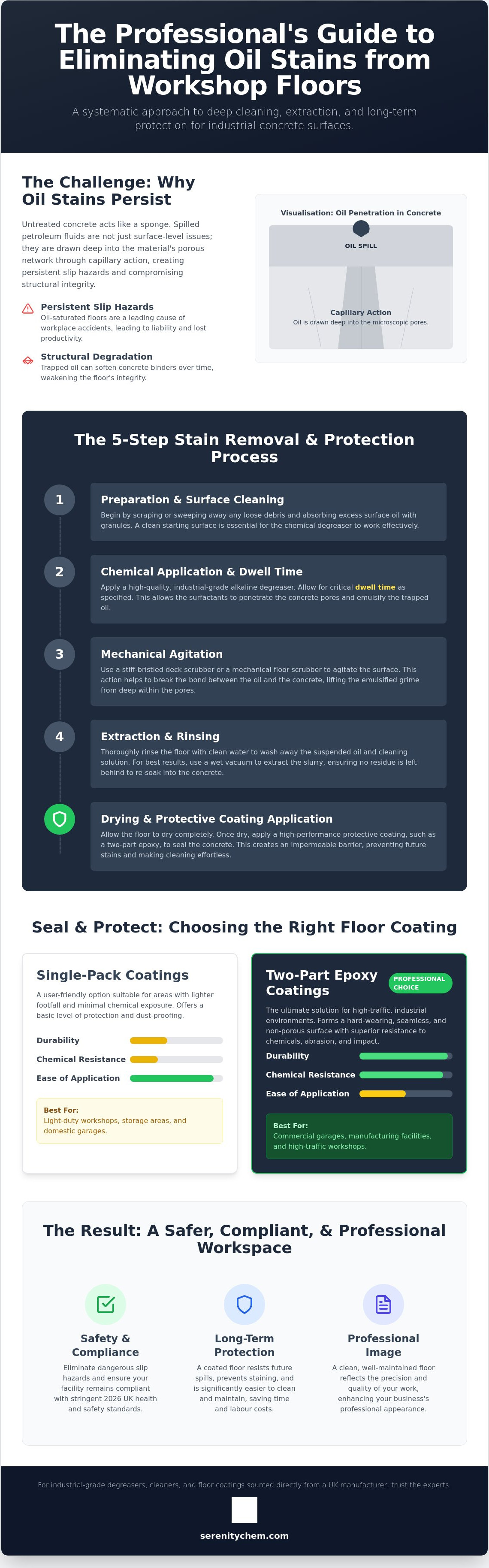
Concrete is a deceptively complex material. Whilst it appears impenetrable, it's actually a network of microscopic pores and capillaries. When petroleum-based lubricants or engine oils are spilled, they don't simply sit on the surface. They're drawn deep into the slab through capillary action. This is the primary reason why learning how to remove oil stains from workshop floor surfaces is so challenging; you aren't just cleaning a surface, you're treating a three-dimensional substrate that has absorbed the contaminant.
Surface-level spills are often addressed quickly with absorbent granules, but the real issue lies in deep-seated leaching. Over time, oil that has migrated into the concrete begins to compromise its structural integrity. It can soften certain types of older concrete binders and, more importantly, it creates a permanent slip hazard that cannot be resolved with a simple mop and bucket. Standard domestic detergents are designed for food-based greases. They lack the molecular "clout" needed to break the bond of industrial hydrocarbons. To effectively restore the floor, one must understand The Chemistry of Oil Removal, which involves specific surfactants that can penetrate the pores and emulsify the oil for extraction.
Understanding Concrete Porosity
The capillary action within a concrete slab acts much like a wick. As oil sits on the surface, gravity and suction pull it into the internal structure. Temperature changes play a significant role here. In a warm workshop, oil becomes less viscous, allowing it to travel deeper into the floor. When the floor cools, the oil thickens and becomes trapped. This leads to a phenomenon known as "ghosting," where a stain appears to have been removed, only to resurface days later as the trapped oil migrates back to the surface to find equilibrium.
Health and Safety Implications in the UK
In a professional UK workshop environment, floor safety is a non-negotiable priority. Oil-saturated floors are a leading cause of slips and falls, which can result in significant liability and lost productivity. Maintaining a clean, dry environment is central to meeting the high standards expected of a commercial floor cleaner supplier and facility manager. Beyond physical safety, there are environmental considerations. Oil runoff from a workshop floor can enter local drainage systems, leading to potential fines if the waste is not managed responsibly. Using the correct degreasing agents ensures that oil is properly emulsified and can be disposed of according to UK environmental regulations.
The Chemistry of Oil Removal: Emulsification and Extraction
Removing oil from concrete is less about physical force and more about targeted molecular interaction. To understand how to remove oil stains from workshop floor surfaces, you must look at the role of surfactants. These molecules have a dual nature; one end is attracted to water, whilst the other is attracted to oil. When applied, they surround the oil molecules, breaking their bond with the concrete and lifting them into a suspension. This process is often aided by alkaline builders, which saponify greases. This effectively turns them into a water-soluble soap that can be rinsed away without leaving a residue.
One of the most frequent mistakes in workshop maintenance is rushing the process. Dwell time is critical. The chemical needs time to penetrate the pores and complete the emulsification. Without sufficient dwell time, even the strongest industrial cleaners will only affect the surface layer, leaving deep-seated oil untouched. Consulting a professional cleaning chemicals list ensures you're using high-pH solutions specifically formulated for these resilient hydrocarbons.
Solvent vs. Aqueous Degreasers
Choosing the right medium depends on the age and type of the stain. Solvent-based degreasers are highly effective for heavy bitumen, tar, or aged resinous deposits that have hardened over years. However, for most routine workshop maintenance, water-based alkaline degreasers are preferred. They're typically safer for the user and less volatile. Whilst handling concentrated industrial chemicals, always prioritise ventilation and appropriate PPE to ensure a safe working environment.
The Extraction Process
Effective extraction requires more than just pouring a chemical onto the floor. Learning how to remove oil stains from workshop floor areas efficiently requires a combination of chemical dwell time and physical agitation. Using a stiff-bristled deck brush or a rotary floor machine helps the solution reach the oil trapped beneath the surface. Using hot water during the rinsing phase significantly increases the reaction rate, making it much easier to lift the emulsified oil from the capillaries of the slab.
For safety and efficiency, following a structured Small Chemical Spill Cleanup Procedure helps prevent the oil from being re-deposited elsewhere on the slab. Once the floor is thoroughly decontaminated, it's the ideal time to consider long-term protection. Applying a specialist sealant or industrial coating can prevent future spills from ever reaching the concrete pores again. You can explore a range of high-performance floor protection solutions to find a system that suits your specific traffic requirements.
Buying Guide: Choosing the Right Protective Coating
Once you have mastered how to remove oil stains from workshop floor surfaces, the next logical step is long-term prevention. Whilst cleaning restores the floor, a specialist coating ensures it stays that way. Some competitors suggest interlocking tiles as a primary solution, but these can often trap fluids in the joints, creating a hidden reservoir of contamination. A seamless industrial coating provides a hygienic, impenetrable seal that prevents lubricants from ever reaching the concrete pores. This makes future spills easy to wipe away with a simple microfibre mop or squeegee.
Choosing the right finish depends on your specific operational needs. High-traffic workshops require a coating with significant mechanical strength to resist tyre scrub and heavy machinery movement. Chemical resistance is equally vital. In automotive environments, exposure to brake fluid, petrol, and aggressive solvents can quickly degrade standard decorative paints. A gloss finish is often preferred in professional settings as it reflects light, improving visibility in dark bays, whereas a matte or textured finish can help hide minor substrate imperfections.
Polyfloor vs. Chlorinated Rubber
For general-purpose wood and concrete surfaces, Polyfloor Durable Floor Paint (£79.99-139.99) is an excellent choice. It offers a robust, hard-wearing finish suitable for domestic garages and light commercial units. If your environment demands superior chemical protection, Chlorinated Rubber Chemical-Resistant Coating (£29.99-399.99) is the industry standard. It's particularly effective for outdoor workshop areas, wash bays, or floors frequently exposed to acids and alkalis. Whilst Polyfloor is ideal for indoor dry areas, Chlorinated Rubber provides the resilience needed for more volatile conditions.
Specialist Coatings for High-Stakes Environments
Not every workshop floor is a perfect candidate for standard paint. If you're dealing with rising damp or a high water table, applying a traditional coating will likely lead to blistering and failure. In these scenarios, Q19 Damp Proof Membrane Sealant (£49.99-179.99) acts as a vital barrier. It allows you to seal the substrate effectively before applying your final colour coat. For those seeking an exceptionally durable and distinctive finish, Hammer Synthetic Enamel (£79.99-129.99) provides a tough, impact-resistant layer that withstands the rigours of heavy industrial use.
Success depends entirely on the quality of your preparation. Even the most advanced coating will fail if applied over residual grease. This is why the extraction techniques used in learning how to remove oil stains from workshop floor areas are non-negotiable. Once the concrete is chemically clean and the pores are open, these professional coatings will bond permanently to the slab, providing years of reliable service and peace of mind.
Step-by-Step: Preparing and Painting Your Workshop Floor
Achieving a professional finish requires a disciplined approach to preparation. Some online forums suggest that you can simply paint over concrete once it looks dry, but this is a recipe for premature peeling and failure. If any residual oil remains within the pores, the new coating will fail to bond. The initial phase of learning how to remove oil stains from workshop floor surfaces involves deep chemical extraction, but the subsequent rinsing is equally critical. You must ensure all chemical residues are neutralized and removed, leaving a pH-neutral surface ready for the next stage.
Once the concrete is chemically clean, you must open the pores through mechanical profiling. This is usually achieved through acid etching or diamond grinding. This stage creates a "profile" similar to fine sandpaper, which allows the primer to "key" into the slab. Without this mechanical bond, the paint sits on the surface rather than becoming part of the floor. After profiling, the floor must be vacuumed thoroughly to remove every trace of dust and grit, as even microscopic particles can cause bubbles or craters in your final finish.
Priming for Success
Priming is the bridge between your raw concrete and your protective topcoat. For standard concrete surfaces, using Polybond Universal PVA Adhesive & Sealer (£12.99-299.99) as a concrete additive or sealer provides an excellent foundation for subsequent layers. However, many workshops feature metal fixtures, drainage grates, or ferrous floor plates that require specialised attention. In these instances, Zinc Phosphate Primer (£39.99-169.99) should be applied to prevent corrosion and ensure adhesion. If you are working with galvanised steel surfaces, Mordant T Wash (£32.99-149.99) is essential to etch the metal and prepare it for painting.
Application Techniques
The method of application often depends on the scale of your facility. For large, open workshop areas, airless sprayers provide the most consistent and efficient finish. For smaller units or areas with complex racking, high-quality rollers are often more practical. You should always follow the manufacturer's "re-coat" windows; applying a second layer too early can trap solvents, whilst waiting too long may require additional sanding to ensure inter-coat adhesion. A final inspection should reveal a seamless, non-porous finish that is ready to withstand the rigours of daily industrial use.
Properly executing each step ensures that your investment in floor restoration lasts for years rather than months. To achieve a professional-grade result, you can explore our full selection of industrial paints and coatings designed for high-traffic environments.
Standout Solutions from the Serenity Paints & Coatings Collection
Successfully managing a workspace involves more than just a one-off deep clean. Whilst the methods we've discussed for how to remove oil stains from workshop floor surfaces are effective, the longevity of your results depends on the quality of the products you apply next. Sourcing your materials from a UK based chemical supplier ensures that you are receiving industrial-grade formulations designed for the rigours of a professional environment. Unlike standard retail alternatives, these coatings are engineered to resist the specific chemical profiles of modern lubricants and fuels.
Investing in professional-grade coatings significantly reduces long-term maintenance costs. A properly sealed floor requires less aggressive cleaning agents and fewer man-hours to maintain. This proactive approach transforms the floor from a porous liability into a high-performance asset. You can explore the full Paints & Coatings collection to find the specific system that matches your floor's traffic and exposure levels, whether you are managing a small domestic garage or a sprawling commercial unit.
Top Picks for Heavy-Duty Workshops
For environments where rising damp or failing substrates are a concern, the Q19 Damp Proof Membrane offers the structural strength of a two-part epoxy. It provides a reliable barrier that prevents moisture from compromising your topcoat. For those requiring a high-quality, quick-drying finish, our Professional Acrylic Enamel (£29.99-399.99) is a versatile choice for both metal and masonry. We also provide Fence & Decking Paint to ensure that external workshop timber structures receive the same level of professional protection as your internal floors, ensuring a cohesive and well-maintained facility.
Expert Support and Bulk Sourcing
Working with a dedicated cleaning products manufacturer UK based gives you access to expert technical support and bulk sourcing options. This is particularly beneficial for large-scale industrial renovations where consistency across thousands of square metres is essential. Our team is committed to providing transparent, honest advice to help you maintain a safe and principled workplace. By choosing the right chemical solutions now, you ensure that the process of learning how to remove oil stains from workshop floor areas is a task you only have to master once.
Our goal is to provide you with the tools necessary to maintain a clean, safe, and professional environment. Browse the full Serenity Paints & Coatings Collection today to find the durable solutions your workshop deserves.
Secure the Future of Your Workshop Floor
Our comprehensive range of UK-manufactured industrial coatings is trusted by professional workshops and factories across the country to provide a seamless, non-porous finish. We offer solutions for all floor substrates, ensuring that your workspace meets the highest standards of safety and professional decorum. Upgrade Your Workshop with Professional Paints & Coatings today and gain the peace of mind that comes with a principled, expert-led approach to facility care. You've done the hard work of restoration; now it's time to protect that investment for years to come.
Frequently Asked Questions
How long does oil have to be on concrete before it causes permanent staining?
Oil begins to penetrate porous concrete immediately, but a permanent stain typically sets within 24 to 48 hours as it moves into the deeper capillaries. Once it reaches the base of these microscopic pores, it becomes significantly harder to extract without professional emulsifiers. Prompt action with absorbent granules is essential to prevent deep-seated leaching. If left longer, the oil can permanently discolour the slab and compromise the bond of future coatings.
Can I paint directly over an old oil stain if I use a strong primer?
You shouldn't paint directly over an old oil stain, even if you use a high-quality primer. Oil acts as a bond-breaker, which means the paint will simply sit on top of the grease and eventually peel or blister away. You must follow the correct steps for how to remove oil stains from workshop floor surfaces, including deep degreasing and mechanical profiling, to ensure the primer can actually bond to the concrete substrate.
What is the best way to get oil out of a workshop floor without a pressure washer?
Chemical emulsification followed by manual agitation is the most effective alternative to pressure washing. Apply a heavy-duty alkaline degreaser and allow it to dwell for 20 to 30 minutes, then scrub vigorously with a stiff-bristled deck brush to reach the oil inside the pores. Use hot water for rinsing and a wet-vacuum to extract the emulsified waste. This prevents the oil from being re-deposited elsewhere on the slab during the cleaning process.
Is chlorinated rubber paint better than epoxy for a mechanical workshop?
Chlorinated rubber is often superior for workshops exposed to aggressive chemicals, acids, or outdoor elements due to its high chemical resistance. However, epoxy systems typically offer better mechanical strength for heavy machinery and high-traffic tyre scrub. The choice depends on whether your primary concern is chemical spills or physical impact and abrasion. For most mechanical workshops, a chlorinated rubber coating provides the best balance of chemical protection and ease of application.
How do I know if my concrete floor has been degreased enough for painting?
Perform a "water bead test" by splashing small amounts of clean water onto various parts of the dried floor. If the water soaks into the concrete and darkens it, the pores are open and the floor is clean. If the water beads up or sits on the surface, it indicates that residual oil or sealant is still present. Further degreasing is required in those specific areas before you can safely proceed with painting.
What happens if I apply floor paint whilst the concrete is still damp?
Applying floor paint whilst the concrete is still damp will almost certainly lead to adhesion failure and blistering. Moisture trapped beneath the coating will try to escape as vapour, pushing the paint film away from the substrate as it dries. It's vital to allow the floor to dry completely, typically for at least 24 to 48 hours after the final rinse, before starting the painting process. Proper ventilation will help speed up this drying phase.
How many coats of Polyfloor paint are needed for a high-traffic area?
Two coats are the standard requirement for high-traffic environments to ensure adequate film thickness and durability. The first coat acts as a sealer, penetrating the concrete pores, whilst the second coat provides the final wear layer and uniform colour. For exceptionally busy areas or commercial workshops, a third coat may be beneficial to extend the life of the finish. Always allow the first coat to dry fully before applying the subsequent layer.
Can I use Mordant T Wash on a concrete floor to remove oil?
No, you cannot use Mordant T Wash to remove oil; it's an etching solution designed specifically for galvanised steel. Using it on concrete will not help you with how to remove oil stains from workshop floor areas and could cause an adverse chemical reaction. For concrete decontamination, you should always use a dedicated heavy-duty alkaline degreaser. These products are formulated to emulsify hydrocarbons without damaging the structural integrity of the concrete slab.

Hand Sanitiser for Frequent Use: Professional UK Guide 2026
The very product you use to protect your health might be the primary cause of your skin's deterioration. While alcohol-based ...

Food Safe Antibacterial Spray UK: The Professional 2026 Hygiene Guide
Using the wrong disinfectant in a commercial kitchen isn't just a minor oversight; it's a direct threat to your Food Hygiene ...