

Did you know that by 15 August 2026, all cleaning chemicals used in UK facilities must comply with updated GB CLP hazard standards? This regulatory shift means that many traditional, high-VOC agents are no longer a viable option for your business. It's a common frustration to spend a significant portion of your budget on degreasers & removers that underperform, leaving your team to rely on excessive scrubbing that risks damaging sensitive equipment surfaces.
We understand that maintaining a safe, compliant workspace shouldn't come at the cost of your bottom line or your peace of mind. In this guide, you'll learn how to select the most effective chemical solutions to eliminate stubborn grease, oil, and limescale whilst maintaining total surface integrity. We'll examine how to achieve faster cleaning times and lower your cost-per-use through high-quality concentrates. By matching the right emulsification power to your specific industrial or catering environment, you can ensure your facility remains both productive and protected under the latest HSE workplace exposure limits.
Key Takeaways
- Distinguish between organic oil removal and mineral scale treatment to ensure you select the correct product for every cleaning task whilst maintaining surface integrity.
- Understand how emulsification and non-ionic surfactants in professional degreasers & removers lift grease particles without damaging your equipment.
- Reduce your environmental impact and operational costs by switching to high-performance concentrates that offer precise dilution control.
- Learn how to match specific chemical agents to "soil" types, such as animal fats or motor oils, to achieve faster cleaning times.
- Discover how dual-action solutions provide both heavy-duty grease displacement and antibacterial protection for safer, compliant workspaces.
Understanding the Role of Professional Degreasers & Removers
Professional cleaning requires more than just water and physical effort. At its core, the process involves selecting specific chemical agents to tackle different types of contamination. You might ask, What is Degreasing? and how does it differ from standard cleaning? Effectively, degreasers are specialised agents that break down insoluble substances such as heavy oils, greases, and fats that water alone cannot touch. Whilst the terms are often used interchangeably, professional degreasers & removers serve distinct purposes based on the chemical nature of the "soil" they target.
Choosing professional-grade solutions over domestic alternatives isn't just about strength; it's about commercial longevity. Domestic cleaners are often formulated for general use, meaning they don't have the concentration required for high-traffic environments. In contrast, professional solutions are designed for speed and surface integrity, ensuring that expensive equipment isn't corroded by poorly balanced formulas. Understanding the chemistry behind degreasers & removers is essential for any facility manager aiming to maintain a compliant and efficient workspace.
Organic Grease vs. Mineral Limescale
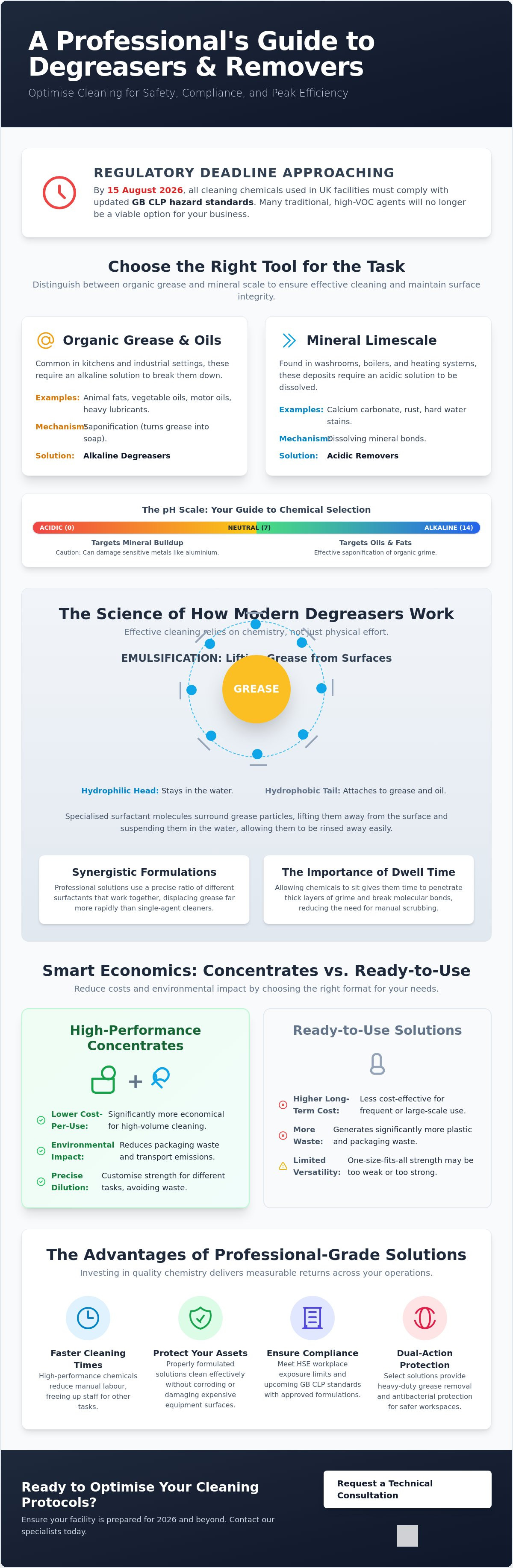
Identifying the source of the grime is the first step in successful removal. Kitchen environments typically deal with organic animal fats and vegetable oils, which require alkaline-based degreasers to saponify the grease. Conversely, washrooms and heating systems accumulate mineral scale or limescale, which necessitates acidic removers to dissolve the calcium deposits. Using the wrong chemical, such as a harsh acidic remover on sensitive metals like aluminium, can lead to permanent pitting and surface damage. In 2026, the pH scale remains the fundamental guide for chemical selection, where a value above 7 targets oils and a value below 7 addresses mineral buildup.
The Impact of Professional Chemicals on Operational Efficiency
Efficiency in a business setting is often measured by the reduction of manual labour hours and energy expenditure. High-performance chemicals do the heavy lifting, allowing staff to simply spray, wait, and rinse rather than spending hours scrubbing. This efficiency is a core component of a comprehensive professional cleaning chemicals list, ensuring every task is completed with the minimum amount of effort. Opting for "cheap" chemicals often backfires, as they require higher volumes and more frequent applications, leading to increased long-term costs and potential safety risks.
The Science of Emulsification: How Modern Degreasers Work
Effective cleaning isn't a result of brute force. It relies on the chemical ability to break the bond between the soil and the surface. This is where surfactants play a vital role. By reducing the surface tension of water, surfactants allow cleaning solutions to spread more easily and penetrate deep into layers of grime that would otherwise remain untouched. For degreasers & removers to be truly effective, they must go beyond simple wetting; they must master the process of emulsification.
Emulsification occurs when specialised detergent molecules surround individual grease particles. These molecules have a hydrophobic tail that attaches to the oil and a hydrophilic head that stays in the water. This structure effectively lifts the grease away from the substrate and keeps it suspended in the cleaning solution. Serenity formulations utilise a principle known as "synergism." This involves a precise ratio of different surfactants that, when combined, displace grease far more rapidly than any single-agent cleaner could. It's a methodical approach to chemistry that ensures maximum efficacy with minimal physical effort.
Dwell time is another critical factor often overlooked in commercial cleaning. Chemicals require a specific window of time to penetrate the full depth of thick carbon or oil layers. Rushing the process often leads to incomplete cleaning and wasted product. By allowing the solution to sit, the synergistic blend can fully disrupt the molecular bonds of the grime. If you're looking to optimise your cleaning protocols for 2026, you might wish to request a technical consultation to ensure your team is using these agents correctly.
Why Non-Ionic Detergents are Superior for Heavy Soiling
Non-ionic surfactants are particularly valued in the UK due to their exceptional stability in hard water areas. Unlike ionic alternatives, they don't react with calcium or magnesium ions, meaning they maintain their cleaning power regardless of local water conditions. These agents are also highly effective at preventing redeposition; once the grease is lifted, the non-ionic molecules ensure it stays trapped in the water rather than settling back onto the clean surface. Chemically lifting soil through emulsification is significantly safer for expensive machinery than abrasive scrubbing, as it removes the risk of micro-scratches that can harbour bacteria.
Antibacterial Properties in Degreasing
In food preparation environments, removing visible grease is only half the battle. Dual-action chemicals are necessary to tackle both the physical soil and the microscopic pathogens that thrive in greasy residues. Integrating a food safe sanitiser for commercial kitchens into your routine ensures that surfaces are not only visually clean but also hygienically safe. These professional solutions are formulated to meet strict EN standards, providing the peace of mind that your facility remains compliant whilst effectively stripping away heavy carbon deposits and animal fats.
Comparing Concentrates vs. Ready-to-Use Solutions
Deciding between concentrated formulas and ready-to-use (RTU) sprays depends on your facility's specific operational needs. Whilst RTU solutions offer immediate convenience for spot-cleaning and high-traffic areas, they often carry a higher cost-per-litre and a larger environmental footprint. In contrast, concentrates represent the gold standard for high-volume users. They significantly reduce plastic waste and shipping emissions. By purchasing bulk 5L or 20L containers of degreasers & removers, businesses can drastically lower their operational overheads whilst adhering to the new Extended Producer Responsibility (EPR) rules effective as of 2026.
Choosing the right format involves a simple framework:
- Ready-to-Use: Best for rapid response, small-scale tasks, and staff training where precise dilution might be a hurdle.
- 5L Concentrates: The versatile choice for most commercial kitchens and workshops, balancing easy storage with significant economy.
- 20L Containers: Ideal for industrial facilities with automated dosing systems or extremely high daily chemical consumption.
Calculating the Real Cost-Per-Use
The financial advantage of concentrates becomes clear when you look at the yield. A single 5L container of a professional-grade concentrate can often produce hundreds of trigger spray bottles. It's a massive saving. To ensure this efficiency, it's essential to partner with a reputable cleaning products manufacturer UK. They ensure that the chemical potency remains consistent across every batch. Be wary of the "dilution trap" where users over-dilute a product to save money. This practice inevitably leads to poor results. It requires more manual labour and ultimately wastes more resources than it saves. Accuracy is key to performance.
Storage and Safety Considerations
Transitioning to concentrates requires a more structured approach to workplace safety. Your chemical store must be organised according to COSHH guidelines. This means ensuring that incompatible chemicals are separated and spill kits are readily accessible. Safety remains the priority. When decanting from bulk containers, you must ensure that all secondary "user" bottles are clearly labelled with the product name, hazard symbols, and correct dilution instructions. This level of organisation doesn't just ensure compliance. It builds a culture of professional responsibility and safety amongst your team. If you're ready to upgrade your inventory, you can browse our full range of professional degreasers & removers for bulk options that suit your industry requirements.
Application Guide: Matching Chemicals to Your Industry
Selecting the right degreasers & removers requires a clear understanding of the specific contamination you're facing. The chemical structure of animal fats in a commercial kitchen differs significantly from the mineral oils found in a vehicle workshop. Matching the chemical's pH and surfactant profile to the "soil" type is the only way to ensure cleaning efficiency without risking surface damage. It's about precision rather than power alone.
In the hospitality sector, the cleaning regime is split between aesthetic maintenance and deep hygiene. Front-of-house areas require gentle, non-streaking cleaners, whilst back-of-house environments demand high-strength emulsifiers. Beyond grease, commercial appliances like dishwashers and coffee machines require regular attention from acidic removers. In regions with hard water, mineral deposits can quickly choke internal components, leading to costly repairs and increased energy consumption. Using a dedicated descaler is a principled approach to asset management that extends the life of your equipment.
Catering and Food Production
Commercial kitchens are perhaps the most challenging environments for grease management. Extractors and ovens accumulate layers of burnt-on carbon that can become a fire hazard if left untreated. These areas require high-alkalinity degreasers that can penetrate and soften baked-on residues. Safety is a critical consideration here; any chemical used must be non-tainting and food-safe. Once the heavy degreasing is complete, it's essential to follow up with an antibacterial surface spray UK standards require for food-safe environments. This two-step process ensures the surface is both physically clean and microbiologically safe.
Industrial and Workshop Environments
Industrial settings deal with mineral-based lubricants, hydraulic fluids, and heavy resins. These substances require a different chemical approach than organic fats. When cleaning concrete floors or machinery, you need a heavy-duty solution that can lift these oils without compromising the integrity of epoxy coatings or floor seals. If your facility uses floor scrubbing machines, ensure your chosen degreaser is a low-foaming variety to protect the machine's vacuum motors. Given the strength of these industrial formulas, staff must be strictly trained on PPE protocols, including the use of chemical-resistant gloves and eye protection. If you need assistance choosing a product for a specific industrial application, contact our technical team for expert advice on surface compatibility.
Standout Solutions: The Serenity Degreasers & Removers Collection
The previous sections have detailed the science and strategy behind effective industrial cleaning. Now, applying these principles requires a range of degreasers & removers that deliver consistent results under commercial pressure. The Serenity collection is formulated to meet the specific demands of UK businesses in 2026, combining high-performance chemistry with a clear focus on user safety and environmental compliance. By choosing solutions that align with the latest GB CLP hazard standards, you can ensure your facility remains both productive and protected.
For deep cleaning and heavy oil displacement, Serenity Heavy Duty Degreaser serves as the foundation of an effective regime. It utilises the synergistic surfactant technology discussed earlier to penetrate thick layers of grease on industrial floors and machinery. In food preparation environments, Serenity Kitchen Sanitiser offers the dual-action performance necessary to strip away animal fats whilst providing the antibacterial protection required by EN standards. To address the mineral scale and limescale deposits that threaten the efficiency of your appliances and washroom surfaces, Serenity Toilet Cleaner provides the acidic power needed to dissolve stubborn buildup without damaging sensitive substrates.
Why Choose Serenity Formulations?
Serenity products are proudly manufactured in the UK. This local production isn't just a matter of pride; it's a strategic choice that supports ethical responsibility and reduces shipping emissions. By purchasing direct from the manufacturer, your business avoids the inflated costs of middle-market distributors. This ensures you receive professional-grade formulas that out-perform domestic alternatives whilst maintaining a lower cost-per-use. It's a principled approach to procurement that prioritises long-term value and integrity over short-term savings.
Getting Started with Your Professional Hygiene Routine
Transitioning from domestic-grade products to a professional chemical system is a straightforward process that yields immediate benefits in labour efficiency. Start by identifying the primary "soil" types in your facility and selecting the corresponding Serenity concentrates. We provide comprehensive technical data sheets and safety information for every product, ensuring you have the documentation necessary for COSHH compliance and staff training. This methodical approach removes the confusion often associated with chemical safety, allowing your team to work with confidence. If you're ready to enhance your facility's standards, you can shop the complete Serenity Degreasers & Removers collection today to find the bulk options that best suit your operational needs.
Future-Proofing Your Facility Hygiene
Transitioning to a professional hygiene system is a strategic investment in your business's longevity and safety. By matching specific chemical emulsification power to your industry's unique challenges, you can significantly reduce manual labour and protect expensive equipment. We've explored how modern, professional-grade concentrates don't just lower your cost-per-use; they also help you meet the rigorous environmental and packaging standards effective in 2026.
Using high-performance degreasers & removers ensures your workspace remains compliant with the latest workplace exposure limits whilst maintaining the highest hygiene standards. As a UK-based manufacturer, we offer a range of HACCP-compliant options tailored for both industrial workshops and commercial kitchens. If you're ready to enhance your facility's efficiency and safety, Browse the Serenity Degreasers & Removers Collection to find the ideal solutions for your needs. Maintaining a principled and productive workspace is well within your reach.
Frequently Asked Questions
What is the difference between a degreaser and a multi-purpose cleaner?
Degreasers are specifically formulated to break down insoluble substances like oils, fats, and greases, whereas multi-purpose cleaners are designed for general surface dust and light soil. Whilst a multi-surface cleaner is excellent for daily maintenance, it lacks the emulsification power needed to lift heavy industrial or catering residues. Choosing a dedicated degreaser ensures that the chemical bond of the grease is disrupted, allowing for a thorough clean without excessive scrubbing.
Can I use heavy-duty degreasers on all types of flooring?
No, you should always verify surface compatibility before application. High-alkalinity degreasers & removers can damage sensitive materials like unsealed wood, certain natural stones, or specific floor coatings. It's best to perform a small patch test on an inconspicuous area to ensure the substrate's integrity remains intact. For general floor maintenance, using a pH-neutral solution is often safer for daily use on polished surfaces.
How do I know if a degreaser is safe for use in a food preparation area?
You must look for products explicitly labelled as food-safe, non-tainting, and ideally HACCP-compliant. These chemicals, such as Serenity Kitchen Sanitiser, are formulated to leave no harmful residues that could contaminate food products. Always ensure that surfaces are thoroughly rinsed with clean water after the degreasing process is complete. This follows the principled approach to hygiene required in commercial catering environments.
Why should I choose a concentrate over a ready-to-use spray?
Concentrates offer superior cost-efficiency and a reduced environmental footprint compared to ready-to-use alternatives. By purchasing in bulk, you significantly lower your cost-per-use and minimise the amount of plastic waste generated by your facility. Concentrates also allow you to adjust the strength of the solution to suit the specific level of soiling, providing a more versatile cleaning tool for your team.
What safety precautions should my staff take when using industrial removers?
Staff must wear appropriate Personal Protective Equipment (PPE), including chemical-resistant gloves and eye protection, as outlined in the product's safety data sheet. Ensure the workspace is well-ventilated to prevent the buildup of vapours. It's also essential that all team members are trained on the correct handling and dilution procedures to avoid accidental skin or eye contact. Safety remains the priority in any professional cleaning regime.
How often should I use a descaler on my commercial kitchen equipment?
The frequency of descaling depends on the water hardness in your specific UK region and the volume of equipment use. In hard water areas, appliances like dishwashers and coffee machines often require descaling monthly to prevent mineral buildup from affecting performance. Regular maintenance with a dedicated remover extends the lifespan of expensive commercial assets and maintains energy efficiency.
Are Serenity degreasers compatible with floor cleaning machines?
Yes, Serenity Heavy Duty Degreaser is specifically designed to be low-foaming, making it safe for use in automatic floor scrubbers and pressure washers. This prevents excessive suds from damaging vacuum motors or leaving slippery residues on the floor. Using the correct machine-compatible degreasers & removers ensures a thorough clean whilst protecting your mechanical equipment from unnecessary wear.
Do these products comply with UK COSHH regulations?
All Serenity professional chemicals fully comply with UK COSHH regulations and the latest GB CLP hazard standards. We provide comprehensive Safety Data Sheets (SDS) for every product in our range to assist with your workplace risk assessments. This documentation helps you maintain a safe, legally compliant workspace and ensures your team understands the specific properties of the chemicals they use.

Hand Sanitiser for Frequent Use: Professional UK Guide 2026
The very product you use to protect your health might be the primary cause of your skin's deterioration. While alcohol-based ...

Food Safe Antibacterial Spray UK: The Professional 2026 Hygiene Guide
Using the wrong disinfectant in a commercial kitchen isn't just a minor oversight; it's a direct threat to your Food Hygiene ...