

Pouring an unverified chemical into your industrial floor scrubber isn't just a minor cleaning error; it's a direct threat to your most expensive machinery and your facility's safety compliance. You likely know that maintaining a pristine environment is vital for productivity, yet finding the best degreaser for concrete warehouse floors often feels like a gamble between efficiency and equipment damage. Clogged tanks, stripped floor finishes, and lingering tyre marks are common frustrations that disrupt your daily operations and inflate maintenance costs.
This professional guide will show you how to select the right industrial floor scrubber chemicals to maximise machine performance, ensure floor longevity, and maintain strict COSHH compliance. We'll explore the critical balance between pH levels and cleaning power, whilst examining the global shift toward safer, biodegradable solutions that align with 2026 safety standards. By the end of this article, you'll have a clear framework for choosing solutions that deliver a superior clean without compromising the integrity of your equipment or the health of your workforce.
Key Takeaways
- Learn why low-foam detergents are essential for scrubber-dryers to prevent mechanical failure and ensure a streak-free finish.
- Discover how to identify the best degreaser for concrete warehouse floors by understanding the pH scale and specific soil types.
- Understand the unique requirements of different surfaces, from porous concrete to sensitive epoxy resin, to avoid surface degradation.
- Master machine maintenance by using defoamers to protect sensitive electronics from foam ingress in the recovery tank.
- Ensure COSHH compliance and operational efficiency by sourcing high-performance formulations directly from a trusted UK manufacturer.
Optimising Performance with Industrial Floor Scrubber Machine Chemicals
Industrial floor cleaning is a precise science where mechanical power meets chemical engineering. Unlike standard cleaning supplies, industrial floor scrubber chemicals are low-foam detergents specifically designed to work with the high-speed rotation of brushes and pads. When searching for the best degreaser for concrete warehouse floors, it's vital to distinguish between these machine-specific formulations and traditional manual mopping agents. Manual detergents often contain high levels of foaming agents that, whilst effective for a bucket and mop, will quickly overwhelm a scrubber-dryer's recovery tank.
The economic impact of using professional-grade concentrates is significant for large facilities. Correct dilution rates ensure you aren't paying to transport water, whilst precise dosing systems within the machine prevent chemical wastage. Using the right concentration doesn't just save money on the product itself; it protects the floor's longevity by avoiding the sticky residue left behind by over-concentrated solutions. Mechanical agitation requires a specific dwell time to be effective. If the chemical is too weak, the brushes will simply move the dirt around; if it's too aggressive, it may damage the concrete seal.
The Role of Chemistry in Mechanical Cleaning
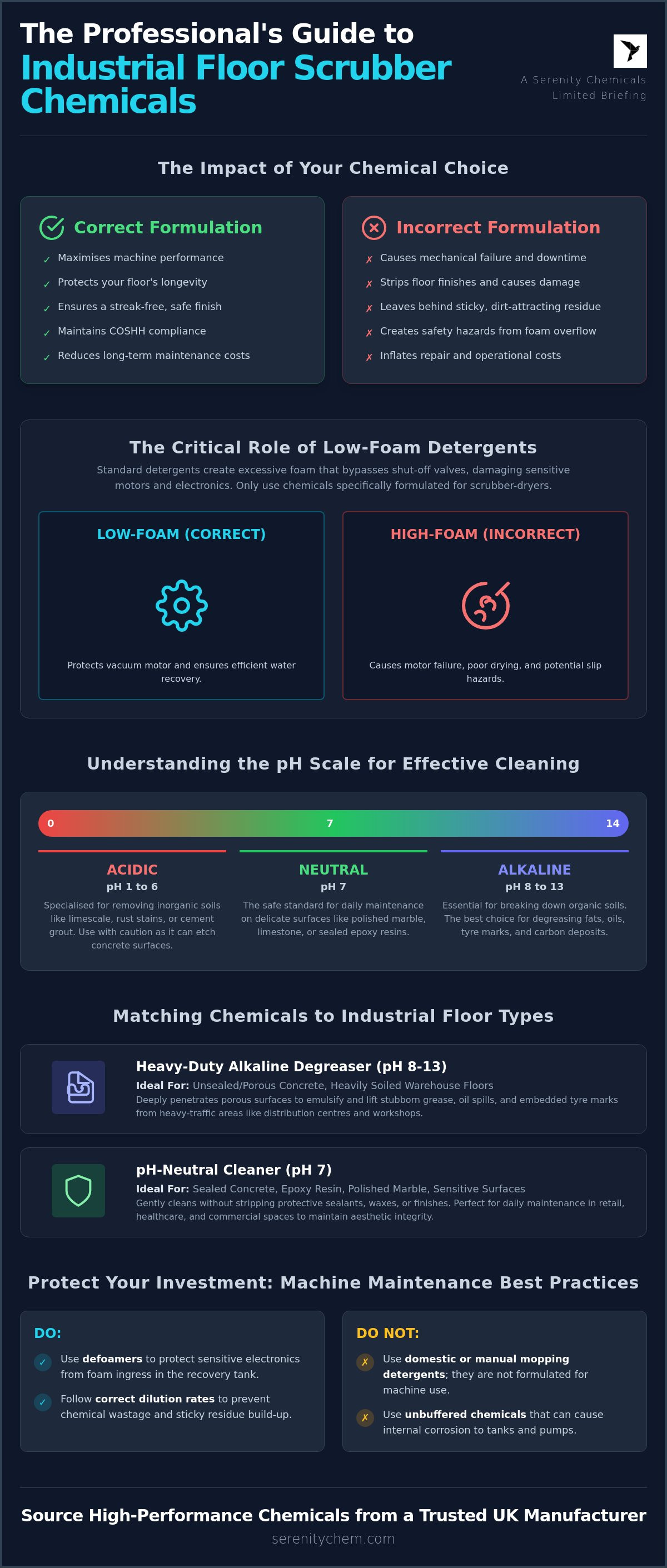
Effective cleaning relies on the synergy of surfactants and mechanical agitation. Surfactants work to break the surface tension of water, allowing it to penetrate deep into the porous surface of a warehouse floor. This process is essential for different types of cleaning agents to lift stubborn oils and grease. Once the dirt is dislodged by the brushes, the chemical must hold these particles in suspension. This ensures that the vacuum system can recover the dirty solution in a single pass, leaving the floor dry and safe for immediate use. High-suds detergents are a primary cause of motor failure because foam doesn't trigger standard float shut-off valves.
Why Standard Detergents Damage Industrial Machines
Using DIY or domestic substitutes is a costly mistake that often leads to significant downtime. Unbuffered chemical solutions can cause internal corrosion in the tanks and pumps, leading to leaks that are difficult to repair. Sophisticated dosing and distribution systems are calibrated for specific viscosities; using the wrong fluid can lead to clogs that disrupt the flow of water to the brushes. The best degreaser for concrete warehouse floors, such as Serenity Heavy Duty Degreaser, is formulated to be compatible with professional hardware whilst providing the strength needed to tackle tyre marks and oil spills. Investing in the correct chemistry is a principled choice that prioritises the health of your machinery and the safety of your operators.
Selecting the Correct Formulation: Neutral vs Heavy-Duty Solutions
Selecting the right chemical requires an understanding of the pH scale. This logarithmic scale measures the acidity or alkalinity of a liquid, ranging from 0 to 14. In industrial cleaning, your choice dictates whether you are gently lifting surface dust or aggressively emulsifying deep-seated grease. Most professional cleaning tasks fall into three categories:
- Neutral Cleaners (pH 7): These are chemically balanced to be non-reactive. They are the safe standard for routine maintenance on delicate surfaces.
- Alkaline Degreasers (pH 8 to 13): These solutions react with organic soils. They are essential for breaking down fats, oils, and carbon deposits.
- Acidic Formulations (pH 1 to 6): These are specialised tools for inorganic soils. They are typically used to remove limescale, rust stains, or cement grout, but they can etch concrete if used incorrectly.
Neutral Cleaners for Sensitive Surfaces
Sensitive floor types, such as polished marble, limestone, or specific epoxy resins, can be irreparably damaged by harsh chemicals. A pH-neutral solution, such as Serenity Floor Cleaner, ensures that you aren't stripping away protective sealants or waxes whilst you clean. In high-traffic environments like retail centres or hospitals, these cleaners provide a consistent finish without the risk of surface clouding. They are designed for daily use, maintaining the floor's aesthetic integrity and protecting the long-term investment in the flooring material.
The Best Degreaser for Concrete Warehouse Floors
When dealing with the heavy oils and stubborn tyre marks found in distribution centres, a neutral cleaner often falls short. Finding the best degreaser for concrete warehouse floors involves looking for high-alkaline formulations that excel at emulsification. This chemical process breaks down hydrophobic substances, such as grease, into smaller droplets that can be suspended in water for vacuum recovery.
In automotive workshops or busy warehouses, high-alkaline solutions are essential for safety. Grease buildup is a significant slip hazard; removing it effectively requires a product like Serenity Heavy Duty Degreaser. Because these chemicals are reactive, rinsing the floor after the scrubbing cycle is vital. This prevents chemical residue from drying and potentially weakening the concrete surface or creating a dull film over time. If you are unsure which formulation suits your specific environment, you can speak with our technical team for tailored guidance on chemical compatibility.
Matching Chemicals to Industrial Floor Types
Every industrial floor has a unique chemical profile that dictates how it responds to cleaning agents. Choosing a product without considering the substrate can lead to costly repairs or permanent surface degradation. Concrete remains the most common industrial surface, yet its porous nature makes it particularly difficult to manage without the correct chemistry. It acts like a hard sponge, drawing oils and spills deep into its structure where standard surface cleaners cannot reach them.
Warehouse Concrete and Polished Stone
In large-scale logistics hubs, the best degreaser for concrete warehouse floors must be capable of lifting carbon deposits and rubber scuffs without causing salt bloom. Efflorescence, often referred to as salt bloom, occurs when moisture reacts with the calcium hydroxide in the concrete, leaving behind unsightly white streaks as it dries. A high-quality, buffered alkaline cleaner prevents this reaction whilst ensuring deep-seated oils are emulsified for vacuum recovery. Polished concrete requires a low-residue finish to maintain its lustre and prevent the surface from becoming dull or slippery.
Addressing tyre marks and heavy scuffing requires a detergent with high soil-suspension properties. If the lifted dirt isn't held in the water solution, it will simply settle back into the concrete pores as the machine moves forward. This leads to a "greyed" appearance over time, even if the floor is technically scrubbed every day. Using a professional formulation ensures that the vacuum system can remove 100% of the slurry, leaving the concrete clean and open for its next use.
Epoxy Resins and Safety Flooring
Epoxy resins and safety floors require a different approach. Resinous surfaces are non-porous, meaning the dirt sits on top; however, the material itself is sensitive to aggressive solvents which can cause "blooming" or surface softening. Safety flooring relies on a specific texture to provide traction. This texture often traps microscopic grease particles that turn a slip-resistant surface into a hazard. Using a targeted product like Serenity Heavy Duty Degreaser ensures these contaminants are lifted without damaging the resin bond or leaving a soapy film that compromises grip.
In food-processing zones or commercial kitchens, the stakes are higher. You must prioritise food-safe, non-tainting formulations that are effective against animal fats whilst remaining compliant with health and safety regulations. Vinyl and Luxury Vinyl Tile (LVT) floors, often used in staff areas, have a thin wear layer that is easily stripped by high-pH chemicals. Protecting this layer with gentle surfactants extends the floor's lifespan and maintains its professional appearance without the need for frequent stripping and resealing.
Protecting Your Investment: Machine Maintenance and Defoamers
The mechanical life of a scrubber-dryer is often cut short not by external damage, but by internal neglect. Whilst selecting the best degreaser for concrete warehouse floors is vital for cleanliness, the way that chemical interacts with the machine's recovery system determines the equipment's lifespan. Foam ingress into the vacuum motor is the most frequent cause of mechanical failure in industrial cleaning. When high-speed brushes agitate chemical solutions, they create bubbles. If these bubbles aren't managed, they bypass the machine's float shut-off system and enter the sensitive electronics and motor housing, leading to catastrophic electrical failure.
The Critical Importance of Defoaming Agents
Excessive foam is rarely caused by the fresh solution alone. It's often a reaction between the new detergent and recovered contaminants, such as old oils or residual floor polish from previous treatments. Defoamers act as bubble-breakers by reducing the surface tension of the liquid in the recovery tank. It's a common mistake to add defoamer to the clean solution tank; instead, it should be dosed directly into the recovery tank or the vacuum hose. This small, principled investment in a defoaming agent can save a business thousands in vacuum motor repairs and prevent the frustration of unplanned downtime.
COSHH Compliance and Chemical Safety
Maintaining a professional facility involves more than just clean floors; it requires strict adherence to UK safety standards. COSHH (Control of Substances Hazardous to Health) regulations mandate that every chemical on-site must have an accessible Safety Data Sheet (SDS). These documents provide essential information on Personal Protective Equipment (PPE) and emergency procedures. If you decant chemicals from bulk containers into smaller dosing bottles, you must ensure they are clearly and correctly labelled to prevent accidental misuse. Dosing accuracy is not just about cost; it's about the physics of the clean, as over-dosing creates unnecessary foam and residue.
Daily maintenance is equally important for long-term machine health. After every shift, you should flush the chemical lines with clean water. This prevents the surfactants in even the best degreaser for concrete warehouse floors from drying and forming crystalline build-up, which can clog the distribution manifold or the solenoid valves. Training your staff to follow these methodical steps ensures a culture of care and operational integrity. For more information on safely integrating our high-performance formulations into your maintenance routine, contact our technical support team.
Sourcing High-Performance Chemicals from Serenity Chemicals
Choosing a national supplier that manufactures its own formulations provides a level of technical transparency that third-party distributors simply cannot match. When you source the best degreaser for concrete warehouse floors directly from the point of production, you ensure the chemistry is fresh and the support is direct. This principled approach to manufacturing allows for a leaner supply chain, which translates into both cost-efficiency and a reduced environmental footprint for your facility. For large-scale operations, the reliability of a UK-based manufacturer ensures that critical cleaning stock is always available when needed.
Our commitment to excellence extends beyond the product in the container. We provide customised solutions for unique industrial challenges, recognising that different industrial settings across the country may face varied soil types and environmental conditions. By working with a partner who understands the nuances of chemical interactions, you can protect your machinery and your flooring assets simultaneously. This steady, expert guidance helps facility managers move away from trial-and-error cleaning toward a methodical, results-driven maintenance programme, a principle shared by industry leaders like JAS Global Industries who provide speciality chemical solutions for mining and water treatment.
The Benefits of Buying Direct from a UK Manufacturer
Eliminating the middleman simplifies your procurement process and provides immediate access to technical expertise. If you encounter a stubborn stain or a mechanical dosing issue, you can speak directly to the people who formulated the product. This level of accountability is a core part of our service-oriented guide philosophy. When choosing a cleaning products manufacturer in the UK, it's essential to prioritise those who offer consistent batch quality and fast, reliable delivery across the country. This ensures your facility operations never grind to a halt due to a lack of essential supplies.
Serenity’s Range: Efficacy Meets Responsibility
Our product range is designed to cover every aspect of industrial floor care with integrity. For routine maintenance on sensitive or sealed surfaces, Serenity Floor Cleaner provides a gentle but thorough clean that preserves the floor's finish. When the environment demands more aggressive action, Serenity Heavy Duty Degreaser stands out as the best degreaser for concrete warehouse floors, specifically engineered to emulsify heavy oils and carbonised grease without damaging the substrate.
Integrating these high-performance solutions into your professional cleaning chemicals list ensures that your team has the right tool for every task. We don't just sell chemicals; we provide a framework for safer, more efficient, and more responsible industrial cleaning. By choosing Serenity, you are investing in a partnership that values the longevity of your equipment and the well-being of your staff as much as the final cleaning result.
Achieving Operational Excellence in Industrial Floor Maintenance
Effective floor care is a synergy between high-performance hardware and the precise chemistry used within it. The longevity of your facility's surfaces and the reliability of your scrubber-dryer depend on selecting the correct pH-balanced formulations and maintaining a rigorous defoaming protocol. By prioritising machine-specific detergents over generic alternatives, you prevent costly downtime and ensure a safer, more productive environment for your team.
Whether you're searching for the best degreaser for concrete warehouse floors or a gentle daily cleaner for sensitive resins, Serenity Chemicals provides the technical transparency you need. Our UK-based manufacturing ensures direct-to-business reliability; every product is formulated for maximum machine protection and accompanied by full COSHH and SDS documentation. This methodical approach to chemical safety and efficacy allows you to operate with complete peace of mind. Contact our experts to discuss your industrial floor care requirements and discover how a principled approach to chemistry can transform your facility maintenance. We look forward to helping you achieve a cleaner, safer workspace.
Frequently Asked Questions
Can I use household floor cleaner in an industrial scrubber-dryer?
You shouldn't use household floor cleaners in an industrial scrubber-dryer because they contain high-foaming surfactants. These detergents are designed for manual mopping and will quickly create excessive suds that can enter and destroy the vacuum motor. Industrial machines require low-foam formulations specifically engineered for mechanical agitation to ensure safe operation and a streak-free finish without risking mechanical failure.
What happens if I don't use a defoamer in my floor machine?
Operating your machine without a defoamer risks catastrophic vacuum motor failure due to foam ingress. Foam doesn't trigger standard float shut-off valves; this allows moisture and bubbles to bypass the recovery tank and enter the electrical components. Using a defoaming agent protects your investment and prevents the significant costs associated with unplanned mechanical repairs and the resulting operational downtime.
How do I know if I need a neutral cleaner or a heavy-duty degreaser?
Choose a neutral cleaner for daily maintenance of sensitive or sealed surfaces where only light dust and surface dirt are present. If you're dealing with stubborn oils, fats, or industrial grime, you'll need the best degreaser for concrete warehouse floors. Heavy-duty alkaline solutions are necessary to emulsify organic soils that neutral detergents cannot effectively lift from porous concrete surfaces.
Are your industrial floor chemicals safe for use in food preparation areas?
Many of our industrial floor chemicals, such as Serenity Hard Surface Sanitiser, are formulated to be safe for use in food preparation environments. These products are non-tainting and highly effective against the organic fats commonly found in commercial kitchens and food processing plants. Always verify the specific product's suitability by checking the technical data sheet to ensure it meets your facility's specific hygiene standards.
What is the correct dilution ratio for industrial floor scrubber chemicals?
The correct dilution ratio depends on the level of soiling and the specific chemical being used for the task. For routine maintenance, a ratio of 1:100 or 1:200 is often sufficient; however, heavy industrial degreasing may require a stronger 1:50 concentration. Always follow the manufacturer's guidelines on the label to avoid chemical wastage or the risk of leaving a slippery residue on the floor surface.
Do industrial floor chemicals expire or lose their efficacy over time?
Industrial floor chemicals do have a shelf life, typically ranging from 12 to 24 months when stored in a cool, dry environment. Over time, active surfactants can degrade, leading to reduced cleaning efficacy or changes in the product's viscosity. We recommend rotating your stock regularly and sourcing directly from a UK manufacturer to ensure you're always using the freshest and most effective batches available.
Can these chemicals remove rubber tyre marks from warehouse floors?
Yes, specialised high-alkaline formulations are designed to lift stubborn rubber scuffs and tyre marks from warehouse floors. The best degreaser for concrete warehouse floors works by breaking the bond between the rubber residue and the concrete surface. For the most effective results, allow the chemical a short dwell time before engaging the scrubber's vacuum system to ensure the complete removal of the marks.
How do I ensure my cleaning regime is COSHH compliant?
Ensure COSHH compliance by maintaining an up-to-date folder of Safety Data Sheets (SDS) for every chemical used on-site. You must also conduct regular risk assessments, provide staff with appropriate Personal Protective Equipment (PPE), and ensure all decanted containers are correctly labelled. Training your team in safe handling procedures is a vital part of maintaining a responsible and legally compliant cleaning regime in the UK.

Hand Sanitiser for Frequent Use: Professional UK Guide 2026
The very product you use to protect your health might be the primary cause of your skin's deterioration. While alcohol-based ...

Food Safe Antibacterial Spray UK: The Professional 2026 Hygiene Guide
Using the wrong disinfectant in a commercial kitchen isn't just a minor oversight; it's a direct threat to your Food Hygiene ...