

Did you know that investing in hand hygiene can yield a return of up to 15 times the initial cost in healthcare savings? Whilst the financial benefits are clear, the human cost of seasonal illness and high staff absenteeism remains a significant challenge for many UK businesses. You likely find that even the most rigorous protocols fail when employees avoid sanitisers that leave their skin feeling dry or irritated. Understanding the critical link between transmission and hand hygiene is the first step toward creating a safer, more productive workplace.
We agree that protecting your team shouldn't come at the expense of their comfort or skin health. This article will help you understand the science of pathogen transmission and show you how to implement a high-compliance strategy using modern, skin-friendly solutions. We will explore the primary routes of infection, clarify the confusion surrounding EN standards, and introduce effective, UK-manufactured products that your staff will actually want to use. By focusing on both efficacy and user experience, you can build a hygiene culture that truly protects your organisation.
Key Takeaways
- Understand the fundamental link between pathogen transmission and hand hygiene to identify exactly how germs move through your workplace.
- Distinguish between direct and indirect contact routes to effectively prioritise the sanitisation of shared surfaces and high-traffic touchpoints.
- Learn how to overcome compliance barriers by addressing the common issue of skin irritation caused by traditional alcohol-based products.
- Follow a structured strategy for implementing effective hygiene protocols, from conducting facility audits to selecting skin-friendly, high-performance chemistry.
- Gain clarity on essential EN standards and how alcohol-free solutions provide robust protection whilst supporting long-term skin health.
The Critical Link Between Disease Transmission and Hand Hygiene
Transmission describes the movement of pathogens from a reservoir to a susceptible host. In any shared facility, this movement is rarely a straight line. Instead, it is a complex web of interactions where hands serve as the primary "vector" for cross-contamination. Every time an employee touches a door handle and then their eyes or mouth, they facilitate a transfer that could lead to illness. Understanding the direct relationship between transmission and hand hygiene is essential for any manager looking to maintain a healthy and stable environment.
Many UK businesses are now moving away from the "emergency response" mindset that defined previous years. They are instead building sustained hygiene cultures that operate consistently throughout the seasons. This shift acknowledges that pathogens don't only exist during high-profile outbreaks. The importance of hand washing and sanitising lies in its ability to break the infection chain at its most vulnerable point: the point of contact. By making hygiene a habitual part of the workday, you create a resilient barrier against the spread of germs.
Why Surface and Hand Hygiene Must Work Together
Germs often survive on "fomites," which are inanimate objects such as shared kettles, printers, or desks. These surfaces act as staging areas for bacteria and viruses. To be truly effective, your protocol must link surface cleaning with hand care. Whilst applying a professional antibacterial surface spray UK businesses trust will clear a desk of pathogens, that surface can be re-contaminated within seconds by a single touch. This re-contamination cycle is a major cause of workplace outbreaks. Integrated safety means ensuring that both the environment and the people within it are part of the same protective shield.
The Economic Case for High-Compliance Hygiene
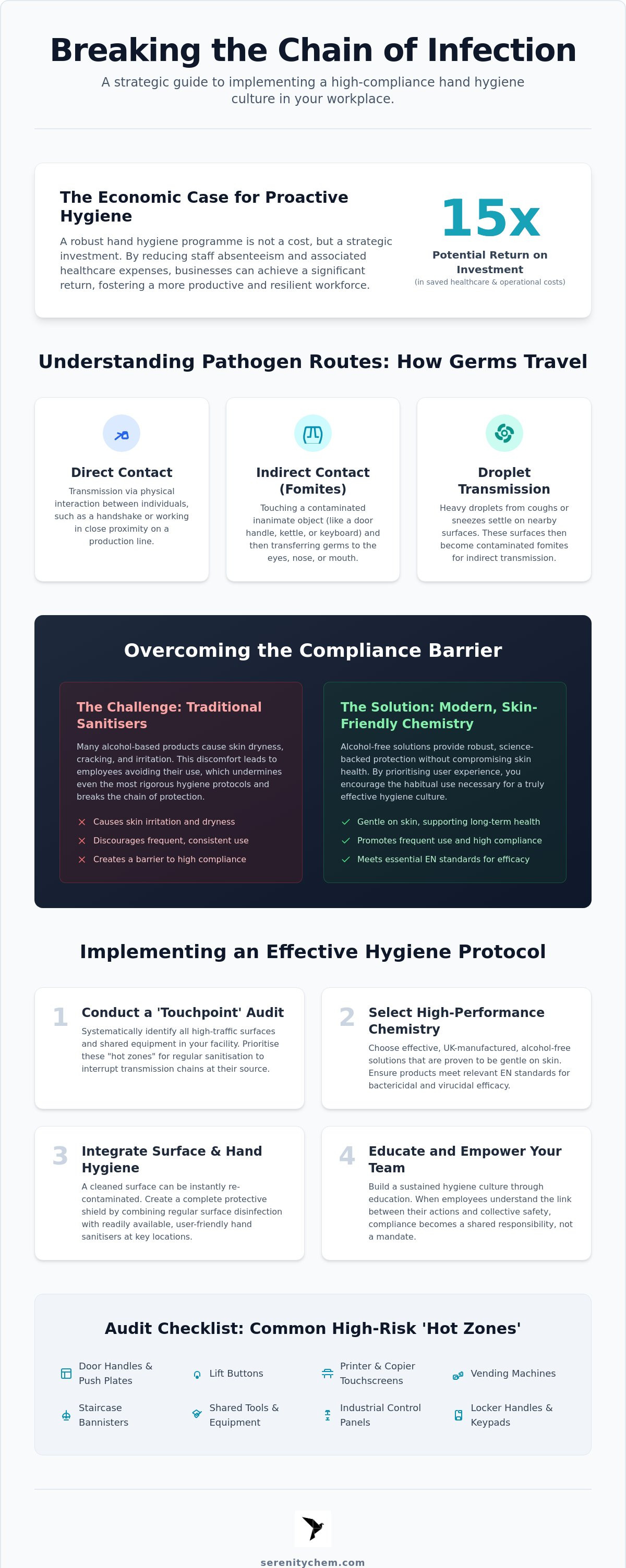
High staff absenteeism remains a significant drain on the UK economy. It stalls productivity and creates a ripple effect of stress for the employees who remain on-site. Data suggests that investing in robust hand hygiene can yield a return of up to 15 times the initial expenditure in saved healthcare and operational costs. Choosing effective, skin-friendly chemicals is a strategic decision that prevents major disruptions. It also reinforces your corporate social responsibility. When you provide solutions that protect without causing irritation, you demonstrate a principled commitment to the safety and comfort of your team. Trust is built when employees feel that their well-being is a genuine priority.
Understanding Pathogen Routes: How Germs Travel in Your Facility
Pathogens don't move through a facility on their own; they rely on human activity and environmental surfaces to circulate. Direct contact occurs when individuals interact physically, such as through a handshake or by working in close proximity on a production line. Indirect contact is often more insidious and harder to track. This happens when a person touches a contaminated object and subsequently transfers those microorganisms to their eyes, nose, or mouth. This cycle of transmission and hand hygiene failure is the primary reason why a single illness can quickly impact an entire department.
Droplet transmission is another significant factor in workplace health. Whilst many viruses are expelled into the air through coughs or sneezes, the heaviest droplets eventually settle on desks, keyboards, and communal equipment. If a staff member touches these surfaces, they become a carrier. Furthermore, microorganisms can form resilient biofilms on the skin. These are complex communities of bacteria that are much harder to remove than loose, surface-level dirt. Following CDC guidelines on handwashing and sanitising is the only way to ensure these persistent layers are effectively neutralised before they can be passed on.
The "Touchpoint" Audit: Identifying High-Risk Zones
Every facility has "hot zones" where cross-contamination is most likely to occur. A thorough audit helps you identify these areas so you can prioritise your hygiene efforts. Common touchpoints include:
- Shared printer touchscreens and paper trays.
- Industrial control panels and shared tool handles.
- Staircase bannisters and lift buttons.
- Vending machine interfaces and locker handles.
Communal kitchens are often the epicentre of workplace transmission. Fridge handles, kettle switches, and microwave buttons are touched by almost every employee but are rarely cleaned as frequently as individual workstations. Placing sanitisation stations at transition points, such as the entrance to a canteen or between the warehouse and the office, encourages staff to clean their hands before they enter a new environment. If you're unsure where to position your stations, you can speak with our technical team for guidance on facility-wide protection.
Fomite Transmission and the Persistence of Pathogens
A fomite is an inanimate object capable of carrying infectious organisms. The survival rate of pathogens on these objects is often underestimated. Some bacteria can persist on hard plastics or stainless steel for several days, whilst certain respiratory viruses remain infectious on surfaces for many hours. Because it's impossible to sanitise every surface every minute, hand hygiene serves as your last line of defence. It ensures that even if a staff member touches a contaminated object, the journey of the pathogen ends there, preventing further spread through the building.
Addressing the Compliance Barrier: Skin Health and Irritation
The most sophisticated infection control plan will fail if the people expected to follow it find the process physically uncomfortable. Whilst managers often focus on the chemical efficacy of a product, the primary reason for poor hygiene compliance is actually skin health. When employees experience painful, dry, or cracked skin, they naturally avoid using sanitisers. This creates a dangerous gap in your defence against transmission and hand hygiene protocols. Understanding the "dermatitis cycle" is vital; frequent application of traditional alcohol-based rubs strips away natural oils, damaging the skin's protective barrier and making it even more susceptible to irritation. Maintaining this barrier often requires a focus on ingredient purity, a standard that Sunshine Valley highlights in their professional checklists for wellness components like niacinamide.
Beyond the physical discomfort, there are specific safety risks associated with alcohol-based products in industrial or high-heat environments. Flammability is a genuine concern in workshops or manufacturing plants where sparks or heat sources are present. As a principled employer, you have an ethical responsibility to provide solutions that don't compromise safety or comfort. Providing "kind-to-skin" alternatives isn't just about avoiding complaints; it's about ensuring your staff can perform their duties without the distraction of skin irritation. This approach aligns with the broader WHO Guidelines on Hand Hygiene, which emphasise the importance of skin care in maintaining high compliance levels.
The Rise of Alcohol-Free Hand Sanitisers
Traditional ethanol-based sanitisers are effective but notoriously drying. In contrast, modern alcohol-free formulations offer a moisturising alternative that supports the skin's natural integrity. These solutions allow for more frequent use throughout the day without the stinging or redness often associated with high-alcohol content. For a detailed look at the technical efficacy of these products, our alcohol free hand sanitiser UK guide provides comprehensive data on how they perform against pathogens whilst remaining gentle on the hands.
Improving User Experience to Drive Behavioural Change
The sensory appeal of a product plays a major role in how often it's used. Many office-based teams prefer foam over gel because it spreads more evenly and dries without leaving a sticky residue. When a sanitiser feels premium and leaves hands feeling soft rather than tacky, staff are far more likely to use it habitually. Choosing a high-quality product signals to your team that the business values their well-being. This small change in procurement can lead to a significant shift in behaviour, transforming a chore into a seamless part of the daily routine, much like how natural bath and body essentials from Elixir-369 can elevate one's personal wellness routine.
Implementing an Effective Hand Hygiene Protocol
Creating a robust protocol requires more than just installing a few dispensers. It demands a systematic approach that integrates with the daily flow of your operations. A well-structured strategy ensures that transmission and hand hygiene management becomes a seamless part of the working day rather than an occasional task. To achieve high compliance, you should follow a clear, five-step implementation process.
- Step 1: Conduct a facility-wide audit. Map the movement of staff to identify high-traffic zones. Focus on areas where people transition between different environments, such as entering a warehouse from an office.
- Step 2: Select the correct chemistry. Match the product to the user. For teams with sensitive skin or those in high-heat environments, alcohol-free solutions provide the necessary protection without the risk of irritation or flammability.
- Step 3: Strategic placement. Position dispensers where they are most visible and accessible. Entry points, lift lobbies, and communal hubs are essential locations.
- Step 4: Education and technique. Training should focus on the 20-second technique. Ensure staff understand how to cover all hand surfaces, including between fingers and around the thumbs.
- Step 5: Regular monitoring. Empty dispensers lead to "hygiene fatigue" and a drop in compliance. Establish a schedule for replenishment to maintain the integrity of your protocol.
If you need assistance in mapping your facility or selecting the right products for your specific industry, you can request a facility hygiene consultation with our technical team.
Adapting the "5 Moments" for the Modern Workplace
The clinical "5 Moments" used in healthcare don't always translate directly to a warehouse or office. Instead, we recommend adopting a commercial version of this framework. Encourage staff to sanitise their hands upon entering the building, before and after using communal equipment like printers or shared tools, and before entering the canteen. It's also vital to sanitise after coughing or sneezing and, finally, upon leaving the workplace. This last moment is crucial for preventing the transfer of pathogens back to the home environment.
Visual Cues and Nudge Theory
Psychology plays a significant role in compliance. Clear, professional signage acts as a constant prompt for hygiene behaviour. Nudge theory suggests that small environmental changes can lead to large shifts in habit. For example, using brightly coloured dispensers or placing them in the direct line of sight at a doorway "nudges" employees to use them without thinking. Simple posters demonstrating the correct application of foam can also improve the thoroughness of the process, ensuring that the chemistry has the time it needs to work effectively.
Serenity Alcohol-Free Solutions: Science-Backed Protection
Serenity Alcohol Free Hand Sanitiser offers a high-performance alternative to traditional alcohol rubs without the associated drawbacks. Whilst some believe that alcohol is the only effective way to neutralise pathogens, modern chemistry has evolved to provide equally powerful, non-irritating options. Our formula is rigorously tested to EN 1276 and EN 14476 standards. This ensures it provides robust protection against both bacteria and viruses; it's a dependable shield for any workplace. By choosing a product that staff feel comfortable using multiple times a day, you reinforce the vital link between transmission and hand hygiene compliance.
Operating as a UK-based manufacturer, Serenity Chemicals Limited provides a level of supply chain security that imported products simply cannot match. We maintain strict control over our formulations to ensure consistent quality and safety for our users. This local production also results in a lower carbon footprint, supporting your organisation's sustainability goals. Whether you are managing a primary school, a busy corporate office, or a heavy-duty industrial site, our range is designed to meet the specific challenges of your environment without compromise.
Why Serenity is the "Principled Expert" Choice
We believe that efficacy and user comfort should never be mutually exclusive. Our non-drying, moisturising formulas are designed for those who need to sanitise frequently throughout a long shift. This focus on skin health removes the most common barrier to compliance. Safety is another critical advantage; being non-flammable and non-toxic, Serenity sanitisers are ideal for high-risk zones where alcohol-based products pose a fire hazard. For organisations looking to customise their entire hygiene inventory, we recommend reviewing our professional cleaning chemicals list to ensure every area of your facility is protected.
Sourcing Direct from a UK Manufacturer
Buying direct from the source is a strategic move for any procurement manager. It eliminates unnecessary middleman costs and ensures you have a direct line to technical expertise and reliable stock levels. We also provide bulk refill options for our sanitisers; this approach significantly reduces plastic waste and lowers your overall overheads. It's a principled way to manage your facility that balances financial efficiency with environmental responsibility. You can Explore our range of Serenity Alcohol Free Hand Sanitisers to find the right format for your dispensers and start building a more resilient hygiene culture today.
Securing Your Workplace Health Culture
Establishing a resilient hygiene strategy is about more than just checking a box; it's about providing your team with the tools they need to stay safe and productive. We've explored how understanding pathogen routes and addressing the physical barriers to compliance can transform your facility's safety profile. When you prioritise skin-friendly solutions, you ensure that transmission and hand hygiene protocols are followed consistently rather than avoided. This proactive approach protects your staff whilst safeguarding your operational efficiency.
Our solutions are manufactured in the UK to ISO 9001 standards and independently tested to EN 14476 and EN 1276 specifications. This ensures you receive high-performance antibacterial and antiviral protection that is also dermatologically tested and non-drying. You don't have to choose between chemical efficacy and employee comfort. By making the switch to modern, alcohol-free chemistry, you invest in a principled solution that values long-term well-being. Switch to Serenity Alcohol Free Hand Sanitiser today to see how we can help you build a healthier, more compliant workplace environment.
Frequently Asked Questions
How does hand hygiene reduce the transmission of infectious diseases?
Hand hygiene breaks the chain of infection by removing or killing pathogens before they can enter the body or be transferred to other people. By cleaning your hands, you neutralise the primary vector that moves germs from contaminated surfaces to vulnerable entry points like the mouth, nose, and eyes. This simple action is the most effective way to manage transmission and hand hygiene in shared environments, significantly lowering the risk of cross-contamination.
Is alcohol-free hand sanitiser as effective as alcohol-based versions?
Modern alcohol-free sanitisers are just as effective as alcohol-based versions when they are formulated to meet specific European standards. High-performance products use advanced antimicrobial agents that provide broad-spectrum protection against bacteria and viruses. These formulations often offer a longer-lasting residual effect on the skin compared to alcohol, which evaporates almost immediately. This makes them a reliable choice for sustained protection in busy workplaces where frequent application is necessary.
What are the EN 14476 and EN 1276 standards for hand hygiene?
These are rigorous European testing standards that verify the efficacy of chemical disinfectants and antiseptics. EN 1276 confirms that a product is effective against bacteria, requiring a 99.999% reduction within a specific contact time. EN 14476 is the standard for antiviral activity, proving the product can neutralise enveloped viruses. Ensuring your sanitiser meets both standards provides peace of mind that it is scientifically capable of protecting your staff from a wide range of pathogens.
How often should employees sanitise their hands in an office environment?
Employees should sanitise their hands at key transition moments throughout the day rather than at set time intervals. These moments include upon arrival at the office, before and after eating, and after using shared equipment like printers, kettles, or lift buttons. It is also essential to sanitise after coughing, sneezing, or touching the face. Focusing on these high-risk points ensures the best balance between protection and practical workflow whilst maintaining high hygiene standards.
Can frequent hand sanitising cause skin problems like dermatitis?
Frequent use of traditional alcohol-based sanitisers can lead to contact dermatitis because the ethanol strips away the skin's natural protective oils. This often results in dryness, cracking, and irritation, which can discourage staff from following protocols. Switching to a dermatologically tested, alcohol-free formula helps prevent these issues. These kind-to-skin products contain moisturising agents that maintain the skin's integrity even with repeated daily use, ensuring that transmission and hand hygiene goals are met without discomfort.
What is the correct way to apply foam hand sanitiser for maximum efficacy?
To apply foam sanitiser correctly, dispense a palm-sized amount and rub it thoroughly over all surfaces of your hands for at least 20 seconds. You must ensure you cover the backs of your hands, between your fingers, and around your thumbs and fingernails. Continue rubbing until your hands are completely dry. This mechanical action, combined with the chemical properties of the foam, ensures that pathogens are effectively neutralised across the entire hand surface before you touch any other objects.
Why should UK businesses choose an alcohol-free sanitiser for their staff?
UK businesses benefit from alcohol-free sanitisers because they address the primary barriers to hygiene compliance: skin irritation and safety risks. These formulas are non-flammable and non-toxic, making them safer for use in various environments, including schools, offices, and industrial sites. Additionally, sourcing from a UK manufacturer ensures supply chain reliability and a lower carbon footprint. It is a principled choice that demonstrates a clear commitment to both employee well-being and corporate environmental responsibility.
Does hand sanitiser expire, and how should it be stored?
Hand sanitiser does have a shelf life, typically around two to three years from the date of manufacture. Over time, the active ingredients may lose their potency, which reduces the product's overall efficacy against germs. To maintain the integrity of your supply, store it in a cool, dry place away from direct sunlight and heat sources. Ensure that containers are kept tightly sealed when not in use to prevent contamination and maintain the stability of the chemical formulation.

Hand Sanitiser for Frequent Use: Professional UK Guide 2026
The very product you use to protect your health might be the primary cause of your skin's deterioration. While alcohol-based ...

Food Safe Antibacterial Spray UK: The Professional 2026 Hygiene Guide
Using the wrong disinfectant in a commercial kitchen isn't just a minor oversight; it's a direct threat to your Food Hygiene ...