

What if the traditional mopping routine you rely on is actually contributing to the rapid resoiling of your premises? It's a common frustration for UK facility managers who watch high-value flooring lose its lustre just hours after a shift ends. You likely agree that keeping up with constant footfall often feels like an expensive, uphill struggle where labour costs spiral while slip hazards and dull surfaces remain a persistent concern. The secret to breaking this cycle isn't more frequent scrubbing, but using a technically superior floor cleaner for high traffic areas that prioritises soil suspension over simple surface wetting.
In this 2026 guide, you'll discover how to maintain pristine, safe, and durable floors in the UK's busiest environments using professional-grade chemical solutions. We will provide a clear overview of how to improve slip resistance and achieve longer-lasting cleanliness through residue-free formulations. By the end of this article, you'll understand how to source cost-effective bulk supplies that ensure full compliance with UK safety standards while significantly reducing your long-term maintenance overheads.
Key Takeaways
- Identify and protect high-traffic zones like receptions and corridors to extend the lifespan and surface integrity of your flooring.
- Learn the technical role of soil suspension and surfactants in lifting deep-set grime whilst maintaining a professional, residue-free finish.
- Discover how to select the most effective floor cleaner for high traffic areas based on your specific flooring material and safety requirements.
- Optimise your cleaning routine with no-rinse solutions and zonal scheduling to significantly reduce labour costs and mopping frequency.
- Ensure consistent results and compliance with UK standards by sourcing high-performance chemical solutions directly from a trusted manufacturer.
Understanding the Demands of High Traffic Flooring
High-traffic environments in the UK, such as busy hospital corridors, university receptions, and retail centres, face a unique set of challenges that go beyond simple aesthetic maintenance. In these zones, the sheer volume of footfall introduces a constant stream of abrasive particles and organic contaminants that can quickly degrade the surface integrity of even the most durable flooring. Whilst standard domestic products might suffice for a quiet home, they often lack the chemical sophistication required to manage the heavy soil loads found in professional settings. Choosing an appropriate floor cleaner for high traffic areas is essential to prevent the accelerated wear that leads to costly, premature floor replacements.
For facilities where footfall is exceptionally high, daily mopping may not be enough to prevent long-term staining; in these cases, specialists like Tile Cleaning Solutions demonstrate how professional restoration and sealing can maintain the integrity of tile and stone over many years.
Understanding floor cleaning basics is the first step towards a sustainable maintenance strategy. When dirt isn't properly suspended and removed, it acts like sandpaper under the weight of thousands of footsteps, grinding down protective finishes and exposing the core material to permanent staining and moisture damage. This hidden cost of poor maintenance often manifests as a dull, lifeless appearance that no amount of buffing can fix, eventually forcing a complete floor replacement years before it should be necessary.
Identifying High Traffic Stress Points
In any commercial facility, certain areas bear the brunt of daily activity. Entryways are the primary point of soil ingress, where grit and moisture are tracked directly from the street. Pivot points, such as the areas around lift buttons or reception desks, experience intense mechanical wear because of frequent turning and shuffling. Amongst professional environments, you'll also encounter a variety of contaminants including road salt during winter, industrial oils, and organic matter in communal breakrooms. Without a specialised floor cleaner for high traffic areas, these substances can bond to the surface, making them significantly harder to remove during routine mopping.
In cases where intense mechanical wear has already compromised the structural integrity of timber surfaces, Restore-Rite professional-grade wood restoration and epoxy systems can offer a cost-effective alternative to replacement; click here to locate a specialist dealer.
The Critical Link Between Cleanliness and Safety
UK business owners must recognise that floor maintenance is a central pillar of risk management. Dirt buildup doesn't just look unprofessional; it actively compromises the slip-resistance of specialised safety flooring. A common issue is the 'cleaning residue' left behind by inferior chemicals. This film can create a dangerously slippery surface whilst drying, or even after it appears dry. Under UK health and safety regulations, maintaining a safe environment is a legal requirement. Using a high-performance solution like Serenity Floor Cleaner ensures that soil is lifted and removed completely, leaving a clean, high-friction surface that protects both your staff and your visitors from avoidable accidents.
The Science of Effective Soil Removal and Surface Protection
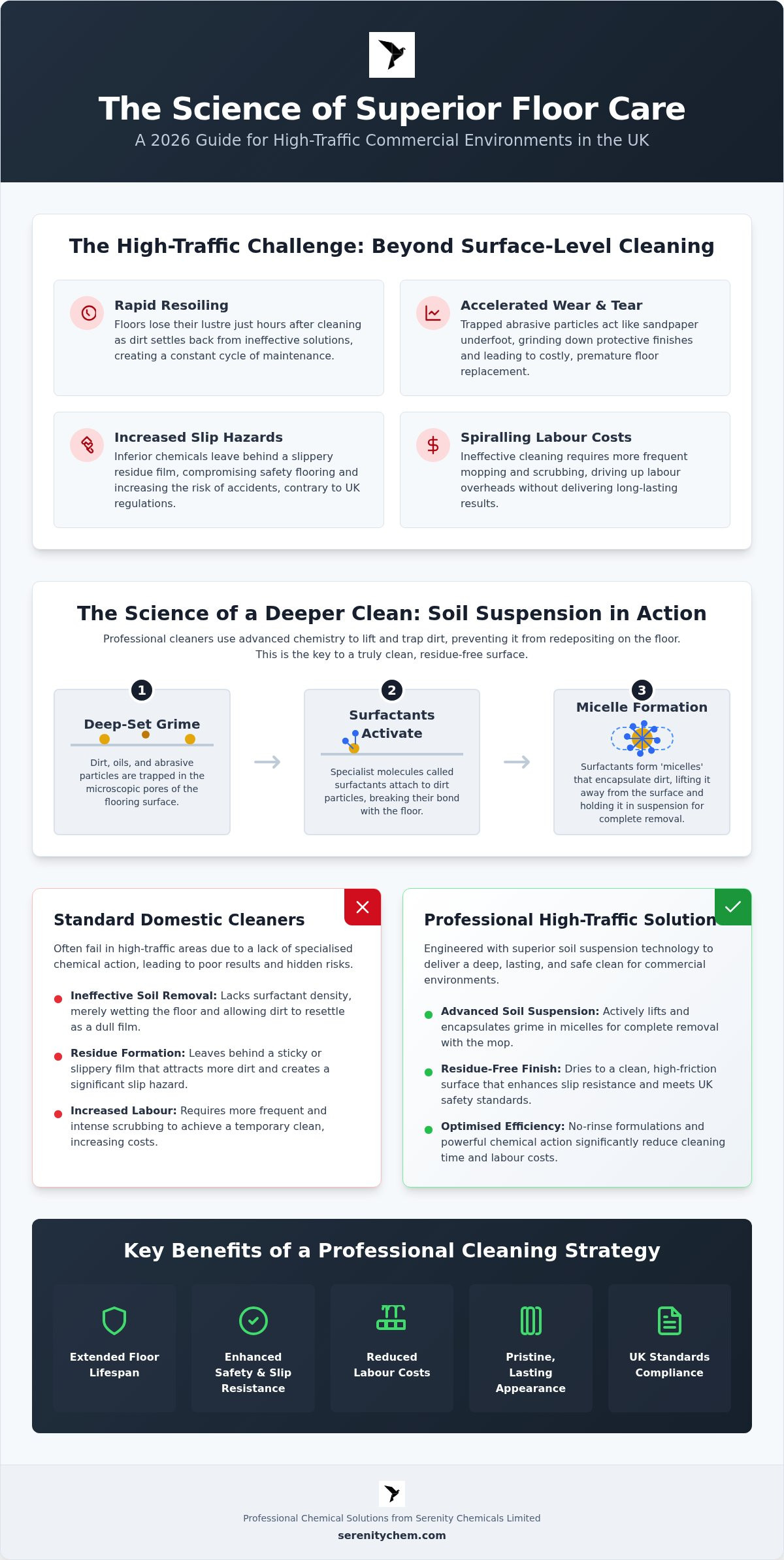
Soil suspension is the process of lifting and holding dirt away from the surface. In busy UK environments, this chemical action is the difference between a truly clean floor and one that merely looks wet. When you use a professional floor cleaner for high traffic areas, you aren't just wetting the floor; you're initiating a complex molecular interaction designed to isolate contaminants. Without this suspension, dirt simply settles back into the texture of the floor as the water evaporates, leading to the rapid resoiling that plagues many commercial facilities.
Surfactants are the workhorses of this process. These molecules possess a dual nature: a hydrophilic head that's attracted to water and a hydrophobic tail that seeks out oils and grease. When applied to a soiled floor, these tails attach to the grime, whilst the heads remain in the water. This action breaks the surface tension, allowing the cleaning solution to penetrate deep into the microscopic pores of the flooring material. It's a methodical process that ensures even deep-set grime is reached and loosened.
Surfactants and Micelle Formation Explained
As surfactants surround dirt particles, they form spherical structures known as micelles. These micelles encapsulate the dirt, trapping it in a protective bubble that prevents it from redepositing onto the floor as you move your mop. This is a critical distinction. Lesser products often lack the surfactant density to maintain this suspension, resulting in the 'grey film' frequently seen on high-traffic floors. High-quality surfactants significantly reduce the physical effort required for scrubbing, as the chemistry does the heavy lifting. This approach aligns with broader CDC disinfection guidelines which emphasise the importance of thorough soil removal as a prerequisite for effective hygiene.
PH Balance and Substrate Compatibility
The chemical strength of your solution must be balanced against the sensitivity of the flooring. Neutral cleaners (pH 7) are essential for delicate surfaces like polished marble or limestone, where acidic or highly alkaline chemicals could etch the stone. However, amongst the heavy-duty soil found in warehouses or industrial kitchens, a mildly alkaline cleaner is often more effective at breaking down stubborn fats and carbon deposits. Using a neutral cleaner in an environment that requires an alkaline boost often leads to poor results and wasted labour.
Protecting the 'wear layer' of modern materials like LVT (Luxury Vinyl Tile) or standard vinyl is vital. If a chemical is too aggressive, it can strip the protective factory finish, leaving the porous material underneath vulnerable to permanent damage. If you're unsure which formulation suits your specific flooring, you can speak with our technical team for tailored guidance on substrate compatibility. Correct pH selection ensures you achieve maximum cleanliness without compromising the floor's longevity.
Selecting the Right Formulation for Your Floor Type
Selecting a floor cleaner for high traffic areas requires a nuanced understanding of the substrate you're treating. A common error in facility management is the assumption that a single chemical can effectively clean every surface from polished marble to industrial concrete. This approach often leads to poor results because different materials interact with surfactants in distinct ways. For example, porous surfaces like concrete require deep-penetration chemicals to lift embedded oils, whilst non-porous ceramic tiles need formulations that leave zero residue to maintain their aesthetic appeal. Matching the chemical's aggression to the specific floor material is a fundamental step in preserving your investment.
Hard Surfaces vs. Resilient Flooring
In receptions and high-profile lobbies, ceramic tiles and natural stone are frequently chosen for their durability. However, these surfaces are prone to showing streaks and dulling if the chemical isn't perfectly balanced. In contrast, the safety flooring found amongst healthcare settings is designed with texture to provide slip resistance. Maintaining this texture is vital. If the wrong cleaner is used, it can fill the microscopic 'peaks and valleys' of the floor with residue, effectively turning a safety floor into a hazard. For older vinyl or linoleum, the primary goal is preventing the 'grey film' effect, which occurs when suspended soil isn't fully removed and dries back into the surface.
For those using mechanical equipment, the choice of formulation becomes even more critical. High-traffic maintenance often involves scrubber-dryer machines, which require low-foaming agents. Excessive foam can damage the vacuum motors of these expensive machines and leave a soapy film on the floor that attracts more dirt. Whilst 'green' alternatives are increasingly popular, they must be rigorously evaluated for efficacy in high-soil environments. A principled professional prioritises results that ensure safety and hygiene without compromising on environmental responsibility.
Heavy Duty Degreasing for Industrial Areas
Industrial zones, such as automotive workshops or manufacturing plants, face a different category of contaminant: heavy oils and lubricants. These substances require a more aggressive chemical response than a standard daily cleaner. Using Serenity Heavy Duty Degreaser allows for the breakdown of stubborn industrial buildup that would otherwise remain untouched by milder solutions. It's a targeted approach that addresses the specific molecular bond of grease.
When using such concentrated degreasers in public-facing zones, it's essential to follow strict safety protocols to ensure the area remains slip-resistant whilst the chemical works to lift the grease. Ensuring the correct dilution ratio is key to both cost-efficiency and surface protection. Matching the chemical's aggression to the actual soil load ensures a thorough clean whilst protecting the underlying substrate from unnecessary chemical wear. This precision ensures your facility remains both pristine and safe for every user.
Optimising Your Cleaning Routine for Maximum Efficiency
Efficiency in floor care isn't about mopping more often; it's about mopping smarter. For UK businesses, labour accounts for a significant portion of the cleaning budget, and every wasted minute adds to the operational overhead. Transitioning to a high-performance floor cleaner for high traffic areas allows facilities to move away from labour-intensive multi-stage processes. By adopting modern chemical technologies, you can achieve a superior finish whilst reducing the hours spent on repetitive tasks.
The Benefits of No-Rinse Floor Cleaners
Conventional mopping often requires a rinse cycle to remove sticky residues left by soapy detergents. This second pass doubles the labour time and keeps corridors "out of service" for longer. Switching to a no-rinse floor cleaner eliminates this requirement. These formulations are engineered to dry clear and streak-free, which significantly improves drying times and reduces the risk of slips during the evaporation phase. Crucially, they stop the "bucket-to-floor" redeposition of dirty water, ensuring that soil is removed rather than redistributed.
Using professional concentrates is another pillar of an efficient routine. These products offer a smaller storage footprint and drastically reduce plastic waste compared to ready-to-use alternatives. However, the efficacy of a concentrate depends on correct dilution. Training staff to use precise measurements ensures consistent slip-resistance across all surfaces. When a solution is too weak, it fails to suspend soil; when it is too strong, it leaves a film. Precision is the key to maintaining a safe, professional environment when using a floor cleaner for high traffic areas.
Implementing a Zonal Maintenance Schedule
An effective schedule organises tasks based on actual footfall data rather than a rigid daily checklist. This methodical approach ensures that resources are allocated where they are needed most, preventing the over-cleaning of quiet areas whilst focusing on high-stress zones.
- Primary Zones: Entryways and reception desks require daily attention to manage soil ingress and moisture.
- Secondary Zones: Internal corridors might only need a deep-clean cycle twice weekly, depending on usage patterns.
- Preventative Measures: High-quality entrance matting acts as a first line of defence, trapping a substantial portion of grit before it reaches your floors.
By monitoring the appearance of your flooring, you can adjust chemical concentrations dynamically. If a particular area shows signs of dulling, increasing the surfactant ratio for a single shift can restore the finish without requiring a full strip and seal. If you need assistance in developing a bespoke maintenance protocol for your facility, you can consult with our technical experts to find the most efficient solution for your specific needs.
Professional Solutions from Serenity Chemicals
Choosing a floor cleaner for high traffic areas is as much about the manufacturer as it is about the chemical formulation. At Serenity Chemicals, we take pride in our role as a dedicated UK manufacturer. By controlling the entire process from proprietary formulation to final distribution, we ensure that every batch meets our rigorous standards for performance and safety. This direct relationship allows us to provide a level of consistency that resellers often struggle to match, giving you peace of mind that your facility's safety is never compromised by variable product quality.
Why Buy Direct from a UK Manufacturer?
Buying direct offers significant logistical and ethical advantages. It reduces supply chain delays and ensures a smaller carbon footprint, as products don't travel through multiple middleman warehouses. Perhaps most importantly, you gain access to expert technical advice from the people who actually formulated the product. Our guide on choosing a cleaning products manufacturer in the UK provides further insight into why this partnership is vital for long-term facility management.
Serenity Floor Cleaner: Performance Profile
Serenity Floor Cleaner is engineered for the specific demands of modern commercial environments. It features a fast-drying, streak-free profile that's essential for maintaining aesthetic standards whilst minimising 'out of service' time in busy corridors. It's highly versatile, performing exceptionally well across ceramic tiles, vinyl, and treated wood surfaces. Key performance benefits include:
- Streak-free finish: Maintains the natural lustre of high-value flooring without dulling residues.
- Fast-drying action: Significantly reduces the window of risk for slip-and-fall accidents during cleaning shifts.
- Substrate safety: Formulated to protect the wear layer of modern materials like LVT and safety vinyl.
For organisations looking to scale their maintenance, we act as a reliable commercial floor cleaner supplier, offering bulk wholesale options that maintain cost-efficiency without sacrificing technical efficacy. This ensures you have a steady supply of high-performance chemicals even during periods of peak demand.
Our commitment extends beyond the product itself. We support UK businesses in maintaining compliance with COSHH and other essential safety standards by providing clear, accessible technical data sheets and application guidance. This principled approach ensures that your choice of floor cleaner for high traffic areas supports both the cleanliness of your floors and the well-being of the people who walk on them every day. By choosing a solution tailored for the UK market, you're investing in a product that understands the local regulatory landscape and the specific challenges of British facilities.
Securing the Future of Your Facility's Flooring
Effective floor care in 2026 is defined by a move toward chemical precision and technical efficacy. By prioritising soil suspension and selecting the correct pH-balanced floor cleaner for high traffic areas, you move beyond surface-level aesthetics to protect the long-term structural integrity of your flooring. Implementing a zonal maintenance schedule and adopting no-rinse formulations are proven methods to reduce labour costs whilst ensuring a consistently safe environment for both staff and visitors.
Maintaining professional standards requires a dependable supply of high-performance chemicals. As a UK-based manufacturer, we provide high-concentration formulas designed for maximum economy and efficacy in the busiest environments. Our team is ready to offer expert technical support to help you achieve full compliance with safety standards and maintain pristine surfaces year-round. It's a straightforward path to more durable, safer floors.
Order Serenity Floor Cleaner Direct from the UK Manufacturer to elevate your facility's maintenance routine today.
Frequently Asked Questions
What is the best floor cleaner for high traffic areas with safety flooring?
The best choice for these surfaces is a residue-free solution like Serenity Floor Cleaner, which is specifically formulated as a floor cleaner for high traffic areas. Safety flooring relies on a textured surface to provide grip; inferior products often leave a soapy film that fills this texture, effectively turning a safety floor into a hazard. A professional-grade cleaner ensures that soil is lifted completely whilst maintaining the floor's original friction levels.
How often should I clean floors in a high-traffic retail environment?
High-traffic retail floors require daily maintenance in primary zones such as entryways and till points to manage grit and moisture. You should organise a zonal schedule where deep-clean cycles occur at least weekly to address embedded grime. Regular cleaning prevents abrasive particles from grinding down the floor's wear layer, which is essential for protecting your long-term investment and ensuring the environment remains welcoming for customers.
Can I use a heavy-duty degreaser on polished stone floors?
You should generally avoid using a heavy-duty degreaser on polished natural stone like marble or limestone. These materials are chemically sensitive and can be easily etched by highly alkaline or acidic solutions, leading to permanent surface damage. For these delicate surfaces, it's safer to use a pH-neutral cleaner that provides effective soil suspension without compromising the stone's finish, lustre, or natural colour.
What are the benefits of using a no-rinse floor cleaner in a business?
Using a no-rinse cleaner significantly improves operational efficiency by removing the need for a secondary rinse pass. This technology allows the solution to dry clear and streak-free, which reduces the time corridors are closed to the public. It's a highly effective way to lower labour costs whilst ensuring that floors remain safe and professional. This approach is particularly beneficial for businesses with limited cleaning windows.
How do surfactants help in removing deep-set dirt from commercial tiles?
Surfactants work by breaking the surface tension of the cleaning solution, allowing it to penetrate the microscopic pores of commercial tiles. Once the dirt is reached, surfactant molecules encapsulate the particles to prevent them from settling back onto the surface during the cleaning process. This process, known as soil suspension, ensures that contaminants are fully removed rather than just being redistributed across the floor.
Is it more cost-effective to buy floor cleaner in bulk from a manufacturer?
Buying direct from a UK manufacturer is far more cost-effective because it eliminates middleman markups and reduces transport overheads. Professional concentrates offer a much lower cost-per-wash than standard ready-to-use brands found in retail stores. Bulk sourcing also ensures you have a consistent supply of high-performance chemicals, which is vital for maintaining hygiene and safety standards in large-scale commercial facilities.
How can I improve the slip resistance of my floors whilst cleaning?
You can improve slip resistance by using a specialised floor cleaner for high traffic areas that leaves no sticky or waxy residue behind. It's vital to follow the manufacturer's dilution instructions precisely, as excessive chemical concentration can create a slippery film once dry. Ensuring the floor is thoroughly dry before use and using entrance matting to remove moisture also contribute to a safer walking surface for everyone.

Hand Hygiene in Food Preparation Areas: The 2026 Professional Guide
The Food Standards Agency estimates that foodborne illness costs the UK economy approximately £9 billion every year, with a s...

Sanitising Commercial Kitchen Hard Surfaces: The Professional UK Guide (2026)
Did you know that the average fine for food hygiene offences in the UK has more than tripled since 2016, now reaching over £7...