

Did you know that food hygiene breaches cost UK businesses over £8 million in fines during 2024 alone? Most of these penalties aren't the result of a lack of effort, but rather a misunderstanding of complex regulations. It's often difficult to keep track of shifting standards like BS EN 13697:2023 or the upcoming August 2026 deadline for GB MCL labelling. You want your kitchen to be safe, but the technical jargon surrounding HACCP cleaning products often creates more confusion than clarity.
We understand that maintaining a high-standard kitchen whilst managing chemical safety and COSHH requirements is a significant challenge. You deserve a cleaning routine that protects your customers without slowing down your operations. This guide will help you master your food safety compliance by providing a professional checklist for selecting and using HACCP-compliant cleaning chemicals. We'll break down the essential BS EN standards, simplify your audit preparation, and provide a clear list of the specific sanitisers and degreasers required to keep your business running safely.
Key Takeaways
- Understand why professional sanitisers are essential for food safety and how they're distinct from standard domestic cleaning agents.
- Clarify the specific requirements of BS EN 1276 and BS EN 13697 to ensure your disinfectants are proven to work effectively on non-porous surfaces.
- Implement the "Three Pillars" of hygiene to remove organic matter and visible debris before you begin the final disinfection stage.
- Verify that your HACCP cleaning products are non-tainting and carry the correct certifications by following our simplified compliance checklist.
- Learn how choosing UK-manufactured solutions like Serenity Kitchen Sanitiser helps you maintain a consistent and compliant supply chain.
What are HACCP Cleaning Products and Why are They Vital?
A clean kitchen is the foundation of any successful food business, but the standard for "clean" in a commercial environment is far higher than at home. Within the food industry, Hazard Analysis and Critical Control Points (HACCP) provides a structured framework to manage safety. While many view HACCP as a set of documents, it's also about the specific tools you use. HACCP cleaning products aren't just standard detergents; they're chemical solutions designed to eliminate biological, chemical, and physical hazards at critical control points.
Relying on domestic detergents is a common mistake. These products are often formulated for fragrance and "shine" rather than the total eradication of pathogens. In a catering environment, visual cleanliness is insufficient. A surface can look spotless whilst harbouring dangerous colonies of E. coli or Salmonella. Professional-grade chemicals are vital because they provide a documented level of efficacy that domestic alternatives simply cannot match. They ensure that the "Critical Control Point" of sanitation is actually controlled, rather than just appearing so.
The Legal Requirement for Food Safety in the UK
Compliance isn't optional. The Food Hygiene Regulations 2006 mandate that all UK food businesses implement a management system based on HACCP principles. The Food Standards Agency (FSA) monitors these standards strictly, and the stakes are high. In 2024, food hygiene breaches resulted in over £8 million in fines across the UK. Using professional chemicals simplifies your audit trail. When an inspector visits, having a clear inventory of certified products proves you're taking proactive steps to protect public health and your business's reputation.
Distinguishing Between Cleaning, Sanitising, and Disinfecting
Precision in terminology is essential for a robust safety plan. Cleaning is the physical removal of dirt and grease, usually with a detergent. This is a necessary first step, but it doesn't kill bacteria. Disinfecting uses chemicals to reduce the number of microorganisms to a safe level. Sanitising effectively combines these processes. In high-risk areas, using a food safe sanitiser for commercial kitchens is the industry standard. These products ensure that surfaces in contact with food are free from pathogens without leaving behind harmful residues or taints. By understanding how these processes work together, you create a multi-layered defence against contamination.
Understanding UK Standards: BS EN 1276 and BS EN 13697
Selecting the right HACCP cleaning products requires more than just looking for a "food safe" label. To ensure your kitchen remains compliant and safe, you must verify that your chemicals meet specific British and European standards. These certifications aren't merely suggestions; they're the scientific proof that a product performs as promised under commercial conditions. According to the UK Food Standards Agency guidance, a food safety management system must rely on procedures that effectively control biological hazards, and these EN standards are the benchmark for that control.
BS EN 1276:2019 is the primary standard for chemical disinfectants used in food and industrial areas. It is a quantitative suspension test that measures how effectively a chemical kills bacteria in a lab environment. However, bacteria often behave differently when they are attached to a surface. This is where BS EN 13697:2023 becomes vital. This newer standard tests the efficacy of disinfectants on non-porous surfaces, such as stainless steel worktops or plastic cutting boards. Together, these standards ensure your HACCP cleaning products are capable of handling the unique challenges of a professional kitchen.
Reading a product label correctly is a skill every kitchen manager needs. Beyond the EN codes, you must pay close attention to "contact time". This is the duration the chemical must remain wet on the surface to achieve its certified kill rate. If a label specifies a 30-second contact time but your team wipes it away after five seconds, the disinfection process has failed. If you're struggling to interpret the technical data sheets for your current supplies, you can request a compliance review from our specialists to ensure your inventory is up to date.
Why BS EN Standards are Non-Negotiable
The science behind these standards relies on the "5-log reduction", which represents a 99.999% kill rate of targeted bacteria. Whilst supermarket "antibacterial" sprays often claim to kill 99.9% of germs, they leave behind 100 times more bacteria than a professional BS EN 1276 compliant sanitiser. In a high-risk environment, that remaining 0.1% can still contain enough E. coli or Salmonella to cause a significant outbreak. Professional standards ensure that these specific, dangerous food-borne pathogens are effectively neutralised.
The Benefits of No-Rinse Formulations
In a fast-paced catering environment, every second counts. Using a no rinse food safe sanitiser significantly improves workflow efficiency by removing the need for a secondary wipe-down with water. These formulations are designed to evaporate quickly, ensuring that no harmful chemical residues are left amongst food preparation surfaces to cause taints or contamination. The efficacy of no-rinse sanitisers in high-turnover environments lies in their ability to provide rapid, certified disinfection without the logistical delay of a multi-stage rinsing process.
The Three Pillars of a HACCP Cleaning Regime
A robust hygiene plan is built on three distinct pillars. If one fails, the entire safety structure collapses. To maintain compliance with Food Standards Agency guidance on HACCP, you must understand that cleaning is a sequential process. It isn't just about applying a single product and hoping for the best. Instead, it requires a methodical approach that addresses different types of contamination in a specific order.
The first pillar is degreasing. This involves removing the organic matter, such as oils, fats, and proteins, where bacteria thrive. The second pillar is cleaning, which focuses on the removal of visible dirt, dust, and debris. Finally, the third pillar is sanitising. This is the microbiological kill phase where HACCP cleaning products are used to reduce pathogens to safe levels. Each stage is dependent on the success of the previous one to ensure a truly hygienic environment.
Skipping the degreasing phase is a common mistake that often renders sanitisers completely ineffective. Grease acts as a physical shield for microorganisms. If a surface remains oily, the sanitiser cannot penetrate that layer to reach the bacteria trapped underneath. You essentially end up with "clean" grease sitting on top of a thriving colony of pathogens. This is why a high-quality degreaser is just as important as a disinfectant in your HACCP cleaning products inventory. By removing the organic load first, you ensure the sanitising agent can work at its full, certified potential.
Heavy Duty Degreasing in Professional Kitchens
Extractors, ovens, and grills are notorious for heavy carbon build-up and thick grease deposits. In these areas, standard multi-purpose cleaners aren't enough. You need specialised solutions like Serenity Heavy Duty Degreaser to break down stubborn residues effectively. For staff training and safety, we recommend following a clear how to use heavy duty degreaser guide. Choosing between ready-to-use sprays for convenience or bulk concentrates for cost-efficiency depends on your kitchen's volume, but both must be managed under COSHH guidelines.
Selecting the Right Kitchen Sanitiser
When selecting a sanitiser for high-traffic food contact surfaces, it must be fragrance-free. Strong floral or citrus scents can easily taint delicate ingredients, which is a significant risk in professional catering. Reliability in your supply chain is also a factor in maintaining these standards. Many businesses find that sourcing kitchen degreaser spray wholesale ensures they always have the foundational products needed to keep their surfaces prepared for the final disinfection stage.
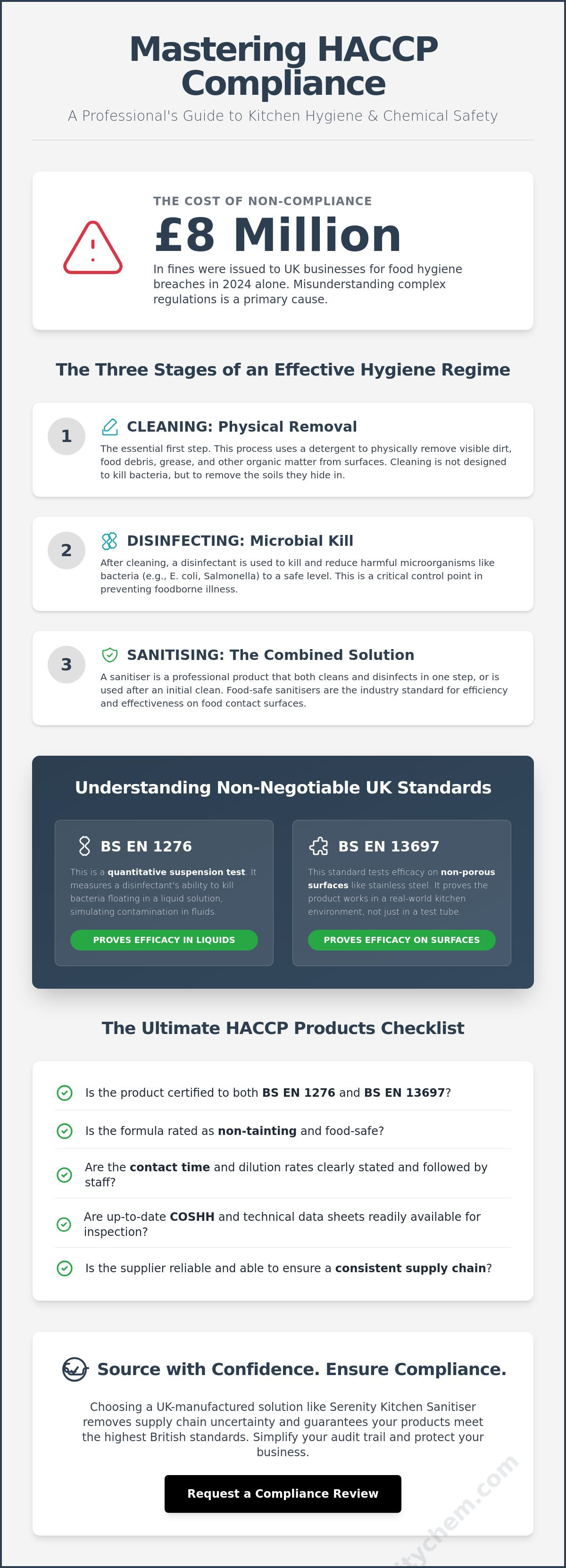
The Ultimate HACCP Cleaning Products Checklist
Creating a food safety management system is a significant undertaking, but the selection of your chemical inventory shouldn't be left to chance. Whilst previous sections focused on the science and strategy, this checklist provides a practical framework for auditing your current supplies. Use these five steps to ensure your HACCP cleaning products meet the rigorous demands of UK food safety inspections.
- Step 1: Certification Verification. Ensure every primary sanitiser in your kitchen carries the BS EN 1276:2019 or BS EN 13697:2023 mark. These certifications are your primary defence during a local authority audit.
- Step 2: Food-Safety Assessment. Confirm that products are fragrance-free and non-tainting. Even a small amount of residual scent can ruin a batch of food and lead to customer complaints or product waste.
- Step 3: Practical Contact Times. Evaluate whether the contact time on the label is realistic for your kitchen's pace. A product requiring a five-minute contact time is often ignored in a high-turnover service environment, leading to hygiene failures.
- Step 4: COSHH Compliance. Safety Data Sheets (SDS) must be easily accessible to all staff, not tucked away in a manager's office. This is a critical requirement for both food safety and health and safety at work.
- Step 5: Organised Storage. Implement a colour-coded system for bottles and cloths to prevent cross-contamination. Chemicals should be stored in a secure, dedicated area away from food preparation zones.
If you're unsure whether your current inventory meets these criteria, you can contact our technical team for a professional compliance review to help bridge any gaps in your documentation.
Operational Checklist: Using Products Correctly
Even the best HACCP cleaning products will fail if they're applied incorrectly. Before any chemical touches a surface, all gross debris and visible food scraps must be physically removed. This pre-cleaning stage ensures the chemical can reach the surface it's intended to treat. Accuracy in dilution is equally vital; using more chemical than recommended doesn't result in a cleaner kitchen, but it does increase the risk of chemical taints and unnecessary costs. Finally, every cleaning task must be logged. An unrecorded task is, in the eyes of an auditor, a task that never happened.
Staff Training and Safety
Your team is the front line of your food safety defence. They must be fully trained in the "clean-sanitise-dry" workflow to ensure pathogens are effectively managed. Whilst handling concentrated heavy-duty chemicals, the use of appropriate Personal Protective Equipment (PPE) is a non-negotiable safety requirement. Regular training reviews are an essential component of maintaining ongoing HACCP compliance and ensuring that safety standards don't slip over time.
Sourcing HACCP Solutions from a UK Manufacturer
Choosing a domestic partner for your hygiene supplies offers a level of reliability that global supply chains often struggle to match. When you source HACCP cleaning products from a UK-based manufacturer, you're not just buying a bottle of chemical; you're securing a transparent and responsive supply line. This proximity ensures that critical products remain in stock even during broader market disruptions, allowing your business to maintain its hygiene standards without interruption.
Our professional range, including Serenity Kitchen Sanitiser and Serenity Heavy Duty Degreaser, is formulated specifically to meet the rigorous British standards discussed in previous sections. These products are developed with the end-user in mind, balancing high efficacy with practical safety. By purchasing in bulk directly from the manufacturer, you also unlock significant economic and environmental advantages. Reducing the number of deliveries lowers your carbon footprint, whilst the lower cost per litre of concentrate helps your bottom line without compromising on the quality of your sanitation.
Beyond the chemicals themselves, a direct relationship with a manufacturer provides invaluable technical support. We assist our clients with comprehensive COSHH documentation and Safety Data Sheets, ensuring that your records are always audit-ready. This level of expert guidance is often missing when purchasing through third-party distributors or general wholesalers who may not understand the specific nuances of food safety regulations.
Why a "Principled Expert" Approach Matters
At Serenity, we believe that professional hygiene is a matter of ethical responsibility. Our commitment to creating effective, ethical formulations means we don't take shortcuts with sub-standard ingredients. This principled approach provides business owners with the peace of mind they need during high-pressure health inspections. Building long-term trust through consistent product performance is far more valuable than the short-term savings found with uncertified alternatives. We position ourselves as your partner in safety, ensuring your reputation is protected by the science behind our solutions.
Next Steps for Your Food Business
The first step toward total compliance is a thorough hygiene audit of your current chemical cupboard. Check for outdated certifications and ensure every product in your inventory serves a specific purpose within your HACCP plan. Once you've identified any gaps, transitioning to a consolidated, HACCP-compliant range will simplify your staff training and reduce the risk of errors. If you're ready to professionalise your cleaning regime, you can contact our team for bespoke wholesale advice and pricing. We're here to help you select the right HACCP cleaning products for your specific operational needs and ensure your business remains safe, compliant, and efficient.
Securing Your Kitchen's Future with Professional Standards
Maintaining a safe and compliant food business requires a disciplined approach to hygiene. By prioritising BS EN 1276 and 13697 standards and adhering to the three pillars of cleaning, you protect both your customers and your professional reputation. You've seen how the right HACCP cleaning products act as a critical line of defence against pathogens and the risk of costly audit failures. Transitioning to a professional, manufacturer-direct range simplifies your compliance whilst providing the technical documentation needed for total peace of mind.
As a UK-based manufacturer, we provide direct wholesale pricing and full BS EN compliance across our entire kitchen range. We also supply comprehensive COSHH support and technical data sheets to ensure your safety records are always up to date and accessible. Taking control of your chemical safety today is the most effective way to prepare for future inspections and ensure the long-term success of your catering operation. We're ready to help you build a cleaner, safer environment for everyone.
Browse our range of professional HACCP-compliant cleaning products
Frequently Asked Questions
What is the difference between BS EN 1276 and BS EN 13697?
BS EN 1276 is a suspension test that measures how effectively a disinfectant kills bacteria in a liquid state, whilst BS EN 13697 evaluates the product's performance on non-porous surfaces like stainless steel. Both standards are necessary because bacteria often behave differently when attached to a worktop compared to a lab solution. Ensuring your HACCP cleaning products meet both criteria provides a comprehensive defence for your food preparation areas.
Do HACCP cleaning products have to be fragrance-free?
Yes, chemicals used in food preparation zones should be fragrance-free to prevent the risk of chemical taints affecting your ingredients. Strong floral or citrus scents can easily migrate into porous foods like dairy products or dough, ruining the sensory quality of your dishes. Using non-tainting formulations ensures that your hygiene routine doesn't compromise the integrity of the food you serve to your customers.
Can I use one product for both degreasing and sanitising?
Whilst some multi-purpose sanitisers exist, they're often less effective than a dedicated two-stage process in environments with high organic loading. A heavy-duty degreaser is specifically formulated to break down fats and oils, whereas a sanitiser focuses on the microbiological kill phase. In a professional kitchen, using separate products ensures that the disinfectant isn't neutralised by a layer of grease, allowing each chemical to work correctly.
How often should I update my HACCP cleaning checklist?
You should review your cleaning checklist at least once a year or whenever there's a significant change in your menu, equipment, or chemical suppliers. Regular updates ensure your protocols remain relevant to your current kitchen operations. If you introduce new high-risk ingredients or increase your volume of service, your cleaning schedule must be adjusted to account for these specific hazards and the required frequency of sanitation.
Is a no-rinse sanitiser safe for direct food contact surfaces?
No-rinse sanitisers are perfectly safe for use on food contact surfaces provided they are applied at the correct dilution and allowed to air dry completely. These formulations are designed to evaporate quickly without leaving behind harmful residues or taints. This makes them a highly efficient choice for high-turnover environments where rinsing with water would be impractical or would risk re-contaminating the surface with non-potable water.
What COSHH documentation do I need for HACCP-compliant chemicals?
You are legally required to maintain a Safety Data Sheet (SDS) for every chemical on-site and conduct a formal COSHH risk assessment for their application. These documents provide essential information on safe handling, storage, and emergency procedures. Keeping these records in a dedicated, organised folder that's easily accessible to all staff is a critical requirement for both food safety audits and health and safety inspections.
Why is contact time so important for HACCP cleaning products?
Contact time is the specific duration a chemical must remain wet on a surface to achieve its certified kill rate against pathogens. If you wipe away HACCP cleaning products too early, the disinfection process will fail, leaving behind viable bacteria that can continue to multiply. Adhering to the manufacturer's specified contact time is the only way to ensure you've achieved the 5-log reduction required for microbiological safety.
Can I buy HACCP-compliant cleaning chemicals in bulk to save costs?
Buying professional cleaning chemicals in bulk is an excellent way to reduce your operational overheads whilst minimising your environmental impact. Sourcing concentrates directly from a UK manufacturer allows you to control your dilution ratios precisely and ensures a consistent supply of high-standard products. This approach provides the best value for money, as the cost per litre is significantly lower than purchasing ready-to-use bottles from general retailers.

Hand Hygiene in Food Preparation Areas: The 2026 Professional Guide
The Food Standards Agency estimates that foodborne illness costs the UK economy approximately £9 billion every year, with a s...

Sanitising Commercial Kitchen Hard Surfaces: The Professional UK Guide (2026)
Did you know that the average fine for food hygiene offences in the UK has more than tripled since 2016, now reaching over £7...