

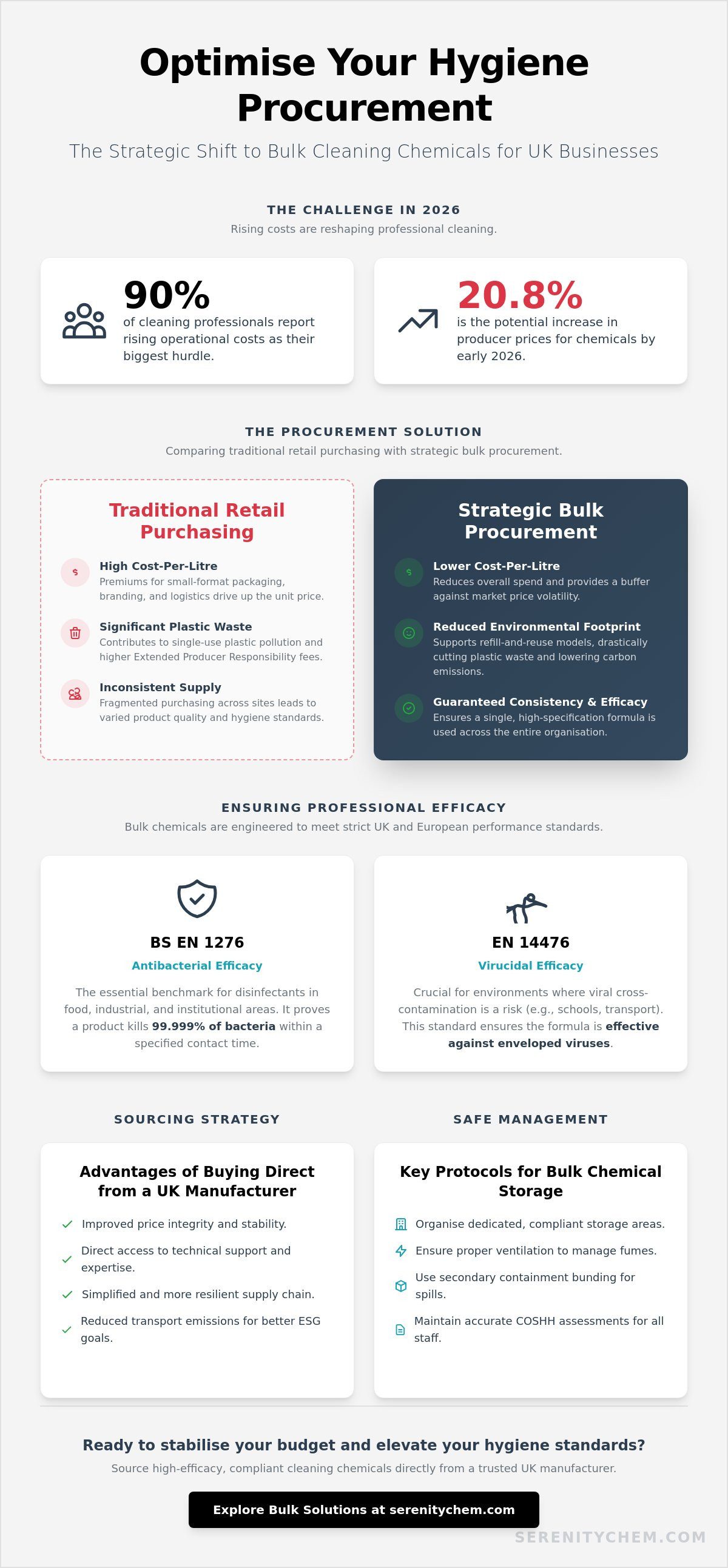
Nearly 90% of cleaning professionals report that rising operational costs are their biggest hurdle this year, and it's easy to see why. With the producer price for chemicals seeing increases of up to 20.8% in early 2026, the traditional habit of purchasing small-format retail products is no longer sustainable for a professional facility. When you decide to buy cleaning chemicals in bulk, you aren't just looking for a cheaper price point; you're seeking a way to stabilise your budget against market volatility whilst maintaining high hygiene standards.
We understand that procurement is about more than just the bottom line. It's about ensuring every bottle in your store cupboard complies with the August 2026 GB CLP regulations and that your team isn't struggling with inconsistent, low-grade supplies. This guide will show you how to optimise your procurement strategy to reduce cost-per-use and meet strict EN standards. We will also examine how sourcing directly from a UK manufacturer simplifies your supply chain and helps you stay ahead of new Extended Producer Responsibility fees for packaging.
Key Takeaways
- Learn how high-concentration formulations significantly lower your cost-per-litre whilst reducing plastic waste and your facility's carbon footprint.
- Understand the technical requirements of BS EN 1276 to ensure your hygiene protocols meet strict professional standards for antibacterial efficacy in food environments.
- Discover the strategic advantages when you buy cleaning chemicals in bulk directly from a UK manufacturer, including better price integrity and access to direct technical support.
- Master the safe management of bulk supplies by organising dedicated storage areas with proper ventilation and secondary containment bunding.
Why UK Businesses Are Shifting to Bulk Cleaning Chemical Procurement
The shift towards high-volume procurement in 2026 isn't a temporary trend; it's a structural change in how UK facilities manage their hygiene budgets. As operational costs continue to climb, organisations are moving away from the inefficiency of retail-grade products. When you buy cleaning chemicals in bulk, you gain a level of control over your supply chain that individual bottle purchases simply cannot provide. This transition allows for a more methodical approach to cleaning, where efficacy and safety take precedence over convenience.
The Economic Advantage of Volume
Analysing the true cost of cleaning requires looking past the invoice total. Retail-ready units often carry a significant premium due to elaborate packaging, labelling, and the logistical costs of moving small units. By switching to 5-litre or 20-litre containers, businesses can see a substantial reduction in their cost-per-litre. This volume-based approach also serves as a buffer against market volatility. Locking in larger quantities from a single UK supplier reduces the frequency of price negotiations and slashes the administrative burden of processing multiple small invoices. Efficiency is the priority. Consolidating your orders means fewer deliveries to manage and less time spent on stock-taking.
Consistency is often the silent casualty of fragmented purchasing. When different departments or sites source their own supplies, the hygiene results often vary. Bulk procurement ensures that every product, from the kitchen sanitiser to the floor cleaner, is the same high-specification formula across the entire organisation. This uniformity simplifies staff training and ensures that COSHH assessments remain accurate for every team member. It's a principled approach that values the safety of the user as much as the cleanliness of the facility.
Sustainability and Environmental Responsibility
Environmental responsibility is now a core requirement for most UK businesses, especially with the 2026 eco-modulated fees for packaging. Reducing single-use plastic is the most direct way to lower a facility's carbon footprint. A refill and reuse model, supported by bulk containers and professional dosing systems, eliminates thousands of small plastic bottles from the waste stream. Choosing to buy cleaning chemicals in bulk is a practical step towards achieving internal sustainability targets and meeting the expectations of eco-conscious stakeholders.
Sourcing from a UK-based manufacturer further enhances these ESG goals by minimising the transport emissions associated with imported goods. This local approach provides peace of mind, knowing your supply chain is both resilient and ethical. Bulk procurement requires a structured approach to safe chemical storage practices, ensuring that high-concentration liquids are handled with care and stored in compliant, well-ventilated environments. By investing in larger formats, you are not just saving money; you are participating in a more responsible and transparent chemical lifecycle.
Understanding Professional Standards and Chemical Efficacy
Professional cleaning chemicals aren't simply larger versions of the products found on supermarket shelves. They are high-concentration formulations specifically engineered for the rigours of industrial and commercial use. Whilst retail products often prioritise fragrance and packaging appeal, professional solutions focus on active agent density and verified kill rates. When you buy cleaning chemicals in bulk, you are investing in technical tools that must perform under demanding conditions, from high-traffic hospital corridors to busy commercial kitchens.
Efficacy in a professional setting is measured by adherence to British and European standards. For instance, BS EN 1276 is the essential benchmark for antibacterial performance in food, industrial, and domestic areas. It proves that a product can kill 99.999% of bacteria within a specific contact time. In environments where viral cross-contamination is a concern, such as schools or public transport, products must meet EN 14476. This standard ensures the formulation is effective against enveloped viruses. Ensuring your supplies meet these benchmarks is a core part of complying with UK regulations for hazardous substances, which dictate how businesses should manage and document the chemicals they use.
The Science of Professional Formulations
The performance of a professional cleaner depends on its chemical balance. High-grade surfactants are used to break down tension between liquids and solids, allowing dirt and grease to be lifted more efficiently. The pH level is also critical; a heavy-duty degreaser will sit on the alkaline side of the scale to strip away organic fats, whilst a toilet cleaner uses acidity to dissolve limescale. Professional formulations often include residual protection agents that continue to work long after the surface has dried, a feature rarely found in standard retail sprays. If you're unsure which formulation suits your specific floor or surface type, you can ask our technical team for a compatibility review.
Alcohol-Free vs. Traditional Sanitisers
There's a growing shift towards alcohol-free hand sanitisers in many professional sectors. These formulations use advanced biocides that provide high levels of protection without the skin-drying effects or flammability risks associated with traditional alcohol gels. They're particularly valued in healthcare and education settings where skin integrity and safety are paramount. When you buy cleaning chemicals in bulk for personal hygiene, choosing alcohol-free options can reduce the risk of contact dermatitis amongst your staff. For a detailed breakdown of these benefits, see our guide on alcohol free hand sanitiser UK requirements.
Sourcing Strategy: Buying Direct from a UK Manufacturer vs. Wholesalers
Buying from a wholesaler often involves paying for a brand name and a distribution layer that adds limited technical value. When you choose to buy cleaning chemicals in bulk directly from the factory, you eliminate the middleman markup. This provides better price integrity, which is vital in a market where chemical products have seen price increases of up to 11.9% in early 2026. Beyond the financial savings, the primary benefit is technical transparency. A manufacturer understands the precise molecular composition of their products, whereas a wholesaler is often just a logistics provider with limited knowledge of chemical efficacy.
Direct sourcing ensures that your documentation is always accurate and up to date. Safety Data Sheets (SDS) are the cornerstone of workplace safety, and receiving them straight from the source reduces the risk of using outdated or generic information. This level of detail is essential for staying compliant with UK Health and Safety Executive (HSE) guidelines. It allows you to build a robust COSHH strategy based on specific chemical properties rather than broad assumptions. You aren't just buying a product; you're gaining a technical partner who can help you resolve complex hygiene challenges.
The Manufacturer Advantage
When you buy from a manufacturer, you receive the latest, most stable batches. Wholesalers may hold stock in warehouses for months, which can affect the shelf life and efficacy of certain active agents. Sourcing direct also opens a channel for expert advice on specific site challenges, such as dealing with hard water mineral deposits or heavy industrial grease. Manufacturers can provide tailored dilution ratios and application methods that wholesalers simply don't have the expertise to offer. For a deeper look at this model, read our guide on how to buy direct from chemical manufacturer partners to streamline your operations.
Quality Control and Traceability
Traceability is a non-negotiable requirement in modern hygiene procurement. UK manufacturers use rigorous batch tracking systems that allow every container to be traced back to its production date and raw material components. This provides a safety net that resellers cannot replicate. Verifying "Made in Britain" credentials isn't just about supporting local industry; it's about supply chain security. In an era of global shipping delays, having a local partner ensures that your stock-outs are minimised and your ethical standards are upheld throughout the manufacturing process. It's a principled way to manage your facility's hygiene requirements.
Safe Management and Storage of Bulk Chemicals
Transitioning to high-volume procurement requires more than just extra shelf space. It demands a disciplined approach to risk management. When you choose to buy cleaning chemicals in bulk, you are handling concentrated substances that require respect and a controlled environment. A professional chemical store must be cool, dry, and well-ventilated to prevent any accumulation of vapours. Adequate lighting is equally important; staff must be able to read safety labels and dilution instructions clearly to avoid costly or dangerous errors. Access control is a non-negotiable requirement to ensure only trained personnel handle the stock.
Secondary containment is a critical component of a safe storage setup. Using bunded pallets or drip trays ensures that any accidental spill or leak is contained within a safe area, preventing it from reaching drains or porous floors. This is particularly important for high-concentration degreasers or sanitisers. Implementing a strict colour-coded system across your facility also minimises the risk of cross-contamination. By assigning specific colours to different zones, such as red for washrooms and blue for general surfaces, you create a visual safety language that your team can follow instinctively. This principled approach protects your staff and ensures the integrity of your hygiene results.
COSHH Compliance and Workplace Safety
Maintaining a safe workplace begins with thorough documentation. You must keep an up-to-date COSHH register for every bulk product on-site. This register should be easily accessible and include the latest Safety Data Sheets provided directly by your manufacturer. Handling concentrates carries a higher risk than using ready-to-use sprays, so providing specific PPE guidance is essential. This usually includes chemical-resistant gloves and eye protection for decanting tasks. For a detailed breakdown of your legal obligations, refer to our comprehensive guide on COSHH information for cleaning chemicals.
Effective Decanting and Dilution
Precision is the key to both safety and cost-efficiency. We recommend using dosing pumps or wall-mounted dilution centres rather than "glug-pouring" directly from a large container. Glug-pouring is notoriously inaccurate; it leads to excessive chemical wastage and can result in solutions that are either too weak to be effective or so strong they damage surface materials. Every secondary container or spray bottle must be clearly labelled with the product name, dilution date, and relevant hazard symbols. If you need assistance designing a compliant storage layout for your facility, contact our safety advisors for professional guidance.
The Serenity Range: Professional Hygiene Solutions in Bulk
The Serenity Range provides a comprehensive answer to the procurement challenges discussed throughout this guide. When you choose to buy cleaning chemicals in bulk from a principled UK manufacturer, you ensure that every litre of product used in your facility meets the highest standards of efficacy and safety. This range isn't just a collection of cleaners; it's a suite of professional tools designed to deliver consistent hygiene results whilst respecting the well-being of the user. From daily maintenance to intensive industrial tasks, these formulations provide the reliability that modern facilities demand.
For daily upkeep, Serenity Multi-Surface Cleaner offers a versatile solution that maintains high-traffic areas without damaging delicate finishes. In contrast, Serenity Heavy Duty Degreaser is engineered for the most demanding environments, such as industrial workshops and commercial kitchens, where organic fats and oils require powerful chemical intervention. Specialist floor care is managed through the Serenity Floor Cleaner range, which is formulated to protect the integrity of various surface materials whilst providing a deep, thorough clean. Personal hygiene is also a priority; our Serenity Alcohol Free Hand Sanitiser provides a skin-friendly alternative to traditional gels, ensuring staff protection without the risk of irritation or dryness.
Kitchen and Food Prep Sanitisers
Maintaining HACCP standards in a busy catering environment requires products that are both powerful and safe for food-contact surfaces. Serenity Kitchen Sanitiser is designed for this specific purpose, providing the antibacterial performance required by professional standards. One of the primary benefits for fast-paced kitchens is our no-rinse formulation, which allows teams to sanitise surfaces efficiently without the need for a secondary wipe-down. This saves time and reduces the risk of cross-contamination. For a more detailed look at maintaining these standards, you can refer to our food safe sanitiser for commercial kitchens reference guide.
Specialist Surface and Carpet Care
Achieving a professional finish often depends on the specialist products used for specific textures and materials. Serenity Glass & Mirror Cleaner ensures streak-free results on partitions and windows, which is essential for maintaining a polished facility aesthetic. For deep cleaning of soft furnishings, Serenity Carpet Shampoo is optimised for use in commercial extraction machines, lifting embedded dirt and refreshing fibres. Washroom hygiene is equally critical; the combination of Serenity Toilet Cleaner and Serenity Hard Surface Sanitiser ensures that high-risk areas remain both visually clean and microbiologically safe. By choosing to buy cleaning chemicals in bulk from this coordinated range, you simplify your inventory and guarantee that every product works in harmony with your overall hygiene strategy.
Optimising Your Hygiene Strategy for 2026 and Beyond
As operational costs and regulatory requirements evolve through 2026, shifting your procurement strategy is no longer optional. Transitioning from small-scale retail purchases to a high-volume, manufacturer-direct model provides the stability and efficacy your facility requires. By prioritising products tested to EN 1276 and EN 14476 standards, you ensure that your hygiene protocols are rooted in verified science rather than marketing claims. This transition isn't just about reducing spend; it's about building a resilient, compliant, and sustainable cleaning operation.
When you choose to buy cleaning chemicals in bulk from a UK-based manufacturer like Serenity Chemicals, you gain more than just a volume discount. You receive expert technical support and the peace of mind that comes from a transparent, ethical supply chain. This principled approach to hygiene protects your staff, your surfaces, and your budget. It's time to move beyond reactive purchasing and embrace a proactive, professional strategy that delivers consistent results across every department.
Browse the Serenity range and buy cleaning chemicals in bulk today to secure your facility's hygiene future with a partner you can trust.
Frequently Asked Questions
Is it cheaper to buy cleaning chemicals in bulk for a small business?
Yes, purchasing in larger formats is almost always more cost-effective because the cost-per-use is significantly lower than retail alternatives. Even for smaller operations, the reduction in packaging costs and delivery fees provides a clear economic advantage. When you buy cleaning chemicals in bulk, you also protect your business against the frequent price fluctuations seen in the retail market.
What are the storage requirements for large quantities of cleaning chemicals?
Bulk chemicals must be stored in a cool, dry, and well-ventilated area away from direct sunlight and heat sources. It's essential to use secondary containment, such as bunded pallets, to catch any accidental leaks or spills. You should also ensure that incompatible substances are segregated according to the guidance found in their specific Safety Data Sheets to maintain a safe workplace.
How long do bulk cleaning chemicals typically last before expiring?
Most professional-grade cleaning concentrates have a shelf life of 12 to 24 months when kept in their original, sealed containers. Once a product is diluted into a secondary trigger spray, its efficacy can diminish more quickly, especially for sanitising agents. We recommend a "first-in, first-out" inventory system to ensure you're always using the freshest batches available.
Do I need specific insurance to store bulk chemicals on-site?
You should notify your insurance provider if you're storing significant volumes of hazardous substances, as this may influence your policy terms. Whilst standard commercial insurance typically covers cleaning supplies, "bulk" storage often requires you to demonstrate that you've conducted thorough risk assessments. Following HSE guidelines for storage and handling is the best way to remain compliant and insured.
Can I buy professional-grade cleaning chemicals without a trade account?
Yes, many specialist manufacturers now allow businesses to purchase high-performance solutions directly through their websites without a formal trade application. This accessibility makes it easier for organisations of all sizes to buy cleaning chemicals in bulk and benefit from industrial-strength efficacy. Whilst trade accounts can offer bespoke pricing for very high volumes, they aren't always a requirement for standard bulk orders.
What is the difference between domestic and professional bulk cleaners?
Professional cleaners are highly concentrated formulations designed to be diluted, whereas domestic products are often pre-diluted for the consumer market. Professional solutions are also tested to rigorous standards like EN 1276 and EN 14476 to guarantee performance in commercial environments. Domestic cleaners often prioritise scent and ease of use over the technical kill rates required in healthcare or catering sectors.
How do I ensure my staff are using bulk concentrates safely?
The most effective method is to install automated dosing systems or wall-mounted dispensers that remove the need for manual pouring. You must also provide clear, accessible COSHH training and the appropriate Personal Protective Equipment, such as gloves and eye protection. Labelling every secondary container with the correct product name and hazard symbols is a legal requirement that keeps your team informed.
Are bulk cleaning chemicals more environmentally friendly?
Bulk procurement is a much more sustainable choice because it dramatically reduces the amount of single-use plastic entering the waste stream. By using 5-litre or 20-litre containers to refill trigger sprays, you minimise packaging waste and lower the carbon emissions associated with frequent transport. Sourcing from a UK manufacturer further reduces the environmental impact by shortening the overall supply chain.

Hand Hygiene in Food Preparation Areas: The 2026 Professional Guide
The Food Standards Agency estimates that foodborne illness costs the UK economy approximately £9 billion every year, with a s...

Sanitising Commercial Kitchen Hard Surfaces: The Professional UK Guide (2026)
Did you know that the average fine for food hygiene offences in the UK has more than tripled since 2016, now reaching over £7...