

By 15 August 2026, every cleaning chemical in your facility must meet the updated GB CLP hazard standards, or you're risking more than just a smeary window. It's a daunting reality for many SME owners who already find the cost of cleaning supplies for a small business UK to be both opaque and unpredictable. You've likely felt the frustration of choosing between expensive retail brands and confusing wholesale catalogues, all whilst worrying if your products actually meet the latest EN efficacy standards.
We understand that maintaining a safe environment shouldn't feel like a financial guessing game. This article provides a professional breakdown of chemical costs and compliance requirements to help you regain control of your hygiene budget. We'll examine how strategic sourcing and a focus on cost-per-use can reduce waste, ensure full COSHH compliance, and create a predictable monthly spend for your business. By moving away from price-per-bottle and focusing on dilution efficacy, you can protect both your staff and your bottom line with confidence.
Key Takeaways
- Learn how to transition your hygiene spend from an unpredictable variable expense into a manageable fixed operational cost for your business.
- Discover why "cost-per-dilution" is a more accurate financial metric than price-per-bottle when evaluating professional-grade chemicals.
- Identify the specific financial thresholds where switching to wholesale procurement significantly lowers the cost of cleaning supplies for a small business UK.
- Understand how to integrate COSHH assessments and the latest 2026 GB CLP hazard standards into your procurement process to avoid regulatory fines.
- Explore the logistical and financial advantages of sourcing directly from a UK manufacturer to ensure supply chain stability and improved margins.
Calculating the Baseline: What Small Businesses Spend on Hygiene
Setting a budget for the cost of cleaning supplies for a small business UK requires looking beyond the price of a single bottle. In 2026, hygiene has transitioned from a discretionary purchase into a fixed operational expense. This shift is driven by stricter health and safety expectations and the legal requirement to adhere to the Control of Substances Hazardous to Health (COSHH) regulations. For most SMEs, facilities management and hygiene supplies typically account for a small but essential percentage of annual turnover. Whilst these costs vary, they're no longer a variable you can afford to overlook.
It's vital to distinguish between cleaning for appearance and cleaning for sanitisation. Whilst a surface might look polished, it isn't necessarily safe. Professional-grade sanitisation requires products that meet specific EN standards, ensuring that bacteria and viruses are neutralised rather than just moved around. This distinction is what separates a basic tidy-up from a compliant hygiene strategy.
Industry-Specific Budget Variations
Every sector faces unique hygiene challenges that dictate their spending patterns. These requirements often fall into three main categories:
- Office and professional services: Spending is concentrated on high-traffic touchpoints like door handles, lift buttons, and shared kitchenettes.
- Retail and hospitality: Budgets must account for high-frequency surface sanitisation of customer-facing areas and stringent food safety protocols.
- Healthcare and education: These environments require high-volume use of medical-grade disinfectants to meet rigorous safety standards.
The "Supermarket Trap" for Small Businesses
Many micro-businesses fall into the "supermarket trap" by purchasing domestic cleaning brands from local retail centres. This approach often inflates the annual cost of cleaning supplies for a small business UK. Domestic products are rarely designed for high-frequency commercial use and lack the concentrated formulations found in professional supplies. Buying retail means paying a premium for branding and packaging whilst missing out on the efficiency of bulk dilution.
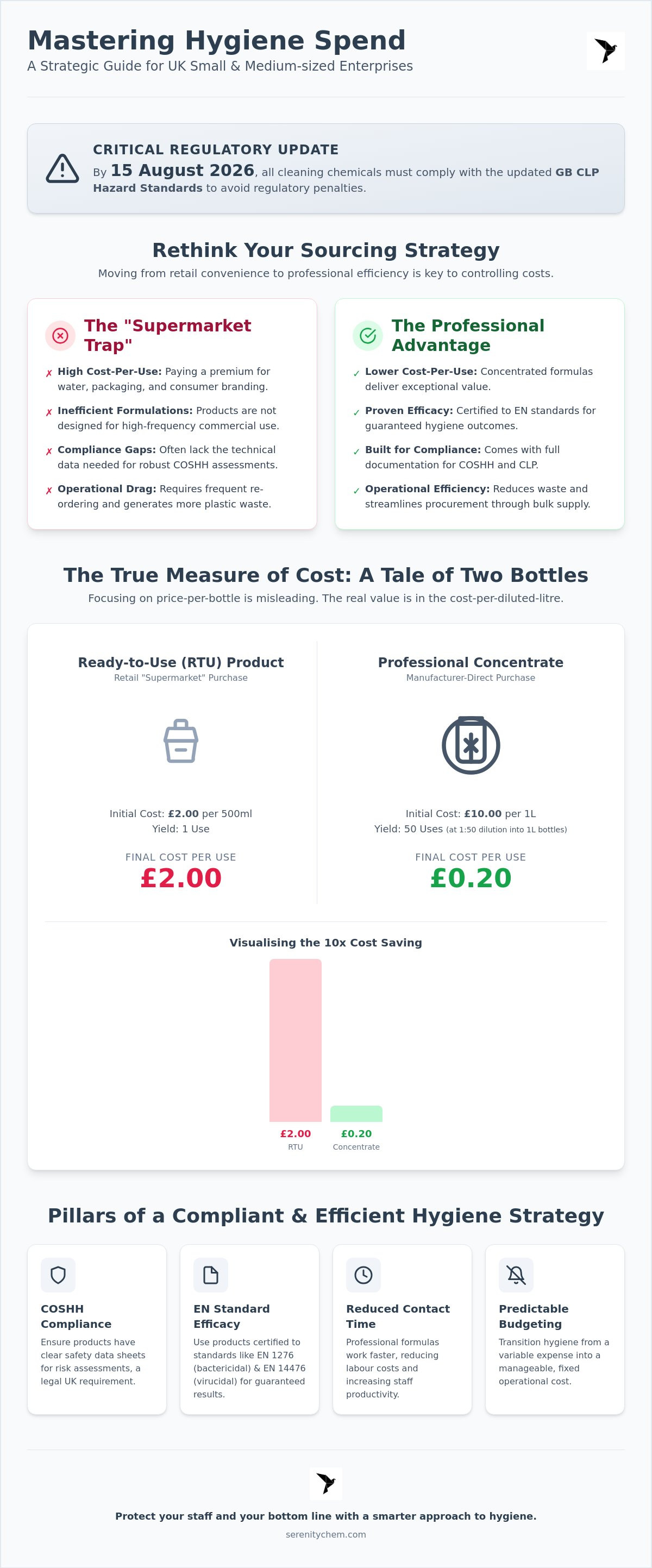
Consumer-grade products also frequently lack the rigorous efficacy data and technical documentation required for a robust COSHH assessment. This leads to hidden costs, including the time spent on frequent re-ordering and the waste generated by using ready-to-use sprays instead of concentrated solutions. Transitioning to professional-grade supplies allows for a more methodical approach. It reduces the cost-per-use and provides the peace of mind that comes with proven efficacy and manufacturer-direct transparency.
The Hidden Variables: Efficacy, EN Standards, and Dilution Ratios
Focusing purely on the initial purchase price is a common oversight when calculating the cost of cleaning supplies for a small business UK. True value lies in efficacy and the technical standards that guarantee a product does its job correctly the first time. For instance, certifications like EN 1276 (bactericidal) and EN 14476 (virucidal) provide more than just peace of mind; they offer financial protection against the costs of ineffective cleaning and potential health outbreaks. When a product is verified to kill 99.99% of pathogens within a specific timeframe, you aren't just buying a liquid; you're buying a predictable hygiene outcome.
Contact time is another hidden variable that impacts your bottom line. If a cheap disinfectant requires a ten-minute contact time to be effective, your labour costs increase as staff wait to finish a task. Professional formulations often achieve high-level sanitisation in significantly less time. This efficiency reduces product consumption and frees up your team for other essential duties. Following the Health and Safety Executive (HSE) guidance on cleaning ensures you're applying these chemicals safely whilst maximising their operational value.
Concentrates vs. Ready-to-Use (RTU) Formulations
Ready-to-use sprays are convenient but expensive. When you buy RTU, you're largely paying for water and plastic packaging. Professional concentrates, such as Serenity Multi-Surface Cleaner, allow you to control the dilution ratio based on the specific task. Breaking down the cost-per-litre of a concentrate often reveals that it's a fraction of the price of an RTU equivalent. To prevent "glugging" and product waste, it's essential to train staff on correct measurement. This reduces chemical spend and significantly lowers your business's environmental footprint by cutting down on single-use plastic bottles.
The Role of Alcohol-Free Sanitisers in Workplace Budgeting
Traditional alcohol-based gels evaporate quickly and can lead to skin irritation, often resulting in lower staff compliance. Alcohol-free foam sanitisers, like Serenity Alcohol Free Hand Sanitiser, offer a different financial profile. These formulations typically provide more applications per litre and offer residual protection that lasts longer on the skin. For a deeper look at these benefits, see our Alcohol-Free Hand Sanitiser UK: The Professional Guide (2026).
By choosing products with longer-lasting residual efficacy, you can often reduce the frequency of application without compromising safety. This strategic approach keeps the cost of cleaning supplies for a small business UK manageable and predictable. If you're unsure which formulation best suits your facility's specific needs, you can request a professional consultation to audit your current usage and identify potential savings.
Strategic Sourcing: Wholesale vs Retail and the Impact of Bulk Buying
Sourcing strategy is the primary lever that controls the cost of cleaning supplies for a small business UK. Whilst retail outlets offer the convenience of immediate availability, they operate on high-street margins that penalise the business owner. High-street products are often diluted for consumer safety and packaged in small, single-use containers that inflate the price-per-litre. Transitioning to a wholesale model isn't just about buying more; it's about buying smarter by focusing on industrial-strength formulations that offer a lower cost-per-application.
For a micro-business, the "bulk buy" threshold is often lower than expected. You don't need a warehouse to benefit from wholesale pricing. In many cases, switching from 750ml ready-to-use sprays to a single 5L container of concentrate provides an immediate return on investment. The key is to balance the savings of bulk purchasing with the logistics of your workspace. Managing professional chemicals in limited spaces requires a methodical approach, such as using stackable containers or dedicated chemical cupboards that keep your facility organised and compliant.
Moving away from ad-hoc, emergency purchases towards a planned procurement cycle creates budget predictability. Subscription-style ordering or monthly inventory checks prevent the hidden costs of "top-up" trips to the supermarket, which waste both fuel and valuable staff time. By treating hygiene supplies as a scheduled utility rather than a reactive purchase, you can maintain a steady cash flow and ensure you never run out of essential sanitisers.
Wholesale Procurement Framework
To optimise your spend, you must identify your "hero products." These are high-turnover items like Serenity Multi-Surface Cleaner or Serenity Floor Cleaner that should always be sourced in larger volumes. Utilising a professional cleaning chemicals list helps you standardise your inventory and avoid over-ordering niche products. When selecting a national UK supplier, always evaluate delivery fees against your order volume; many wholesalers offer free delivery on orders over £185, making it financially beneficial to consolidate your hygiene and PPE requirements into a single monthly shipment.
Manufacturer-Direct Sourcing
The most efficient way to reduce the cost of cleaning supplies for a small business UK is to remove the middleman margin entirely. Sourcing directly from a UK manufacturer like Serenity Chemicals Limited provides transparency that traditional distributors cannot match. You gain direct access to technical data sheets and expert COSHH support, ensuring your safety documentation is always up to date. This direct relationship also allows for customised solutions. If your business faces specific challenges, such as heavy grease build-up in a commercial kitchen, you can access specialist products like Serenity Heavy Duty Degreaser at manufacturer-direct prices, ensuring you have the right tool for the job without the retail markup.
Operational Compliance: COSHH, Training, and Storage Costs
Operational compliance represents a significant portion of the true cost of cleaning supplies for a small business UK. Whilst the price of the liquid is visible, the financial risk of non-compliance is often hidden until an inspection occurs. With the 15 August 2026 deadline for updated GB CLP hazard standards now in effect, businesses must ensure every product in their inventory features compliant labelling and up-to-date Safety Data Sheets. Failing to meet these Health and Safety Executive (HSE) requirements can lead to substantial fines and increased insurance liability, making professional procurement a vital form of financial protection.
Integrating COSHH assessments into your procurement process ensures that you only purchase chemicals that your facility can safely store and your staff can safely handle. Beyond the chemicals themselves, you must budget for appropriate Personal Protective Equipment (PPE) such as gloves and eye protection. In July 2026, the wholesale price for a box of 100 nitrile gloves averages around £4.90. Whilst this is a recurring expense, providing high-quality PPE and comprehensive training reduces the risk of workplace accidents and skin irritation claims, ultimately protecting your bottom line.
Managing Chemical Safety Data Sheets (MSDS)
A compliant cleaning cupboard is more than just a storage space; it's a managed environment. Professional suppliers are legally obligated to provide accessible safety documentation for every product. Organising these sheets into a central folder ensures that staff can quickly reference first-aid measures or spill procedures. When selecting products, refer to established antibacterial surface spray UK standards to ensure your documentation matches the efficacy claims required for your specific industry.
Labour vs. Chemical Costs
Labour is the most expensive component of any hygiene strategy, with average cleaner rates in the UK ranging between £10 and £20 per hour. High-performance chemicals, such as Serenity Kitchen Sanitiser, are designed to reduce these labour hours through "no-rinse" formulations. By eliminating the need for a secondary wipe-down, you significantly reduce the time required to complete a cleaning cycle. Calculating the ROI of professional-grade floor care, like Serenity Floor Cleaner, often reveals that the slightly higher initial chemical cost is easily offset by the reduction in manual scrubbing time and the extended life of the flooring material.
Ensuring your team is trained to use these professional formulations correctly prevents product waste and ensures full compliance with the latest safety standards. If you need assistance aligning your chemical inventory with current UK regulations, contact our technical team for a compliance audit to identify potential risks and efficiency gains in your current setup.
Optimising Your Budget: The Benefits of Sourcing Direct from a UK Manufacturer
Sourcing directly from a UK-based manufacturer is the final step in mastering the cost of cleaning supplies for a small business UK. In 2026, global supply chain volatility remains a concern for many SMEs, making local production a significant advantage for budget stability. When you bypass traditional distributors, you eliminate the "middleman margin" that often inflates the price of professional chemicals. This direct relationship ensures that you aren't just a transaction; you're a partner with access to the people who actually formulate and test the solutions you use every day.
UK manufacturing also guarantees that your supplies are formulated specifically for the British regulatory environment. This ensures that every bottle of Serenity Floor Cleaner or Serenity Kitchen Sanitiser is already aligned with the latest GB CLP hazard standards discussed earlier. By choosing a national supply chain, you reduce the carbon footprint of your deliveries and support the local economy, all whilst maintaining a lean and predictable hygiene budget that isn't subject to the fluctuations of international shipping or import tariffs.
The Serenity Advantage for UK SMEs
Working with Serenity Chemicals Limited allows you to access professional-grade products like Serenity Multi-Surface Cleaner at manufacturer prices. This level of transparency is rare in a market often dominated by opaque retail pricing. For the modern business, ethical considerations are just as important as the bottom line. Our formulations are cruelty-free and vegan-friendly, allowing you to meet your corporate social responsibility goals without compromising on efficacy or cost. It's a principled approach to procurement that prioritises both the well-being of your staff and the integrity of your facility.
Complementing a clean workspace with healthy nutritional choices is another way to support employee health; you can learn more about le jus and their commitment to natural, fresh beverages for wellness-conscious environments.
Transitioning to a Professional Supply Model
Moving from a retail-dependent model to a professional wholesale system doesn't have to cause operational disruption. The transition is most effective when done in stages, beginning with your highest-volume items. Setting up a recurring order system for core sanitisers ensures you never face the "emergency supermarket run" that inflates your monthly spend. This methodical approach allows you to forecast your costs with precision, turning hygiene from a reactive headache into a streamlined operational process.
To conclude your budget audit for 2026, use this final checklist to ensure your procurement strategy is as efficient as possible:
- Audit current usage: Identify which products are used most frequently and switch these to concentrated wholesale versions first.
- Verify compliance: Ensure all products meet the 15 August 2026 GB CLP labelling requirements to avoid potential fines.
- Review dilution ratios: Check that staff are using the correct cost-per-dilution measurements rather than "glugging" concentrated product.
- Consolidate suppliers: Reduce delivery fees by sourcing your chemicals, sanitisers, and floor care solutions from a single UK manufacturer.
- Check technical support: Ensure your supplier provides full MSDS documentation and COSHH support as part of their service.
By focusing on these strategic areas, you can ensure that the cost of cleaning supplies for a small business UK remains a manageable and transparent part of your business operations. A long-term hygiene partnership with Serenity Chemicals Limited provides more than just chemicals; it provides the peace of mind that your facility is safe, compliant, and fiscally responsible.
Securing Your Hygiene Budget for 2026 and Beyond
Mastering the cost of cleaning supplies for a small business UK requires a fundamental shift from reactive purchasing to strategic procurement. As we've explored, true financial value isn't found on a retail shelf but in the high-level efficacy of professional concentrates and the stability of a domestic supply chain. By prioritising UK-manufactured formulations that are fully compliant with EN 14476 and EN 1276 standards, you protect your workforce whilst ensuring your facility meets the rigorous safety requirements of the current year.
Transitioning to a direct-sourcing model allows you to eliminate middleman margins and focus on cost-per-dilution rather than price-per-bottle. This methodical approach doesn't just lower your monthly overheads; it builds a foundation of professional reliability and trust that supports your business's long-term growth. When your hygiene strategy is both ethical and efficient, you can operate with the confidence that your environment is truly safe.
Explore Serenity’s range of manufacturer-direct cleaning solutions for your business to access bulk wholesale pricing and technical support tailored to your needs. Taking control of your procurement today creates a more predictable and sustainable future for your business.
Frequently Asked Questions
How much does the average UK small business spend on cleaning supplies?
Monthly expenditure is influenced by footfall and industry standards rather than a flat rate. For an average SME, hygiene costs have become a fixed operational expense rather than a variable one. This ensures that the cost of cleaning supplies for a small business UK remains manageable when factored into the annual facilities management budget and turnover projections.
Is it cheaper to buy cleaning supplies in bulk for a small office?
Bulk purchasing is nearly always more economical for small offices because it reduces the unit price of the active chemical. By switching from 750ml retail sprays to 5L concentrates, businesses can significantly lower their recurring spend. This approach also minimises delivery fees and reduces the administrative burden associated with frequent, ad-hoc supermarket trips.
What are the essential COSHH requirements for small business owners?
The core requirements involve identifying hazardous substances, conducting risk assessments, and implementing control measures to prevent ill health. You must also ensure that all staff are trained on the safe use of chemicals and have access to current Safety Data Sheets. Adhering to the latest August 2026 GB CLP hazard standards is now essential for legal compliance.
Do professional cleaning chemicals expire or lose efficacy?
Most professional cleaning chemicals remain effective for 12 to 24 months if stored in a cool, dry environment. However, once a product is diluted into a trigger bottle, its shelf life can decrease significantly. To maintain efficacy and safety, it's best practice to mix only what is needed for the immediate task or the week ahead.
What is the difference between a sanitiser and a disinfectant in terms of cost?
Sanitisers generally cost less per application for routine tasks because they combine cleaning and light disinfection in one step. Disinfectants are often more specialised and may require longer contact times, which can increase labour costs. Choosing the right product for the specific environment prevents over-spending on high-level chemicals where a standard sanitiser is sufficient.
Can I use domestic cleaning products in a commercial kitchen?
Using domestic products in a commercial kitchen often leads to higher long-term costs and potential compliance failures. Commercial environments require products that meet EN 1276 standards for food safety and bacterial reduction. Professional solutions like Serenity Kitchen Sanitiser are formulated to handle heavy grease and high-volume use, which domestic brands cannot reliably manage. To complement your hygiene standards, LabelFood provides industrial labelling solutions that help maintain precise food safety and rotation records.
How do dilution ratios affect the total cost of cleaning chemicals?
Dilution ratios directly determine the total cost of cleaning supplies for a small business UK by defining the yield of every litre purchased. A highly concentrated product might have a higher initial price but offers a much lower cost-per-use. Accurate dosing prevents chemical waste and ensures that your hygiene budget is spent on active ingredients rather than water.
Why is alcohol-free hand sanitiser becoming a preferred choice for UK businesses?
Alcohol-free sanitisers are preferred because they provide longer-lasting residual protection on the skin compared to traditional alcohol-based gels. These foam-based formulations, such as Serenity Alcohol Free Hand Sanitiser, are non-flammable and don't cause the skin dryness that leads to reduced staff compliance. For businesses, this means fewer skin irritation issues and more applications per litre.

Hand Sanitiser for Frequent Use: Professional UK Guide 2026
The very product you use to protect your health might be the primary cause of your skin's deterioration. While alcohol-based ...

Food Safe Antibacterial Spray UK: The Professional 2026 Hygiene Guide
Using the wrong disinfectant in a commercial kitchen isn't just a minor oversight; it's a direct threat to your Food Hygiene ...