

Could the very product you rely on for infection control be posing a silent threat to your residents and staff? Whilst keeping germs at bay is your top priority, the hidden costs of traditional gels often include painful dermatitis for your team and significant fire risks in storage. Many providers are now making the switch to alcohol free hand sanitiser for care homes to eliminate these hazards whilst maintaining the highest standards of hygiene. It is a transition that balances clinical efficacy with the practical realities of daily care.
We know that your primary focus is creating a safe, comfortable environment that meets every CQC requirement. It's a difficult balance when traditional products cause skin irritation or present a dangerous ingestion risk for residents living with dementia. This 2026 guide will show you why alcohol-free solutions are now considered the gold standard for resident safety and skin health in the UK. We will examine the latest updates to the Care Home Infection Prevention and Control Manual, the efficacy of non-alcohol active ingredients against pathogens like norovirus, and practical ways to improve hygiene compliance across your facility.
Key Takeaways
- Understand how advanced antimicrobial chemistry provides a "residual-kill" effect that continues protecting skin long after the initial application.
- Discover how switching to alcohol free hand sanitiser for care homes eliminates flammability hazards and simplifies bulk storage compliance under UK safety regulations.
- Learn why foam formulations are superior to traditional gels for protecting staff from dermatitis and reducing slip hazards in communal areas.
- Identify the most effective placement for hygiene stations to maximise resident engagement and maintain rigorous CQC infection control standards.
- Explore the operational advantages of sourcing professional-grade, UK-manufactured solutions that prioritise both efficacy and ethical responsibility.
The Growing Shift Towards Alcohol-Free Hand Sanitiser in Care Homes
The shift towards alcohol free hand sanitiser for care homes represents a significant upgrade in professional hygiene standards. These solutions aren't merely a substitute for alcohol; they're engineered antimicrobial products that utilise advanced chemistry, such as Benzalkonium Chloride, to neutralise pathogens. Unlike traditional gels that rely on high concentrations of ethanol, modern alcohol-free formulations are typically delivered as a foam. This transition from gel to foam is intentional. Foams provide better surface coverage, reduce the risk of floor spills, and don't evaporate as quickly, allowing for a more thorough application that reaches every part of the hand.
Reliability is essential when managing a high-stakes environment like a residential care facility. Choosing a UK based chemical supplier allows managers to maintain consistent quality and ensures that every batch meets rigorous safety standards. It's about more than just killing germs; it's about a dual-purpose strategy that combines robust infection control with proactive resident safeguarding. By integrating alcohol free hand sanitiser for care homes into your daily routine, you address environmental hazards whilst maintaining clinical excellence.
Prioritising Resident Safety and Dementia Care
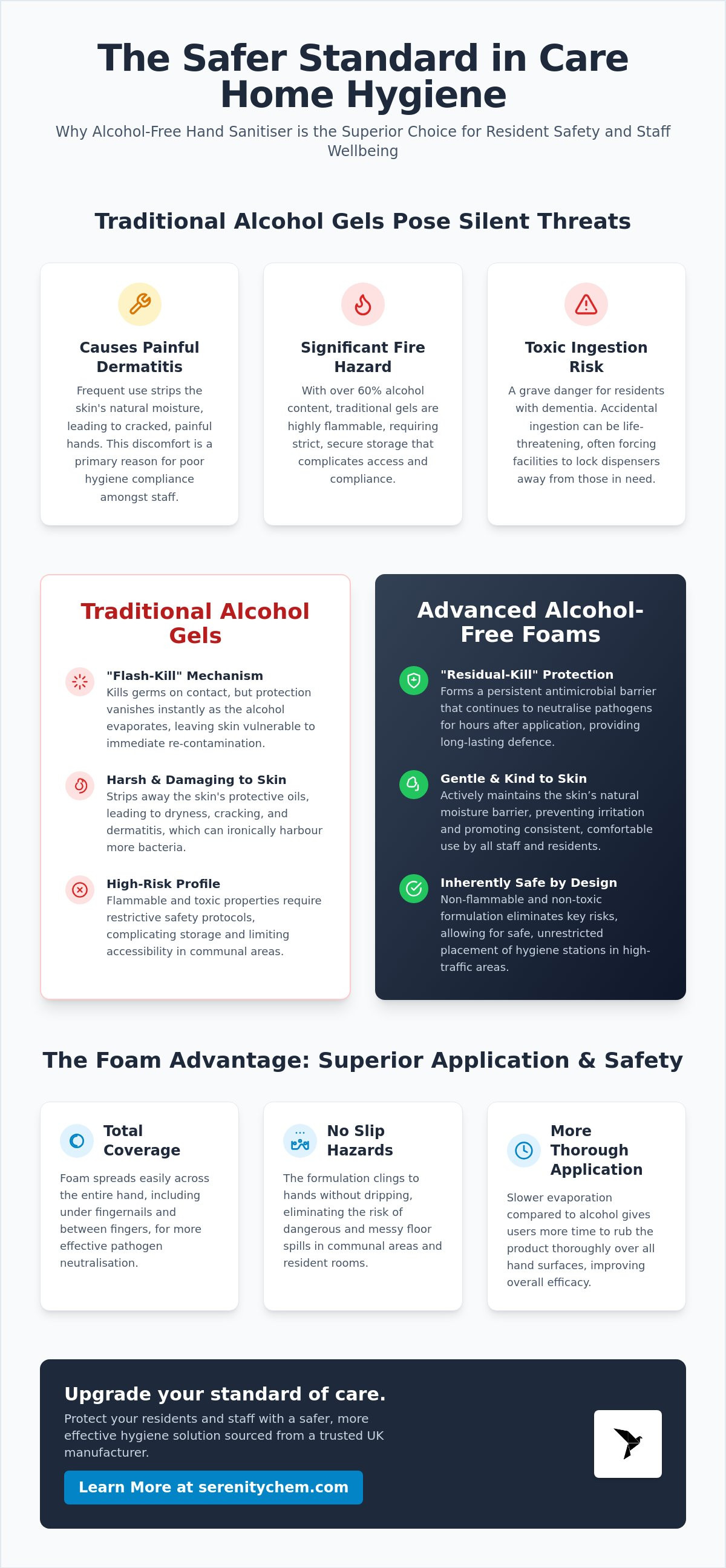
Accidental ingestion is a grave concern in facilities supporting residents with cognitive impairments or dementia. Traditional hand sanitizer often contains upwards of 60% alcohol, making it both toxic and highly flammable. If a resident ingests these gels, the consequences can be life-threatening. Switching to non-toxic, alcohol-free alternatives provides immediate peace of mind for staff. Because these products are non-flammable, you can often remove "lock-and-key" restrictions on dispensers. This makes hygiene stations more accessible in communal areas without compromising the safety of vulnerable individuals.
Protecting Skin Integrity for Staff and Residents
Frequent hand hygiene is the cornerstone of infection control, yet it often comes at a physical cost. Approximately 70% of healthcare workers don't routinely practice hand hygiene, and a primary reason is the discomfort caused by repeat alcohol exposure. Contact dermatitis is a common issue amongst care staff, leading to cracked, painful skin that can actually harbour more bacteria. Alcohol-free formulations help maintain the skin’s natural moisture barrier rather than stripping it away. This is equally vital for elderly residents. Their skin is often thin and fragile; a gentle, moisturising foam ensures they stay protected without the risk of irritation or chemical burns.
Understanding the Efficacy: How Alcohol-Free Formulations Work
The science behind alcohol free hand sanitiser for care homes relies on Quaternary Ammonium Compounds (QACs), most notably Benzalkonium Chloride. Whilst alcohol acts by dissolving the lipid membrane of a cell, QACs work by binding to the pathogen's surface and disrupting its structural integrity. This process is highly effective against "enveloped" viruses, a category that includes many common seasonal illnesses found in residential settings. Research into the Efficacy of hand sanitizer formulations indicates that these non-alcohol solutions provide a robust alternative to traditional gels in clinical environments. They offer a sophisticated approach to hygiene that prioritises long-term protection over a temporary fix.
A primary distinction between these formulations is the difference between a "flash-kill" and a "residual-kill." Alcohol provides a rapid, near-instantaneous kill, but its efficacy vanishes the moment the liquid evaporates from the skin. In contrast, alcohol-free sanitisers provide a persistent antimicrobial effect that doesn't disappear with evaporation. Benzalkonium Chloride creates a protective antimicrobial barrier on the skin that remains active for several hours after the initial application. This means the product continues to work against re-contamination long after the hands have dried, providing an essential safety net for busy environments.
The Science of Residual Protection
In a fast-paced residential environment, staff move constantly between different high-touch zones, such as resident rooms, dining areas, and medical stations. Because alcohol stops working once it's dry, hands are immediately susceptible to new pathogens upon contact with a contaminated surface. Alcohol-free sanitisers leave a microscopic "active film" on the skin. This film provides an extra layer of security for care teams who may not always have the opportunity to wash their hands between every single interaction. If you have questions about how these formulations fit into your specific facility, you can speak with our technical team for detailed guidance.
Compliance with EN 14476 and British Standards
Procurement for care homes must be guided by verified performance standards. The most critical benchmark is EN 14476, the European standard that proves a product's virucidal activity. Additionally, EN 1500 testing ensures the product is effective as a hygienic handrub in real-world conditions. These certifications aren't just labels; they're your assurance that the product will perform when it matters most. Always ensure you have access to the manufacturer’s COSHH data sheets to confirm that your alcohol free hand sanitiser for care homes meets these essential British and European safety requirements.
Alcohol vs. Alcohol-Free: A Care Home Risk Assessment
When conducting a formal risk assessment for a residential facility, the focus often lands solely on germ-killing power. However, a professional approach requires you to look at the environmental and human risks associated with the chemicals you store. Comparing traditional gels to alcohol free hand sanitiser for care homes reveals stark differences in safety profiles that go far beyond simple hygiene. Managers must weigh the clinical benefits against the logistical burdens of managing flammable, toxic substances in a communal living space.
Alcohol-based sanitisers are typically classified as Class 3 flammable liquids. In large quantities, they significantly increase the "fire load" of a building. This isn't just a theoretical concern; it dictates how and where you can store your supplies under UK health and safety regulations. Alcohol-free solutions, being water-based, carry no such risk. They allow for a more flexible and safer distribution of hygiene stations throughout the home, including areas where residents might be unsupervised.
Eliminating Fire Hazards and Flammability Risks
Switching to non-flammable alternatives simplifies your facility's logistics and compliance paperwork. When you purchase alcohol free hand sanitiser UK in bulk, you don't need the specialised fire-rated cabinets or expensive ventilation systems required for flammable liquids. This reduction in fire risk is a tangible benefit that you can present to fire safety officers and insurance providers. It's a straightforward way to lower the overall risk profile of the building without compromising on infection control.
Preventing Accidental Ingestion and Substance Misuse
In environments supporting vulnerable adults, the presence of high-percentage alcohol is a constant liability. Accidental ingestion amongst residents living with dementia is a documented risk that can lead to emergency hospital admissions. Alcohol-free formulations remove the incentive for intentional misuse and eliminate the danger of alcohol poisoning. It's a proactive safeguarding measure that protects those most at risk whilst giving staff peace of mind during their shifts.
There is also the "sting factor" to consider for your team. Care staff frequently deal with minor abrasions or "paper cuts" from manual handling and administrative tasks. Alcohol-based products cause a sharp, painful stinging sensation on broken skin, which often leads to subconscious avoidance. Alcohol-free solutions are painless on minor cuts, which encourages more frequent use and helps build a stronger hygiene culture amongst your employees. To justify the switch to stakeholders, managers should document these specific improvements:
- Reduced Fire Load: Elimination of flammable liquid storage requirements.
- Enhanced Safeguarding: Removal of ingestion risks for residents with cognitive impairments.
- Improved Compliance: Higher usage rates due to the absence of skin irritation and pain.
- Regulatory Alignment: Adherence to the 2026 updates in the Care Home Infection Prevention and Control Manual.
Best Practices for Implementing Hand Hygiene Stations
Strategically placing hygiene stations is essential for maintaining high compliance rates across a multi-floor care facility. For maximum impact, dispensers should be positioned at every entrance, outside lift doors, and within reach of nursing stations. Integrating alcohol free hand sanitiser for care homes into your facility's ultimate professional cleaning chemicals list ensures that hand hygiene is treated with the same rigour as surface disinfection.
Foam formulations offer a distinct advantage in high-traffic care centres compared to traditional gels. Gels often drip from dispensers, creating slippery patches on lino or vinyl flooring that pose a serious fall risk for residents. Foam stays on the hand, providing better coverage whilst being more cost-efficient; a single litre of foam typically provides significantly more applications than a litre of gel. This efficiency makes it the preferred choice for large-scale operations looking to balance safety with budget requirements.
To ensure staff are using the product effectively, implement this 6-step hand rubbing technique during training sessions:
- Step 1: Apply a palmful of foam to cover all surfaces of the hands.
- Step 2: Rub hands palm to palm.
- Step 3: Rub the back of each hand with the palm of the other with fingers interlaced.
- Step 4: Rub palm to palm with fingers interlaced.
- Step 5: Rub the backs of fingers to opposing palms with fingers interlocked.
- Step 6: Rub each thumb rotationally and rub fingertips into the opposite palm to ensure nails are cleaned.
Selecting the Right Dispensing Systems and Refills
Automatic touchless dispensers are the gold standard for modern infection control, as they eliminate a common touchpoint. However, manual push-button systems remain a reliable and durable alternative for lower-risk areas. To manage costs effectively, prioritise bulk refill systems over individual pump bottles. Bulk refills reduce plastic waste and lower the price per millilitre. Clear, high-contrast signage is also vital; it prompts visitors and residents to sanitise their hands, making hygiene a visible part of the home's culture.
Organising Staff Training and Hygiene Protocols
Effective use of alcohol free hand sanitiser for care homes requires education that clarifies when sanitising is appropriate. Staff should use sanitiser only on visibly clean hands to ensure maximum efficacy. If hands are soiled, traditional soap and water are required. Monitoring compliance should be a supportive process. Use "hand hygiene champions" to encourage best practices rather than focusing on punitive measures. This approach builds a principled culture of care where staff feel empowered to protect themselves and their residents. If you need assistance with planning your facility's hygiene station layout, contact our hygiene specialists for a professional consultation.
Sourcing Reliable Hygiene Solutions from Serenity Chemicals
Choosing a hygiene partner is a decision that impacts the daily safety of your residents and the health of your team. Serenity Alcohol Free Hand Sanitiser is developed as a premium, professional-grade solution specifically for high-pressure healthcare environments. As a principled expert in chemical formulation, we prioritise integrity and efficacy above all else. We don't believe in aggressive sales tactics; instead, we focus on providing a solution that is both effective and responsible. Our alcohol free hand sanitiser for care homes isn't just another product on a shelf; it's a meticulously engineered tool designed to meet the rigorous demands of modern infection control whilst remaining gentle on those who use it most.
Buying direct from a UK manufacturer provides a level of transparency and reliability that third-party marketplaces simply cannot match. When you source your supplies directly, you eliminate the uncertainty of middleman markups and inconsistent stock levels. We maintain full control over our production process, ensuring that every bottle of alcohol free hand sanitiser for care homes meets our exacting standards. This direct relationship allows us to provide the technical support and COSHH documentation you need for regulatory compliance without delay. It also ensures that your procurement spend stays within the UK economy, supporting local jobs and industry expertise.
Why UK Manufacturing Matters for Supply Chain Security
Consistency is vital for essential care supplies. By manufacturing our products within the UK, we offer stable lead times that help care home managers avoid the stress of unexpected stock shortages. This local approach also supports your facility's sustainability goals. Buying British significantly reduces the carbon footprint associated with your procurement by minimising long-distance shipping. Having a local point of contact means you can access safety data and technical advice from the people who actually formulated the product. We provide a steady, composed service that reflects our commitment to long-term trust over short-term persuasion.
Bulk Purchasing and Wholesale Benefits for Care Groups
Managing multiple sites requires a streamlined approach to logistics and budgeting. We offer volume discounts for multi-site care organisations to ensure that high hygiene standards remain affordable at scale. Our supply schedules are fully customisable, allowing you to align deliveries with your facility's specific usage patterns so you never run out of essential stock. This no-nonsense approach to supply chain management respects your time and your operational budget. We invite managers to explore our full range of specialised hygiene products to build a comprehensive cleaning protocol that prioritises safety, efficiency, and resident well-being.
Future-Proofing Your Facility’s Hygiene Protocol
Transitioning to a safer hygiene protocol is a proactive step that protects your residents, your staff, and your facility. By choosing alcohol free hand sanitiser for care homes, you move beyond simple germ-killing to a comprehensive safety strategy. As we've explored, these advanced formulations provide essential residual protection whilst eliminating the logistical burdens and fire risks associated with traditional gels. It's a choice that balances clinical excellence with a genuine commitment to the long-term well-being of your community.
Serenity Chemicals offers the reliability of products manufactured in the UK to rigorous EN 14476 standards. Our range is already trusted by leading UK healthcare and care providers because our solutions are dermatologically tested and entirely non-flammable. You don't have to compromise on efficacy to ensure a safer environment for those with cognitive impairments or to protect your team from contact dermatitis. We're ready to support your facility with transparent technical advice and dependable supply schedules to ensure you maintain the highest standards of care.
View the Serenity Alcohol Free Hand Sanitiser Range
Frequently Asked Questions
Is alcohol-free hand sanitiser as effective as alcohol gel against Norovirus?
Alcohol-free sanitisers are highly effective against Norovirus when they meet the EN 14476 standard for virucidal activity. Whilst alcohol-based gels often struggle to neutralise non-enveloped viruses like Norovirus, advanced quaternary ammonium compounds provide a robust defense. Research indicates that rigorous hand hygiene practices can reduce Norovirus outbreaks in long-term care facilities by 15%, making these formulations a vital tool for infection control.
Can alcohol-free hand sanitiser be used on sensitive skin or eczema?
Alcohol-free formulations are specifically designed to be gentle on sensitive skin and conditions such as eczema. Unlike alcohol-based gels that strip moisture and cause painful stinging on broken skin, these water-based foams help maintain the skin’s natural moisture barrier. This makes alcohol free hand sanitiser for care homes a superior choice for staff suffering from contact dermatitis or residents with fragile, elderly skin.
Does alcohol-free hand sanitiser expire or lose potency over time?
Alcohol-free hand sanitisers do have an expiry date, typically ranging from two to three years from the date of manufacture. You can find this information clearly marked on the packaging or the COSHH data sheet provided by your manufacturer. It's essential to monitor these dates because the active antimicrobial ingredients can lose their potency once the product has passed its shelf life.
Is it safe if a resident accidentally swallows alcohol-free sanitiser?
Alcohol-free sanitiser is significantly safer than alcohol-based alternatives if accidentally ingested, as it does not carry the risk of alcohol poisoning. Whilst the product is non-toxic in small amounts, you should always consult a medical professional if a resident swallows any chemical solution. Using these non-flammable formulations provides essential peace of mind in dementia care environments where the risk of accidental ingestion is a constant concern.
How much alcohol-free foam should be used per application for full protection?
You should apply enough foam to thoroughly wet both hands, which is typically one full pump or a palmful of product. The key is ensuring that all surfaces, including fingertips, thumbs, and between fingers, remain wet for at least 30 seconds during the rubbing process. This ensures the active ingredients have sufficient contact time to neutralise pathogens effectively across the entire surface of the skin.
Are alcohol-free sanitisers compliant with CQC infection control standards?
Alcohol-free sanitisers are fully compliant with CQC infection control standards provided they meet the required British and European efficacy benchmarks. As of March 2026, the Care Home Infection Prevention and Control Manual recognises both alcohol and non-alcohol based hand rubs as acceptable. Choosing alcohol free hand sanitiser for care homes that is EN 14476 certified ensures your facility remains compliant during professional inspections.
Do I need to change my dispensers if I switch from gel to alcohol-free foam?
You will usually need to update your dispensers when switching from a gel to a foam formulation. Foam sanitisers require a specific aeration pump to turn the liquid into a foam consistency, which standard gel dispensers do not possess. Professional suppliers often provide compatible touchless or manual dispensing systems that are designed specifically for the high-frequency use required in residential care settings.
What is the most effective active ingredient in alcohol-free hand sanitisers?
Benzalkonium Chloride is widely regarded as the most effective active ingredient in professional-grade alcohol-free sanitisers. It is a quaternary ammonium compound that offers a broad spectrum of antimicrobial activity against both bacteria and viruses. Its primary advantage is its residual effect, which continues to protect the skin for several hours after application, unlike alcohol which evaporates and stops working almost instantly.

Hand Sanitiser for Frequent Use: Professional UK Guide 2026
The very product you use to protect your health might be the primary cause of your skin's deterioration. While alcohol-based ...

Food Safe Antibacterial Spray UK: The Professional 2026 Hygiene Guide
Using the wrong disinfectant in a commercial kitchen isn't just a minor oversight; it's a direct threat to your Food Hygiene ...