

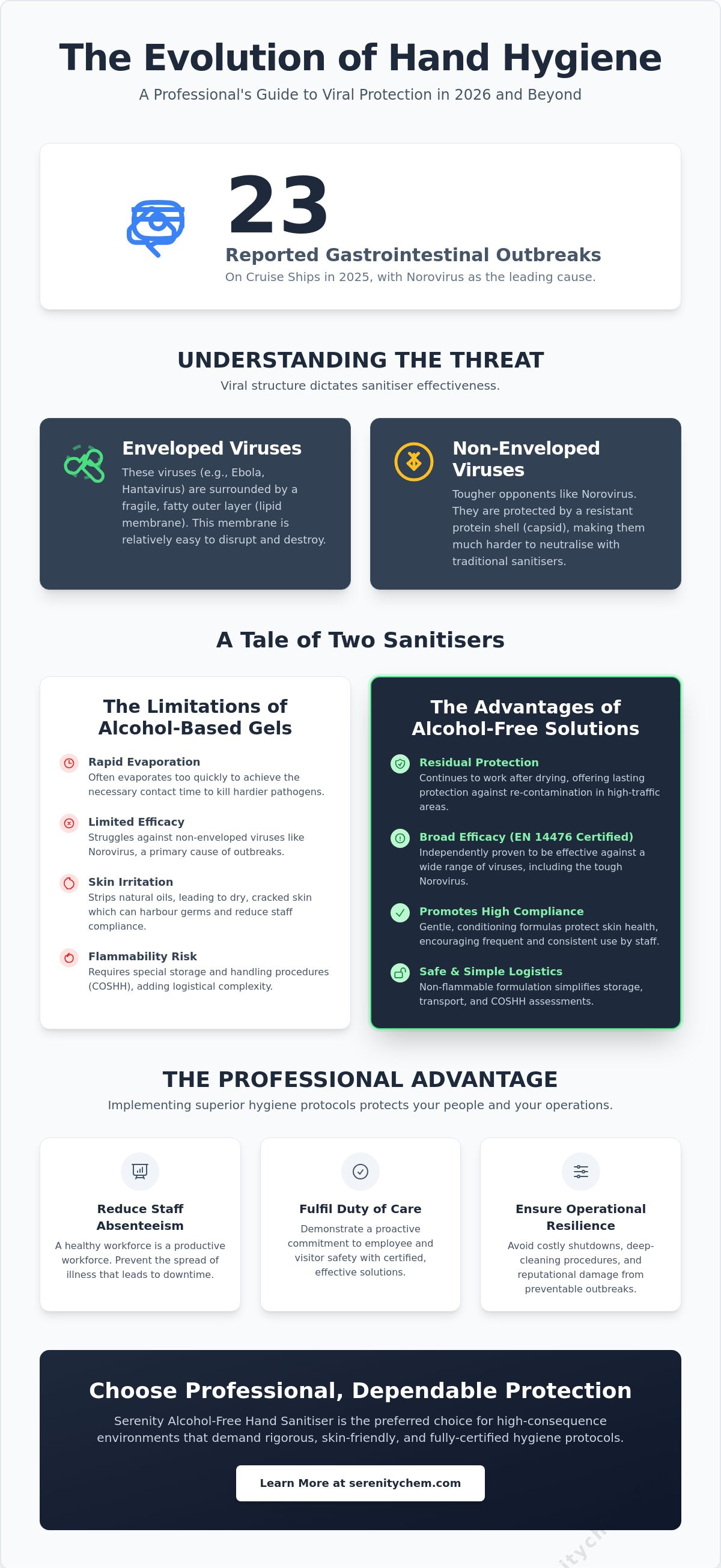
Did you know that in 2025, there were 23 reported gastrointestinal illness outbreaks on cruise ships, with norovirus identified as the most common cause? Many professionals believe that high-percentage alcohol gels are the ultimate solution for every viral threat, yet the reality is far more nuanced. We understand the constant pressure you face to keep operations running whilst managing the risk of staff sickness and the skin irritation caused by harsh chemicals. Understanding the effectiveness of alcohol free hand sanitiser and hanta virus / ebola / norovirus especially on cruise ships and the importance of hand hygiene in work environments is vital for any modern safety officer. This article provides a clear look at viral efficacy and explains why moving beyond traditional gels can improve both compliance and protection. You will learn how to choose a solution that staff will actually use, ensuring your facility remains safe and fully operational.
Key Takeaways
- Understand why professional hygiene standards in 2026 are moving towards alcohol-free solutions to ensure sustainable, long-term skin health for your workforce.
- Learn the scientific distinction between enveloped and non-enveloped viruses to identify why Norovirus remains such a persistent threat to traditional alcohol-based products.
- Recognise the critical role of alcohol free hand sanitiser and hanta virus / ebola / norovirus especially on cruise ships and the importance of hand hygiene in work environments to prevent operational shutdowns.
- Discover how implementing high-efficacy hygiene protocols can significantly reduce staff absenteeism and help organisations fulfil their legal duty of care.
- Explore why Serenity Alcohol-Free Hand Sanitiser is the preferred choice for professional environments that require rigorous, dependable protection.
The Evolution of Hand Hygiene: Why Alcohol-Free is Rising in 2026
Professional hygiene standards in 2026 have moved beyond the reactive habits of previous years. Modern protocols now prioritise a blend of technical efficacy and long-term skin health. Alcohol-free hand sanitiser, typically utilising active ingredients like benzalkonium chloride at concentrations of 0.1% to 0.13%, has emerged as a preferred choice for high-consequence environments. This transition marks a shift from "emergency" measures to sustainable, professional standards that respect the user's well-being whilst providing robust protection against pathogens.
The discussion surrounding alcohol free hand sanitiser and hanta virus / ebola / norovirus especially on cruise ships and the importance of hand hygiene in work environments has intensified as we learn more about viral structures. Whilst alcohol is a traditional staple, it isn't always the most effective or practical tool for every scenario. For a comprehensive Hand sanitizer overview, it's clear that the industry is diversifying to meet specific biological threats like the non-enveloped Norovirus, which remains famously resistant to many standard alcohol gels.
The Limitations of Alcohol-Based Sanitisers
Alcohol-based products often evaporate too quickly to neutralise certain hardy pathogens that require longer contact times. There is also the significant issue of skin integrity. Frequent application of high-percentage alcohol strips natural oils, leading to dry and cracked skin. These cracks aren't just painful; they serve as microscopic gateways for bacteria and viruses. In commercial and maritime settings, the flammability of alcohol creates additional logistical burdens, requiring specialised storage and careful management to comply with safety regulations.
The Benefits of Alcohol-Free Formulations
Solutions like Serenity Alcohol Free Hand Sanitiser offer several distinct advantages for the modern workplace. These formulations don't rely on rapid evaporation to kill germs. Instead, they provide a level of residual protection that continues to work after the product has dried on the skin. This persistence is a key advantage in high-traffic zones where re-contamination happens quickly. Because these formulas are gentle and often include skin conditioners, staff are far more likely to use them frequently. High compliance is the foundation of any successful hygiene programme. From a management perspective, being non-flammable makes them far easier to handle under COSHH assessments.
Health and safety managers now recognise that the implementation of alcohol free hand sanitiser and hanta virus / ebola / norovirus especially on cruise ships and the importance of hand hygiene in work environments is a matter of operational resilience. With Norovirus outbreaks on cruise ships reaching 23 reported cases in 2025, the need for a reliable, non-irritating solution has never been more apparent. By focusing on products that protect the skin's natural barrier while neutralising threats, organisations can maintain a healthier, more productive workforce.
Norovirus, Ebola, and Hantavirus: Understanding Viral Structures
To select the right protection, you must first understand the biology of the threat. Viruses are generally categorised into two groups: enveloped and non-enveloped. Enveloped viruses, such as Ebola and Hantavirus, possess an outer lipid membrane that is relatively easy to disrupt with the right chemical surfactants. In contrast, non-enveloped viruses like Norovirus are encased in a tough protein shell. This structural difference is why the choice of alcohol free hand sanitiser and hanta virus / ebola / norovirus especially on cruise ships and the importance of hand hygiene in work environments is so critical. Relying on a single type of disinfectant without understanding these structures can lead to significant gaps in your safety protocol.
Antiviral performance is not a matter of guesswork. It is verified through rigorous testing standards, most notably EN 14476. This European standard proves that a product can effectively reduce viral loads under specific conditions. When managing high-consequence environments, looking for this certification is essential. It provides the peace of mind that your hygiene solution has been independently validated against the very pathogens you are trying to exclude from your facility.
The Norovirus Challenge
Norovirus is a formidable opponent in high-traffic environments because it requires a remarkably low infectious dose to cause illness. A mere 18 to 1,000 viral particles can trigger an outbreak that spreads rapidly through person-to-person contact. Because it lacks a lipid envelope, standard alcohol gels often fail to penetrate its protein coating, leaving the virus active on hands. This resilience explains why Norovirus thrives in semi-enclosed spaces. If your current hygiene strategy relies solely on alcohol, you may be operating under a false sense of security. Advanced formulations are designed to address these "hardy" viruses where traditional gels fall short.
Ebola and Hantavirus: High-Consequence Pathogens
Whilst Norovirus causes widespread operational disruption, pathogens like Ebola and Hantavirus present even higher risks to human life. For instance, the case fatality rate for Hantavirus Pulmonary Syndrome in the United States remains between 20% and 38%. These enveloped viruses require a broad-spectrum approach to disinfection to prevent transmission. Following OSHA hand hygiene recommendations is a sensible starting point for any risk assessment in a professional setting. Choosing a high-quality alcohol-free hand sanitiser UK professionals trust ensures that your team is protected against a wide range of biological threats. When considering the risks of alcohol free hand sanitiser and hanta virus / ebola / norovirus especially on cruise ships and the importance of hand hygiene in work environments, it becomes clear that broad-spectrum efficacy is non-negotiable.
Effective hygiene is about precision and choosing the right tool for the specific biological challenge. If you are unsure which formulation best suits your specific risk profile, you can speak with our technical team for guidance on implementing a robust hygiene framework. Understanding the science behind the viral shell is the first step toward a safer, more resilient workplace.
Managing Outbreak Risks on Cruise Ships
Cruise ships operate as "floating cities" where thousands of individuals share dining, entertainment, and sleeping quarters in close proximity. This high density makes them uniquely vulnerable to rapid viral transmission. In March 2026, for example, the Star Princess experienced a Norovirus outbreak, highlighting the ongoing challenge for the maritime industry. The implementation of alcohol free hand sanitiser and hanta virus / ebola / norovirus especially on cruise ships and the importance of hand hygiene in work environments is not just a health measure; it's a logistical necessity. Managing these risks requires a strategic approach that passengers and crew will actually adopt.
Logistically, maintaining hygiene amongst thousands of passengers is a constant battle. Alcohol-based sanitisers present a significant fire risk in maritime environments, often requiring specialised fire-rated storage lockers and careful placement away from heat sources. Transitioning to alcohol-free foam solutions simplifies compliance with maritime fire regulations whilst providing a safer alternative for high-traffic zones. Integrating sanitiser stations at every gangway and buffet entrance ensures that hygiene becomes a frictionless part of the passenger's daily routine, helping to intercept pathogens before they reach communal areas.
Passenger Compliance and Experience
The psychology of hygiene is a vital consideration for cruise lines. Passengers often avoid traditional alcohol gels because they feel sticky or carry a harsh, clinical smell that contradicts a luxury holiday experience. Alcohol-free foam sanitisers provide a more premium feel. They dry quickly without residue and lack the overwhelming chemical scent that can linger in enclosed public spaces. By improving the user experience, cruise operators can naturally increase compliance rates. When the product feels like a benefit rather than a chore, passengers are more likely to use it frequently, which is the most effective way to break the chain of infection in a shared environment.
Staff Protection and Operational Continuity
Crew members are the backbone of the ship and are in constant contact with public surfaces, from lift buttons to cabin door handles. Protecting them is essential for operational continuity. When a single crew member becomes ill, the risk of cross-contamination in galleys or corridors increases exponentially. An outbreak doesn't just impact health; it leads to potential refunds, docking fees, and severe reputational damage. Because alcohol-free formulations like Serenity Alcohol Free Hand Sanitiser are gentler on the skin, crew members are less likely to suffer from the dermatitis that often leads to reduced hygiene compliance. Training crew on the correct application of these sanitisers is a proactive step in a broader safety framework that keeps the ship sailing on schedule.
The Importance of Hand Hygiene in Work Environments
Maintaining a healthy workforce is a fundamental requirement for any successful business. There's a direct link between rigorous hand hygiene and reduced staff absenteeism. When illness spreads through an office or warehouse, the resulting dip in productivity can be costly. Beyond the financial impact, employers have a clear duty of care under UK health and safety legislation to provide a safe working environment. Whilst the maritime sector faces unique challenges, the link between alcohol free hand sanitiser and hanta virus / ebola / norovirus especially on cruise ships and the importance of hand hygiene in work environments is equally relevant to land-based businesses. Recent data from 2026 indicates that only 76% of people report washing their hands after using public restrooms, a decline from the previous year. This trend makes the provision of effective sanitising solutions even more critical.
Fostering a "Hygiene First" culture requires more than just placing a few bottles around the building. It involves identifying high-risk zones where bacteria and viruses are most likely to spread. Shared spaces like canteens, breakrooms, and lift lobbies are primary transmission hubs. By making hand hygiene a visible and accessible part of the daily routine, organisations can significantly lower the risk of facility-wide illness. It's about protecting people in the places they naturally gather.
Workplace Compliance and COSHH
Using alcohol-free products like Serenity Alcohol Free Hand Sanitiser simplifies COSHH assessments. Because these formulations are non-flammable, they don't require the specialised storage or fire safety considerations associated with high-alcohol gels. This makes them ideal for warehouses and factories where fire risks are already a concern. Furthermore, these sanitisers reduce the risk of occupational dermatitis. Staff are more likely to comply with hygiene protocols when the product doesn't cause skin irritation or dryness. Strategic placement at entry points and near shared equipment like printers or coffee machines ensures maximum usage throughout the day.
Integrating Surface and Hand Hygiene
Effective bio-security relies on addressing the "Hand-to-Surface" loop. Pathogens are constantly transferred from hands to door handles, keyboards, and desks, then back to other users. Addressing one without the other creates a gap in your defences. In high-stakes environments like staff kitchens, using a food safe sanitiser for commercial kitchens alongside dedicated hand hygiene stations provides a dual layer of protection. This integrated approach is the foundation of a modern bio-security plan. It ensures that every touchpoint in the office or factory is managed with the same level of professional rigour.
If you're looking to upgrade your facility's safety protocols, we can help you design a bespoke hygiene framework. Contact our team today to discuss your workplace hygiene requirements and discover how our alcohol-free solutions can protect your staff.
Choosing Serenity Alcohol-Free Hand Sanitiser for Professional Protection
Selecting a hygiene partner is a significant decision for any safety-conscious organisation. When evaluating the role of alcohol free hand sanitiser and hanta virus / ebola / norovirus especially on cruise ships and the importance of hand hygiene in work environments, procurement teams require a product that balances laboratory-proven kill rates with practical usability. Serenity Alcohol Free Hand Sanitiser is engineered to meet these exacting standards. It provides a technical solution that doesn't compromise on the well-being of the end-user, ensuring that your bio-security protocols are both effective and sustainable.
Reliability is the cornerstone of professional hygiene. We understand that in high-consequence environments, there's no room for products that fail to perform against hardy pathogens. By choosing a UK-based manufacturer like Serenity Chemicals Limited, you're investing in a transparent supply chain and rigorous quality control. This principled approach ensures that every litre of sanitiser delivered to your facility meets the high standards your staff and passengers expect. We maintain a steady, purposeful rhythm in our service, focusing on long-term trust over short-term persuasion.
Superior Efficacy Against Viral Threats
Our formulation is specifically designed to address the challenges posed by non-enveloped viruses where traditional methods often fall short. Whilst earlier chapters explored the biological resilience of these threats, our focus is on providing a solution that works consistently. We've prioritised skin integrity by incorporating advanced moisturising agents to prevent the dryness and irritation that often lead to reduced compliance. For sensitive environments, we offer fragrance-free and dye-free options, ensuring the product is suitable for everyone, including those with pre-existing skin conditions or allergies.
The Serenity Advantage for Large Organisations
Managing hygiene on a large scale requires a dependable partner who understands the logistics of bulk supply. We provide cost-effective purchasing options tailored for cruise lines and national businesses, ensuring you never face a shortage during critical periods. Our support extends beyond the product itself. We offer expert guidance on implementation, helping you identify the most effective locations for sanitiser points to maximise employee and passenger usage. This service-oriented approach helps you make informed decisions regarding safety and application across diverse sites.
- Direct-from-manufacturer reliability ensures consistent chemical composition and efficacy across every batch.
- Bulk distribution networks are optimised for rapid delivery to major ports and commercial hubs.
- Comprehensive technical data sheets and safety documentation are provided to simplify your health and safety audits.
Choosing the right protection is about more than just meeting a regulatory requirement. It's about providing peace of mind to your workforce and guests. By integrating Serenity Alcohol Free Hand Sanitiser into your broader hygiene framework, you're demonstrating a commitment to safety, ethics, and professional excellence. Our team is ready to help you strengthen your defences against viral threats with solutions that work as hard as your business does.
Securing Your Facility with Advanced Hygiene Standards
Establishing a resilient hygiene framework is no longer just about meeting basic compliance; it's about protecting the long-term health of your staff and the continuity of your operations. We've seen how the structural differences in viruses dictate the effectiveness of your disinfectants. Whilst alcohol remains a common choice, the transition towards alcohol free hand sanitiser and hanta virus / ebola / norovirus especially on cruise ships and the importance of hand hygiene in work environments reflects a more sophisticated understanding of modern biological threats. By addressing the "Hand-to-Surface" loop with products that people actually want to use, you can significantly reduce the risk of facility-wide outbreaks.
Serenity Alcohol Free Hand Sanitiser provides this essential layer of protection through a formula that's tested to EN 14476 standards and manufactured right here in the UK. Our non-drying formula ensures that even the most frequent users can maintain skin integrity without irritation. It's a principled choice for any organisation that values both efficacy and the well-being of its people. We're here to help you navigate these safety requirements with confidence. Protect your environment with Serenity Alcohol-Free Hand Sanitiser. Together, we can create a safer, healthier future for your workplace.
Frequently Asked Questions
Does alcohol-free hand sanitiser really kill Norovirus?
Specific alcohol-free formulations are engineered to neutralise Norovirus by disrupting its tough protein shell. Many traditional alcohol gels fail because they cannot penetrate the structure of non-enveloped viruses. Professional products, such as Serenity Alcohol Free Hand Sanitiser, utilise advanced antimicrobial agents that provide a higher level of efficacy against these hardy pathogens. It is essential to verify that your chosen product has been independently tested against Norovirus specifically.
Is alcohol-free sanitiser effective against Ebola and Hantavirus?
Alcohol-free sanitisers are highly effective against enveloped viruses like Ebola and Hantavirus. These pathogens possess a lipid outer membrane that is easily broken down by the surfactants found in professional alcohol-free formulas. Whilst soap and water are always the first choice for decontamination, these sanitisers provide a dependable secondary defence in environments where sinks aren't immediately available, ensuring your team remains protected against high-consequence biological threats.
Why is alcohol-free sanitiser better for cruise ships?
Alcohol-free sanitisers eliminate the significant fire risks associated with storing large quantities of flammable alcohol in a maritime environment. They also improve passenger compliance because the foam is non-sticky and lacks a harsh chemical scent. This is particularly important for managing the risk of Norovirus in shared dining areas and gangways. By providing a more pleasant user experience, cruise operators can ensure that guests use the stations more frequently.
Can alcohol-free hand sanitiser cause skin irritation?
Professional alcohol-free sanitisers are designed to be much gentler on the skin than their alcohol-based counterparts. Traditional gels strip away natural oils, which often leads to painful dermatitis and cracked skin amongst frequent users. Our formulations include moisturising agents that protect the skin's natural barrier. This makes them ideal for high-frequency use in professional settings where staff must sanitise their hands multiple times throughout a single shift.
What is the difference between enveloped and non-enveloped viruses?
The distinction lies in the virus's outer coating. Enveloped viruses, such as Ebola, have a fatty lipid layer that is relatively fragile. Non-enveloped viruses, like Norovirus, are encased in a resilient protein shell. Selecting an alcohol free hand sanitiser and hanta virus / ebola / norovirus especially on cruise ships and the importance of hand hygiene in work environments requires a product capable of tackling both structures. Understanding this biology is the first step in building a robust bio-security plan.
Is Serenity hand sanitiser tested to EN 14476 standards?
Yes, Serenity Alcohol Free Hand Sanitiser is rigorously tested to EN 14476 standards to guarantee its antiviral performance. This European certification proves that the product is effective against a broad spectrum of viruses under controlled conditions. For B2B buyers in high-stakes industries, this testing provides the necessary evidence that their hygiene protocols are supported by scientific validation. It ensures that you aren't just providing a product, but a verified safety solution.
How often should staff use hand sanitiser in a work environment?
Staff should use sanitiser at every major transition point, such as entering the office, before eating in canteens, and after using shared equipment. Regular application helps break the "Hand-to-Surface" loop that allows viruses to spread through a building. When hygiene becomes a frictionless part of the daily routine, the risk of a facility-wide outbreak is greatly reduced. This proactive behaviour is a key part of an employer's legal duty of care.
Are alcohol-free sanitisers safe for children and schools?
Alcohol-free sanitisers are an excellent choice for educational settings because they are non-toxic and non-flammable. They don't pose the same risks of accidental ingestion or fire hazards that alcohol-based gels do. Furthermore, children are more likely to use a foam that doesn't sting or smell like chemicals. By making hand hygiene easy and comfortable, schools can maintain better attendance rates and reduce the seasonal spread of common viral illnesses amongst pupils.

Hand Hygiene in Food Preparation Areas: The 2026 Professional Guide
The Food Standards Agency estimates that foodborne illness costs the UK economy approximately £9 billion every year, with a s...

Sanitising Commercial Kitchen Hard Surfaces: The Professional UK Guide (2026)
Did you know that the average fine for food hygiene offences in the UK has more than tripled since 2016, now reaching over £7...