

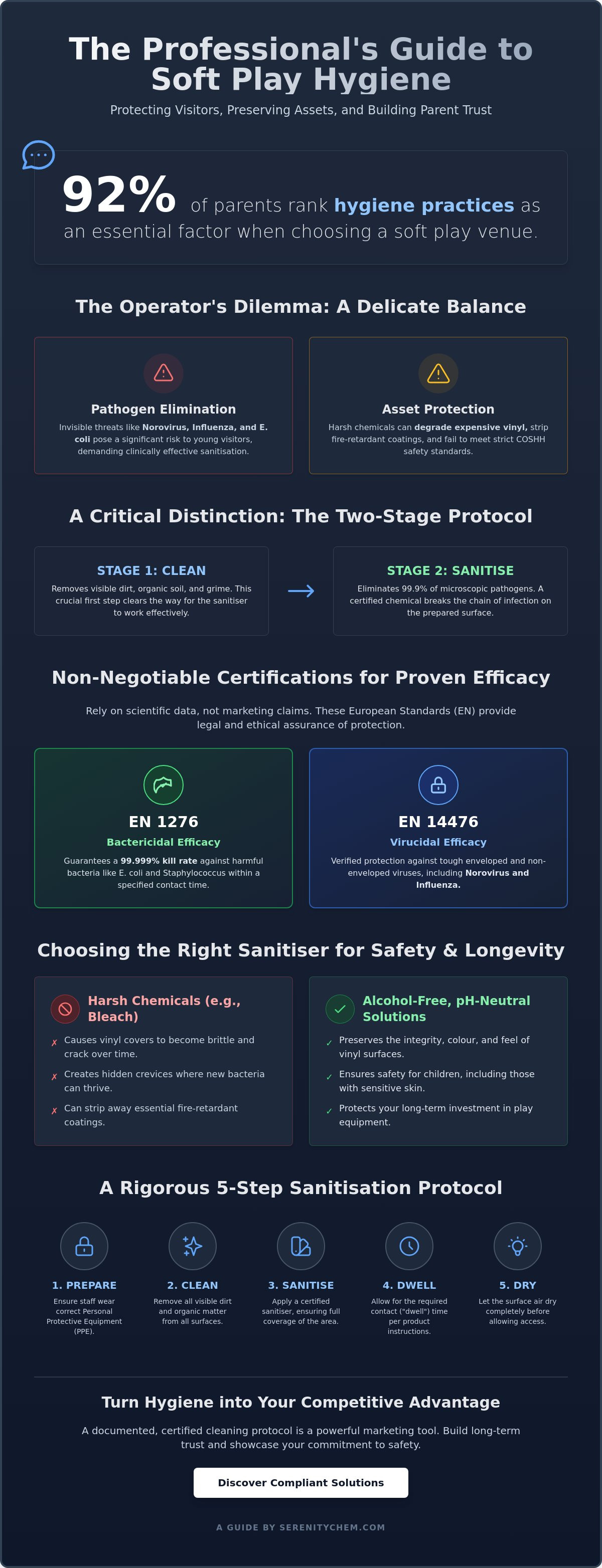
Did you know that 92% of parents now rank hygiene practices as an essential factor when choosing a soft play venue? Whilst structural safety is vital, the invisible threat of Norovirus and seasonal flu remains a primary concern for operators. You likely worry that high-strength chemicals might degrade your expensive vinyl or fail to meet strict COSHH standards. It's a difficult balance to maintain; you need a space that's clinically clean but remains gentle enough for a toddler's skin.
This guide teaches you exactly how to sanitise soft play equipment using a technical protocol that eliminates 99.9% of pathogens without causing material fatigue. By following these steps, you'll ensure your facility meets the BS EN 1176-1:2017 standards whilst significantly increasing parent confidence scores. We'll examine the shift towards alcohol-free solutions like Serenity Hard Surface Sanitiser, the impact of the 2026 surfacing updates, and a structured cleaning routine that protects both your visitors and your investment.
Key Takeaways
- Understand how to sanitise soft play equipment by addressing the specific "bio-load" challenges found in high-traffic areas like ball pits and crawl tunnels.
- Identify the critical EN 1276 and EN 14476 certifications required to ensure your cleaning solutions provide verified bactericidal and virucidal protection.
- Discover the technical advantages of alcohol-free formulas for preserving vinyl integrity and ensuring the safety of children with sensitive skin conditions.
- Implement a rigorous, documented cleaning protocol that satisfies health and safety inspections whilst protecting your staff through correct PPE usage.
- Learn how to leverage your high hygiene standards as a competitive marketing advantage to build long-term trust with parents and caregivers.
Understanding the Hygiene Challenges of Soft Play Environments
Soft play centres are unique. They aren't just playgrounds; they're high-intensity environments where children interact closely with surfaces and each other. Professional soft play sanitisation is defined as the reduction of microorganisms to a level considered safe by public health standards. It isn't merely about making things look tidy or smelling fresh. It's about breaking the chain of infection in a space where "social distancing" is non-existent for toddlers.
High-traffic areas like ball pits and crawl tunnels carry a heavy "bio-load." This term refers to the accumulation of organic matter, such as sweat, saliva, and skin cells, that serves as a breeding ground for bacteria. When considering how to sanitise soft play equipment, you must account for how these materials respond to moisture. Porous foam and vinyl covers require specific chemical behaviours. You need a solution that provides enough contact time to kill pathogens without seeping into the internal foam. If moisture penetrates the seams, it can lead to internal mould growth and structural degradation. This ruins the equipment and creates a hidden health hazard that parents can't see but children might breathe in.
The Difference Between Cleaning and Sanitising
Cleaning removes visible dirt, grease, and debris. You might use a product like Serenity Multi-Surface Cleaner for this initial stage to clear the surface of physical grime. However, cleaning alone doesn't kill microscopic pathogens. Sanitising is the second, more technical step. If you apply a sanitiser directly to a dirty surface, the organic soil creates "interference," shielding the germs from the chemical. This is why professional operators use a two-stage protocol: clean first to clear the path, then sanitise to eliminate the risk. It's a methodical approach that ensures the chemistry can actually reach the bacteria it's designed to destroy.
Common Pathogens in UK Play Centres
UK play centres face constant pressure from viral and bacterial threats. High-risk viruses such as Norovirus and Influenza are common, especially during winter months. Bacterial threats like E. coli and Staphylococcus aureus can also thrive in "dead zones." These are the hidden corners, velcro seams, and undersides of mats that are often missed during a rushed clean. Understanding infection transmission in childcare settings is vital for any operator. It's your legal responsibility under the Health and Safety at Work etc. Act 1974 to provide a safe environment. Ethically, it's about protecting the most vulnerable members of our community. Using a dedicated product like Serenity Hard Surface Sanitiser ensures these microscopic threats are neutralised effectively across all play surfaces.
Selecting the Right Chemicals: Efficacy, Safety, and EN Standards
Understanding how to sanitise soft play equipment correctly begins with technical verification rather than marketing claims. In a professional 2026 environment, "non-toxic" is a vague descriptor that offers no legal protection. Operators must instead rely on European Standards (EN) to ensure their chemical choices actually neutralise the pathogens found in high-traffic play zones. Adopting a principled approach to chemical selection not only protects the children but also ensures your facility remains compliant with the Health and Safety at Work etc. Act 1974.
Deciphering EN 14476 and EN 1276
UK businesses should prioritise products with EN 14476 and EN 1276 certifications. EN 14476 is the rigorous European standard for antiviral efficacy. For a product to claim this, it must be tested against specific "surrogate" viruses, such as Poliovirus or Norovirus, to prove it can deactivate enveloped and non-enveloped viral strains. EN 1276 is the benchmark for bactericidal activity, requiring a 99.999% kill rate within a specific timeframe. When these standards are met, you can be confident that your protocol is backed by scientific data rather than guesswork.
The Danger of Corrosive Chemicals on Vinyl and Foam
Whilst efficacy is paramount, material longevity is a significant concern for any operator. High-concentration bleach is a common mistake; it causes vinyl covers to become brittle and crack over time. These cracks then harbour the very bacteria you're trying to eliminate. Furthermore, certain harsh solvents can strip away the fire-retardant coatings required by BS EN 1176-1:2017. Choosing a pH-neutral solution, like Serenity Hard Surface Sanitiser, preserves the equipment's colour and structural integrity whilst providing high-level disinfection. This balance is essential for maintaining high parent confidence scores and reducing long-term replacement costs.
Every chemical in your cupboard must have a corresponding Safety Data Sheet (SDS). This document details the "contact time" required for the sanitiser to work. If a product requires a five-minute contact time but is wiped away after thirty seconds, the surface remains contaminated. Your COSHH (Control of Substances Hazardous to Health) assessments should clearly outline these timings for your staff. For broader guidance on maintaining a safe environment, the Public Playground Safety Handbook provides an excellent framework for integrating hygiene into your overall safety strategy. If you're unsure which EN-rated solutions best suit your specific facility, you can contact our technical team for guidance on compliant chemical selection.
Alcohol-Free vs. Traditional Sanitisers for Play Areas
Choosing the right chemistry for your facility involves more than just checking a kill rate. You have to consider how that chemical behaves once it leaves the bottle. Traditional alcohol-based sanitisers are often the default choice in many industries, yet they present specific challenges in a soft play context. When you're deciding how to sanitise soft play equipment effectively, the choice between alcohol and alcohol-free formulas can impact everything from fire safety to the health of a child's skin.
Alcohol is a "kill-on-contact" agent that works by dissolving the outer membrane of a pathogen. It's fast, but it has a significant drawback: it evaporates almost instantly. Once the alcohol has vanished from a vinyl slide or a foam block, its protective qualities vanish with it. In a high-traffic environment where children are constantly touching surfaces, this lack of residual protection is a weakness. Alcohol-free sanitisers, such as Serenity Hard Surface Sanitiser, utilise different active ingredients that don't rely on rapid evaporation. They stay active on the surface for longer, providing a more robust defence against immediate re-contamination.
Fire safety is another critical factor. Soft play centres are enclosed environments filled with foam and synthetic fabrics. Storing and using large quantities of flammable, alcohol-based liquids increases the risk profile of your building. Switching to non-flammable, alcohol-free alternatives is a principled choice that enhances the overall safety of your site without compromising on hygiene standards. It's a common myth that alcohol-free means "less powerful." In reality, these solutions meet the same EN 14476 and EN 1276 standards as their alcohol-based counterparts; they simply achieve those results through a safer, more stable chemical delivery system.
Residual Protection and "Kill-On-Contact"
The technical advantage of alcohol-free formulas lies in their use of quaternary ammonium compounds, often called "Quats." These compounds create a microscopic barrier on the equipment. Unlike alcohol, which leaves the surface vulnerable the moment it dries, these ingredients provide lasting protection. This is particularly useful for staff and visitor hygiene too. Encouraging the use of an Alcohol-Free Hand Sanitiser UK: The Professional Guide (2026) at the entrance helps reduce the initial bio-load brought into the play area.
Child Safety and Skin Sensitivity
Childhood skin is thinner and more absorbent than adult skin. Harsh chemical residues can lead to contact dermatitis, a painful irritation that is especially problematic for children with pre-existing conditions like eczema. Alcohol-free sanitisers are significantly gentler. They don't strip the skin of its natural oils, making them the preferred choice for nursery-age children. When you're researching how to sanitise soft play equipment, always look for "dermatologically tested" labels on your supplies. It's a simple step that ensures your hygiene protocol doesn't inadvertently cause physical discomfort to your youngest visitors.
A Step-by-Step Protocol for Sanitising Soft Play Equipment
Establishing a rigorous protocol is about more than aesthetics; it provides a defensive layer for your business. A documented cleaning log is essential for insurance compliance and local authority health inspections. Without a paper trail, you cannot prove due diligence in the event of an outbreak. When training staff on how to sanitise soft play equipment, emphasise that the process must be methodical. Staff should wear appropriate PPE, including nitrile gloves and protective aprons, to guard against the bio-load they'll encounter during deep-clean operations.
The golden rule of facility hygiene is the "top-to-bottom" approach. By starting at the highest point of the play frame and working downwards, you prevent pathogens and dust from falling onto already treated areas. High-touch zones, such as handrails, slide entries, and crawl-through holes, require daily sanitisation. Lower-touch areas, such as the outer netting or upper support beams, can be managed on a weekly rotation unless a specific incident occurs.
Stage 1: The Deep Clean
Begin by removing all loose debris, litter, and lost property from the structure. Once the area is clear, apply Serenity Multi-Surface Cleaner to all vinyl and plastic surfaces. This stage is designed to break down organic matter, grease, and sweat. Pay special attention to velcro seams and net joins where dust and skin cells naturally accumulate. These areas often hide the highest concentrations of bacteria and require a soft-bristled brush to agitate the cleaner into the crevices.
Stage 2: The Sanitisation Phase
Once the surfaces are clean, you can begin the technical sanitisation. Apply a certified product like Serenity Antibacterial Surface Spray or Serenity Hard Surface Sanitiser across all vinyl surfaces. It's critical that the surface remains visibly wet for the duration of the required contact time stated on the Safety Data Sheet. If the chemical dries too quickly, it won't achieve the full virucidal kill rate. After the contact time has elapsed, allow the equipment to air dry naturally or use a clean microfibre cloth to wipe away any remaining residue.
Specialist Focus: Ball Pit Sanitisation
Ball pits are notorious for harbouring pathogens, yet they are often the most neglected area. The most effective method involves using a commercial ball-washing machine. Place the balls into net bags and run them through the machine using a compatible sanitising solution. Whilst the balls are removed, you must sanitise the base floor and the internal walls of the pit using Serenity Hard Surface Sanitiser. This is the only way to ensure the entire "well" of the pit is free from contaminants. We recommend a full rotation and disinfection of ball pits at least once per month, or more frequently during peak illness seasons. If you need assistance in designing a bespoke schedule for your facility, you can contact our team for a protocol consultation to ensure you meet all safety standards.
Maintaining a Hygiene-First Culture in Your Play Centre
Maintaining a hygiene-first culture transforms sanitisation from a back-of-house task into a core business value. In an industry where 92% of parents consider hygiene practices essential when choosing a venue, your protocol is a powerful marketing tool. By mastering how to sanitise soft play equipment to a professional standard, you aren't just meeting a legal requirement; you're building a brand founded on trust and care. This commitment must be visible to your visitors from the moment they enter the building.
Training your team involves adopting a "Principled Expert" mindset. Staff should understand the science behind contact times and the specific EN standards mentioned in previous sections. When employees can confidently explain why they use alcohol-free solutions to protect children with sensitive skin, it reassures parents that your facility is managed by professionals who value safety over shortcuts. A visible "Hygiene Station" strategy, featuring Serenity Alcohol Free Hand Sanitiser at every entry and exit point, reinforces this commitment whilst reducing the initial bio-load brought into the play structure.
Communicating Safety to Parents
Transparency is key to parent confidence. We recommend displaying "Sanitised Daily" signage that explicitly references your adherence to EN 1276 and EN 14476 standards. This technical detail proves you aren't just cleaning for appearances. To show a holistic approach to safety, ensure your cafe follows the same rigorous standards by using a professional food safe sanitiser for commercial kitchens. For your digital marketing, a clear statement on your website helps set expectations: "We use independently tested, alcohol-free sanitisers to ensure a virus-free environment that is gentle on your child’s skin."
Sourcing and Stock Management
Sourcing your supplies directly from a UK chemical manufacturer provides several operational advantages. It ensures batch consistency, which is vital for maintaining the same level of efficacy across all your cleaning cycles. Buying concentrated versions of products like Serenity Hard Surface Sanitiser in bulk also offers significant economic benefits, reducing the cost-per-use whilst ensuring you never run low during peak seasons. Always ensure that all chemicals are stored in a locked, ventilated area away from public access, as part of your broader safety and COSHH management strategy. When you understand how to sanitise soft play equipment using the right tools and a disciplined culture, you protect both your small visitors and your business reputation.
Elevating Your Facility Standards for 2026
Providing a safe environment for children requires a precise balance of technical efficacy and gentle chemistry. By prioritising EN 14476 and EN 1276 certified formulations, you ensure your facility is protected against the most resilient pathogens whilst meeting current UK safety standards. Transitioning to alcohol-free solutions further protects your equipment from degradation and respects the sensitive skin of your youngest visitors. When you refine your protocol for how to sanitise soft play equipment, you're investing in both the longevity of your vinyl structures and the long-term trust of your local community.
Professional hygiene management is a continuous commitment to excellence. At Serenity, we support this mission through our UK-based manufacturing, ensuring guaranteed quality control and batch consistency for every product. Our specialist alcohol-free range is designed specifically for high-traffic, child-safe environments where performance and safety cannot be compromised. To upgrade your facility's hygiene protocol with our expert-led solutions, Explore Serenity’s Professional Range of UK-Manufactured Sanitisers. We're here to help you create a play space that is as safe as it is imaginative.
Frequently Asked Questions
How often should soft play equipment be sanitised?
High-traffic touchpoints should be sanitised daily, whilst the entire structure requires a deep clean at least once a week. Documenting these actions in a cleaning log is vital for meeting your legal obligations under the Health and Safety at Work etc. Act 1974. For larger facilities with high visitor numbers, you might increase the frequency of ball pit rotation to ensure the bio-load remains at safe levels.
Is it safe to use bleach on soft play vinyl?
You should avoid using bleach on soft play vinyl because it causes the material to become brittle and crack over time. These cracks create porous areas where bacteria can hide, making the equipment harder to sanitise in the future. Instead, use a pH-neutral solution like Serenity Hard Surface Sanitiser, which maintains the integrity of the vinyl whilst providing high-level disinfection.
What EN standards should I look for in a play area sanitiser?
Professional operators should look for EN 1276 and EN 14476 certifications. EN 1276 ensures the product is effective against bacteria, whilst EN 14476 verifies its antiviral efficacy against pathogens like Norovirus and Influenza. Always check the manufacturer's technical data sheets to confirm that the product has been tested against relevant surrogate viruses.
Can I use a fogging machine to sanitise soft play?
Fogging machines can be used as a supplementary sanitisation method, but they don't replace the need for physical cleaning. A fogger can reach high-level netting and difficult corners, but it cannot remove the physical bio-load like sweat or skin cells. You must still use a multi-surface cleaner to remove organic soil before any misting or fogging takes place.
Are alcohol-free sanitisers effective against Norovirus?
Yes, alcohol-free sanitisers are highly effective against Norovirus, provided they carry the EN 14476 certification. Formulas like Serenity Antibacterial Surface Spray use advanced chemistry to deactivate non-enveloped viruses without the risk of fire or skin irritation. This makes them a safer choice for enclosed play environments where children are constantly in contact with surfaces.
How do I clean a ball pit effectively?
To clean a ball pit effectively, you must remove all balls and run them through a commercial ball-washing machine using a certified sanitiser. Whilst the pit is empty, the base floor and internal walls should be cleaned with a degreaser and then treated with a virucidal spray. This two-stage process ensures that the entire "well" of the pit is free from hidden contaminants.
What is the best way to remove sticky residues from foam pads?
Sticky residues from spilled drinks or food are best removed using a product like Serenity Heavy Duty Degreaser. Apply the solution to a microfibre cloth and gently agitate the area to lift the residue without damaging the fire-retardant coating of the vinyl. Once the stickiness is gone, you should follow up with a sanitiser to ensure the area is clinically clean.
How long should I leave a sanitiser on the surface before wiping?
You must leave the sanitiser on the surface for the full "contact time" specified on the product's Safety Data Sheet, which is typically between one and five minutes. If you wipe the product away too early, it won't have enough time to penetrate the cell walls of the pathogens. Understanding how to sanitise soft play equipment correctly relies on following these technical timings to ensure a 99.9% kill rate.

Hand Hygiene in Food Preparation Areas: The 2026 Professional Guide
The Food Standards Agency estimates that foodborne illness costs the UK economy approximately £9 billion every year, with a s...

Sanitising Commercial Kitchen Hard Surfaces: The Professional UK Guide (2026)
Did you know that the average fine for food hygiene offences in the UK has more than tripled since 2016, now reaching over £7...