

What if the very solution you rely on for safety is actually compromising your team's skin health? For many UK professionals, the constant cycle of applying harsh chemicals leads to painful dermatitis and irritation, making daily compliance a struggle. Switching to an alcohol free hand sanitiser offers a sophisticated alternative that prioritises dermatological integrity without sacrificing efficacy. These advanced formulations provide a reliable barrier against pathogens whilst remaining gentle enough for frequent, everyday use.
It's understandable that you might worry whether a non-alcohol version can truly match the germ-killing power of traditional gels. You'll discover in this guide why these modern formulations are now the preferred choice for those seeking superior skin care and extended residual protection. We will explore how these products meet rigorous BS EN standards, remove flammability risks from the workplace, and offer a cost-effective bulk solution for maintaining a healthy, productive environment. By moving away from cheap, sticky gels, you can ensure your staff remain protected and comfortable throughout their entire shift.
Key Takeaways
- Understand why modern UK workplaces are transitioning to non-flammable, water-based solutions to eliminate fire risks whilst prioritising staff safety.
- Learn how "persistent-kill" formulations offer a layer of residual protection that traditional alcohol-based gels simply cannot provide.
- Discover how switching to an alcohol free hand sanitiser helps prevent occupational dermatitis and supports long-term skin health for your team.
- Access a tailored checklist to help facilities managers select the most effective hygiene solutions for specific sectors like healthcare, hospitality, or education.
- Gain insights into the logistical and environmental benefits of sourcing high-performance sanitisers directly from a UK manufacturer in bulk.
The Evolution of Alcohol-Free Hand Sanitiser in UK Professional Environments
In the UK professional hygiene market, the landscape is shifting rapidly. An alcohol free hand sanitiser is defined as a water-based antimicrobial solution that typically utilises Quaternary Ammonium Compounds, commonly known as "Quats," as the active agent. This evolution marks a significant departure from the high-ethanol formulations that dominated previous decades. For a broader perspective on the development of these products, this hand sanitizer overview provides useful historical context. By 2026, UK businesses have increasingly prioritised safety and skin health, moving away from flammable gels in favour of more stable, skin-friendly chemistry that doesn't compromise on efficacy.
Adopting Serenity Alcohol Free Hand Sanitiser represents a principled choice for modern organisations. It is no longer enough to simply kill germs; the solution must also be sustainable and safe for the person using it. This approach balances rigorous infection control with a commitment to long-term dermatological health. It's a technical solution designed for those who manage high-traffic environments where safety standards are non-negotiable. Reliability is essential.
Why Traditional Alcohol Gels are Losing Favour
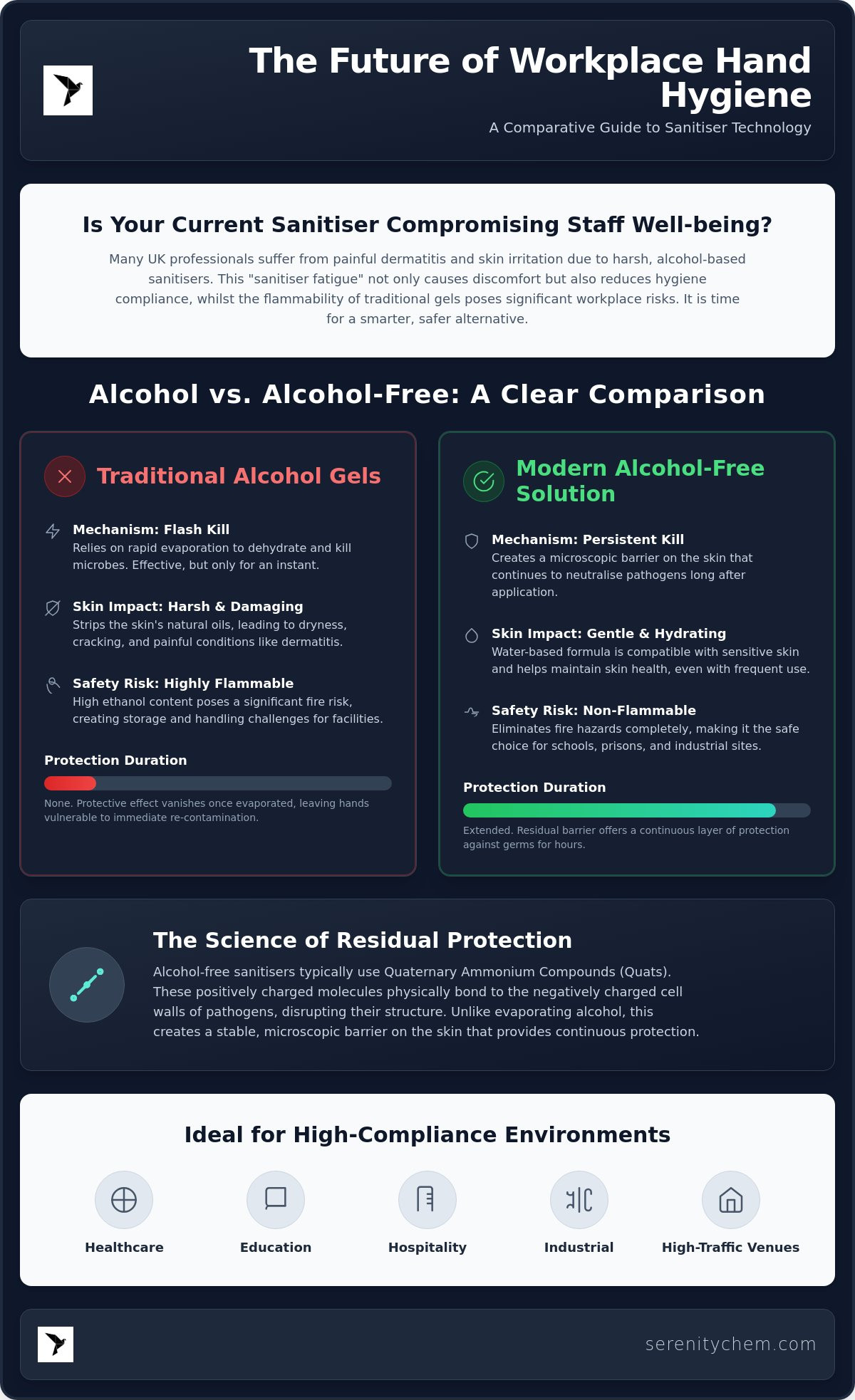
Frequent use of high-alcohol products often leads to what professionals call "sanitiser fatigue." This condition occurs when the skin's natural oils are stripped away, resulting in damaged skin barriers and painful cracking. Beyond physical discomfort, the logistics of storing bulk flammable liquids pose significant fire safety risks for facilities managers. Alcohol also relies on rapid evaporation to kill germs. Once the liquid has dried, the protective effect vanishes. This leaves hands vulnerable to re-contamination almost immediately, requiring more frequent applications and exacerbating skin damage.
The Benefits of Water-Based Hygiene Solutions
Safety is a priority. Water-based solutions offer vastly improved skin hydration. They are compatible with sensitive skin conditions like eczema, making them ideal for staff members who must sanitise dozens of times per day. Because these formulations are non-flammable, they provide a much safer alternative for use in sensitive or high-risk environments such as schools, prisons, and industrial sites. The elimination of the harsh chemical odour associated with ethanol or isopropanol also makes for a more pleasant user experience. This encourages better hygiene compliance amongst staff and visitors alike. The application process becomes a comfortable part of the routine rather than a painful chore.
How Alcohol-Free Formulations Work: The Science of Residual Protection
The efficacy of an alcohol free hand sanitiser relies on a different chemical mechanism than spirit-based gels. While alcohol delivers a "flash-kill" through rapid dehydration of microbes, it evaporates almost instantly. In contrast, alcohol-free formulations typically use Benzalkonium Chloride (BAC) as the primary active ingredient. This surfactant remains on the skin, creating a microscopic barrier that continues to neutralise pathogens long after the liquid has dried. It's a method that prioritises persistent safety over temporary disinfection.
These formulations use specialised surfactants to break down the lipid envelope of certain pathogens. By disrupting this outer fatty layer, the sanitiser effectively deactivates the threat. Unlike ethanol, which is non-selective and volatile, BAC is a stable molecule that doesn't disappear into the air. This stability is why many professionals now view these water-based solutions as a more technically advanced option for daily use. If you're looking to upgrade your facility's hygiene protocols with a scientifically backed solution, you can speak with our technical team for specific advice on implementation.
Understanding Quaternary Ammonium Compounds
Quaternary Ammonium Compounds, or "Quats," have been used in clinical and food-safe environments for decades. These molecules are positively charged, which allows them to attach to the negatively charged cell walls of bacteria. Once attached, they disrupt the cell membrane, leading to the destruction of the microbe. Because they don't rely on evaporation to function, they provide a consistent level of protection that remains effective even in challenging industrial conditions. They don't strip the skin of its natural defences, which is vital for long-term health.
The Concept of Residual Antimicrobial Activity
Residual activity refers to the ability of an antimicrobial product to remain active on a surface for several hours after the initial application. This is a critical advantage in high-traffic UK environments where staff are constantly touching shared surfaces. High-quality formulations can offer up to 4 hours of persistent protection, reducing the risk of re-contamination between washes. While alcohol-based products are widely known, the CDC recommendations on hand sanitizers acknowledge that various active ingredients are suitable for maintaining hand hygiene in different contexts. For busy professionals, this lasting barrier provides peace of mind that a single application offers more than just a momentary clean.
Alcohol vs Alcohol-Free Hand Sanitiser: A Comparative Analysis for 2026
Choosing the right hygiene strategy involves more than just looking at a label. It's about understanding the trade-offs between speed, safety, and skin health. Alcohol-based products are known for their fast drying time, but they often leave a pungent scent and can cause significant skin irritation over time. An alcohol free hand sanitiser offers a different experience; it typically takes slightly longer to dry but leaves the hands feeling hydrated rather than stripped. This improved skin feel is a major factor in driving staff compliance, as people are more likely to use a product that doesn't cause discomfort.
Efficacy Standards: EN 1276 and EN 14476
EN 1276 is the benchmark for bactericidal activity in the UK. It proves that a product can kill 99.999% of bacteria within a specific timeframe, even in "dirty" conditions. For viral protection, EN 14476 is the essential standard for virucidal efficacy. It's a common misconception that only alcohol can meet these requirements. Professional-grade alcohol-free products are rigorously tested against these standards to ensure they provide robust protection in clinical, educational, and public spaces. Always check the technical datasheet to confirm these certifications.
Safety and Practicality in the Workplace
Selecting the Right Sanitiser for Your Organisations Specific Needs
Facilities managers must balance operational efficiency with a duty of care. Choosing an alcohol free hand sanitiser involves more than a simple price comparison; it requires a meticulous look at how the product fits into your specific environment. Whether you're managing a corporate office or an industrial site, the goal is to provide a solution that staff will actually use. If the product smells too strong or leaves a sticky residue, compliance rates will drop, leaving your organisation vulnerable. Reliability in your supply chain is equally vital, which is why sourcing from a UK manufacturer is often the most principled choice for long-term stability.
Before committing to a new hygiene supplier, consider this essential evaluation checklist:
- Certification: Does the product explicitly meet BS EN 1276 and EN 14476 standards?
- Dispenser Compatibility: Can the liquid or foam be used in your existing wall-mounted units, or are proprietary refills required?
- Skin Welfare: Are there added emollients to protect the skin barrier during frequent use?
- Logistics: Is the product available in bulk 5-litre containers to reduce plastic waste and cost-per-use?
Child-Safe and School-Ready Hygiene
Schools have unique safety requirements. An alcohol free hand sanitiser is the preferred choice for primary and secondary schools because it removes the danger of "hand-to-mouth" alcohol transfer in younger children. It also eliminates the risk of accidental ingestion, which is a constant concern for safeguarding leads. For a deeper look at how to protect pupils effectively, our guide on child safe hand sanitiser provides a comprehensive overview of school-specific protocols.
Healthcare and Sensitive Skin Considerations
In healthcare and high-frequency environments, staff might sanitise their hands dozens of times during a single shift. This level of repetition can be devastating for those with pre-existing skin conditions. Professional-grade formulations often include skin-soothing ingredients like aloe vera or glycerine to prevent cracking and dryness. Ensuring your team has access to the best hand sanitiser for eczema isn't just about comfort; it's a vital part of staff welfare and occupational health. When your team's hands are healthy, they're more likely to maintain the rigorous hygiene standards your facility requires.
Compatibility with your existing hardware shouldn't be overlooked. Many organisations find that switching to bulk-fill systems significantly reduces their environmental footprint whilst lowering overheads. To discuss a bespoke supply plan for your facilities, contact our support team today for expert guidance on implementation.
Sourcing High-Performance Alcohol-Free Solutions from a UK Manufacturer
Sourcing hygiene supplies shouldn't be a guessing game. When you partner with a UK manufacturer like Serenity Chemicals Limited, you gain direct access to technical expertise and a transparent supply chain. This proximity ensures that every batch of alcohol free hand sanitiser meets stringent UK safety standards, including COSHH (Control of Substances Hazardous to Health) requirements. Unlike sourcing through international distributors, buying direct eliminates the uncertainty of long-distance logistics and ensures that your facility remains stocked with compliant, high-performance solutions. It's about building a relationship with a producer who understands the specific regulatory landscape of the UK market and can provide the necessary documentation for your safety audits.
Our role as a principled expert is to guide you toward solutions that are both effective and responsible. By manufacturing locally, we reduce the carbon footprint associated with international shipping and maintain a steady supply that isn't vulnerable to global trade disruptions. This local oversight allows us to maintain a meticulous attention to detail in every formulation, ensuring that the product you receive is exactly what your staff and customers deserve. We invite you to explore our full range of professional hygiene solutions to build a comprehensive safety protocol for your organisation.
The Economic Case for Bulk Purchasing
Many organisations focus on the unit price of small 50ml bottles, but the real savings are found in large-scale refill systems. When comparing the cost-per-application, foam formulations often prove more economical than traditional gels. The aerated pump dispenses a precise, effective amount every time, which prevents the common issue of staff using excessive amounts of liquid. Moving to 5-litre or 20-litre refillable systems significantly reduces plastic waste, supporting your organisation's environmental goals whilst lowering the overall cost-per-litre. Buying direct from the source also removes middleman markups, allowing your budget to go further without compromising on the quality of the protection provided. These bulk systems are designed for high-traffic environments where efficiency is just as vital as efficacy.
Serenity Alcohol Free Hand Sanitiser: Our Commitment to Quality
The Serenity brand is built on a foundation of reliability and ethical responsibility. Every bottle of Serenity Alcohol Free Hand Sanitiser is backed by comprehensive safety documentation and technical data sheets. We don't just provide a product; we provide a verified hygiene solution that has undergone rigorous testing to ensure its efficacy against a broad spectrum of pathogens. This commitment to quality extends beyond hand hygiene. We encourage a holistic approach to facility cleanliness, which is why we also provide detailed guidance on other essential products, such as our antibacterial surface spray UK guide. By integrating these high-performance solutions into your daily routine, you can create a safer, healthier environment for everyone whilst maintaining the highest standards of professional decorum.
Elevating Workplace Safety with Advanced Hand Care
Transitioning to an alcohol free hand sanitiser is a strategic decision that balances technical efficacy with a genuine commitment to staff welfare. By prioritising "persistent-kill" formulations, your organisation can benefit from residual antimicrobial activity that remains active long after the initial application. This approach doesn't just reduce the risk of re-contamination; it actively protects the skin barrier from the damage often caused by traditional spirit-based gels. It's a move toward a more sustainable and skin-friendly hygiene culture.
Serenity Alcohol Free Hand Sanitiser is manufactured in the UK to ISO standards, ensuring consistent quality and professional reliability. Our formulations are fully compliant with EN 1276 and EN 14476, providing the high-level protection required in the most demanding professional environments. It's why our solutions are trusted by schools, healthcare facilities, and industrial centres nationwide to maintain safety without compromise. You can ensure your team remains protected whilst avoiding the logistical risks associated with flammable chemicals.
Ready to enhance your facility's hygiene standards? Browse the Serenity Alcohol-Free Hand Sanitiser range to find the right fit for your team. You can move forward with the confidence that your hygiene protocol is both effective and responsible.
Frequently Asked Questions
Is alcohol-free hand sanitiser as effective as alcohol-based gel?
Professional alcohol-free versions are just as effective at neutralising pathogens when they are tested to the same BS EN standards. While alcohol kills through rapid dehydration, these formulations use surfactants that remain on the skin to provide a persistent barrier. This makes them a technically sound choice for environments where constant re-contamination occurs throughout the day.
Does alcohol-free hand sanitiser kill viruses like the flu or norovirus?
High-quality formulations are effective against a wide range of viruses, including enveloped viruses like flu. Interestingly, an alcohol free hand sanitiser is often more effective against non-enveloped viruses like norovirus, which traditional alcohol gels can struggle to neutralise. You should always verify that the product has passed the EN 14476 test for virucidal efficacy before purchasing.
Can I use alcohol-free sanitiser if I have eczema or sensitive skin?
These products are specifically designed to be gentle and are often the preferred choice for those with eczema or sensitive skin. Because they don't contain ethanol, they won't strip away the skin's natural oils or cause the painful stinging associated with spirit-based gels. Many professional versions also include added moisturisers to support skin health during frequent daily use.
How long does alcohol-free hand sanitiser last on the hands after application?
These formulations can provide residual protection for up to 4 hours after a single application. Unlike alcohol, which stops working the moment it evaporates from the skin, the active ingredients in water-based sanitisers stay on the surface. This persistent antimicrobial activity offers a significant safety advantage for staff working in busy, high-traffic UK workplaces.
Is it safe to use alcohol-free hand sanitiser around children and pets?
It is significantly safer for use around children and pets because it removes the risk of accidental alcohol poisoning and is entirely non-flammable. This eliminates the danger of "hand-to-mouth" transfer in schools or nurseries. It also makes storage much simpler for facilities managers, as you don't need specialised fire-rated cabinets or hazardous material protocols.
What are the main active ingredients in non-alcohol hand sanitisers?
The primary active ingredient in most professional non-alcohol sanitisers is Benzalkonium Chloride (BAC). This belongs to a group of chemicals known as Quaternary Ammonium Compounds, or "Quats." These molecules are highly stable and effective at disrupting the cell walls of bacteria and the envelopes of viruses without evaporating into the air.
Does alcohol-free sanitiser meet UK hospital standards (EN 14476)?
Many professional-grade alcohol-free sanitisers meet the EN 14476 standard required for use in UK healthcare and clinical environments. This certification proves the product's efficacy against a broad spectrum of viruses. When sourcing for a hospital or care home, always request the technical data sheet to confirm the product has passed this specific European Norm.
Why does alcohol-free hand sanitiser often come as a foam rather than a gel?
Foam is the preferred delivery method because it provides better surface coverage and is more cost-effective than gel. A single foam pump spreads across the hands more evenly and uses less liquid per application, which reduces overall waste. It also dries more comfortably without leaving the sticky residue often found in cheaper, mass-produced gel formulations.

Hand Sanitiser for Frequent Use: Professional UK Guide 2026
The very product you use to protect your health might be the primary cause of your skin's deterioration. While alcohol-based ...

Food Safe Antibacterial Spray UK: The Professional 2026 Hygiene Guide
Using the wrong disinfectant in a commercial kitchen isn't just a minor oversight; it's a direct threat to your Food Hygiene ...