

If your kitchen's compliance strategy still relies on paper logs and outdated chemical labels, you're effectively inviting an enforcement notice from the Food Standards Agency. Staying ahead of the commercial kitchen cleaning regulations UK 2026 is no longer just about physical hygiene; it's about digital traceability and chemical integrity. We recognise that the fear of a surprise inspection, coupled with high staff turnover, makes these transitions feel daunting. You want to ensure your kitchen is a safe, principled environment without getting lost in technical jargon.
This guide provides a definitive roadmap to mastering the 2026 food safety laws. You'll learn exactly how to manage the 15 August 2026 GB CLP labelling updates and the mandatory shift to digital waste tracking arriving in October. We also preview the best methods for selecting compliant, high-performance chemicals like Serenity Kitchen Sanitiser and Heavy Duty Degreaser to keep your team and patrons protected. By the end of this read, you'll have the clarity required to maintain a compliant, professional kitchen that stands up to any inspection with quiet confidence.
Key Takeaways
- Understand how the Food Safety Act 1990 applies to the latest commercial kitchen cleaning regulations UK 2026 to ensure your hygiene standards meet modern inspection criteria.
- Prepare for the 15 August 2026 GB CLP deadline by updating your Safety Data Sheets and ensuring all chemical labelling reflects the new mandatory classifications.
- Align your maintenance routines with the updated BESA TR/19 standards to effectively manage grease build-up and satisfy stricter fire safety and insurance requirements.
- Transition your record-keeping to the mandatory Digital Waste Tracking Service by October 2026 to maintain a transparent, legally compliant audit trail.
- Discover how sourcing food-safe solutions like Serenity Kitchen Sanitiser from a professional UK manufacturer simplifies compliance and enhances operational efficiency.
The Foundation of UK Kitchen Hygiene: Regulations for 2026
The Food Safety Act 1990 remains the central pillar of British hospitality law, but its application has evolved significantly. In 2026, the interpretation of this legislation focuses heavily on proactive risk management rather than reactive cleaning. Environmental Health Officers (EHOs) now look for a culture of safety that permeates every level of your staff. Understanding the nuances of the commercial kitchen cleaning regulations UK 2026 is the first step in protecting your reputation and your patrons.
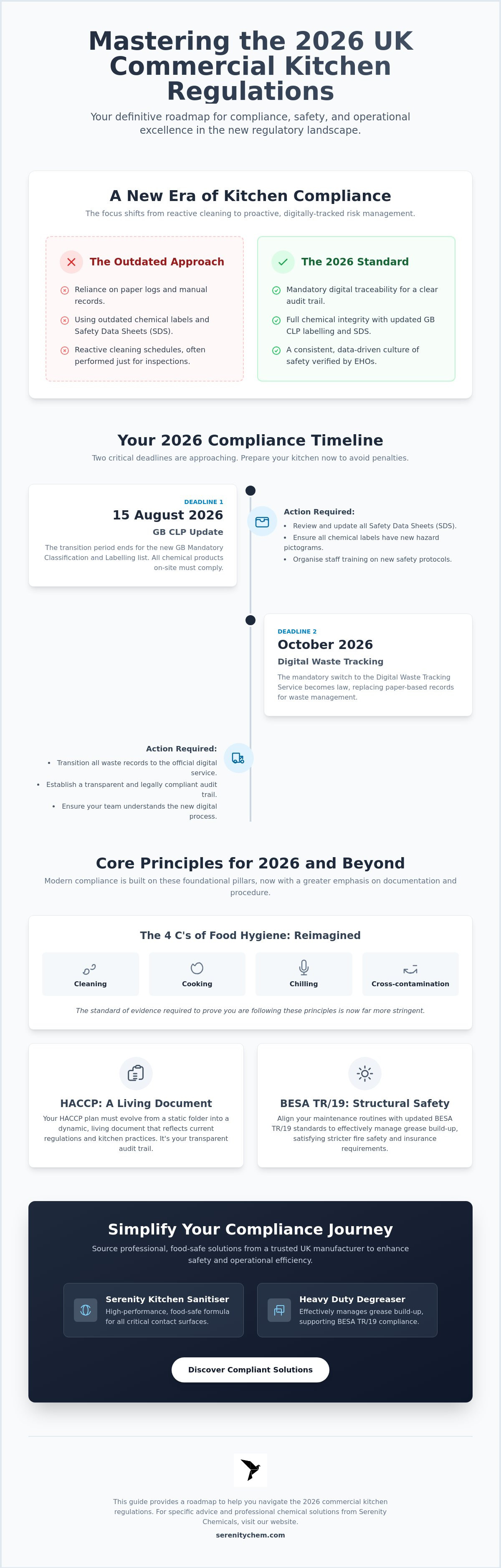
At the heart of these requirements are the '4 Cs' of food hygiene: Cleaning, Cooking, Chilling, and Cross-contamination. These principles represent The Foundation of UK Kitchen Hygiene, ensuring that every plate served is free from biological, chemical, or physical hazards. Whilst these categories haven't changed, the standard of evidence required to prove you're following them has become far more stringent. The Food Standards Agency (FSA) uses these pillars to determine your hygiene rating, which is now a primary factor in consumer choice and insurance premiums.
The 2026 Regulatory Landscape
We've seen a clear shift towards more frequent, data-driven inspections. EHOs are increasingly using digital verification tools to ensure that cleaning isn't just happening before an inspection but is a consistent daily habit. Failing to maintain a professional food safe sanitiser for commercial kitchens protocol is a common reason for rating downgrades. The legal consequences of non-compliance for UK catering businesses are substantial. Beyond the immediate threat of closure, businesses face unlimited fines and the long-term damage of a public '0' or '1' rating on the FSA website.
HACCP Principles in Modern Kitchens
Hazard Analysis and Critical Control Points (HACCP) is no longer a static folder kept on a high shelf. In a 2026 workflow, your HACCP plan must be a living document that reflects current commercial kitchen cleaning regulations UK 2026. You must identify every critical control point, from the moment raw ingredients arrive at the loading bay to the final wipe-down of the pass.
Navigating the 2026 Chemical Safety and Labelling Updates
The introduction of the updated GB Mandatory Classification and Labelling (GB MCL) list on 15 August 2026 represents a pivotal change for catering managers. It isn't just about new stickers on bottles. It's about ensuring that the substances you use are correctly classified under the latest safety data. If your current Safety Data Sheets (SDS) haven't been reviewed by mid-2026, your COSHH assessments are effectively obsolete. This misalignment can lead to failed inspections, as EHOs now look for a precise correlation between your on-site chemicals and your risk assessment documentation. Staying aligned with the commercial kitchen cleaning regulations UK 2026 requires a methodical approach to your chemical stores.
Following the Food Standards Agency (FSA) food hygiene guidance is essential for maintaining a safe environment. The new GB CLP rules require updated hazard pictograms and more specific precautionary statements. You must verify that your chemical supplier is fully prepared for these changes well before the August deadline. If they can't provide updated SDS or clearly labelled packaging, it's time to find a partner who prioritises these technical details. Staff training must also be refreshed to ensure everyone understands the new symbols and handling instructions. This proactive stance protects your team whilst ensuring you remain on the right side of the law.
August 2026: The GB CLP Deadline
The transition period that began in early 2025 concludes on 15 August 2026. After this date, any kitchen chemical that doesn't meet the revised labelling standards is non-compliant. This update introduces revised classifications for 46 specific substances commonly found in industrial cleaners. We recommend auditing your stores now. Check for the updated hazard pictograms; they are your first line of defence against accidental misuse. If you're unsure about your current inventory, speaking with a compliance specialist can clarify your requirements and help you transition smoothly.
Essential Efficacy Standards: EN 1276 and EN 14476
Selecting a compliant antibacterial surface spray UK involves checking for specific European Standards (EN) codes. EN 1276 is the non-negotiable benchmark for food-preparation areas. It proves that a sanitiser can kill 99.999% of bacteria within 5 minutes. In public-facing areas, EN 14476 is becoming equally vital, as it certifies efficacy against viruses. Alcohol-free sanitisers are becoming the preferred choice for skin-sensitive staff in 2026 because they provide high-level protection without causing the dryness or irritation often associated with traditional ethanol-based products. These choices reflect a commitment to both hygiene and staff well-being within the commercial kitchen cleaning regulations UK 2026 framework.
Structural Compliance: BESA TR/19 and Ventilation Standards
Structural compliance is often the most overlooked aspect of the commercial kitchen cleaning regulations UK 2026. Whilst your team may maintain pristine worktops, the hidden areas of your kitchen, specifically the ventilation and ductwork, pose the greatest risk to your business continuity. The publication of TR19® Air in March 2026 has formalised the requirements for ventilation hygiene, introducing mandatory post-clean reporting and a direct link to the Ventilation Hygiene Register (VHR). These standards ensure that grease accumulation is monitored with scientific precision, moving away from subjective visual inspections to a data-driven safety model.
There is a fundamental difference between the daily surface sanitisation performed by your kitchen brigade and the deep structural cleaning required by law. Surface cleaning manages immediate cross-contamination risks, but structural hygiene addresses long-term fire hazards and air quality. Adhering to these structural hygiene standards is a core requirement of the commercial kitchen cleaning regulations UK 2026, and failing to distinguish between these two types of maintenance can lead to significant legal and financial exposure.
Extraction and Ductwork Hygiene
The frequency of your ductwork cleaning is no longer a matter of choice; it's dictated by your kitchen's usage hours. For heavy-duty kitchens operating 12 to 16 hours a day, a professional clean every three months is the mandatory standard. You must ensure that any contractor you hire provides a certificate of cleanliness that references the VHR. This documentation is your primary defence during an audit. Whilst focusing on ductwork, don't ignore the foundations; sourcing from a commercial floor cleaner supplier ensures that high-traffic corridors and kitchen floors remain slip-free and hygienic during these heavy maintenance periods.
Fire Risk Assessments in 2026
In 2026, fire safety and kitchen hygiene are inextricably linked. Your kitchen deep cleaning schedule must be fully integrated into your overall Fire Safety Order compliance strategy. A critical metric in this process is the measurement of grease micron levels. If grease deposits exceed 200 microns as an average across the system, the ductwork is considered a fire hazard and requires immediate remediation. Insurance providers in 2026 have become far more stringent, often requesting proof of professional duct cleaning before renewing a policy or settling a claim. Maintaining a detailed record of these micron levels provides the principled transparency that insurers and fire inspectors expect, protecting your assets and your peace of mind.
Implementing a 2026-Compliant Cleaning Schedule
A robust cleaning programme is the backbone of operational integrity. Under the commercial kitchen cleaning regulations UK 2026, your schedule must be specific, measurable, and easily auditable. Transitioning from generic checklists to a structured, frequency-based system ensures that no corner is overlooked. This methodical approach doesn't just satisfy inspectors; it builds a culture of safety that protects your staff and your patrons alike. We recommend a tiered system that separates tasks into daily, weekly, and monthly categories to maintain a steady rhythm of hygiene.
Cross-contamination remains a primary concern for the Food Standards Agency. Implementing a strict colour-coding system for all cleaning equipment is a principled way to manage this risk. Use red for high-risk sanitary areas, green for food preparation zones, blue for general restaurant areas, and yellow for clinical or high-infection-risk zones. To further enhance staff safety, integrate alcohol free hand sanitiser UK standards into your hygiene stations. These solutions provide effective protection without the skin irritation often caused by traditional ethanol-based products, supporting your team's well-being whilst maintaining compliance.
Daily, Weekly, and Monthly Routines
Your daily routine must focus on high-touch surfaces and immediate food-prep zones. This includes sanitising door handles, light switches, and all worktops using a food-safe sanitiser. Floors should be tackled with a dedicated cleaner to remove grease and spills before they become hazards. Weekly tasks should dive deeper, focusing on refrigerator seals, shelving units, and deep-fat fryer maintenance. Monthly routines are reserved for structural elements, such as moving heavy equipment to clean the floors beneath and checking ventilation filters to ensure they align with the BESA TR/19 standards discussed earlier in this guide.
October 2026: Digital Waste Tracking
A significant shift in the commercial kitchen cleaning regulations UK 2026 arrives in October with the mandatory Digital Waste Tracking Service (DWTS). This DEFRA-led initiative replaces paper-based waste transfer notes with a real-time digital audit trail. You'll need to register your business on the DWTS portal to record the movement of all waste, including used cooking oils and empty cleaning chemical containers. This transparency ensures that hazardous materials are disposed of ethically and responsibly. Check that your chemical supplier provides packaging that is either fully recyclable or easily tracked within this new system. To ensure your business is ready for these digital milestones, you can enquire about our 2026 compliance packages today.
Serenity Chemicals: Professional Solutions for 2026 Compliance
Achieving total compliance requires more than just a rigorous schedule; it requires the right tools. Navigating the complexities of the commercial kitchen cleaning regulations UK 2026 is significantly easier when your supply chain is transparent and technically proficient. Sourcing from a cleaning products manufacturer UK like Serenity Chemicals ensures that your business possesses the regulatory agility needed to adapt to sudden legislative shifts. We take the burden of chemical classification off your shoulders by ensuring every product in our range is fully aligned with the latest ethical manufacturing standards and GB CLP requirements.
Our commitment goes beyond simple efficacy. We understand that in a high-pressure kitchen environment, efficiency is just as vital as safety. By providing direct-from-manufacturer solutions, we guarantee consistency in every batch. This reliability allows you to focus on your culinary operations, secure in the knowledge that your hygiene protocols are backed by a principled expert in chemical safety. Whether you're preparing for an October waste audit or an August labelling update, our solutions provide the peace of mind that comes from professional-grade protection.
High-Performance Kitchen Sanitisers
The Serenity Kitchen Sanitiser is a cornerstone for any business looking to streamline its hygiene routine. Our formulations are engineered to meet EN 1276 standards, providing a 30-second kill time that is essential for fast-paced prep environments. Because it's fragrance-free and food-safe, it won't taint delicate ingredients or irritate staff during frequent use. These sanitisers are available in bulk formats to support the professional cleaning chemicals list of any major catering operation. The no-rinse efficiency of this product allows your team to move quickly between tasks without compromising the commercial kitchen cleaning regulations UK 2026.
Industrial Strength Degreasing
Tackling heavy carbon build-up and stubborn grease is critical for meeting the BESA TR/19 ventilation standards we've discussed. Serenity Heavy Duty Degreaser is specifically formulated to handle the toughest deposits on extraction hoods and floor surfaces. We've developed non-caustic options that protect your staff from harsh fumes whilst effectively removing the combustible grease that insurers and fire officers look for. By maintaining a direct supply chain, we ensure that your degreasing protocols remain consistent and fully compliant with 2026 safety data requirements. This methodical approach to heavy-duty cleaning reduces fire risk and ensures your structural hygiene stands up to the most meticulous inspections.
Securing Your Kitchen's Future Compliance
Mastering the commercial kitchen cleaning regulations UK 2026 is a commitment to both safety and professional integrity. By prioritising digital waste tracking and updating your chemical labelling before the August and October deadlines, you're doing more than just avoiding fines. You're building a transparent, resilient business that earns the trust of Environmental Health Officers and patrons alike. Success in this new landscape depends on the twin pillars of structural hygiene and precise chemical efficacy.
Our UK-based manufacturing facility ensures that every solution we provide is ready for the GB CLP 2026 transition today. With formulations rigorously tested to EN 1276 and EN 14476 standards, we remain the trusted partner for leading UK hospitality and catering providers. We're ready to help you navigate these technical shifts with quiet confidence and meticulous care. Explore our 2026-compliant range of Serenity Kitchen Sanitisers to secure your facility's hygiene rating. With the right roadmap and professional-grade tools, maintaining a safe, principled kitchen is well within your reach.
Frequently Asked Questions
How often must a commercial kitchen undergo a professional deep clean in 2026?
Professional deep cleaning frequency is determined by your kitchen's daily usage hours. Heavy-use kitchens operating 12 to 16 hours a day require a professional clean every three months. Medium-use kitchens operating 6 to 12 hours require six-monthly intervals, whilst light-use facilities need an annual deep clean. These frequencies are essential for maintaining compliance with the latest BESA TR/19 standards and ensuring fire safety integrity across your ductwork and extraction systems.
What are the new GB CLP labelling requirements for 2026?
The mandatory deadline for the updated GB Mandatory Classification and Labelling (GB MCL) list is 15 August 2026. This update introduces revised classifications for 46 substances commonly found in industrial cleaners. Your chemical labels must now feature updated hazard pictograms and more precise precautionary statements. It's your responsibility to ensure that every product in your store, from floor cleaners to sanitisers, reflects these new safety standards to avoid inspection failures.
Is the October 2026 Digital Waste Tracking mandatory for all restaurants?
Yes, the Digital Waste Tracking Service (DWTS) becomes mandatory for all businesses in England, Wales, and Northern Ireland in October 2026. This regulation requires you to digitally record the disposal of all waste, including used cooking oils and empty cleaning chemical containers. This shift from paper transfer notes to a digital audit trail is a core part of the commercial kitchen cleaning regulations UK 2026, aimed at improving environmental transparency.
What EN standards should kitchen sanitisers meet for UK compliance?
Kitchen sanitisers must meet the EN 1276 standard to prove they can kill 99.999% of bacteria within a specific contact time, usually 30 seconds to 5 minutes. For public-facing areas or high-traffic zones, we also recommend products tested to EN 14476 for antiviral efficacy. Using products like Serenity Kitchen Sanitiser ensures that your hygiene protocols are backed by these non-negotiable European Standards, providing the principled protection your business requires.
Can I use alcohol-based sanitisers in a professional food prep area?
Whilst alcohol-based sanitisers are permitted, many kitchens are switching to alcohol-free alternatives like Serenity Alcohol Free Hand Sanitiser in 2026. These solutions eliminate the flammability risks associated with high-ethanol products in hot kitchen environments. They're also much kinder to the skin, preventing the dryness and irritation that often lead to poor hygiene compliance amongst staff. Choosing alcohol-free options demonstrates a commitment to both safety and team well-being.
What happens if my business fails a 2026 FSA hygiene inspection?
Failing an inspection can result in a low hygiene rating of 0 to 2, which must be displayed publicly in most parts of the UK. You may receive an improvement notice or, in cases of imminent health risk, an emergency prohibition order that closes your kitchen immediately. Under the commercial kitchen cleaning regulations UK 2026, inspectors focus heavily on your digital audit trails and chemical labelling. A failure can lead to unlimited fines and significant reputational damage.
How does BESA TR/19 affect my kitchen cleaning schedule?
BESA TR/19 dictates the mandatory cleaning intervals for your ventilation and extraction systems to prevent grease-related fires. The March 2026 update, TR19® Air, requires you to maintain a detailed log of grease micron levels and provide post-clean reports to the Ventilation Hygiene Register. Your cleaning schedule must integrate these professional deep cleans with your daily maintenance to satisfy insurance providers and fire safety officers who now require digital proof of compliance.
Do I need to update my COSHH assessments for the 2026 regulations?
You must update all COSHH assessments by 15 August 2026 to align with the new GB CLP classifications. This involves reviewing the updated Safety Data Sheets (SDS) for every chemical you use and adjusting your risk assessments accordingly. If your assessments don't reflect the new hazard pictograms and handling instructions, they'll be considered obsolete during an inspection. This update ensures your staff are protected and that your safety documentation remains accurate and legally sound.

Hand Sanitiser for Frequent Use: Professional UK Guide 2026
The very product you use to protect your health might be the primary cause of your skin's deterioration. While alcohol-based ...

Food Safe Antibacterial Spray UK: The Professional 2026 Hygiene Guide
Using the wrong disinfectant in a commercial kitchen isn't just a minor oversight; it's a direct threat to your Food Hygiene ...