

A stained office carpet isn't just an eyesore; it's a silent drain on your company’s professional reputation and bottom line. Most facility managers know the frustration of a coffee spill that seems to vanish, only to reappear as a ghost-like smudge a week later. You want a pristine workplace but understandably fear that the wrong chemical might bleach the fibres or cause permanent damage. Learning how to remove tough stains from office carpets doesn't have to be a gamble involving expensive external contractors or risky trial and error.
We believe that professional results should be achievable through reliable, ethical practices that protect your investment. By mastering the science of professional carpet care, you can maintain a clean, odour-free environment whilst significantly extending the lifespan of your commercial flooring. This guide provides a methodical, step-by-step approach to identifying specific stain types, selecting safe surfactants, and applying extraction techniques that ensure stubborn marks stay gone for good. You'll gain the confidence to handle maintenance in-house, ensuring your office remains a welcoming and healthy space for every client and employee.
Key Takeaways
- Understand the chemical science behind surfactants and pH balance to break down stubborn spills without damaging synthetic office fibres.
- Learn the essential "blot, don't rub" technique and why thorough dry-soil removal is the critical first step in any professional cleaning process.
- Discover how to remove tough stains from office carpets by transitioning from reactive spot-cleaning to a strategic, zone-based maintenance schedule.
- Evaluate the long-term cost and safety benefits of using professional-grade concentrates like Serenity Carpet Shampoo over standard domestic alternatives.
- Master the professional "Zone" approach to prioritise high-traffic entrances and extend the overall operational lifespan of your workplace flooring.
Understanding the Challenge of Office Carpet Stains
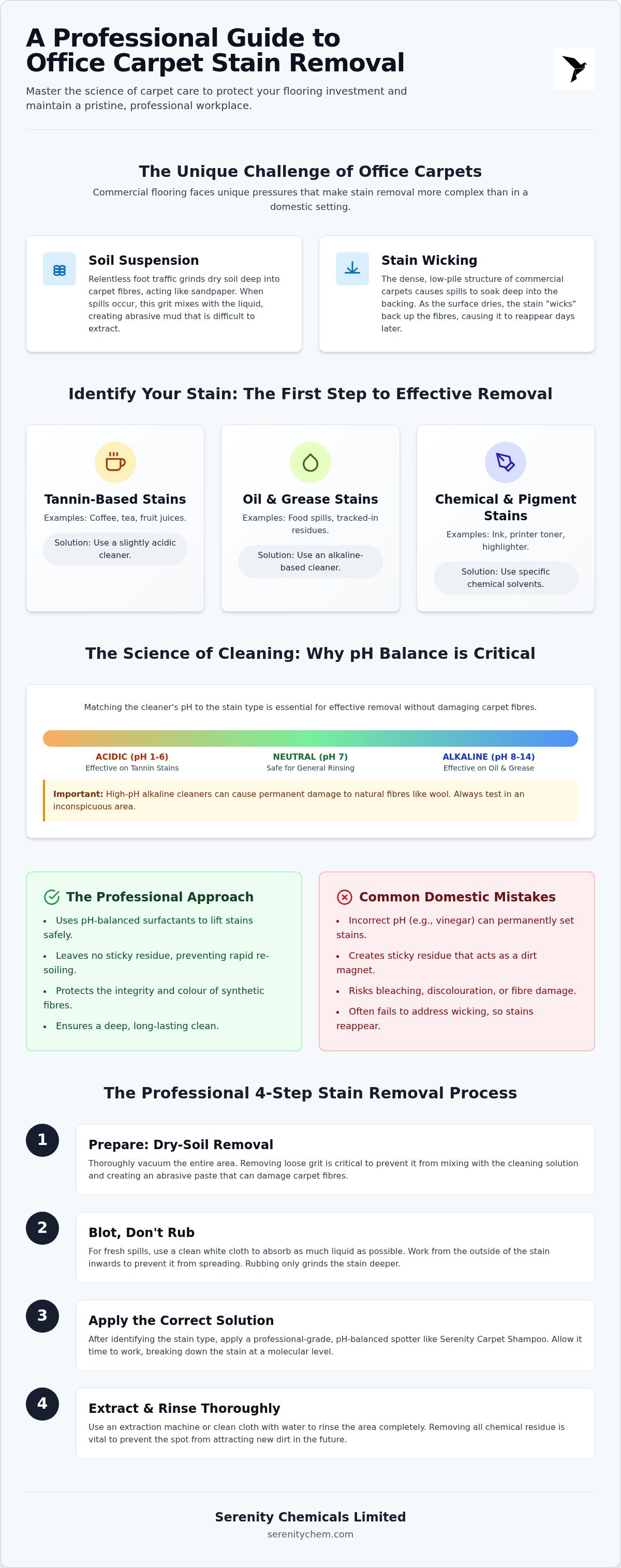
In busy UK office environments, carpets endure constant pressure from relentless foot traffic. This creates a phenomenon known as soil suspension, where dry particles are ground into the fibres, acting like sandpaper. When a liquid spill occurs, it mixes with this existing grit, making it far harder to extract than a simple spill at home. Effective maintenance requires a shift in perspective; you aren't just washing a surface, you're managing complex chemical interactions within a high-pressure environment.
Commercial flooring usually consists of low-pile synthetic fibres or carpet tiles. Unlike domestic plush carpets, these are designed for extreme durability, but their dense structure traps liquids quickly. This density often leads to "wicking," where a spill travels deep into the backing or subfloor. Even if the surface looks clean after a quick scrub, the liquid can travel back up the fibre as it dries, causing "shadow" stains to reappear. Understanding various carpet cleaning methods is essential for preventing these recurring marks and protecting your flooring investment.
The state of your flooring directly influences how clients perceive your business integrity. A stained carpet suggests a lack of attention to detail, which can erode trust before a meeting even begins. For employees, a well-maintained workspace fosters a sense of pride and professional safety. Neglected carpets don't just look poor; they can trap allergens and odours that affect the overall health of the office atmosphere.
Common Office Stain Profiles
Identifying the substance is the first step in learning how to remove tough stains from office carpets. Most workplace marks fall into three categories:
- Tannin-based stains: Coffee, tea, and fruit juices are slightly acidic and can dye synthetic fibres if they aren't neutralised promptly.
- Oil and grease: These often stem from lunchtime food spills or industrial residues tracked in from the street on footwear.
- Chemical and pigment stains: Ink leaks, printer toner, and highlighter fluid require specific solvents to prevent the pigment from spreading across the tile.
Why Domestic Remedies Often Fail in the Workplace
Many facility managers reach for kitchen cupboard staples when a spill happens, but these often exacerbate the problem. High-heat treatments or incorrect pH levels can permanently "set" a stain into the synthetic fibre. Common suggestions like vinegar or baking soda often leave behind a sticky residue that is difficult to rinse out. This residue acts as a magnet for new dirt, leading to rapid re-soiling in that exact spot. For consistent and safe results, it is better to consult a professional cleaning chemicals list. Using specifically formulated products ensures the chemical balance remains safe for the carpet's material whilst delivering the power needed for commercial-grade extraction.
The Science of Professional Stain Extraction
Professional stain removal relies on more than just physical effort. It requires an understanding of how surfactants reduce the surface tension of water, allowing the cleaning solution to penetrate deep into the carpet pile. This process is the foundation of how to remove tough stains from office carpets without causing surface abrasion. Whilst domestic cleaning often focuses on the visible surface, professional chemistry targets the molecular bond between the soil and the fibre.
pH balance in carpet care refers to the measure of acidity or alkalinity in a cleaning solution, which must be carefully managed to prevent damaging the physical structure of synthetic fibres. In a professional maintenance programme, we distinguish between "spotting", which is the immediate treatment of a specific spill, and "extraction", which involves a deep, restorative clean of the entire floor area. Serenity Carpet Shampoo is engineered to bridge this gap, using advanced surfactants to lift particles through chemical attraction rather than aggressive mechanical scrubbing.
PH Levels and Fibre Integrity
The chemical nature of the stain determines the required pH of the cleaner. Tannin-based marks, such as tea or coffee, generally respond best to slightly acidic treatments. Conversely, oily residues and food greases require alkaline solutions to break down lipid bonds. It's vital to exercise caution in executive suites where natural wool blends are common; high-pH alkaline cleaners can cause permanent discolouration or fibre degradation. Adhering to the maintenance standards suggested by the Carpet and Rug Institute helps ensure these delicate materials remain protected. Once a stain is removed, the carpet must be returned to a neutral pH state to prevent it from attracting new soil through a process called resoiling.
Surfactants and Soil Suspension
Surfactants are the workhorses of professional cleaning. They encapsulate dirt particles, suspending them in a liquid solution so they can be easily vacuumed away. For commercial environments, low-foam formulations are essential. Excessive foam can clog extraction machines and leave behind a sticky film that traps more dust. Safety is equally paramount. Every professional user should be familiar with the COSHH information for cleaning chemicals to ensure that surfactants are handled responsibly. If you have specific questions about chemical compatibility for your flooring, you can speak with our team for professional advice. By prioritising chemistry over friction, you protect the integrity of the carpet whilst achieving a deeper level of hygiene.
Commercial Solutions vs. Domestic Hacks: Why Quality Matters
Choosing the right chemistry is a matter of long-term asset management rather than just immediate aesthetics. Whilst domestic "hacks" like salt or soda water are often touted as quick fixes, they rarely meet the rigorous demands of a professional workplace. Salt, for instance, is highly abrasive and notoriously difficult to fully extract from a dense commercial weave, which can lead to premature fibre wear. When considering how to remove tough stains from office carpets, the focus should remain on efficacy and the total cost of ownership. Professional concentrates offer a significantly lower cost-per-use than supermarket alternatives because they are designed to be diluted precisely for the specific level of soiling.
Sourcing directly from a reputable cleaning products manufacturer UK ensures you're using proprietary formulations that meet strict performance criteria. These professional-grade solutions often include advanced polymer technology. Unlike basic soaps that leave a sticky film, these polymers encapsulate soil and dry into a brittle crystal that is easily vacuumed away. This prevents the rapid re-soiling often seen after using domestic detergents. Following IICRC standards for maintenance ensures that your cleaning regime aligns with global best practices, preserving both the appearance and the structural integrity of your flooring investment.
The Myth of the "Natural" Cleaner
The term "natural" is frequently used to imply safety, yet many "chemical-free" remedies are simply ineffective against industrial-grade oil, grease, or printer ink. Professional chemistry, like that found in Serenity Carpet Shampoo, is engineered to balance high performance with a responsible safety profile. By using concentrated solutions, businesses also reduce their environmental footprint. Fewer plastic bottles are transported and discarded, making it a more sustainable choice for large-scale facility management than purchasing multiple ready-to-use domestic sprayers that lack the necessary surfactant power.
Equipment Compatibility
Professional-grade extraction machines are precision tools that require specific chemical compatibility to function correctly. Domestic detergents often produce excessive foam that can overheat vacuum motors or cause pump failure. It's essential to use low-foam products that ensure residue-free drying, especially in high-traffic corridors where damp spots can become slip hazards. Consulting a reliable commercial floor cleaner supplier helps you match the chemistry to your specific machinery. This synergy ensures the longevity of your equipment whilst maintaining the highest hygiene standards across your facility.
Step-by-Step Guide to Removing Common Office Stains
Before applying any liquid solution, the first step in how to remove tough stains from office carpets is the removal of dry soil. In a high-traffic office, carpets act as a filter for dust, grit, and skin cells. If you apply a cleaning agent directly to a spill without vacuuming first, you risk creating a "mud" that is much harder to extract. Use a high-efficiency vacuum to clear the area around the spill, ensuring no loose debris can be pushed deeper into the weave during the treatment process.
The "Blot, Don't Rub" rule is the most critical technical instruction for any facility team. Rubbing a stain causes friction that generates heat, which can permanently bond the pigment to the synthetic fibres. It also distorts the carpet pile, leaving a permanent fuzzy texture that identifies where the spill occurred. Instead, use a clean, white microfibre cloth to blot from the outside of the stain toward the centre. This prevents the liquid from spreading and protects the physical integrity of the carpet tiles.
Once the area is prepared, apply Serenity Carpet Shampoo at the recommended dilution ratio. Using too much concentrate won't make the process faster; instead, it leaves behind a chemical residue that attracts dirt. After the shampoo has encapsulated the soil, the extraction phase must follow. Use a professional extraction machine or a clean damp cloth with fresh water to rinse the area. This neutralises the pH and ensures no active surfactants remain in the pile, which is a step many domestic guides overlook.
Tackling the "Big Three": Coffee, Ink, and Grease
In the workplace, three specific types of spills cause the most permanent damage. For coffee and tea, always use cool water. Hot water can set the tannins permanently into the fibre. When dealing with printer toner or ink, avoid liquid for as long as possible. Toner is a dry powder; vacuuming it with a HEPA-filtered machine before it gets wet is the most effective way to prevent pigment bleeding. For grease and food oils, our professional-grade surfactants emulsify the lipids, allowing them to be lifted away without leaving an oily shadow. If you encounter an unusual spill or heavy adhesive residue, you can contact our technical team for specific guidance.
Post-Stain Care and Drying
Rapid drying is essential to prevent "browning," a process where deep-seated soil wicks to the surface as the carpet dries. Use air movers or ensure the room is well-ventilated to keep the drying time as short as possible. Once the area is dry, gently brush the pile with a soft-bristled brush to restore the carpet's professional texture. If multiple spots appear across a large area, it's time to escalate from spot cleaning to a full-room extraction to maintain a uniform appearance and prevent the "clean spot" effect that occurs when only one small area is treated.
Implementing a Professional Carpet Maintenance Strategy
Successful facility management relies on moving away from reactive "firefighting" when spills occur. Whilst knowing how to remove tough stains from office carpets is essential, a proactive maintenance schedule prevents soil from becoming deeply embedded in the first place. By the time a carpet looks dirty, damage to the fibres has already begun. A structured programme ensures that high-traffic areas receive the attention they need before permanent wear patterns develop, preserving both the aesthetic and the structural integrity of your flooring.
A "Zone" approach is the most efficient way to organise your resources. This strategy categorises your office into three distinct areas based on footfall and soil risk. High-traffic entrances and lift lobbies are "Zone 1" and require daily vacuuming and weekly spot checks. "Zone 2" includes corridors and breakrooms, which need bi-weekly attention. Finally, "Zone 3" covers boardrooms and executive suites, where traffic is lower but the need for a pristine appearance is highest. This logical hierarchy ensures your team focuses effort where it is most needed, rather than cleaning every tile with the same frequency.
Empowering your in-house staff with the right training and tools is the final piece of the strategy. When employees understand the "blot, don't rub" rule and have immediate access to professional-grade chemistry, the likelihood of a permanent stain drops significantly. Sourcing your supplies directly from Serenity Chemicals ensures your team uses consistent, high-performance formulations designed for the specific challenges of a UK commercial environment.
The Economic Value of Carpet Care
The financial argument for a professional strategy is clear. Extending the functional lifespan of a commercial carpet by even two or three years represents a significant saving in capital expenditure. Beyond the cost of the material itself, the disruption and labour costs associated with a full carpet replacement are substantial. Maintaining a clean environment also supports employee well-being and reinforces client trust. A well-kept office signals a company that values precision, care, and professional standards, which is an intangible but vital asset for any business.
Why Serenity Carpet Shampoo is the Professional Choice
Serenity Carpet Shampoo provides a versatile solution for this comprehensive strategy. Its multi-use formula is equally effective for immediate spot-cleaning and as a concentrate for large-scale extraction machines. Buying from a UK manufacturer gives you the peace of mind that the products are rigorously tested and compliant with all safety standards. Because we operate as a specialised hygiene partner rather than just a supplier, we provide the direct support and guidance your facility team needs to maintain a healthy, odour-free workplace. This collaborative approach builds long-term trust and ensures your flooring remains a credit to your professional environment.
Secure Your Flooring Investment with Professional Care
Maintaining a pristine workplace requires more than just reactive cleaning; it demands an understanding of chemical extraction and a commitment to a structured maintenance programme. By prioritising pH-balanced solutions and mastering the "blot, don't rub" technique, you can ensure your flooring remains a credit to your business. Learning how to remove tough stains from office carpets is fundamentally about protecting your capital investment whilst fostering a healthy, professional environment for your team.
Serenity Chemicals provides the technical expertise and high-concentration professional formulas needed to achieve these results in-house. As a UK-based manufacturer trusted by facility managers nationwide, we prioritise safety and efficacy in every bottle. You don't have to navigate complex chemical standards alone. Discover the power of Serenity Carpet Shampoo for your office maintenance and take the first step toward a cleaner, more sustainable workplace. With the right strategy and professional-grade support, a spotless office is well within your reach.
Frequently Asked Questions
What is the best way to remove old, dried-in coffee stains from an office carpet?
Old coffee stains require rehydration to break the bond between the tannin and the fibre. Apply cool water to the area first, followed by a treatment of Serenity Carpet Shampoo. Blot the area from the outside in to prevent the mark from spreading. This methodical approach is the most effective way to manage how to remove tough stains from office carpets when they have been left to dry for several days.
Can I use Serenity Carpet Shampoo in a standard industrial carpet cleaning machine?
Yes, Serenity Carpet Shampoo is specifically formulated for use in both manual applications and standard industrial extraction machines. Its low-foam properties are essential for protecting vacuum motors from moisture damage whilst ensuring a thorough clean. Because it is a high-performance concentrate, it provides an efficient and cost-effective solution for facility managers. Always ensure you follow the recommended dilution ratios on the label to achieve the best results without leaving behind a sticky residue.
How do I remove printer toner from the carpet without spreading the black powder?
You must vacuum printer toner while it is still a dry powder using a high-efficiency HEPA vacuum. Never apply water or liquid cleaners to dry toner, as this will liquefy the plastic pigments and bond them permanently to the carpet fibres. If a shadow remains after thorough vacuuming, apply a small amount of Serenity Carpet Shampoo to a cloth and blot the area gently. This prevents the black powder from bleeding into the surrounding weave.
Is it safe to use professional carpet chemicals in an office with poor ventilation?
Professional chemicals are safe if they are formulated with a focus on indoor air quality and low-odour profiles. Serenity Chemicals prioritises safety and efficacy in our proprietary formulations, ensuring they are suitable for professional environments. It is still a principled practice to maintain as much airflow as possible during and after cleaning. Always consult the Safety Data Sheet (SDS) and follow COSHH guidelines to ensure the well-being of all office occupants during the cleaning process.
How long should I wait for an office carpet to dry after a deep clean?
Most commercial carpets will be dry enough for foot traffic within 4 to 6 hours. This timeframe can be shortened significantly by using industrial air movers or ensuring the building’s ventilation system is active. It is vital to wait until the fibres are completely dry before allowing staff to walk on the area. Walking on damp carpets can compress the pile and cause rapid resoiling by trapping new dirt from the soles of shoes.
Why do some carpet stains seem to reappear a few days after cleaning?
This phenomenon is known as wicking and occurs when a spill has penetrated the carpet backing or subfloor. As the surface dries, the liquid travels back up the fibres through capillary action, bringing the stain to the surface again. Understanding how to remove tough stains from office carpets involves using proper extraction techniques to pull the liquid from the base of the pile. Using a low-moisture cleaning method can also help prevent this recurring issue.
Will professional carpet shampoo damage the adhesive on carpet tiles?
Professional shampoos will not damage carpet tile adhesives if the correct dilution and extraction methods are used. The primary risk to adhesives is over-saturation, where excess water seeps between the tiles and weakens the bond with the subfloor. Serenity Carpet Shampoo is designed to be effective at low moisture levels, making it safe for bitumen-backed tiles. By using an extraction machine to remove moisture promptly, you protect the structural integrity of the flooring.
How often should a high-traffic office carpet be professionally shampooed?
High-traffic zones such as entrances and lift lobbies should be shampooed every 3 to 6 months to prevent permanent fibre damage. Lower-traffic areas like boardrooms may only require a deep clean every 12 months as part of a "Zone" maintenance strategy. Regular interim cleaning prevents the accumulation of abrasive grit that wears down the carpet pile. This proactive approach ensures a consistent professional appearance across your entire facility whilst extending the carpet's operational lifespan.

How to Prevent Cross-Contamination in a Commercial Kitchen: A Professional Guide
A single lapse in hygiene isn't just a mistake; it's a direct threat to your business's survival and your customers' health. ...

Developing a Robust Workplace Hand Hygiene Policy in the UK: A 2026 Guide
In 2025, minor illnesses and infectious diseases accounted for nearly half of the 148.8 million working days lost across the ...