

What if the very product you rely on to protect your workforce is actually driving up your insurance premiums and causing your staff to avoid hand hygiene altogether? For many UK facility managers, the "stinging cycle" of alcohol-based gels has become a persistent barrier to workplace safety. You've likely seen the impact first-hand, from the rise of occupational dermatitis amongst your team to the complex COSHH assessments required for storing flammable liquids in bulk. Investing in wholesale alcohol free hand sanitiser offers a solution that balances these operational demands without the physical or financial risks of traditional gels.
This guide provides a clear path forward by mastering the science and procurement benefits of these advanced formulations. We'll examine how modern products meet the rigorous BS EN 14476:2025 antiviral standards whilst remaining gentle enough for sensitive skin. By the end of this professional briefing, you'll understand how to reduce your warehouse fire load, ensure full regulatory compliance, and secure the long-term skin health of your employees through strategic, direct-from-manufacturer sourcing.
Key Takeaways
- Understand why BS EN 14476:2025 compliance is the gold standard for antiviral efficacy in 2026 and how it ensures your facility remains protected against pathogens.
- Learn how to significantly reduce workplace fire risks and simplify COSHH assessments by replacing flammable gels with non-combustible, water-based alternatives.
- Discover how to protect your workforce from occupational dermatitis and improve hygiene compliance by using skin-friendly formulations that preserve the skin's natural lipid barrier.
- Secure your supply chain and reduce your environmental impact by sourcing wholesale alcohol free hand sanitiser directly from a specialist UK manufacturer.
- Optimise your facility's hygiene protocols by integrating foam-based sanitisation stations into high-traffic workflows for maximum efficiency and staff participation.
The Rise of Wholesale Alcohol-Free Hand Sanitiser in the UK
The landscape of UK workplace hygiene has undergone a significant transformation. Once a niche alternative, alcohol-free formulations are now the primary choice for organisations prioritising safety and sustainability. This shift isn't merely about comfort; it's a strategic move toward advanced water-based antimicrobial solutions that offer sustained protection. For procurement managers, sourcing wholesale alcohol free hand sanitiser has become a way to address complex operational challenges that traditional gels simply cannot solve.
In 2026, we see this adoption most clearly in healthcare, education, and industrial manufacturing. These sectors share a common need: high-frequency use without the risk of skin degradation or fire hazards. By moving away from harsh, solvent-based products, these industries are protecting both their people and their premises. Modern professional standards now recognise that a sanitiser's value is measured not just by its kill rate, but by its ability to maintain the skin's natural defences over time.
The Evolution of Professional Hygiene Standards
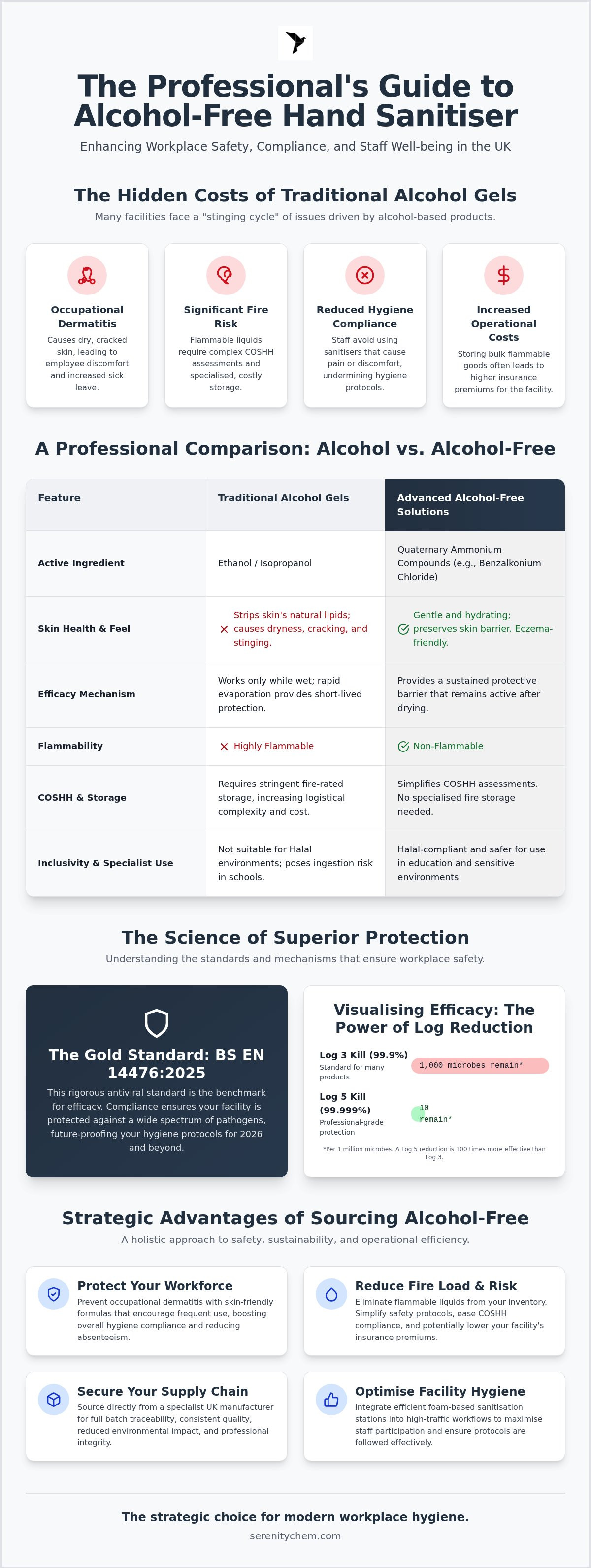
The 2020 pandemic served as a catalyst for change. While alcohol was the immediate response, prolonged use exposed critical limitations, particularly regarding skin health and short-lived efficacy. A comprehensive hand sanitizer overview highlights how the industry has pivoted toward Quaternary Ammonium Compounds (Quats). These active ingredients provide a residual barrier that stays active long after the liquid has dried. Water-based sanitisers function by physically disrupting the fatty lipid membrane of pathogens, effectively neutralising them without the need for aggressive chemical evaporation.
Why UK Businesses are Changing Their Procurement Strategy
The decision to switch is often driven by the bottom line. Occupational dermatitis is a leading cause of employee absence in hygiene-critical roles. When staff hands become cracked and sore, compliance drops and sickness rates rise. By choosing wholesale alcohol free hand sanitiser, businesses can provide an eczema-friendly solution that encourages frequent use. It's a proactive approach to staff welfare that pays dividends in reduced absence.
There's also the matter of logistical safety. Storing large quantities of flammable alcohol requires stringent COSHH compliance and often leads to higher insurance premiums. Alcohol-free alternatives are non-flammable, removing the need for specialised fire-rated storage cabinets. Additionally, these products are inherently more inclusive. They are safe for use in schools where ingestion is a concern and meet the requirements for halal-compliant environments. Sourcing directly from a UK manufacturer like Serenity Chemicals Limited ensures that these standards are met with full batch traceability and professional integrity.
The Science of Efficacy: Understanding Non-Alcohol Formulas
The efficacy of wholesale alcohol free hand sanitiser is often misunderstood by those accustomed to the sharp scent of ethanol. While alcohol works through rapid dehydration and protein denaturation, non-alcohol formulas utilise advanced chemistry to achieve comparable, and often more sustained, results. These water-based solutions act as a vehicle for complex active ingredients that remain stable on the skin. This stability is a key advantage; because the solution doesn't evaporate instantly, it allows for a more thorough interaction with the pathogens it's designed to neutralise.
In professional environments, understanding "Log reduction" is vital. A kill rate of 99.9% (Log 3) sounds impressive, but it leaves 1,000 microbes alive for every million. By contrast, a 99.999% (Log 5) reduction leaves only 10. This difference represents a significant leap in workplace safety, particularly in high-traffic or clinical settings. Following established NHS hand hygiene guidance ensures that these products are used at the right moments to maximise their protective potential. For the sanitiser to work effectively, it requires sufficient contact time, meaning the hands should remain wet with the solution for the duration specified by the manufacturer.
Active Ingredients: The Role of Benzalkonium Chloride (BAC)
Benzalkonium Chloride (BAC) serves as a robust alternative to traditional solvents. As a Quaternary Ammonium Compound, it acts as a surfactant that lowers the surface tension of the liquid, allowing it to spread evenly across the skin's ridges. Once in contact with a virus or bacterium, BAC works by disrupting the fatty lipid envelope that protects the pathogen's core. Because these formulas are non-volatile, they don't simply vanish; they provide a residual protective layer that continues to work long after the initial application has dried.
Navigating EN 14476 and BS EN 1276 Certifications
For UK procurement officers in 2026, verifying certification codes is the only way to guarantee performance. EN 14476:2025 is the essential gold standard for antiviral testing; it confirms the product is effective against enveloped viruses. Meanwhile, BS EN 1276 focuses on bactericidal efficacy, and EN 1500 evaluates the product's performance as a hygienic hand rub. When reviewing wholesale alcohol free hand sanitiser options, always check the label for these specific standards to ensure the formulation meets the rigorous requirements of British safety legislation.
If you require technical data sheets or specific compliance documentation for your facility, you can speak with our technical team for a detailed breakdown of our current certifications.
Professional Advantages: Skin Health and Workplace Safety
The transition towards wholesale alcohol free hand sanitiser is often motivated by a duty of care that extends beyond simple pathogen control. Traditional alcohol gels operate by dissolving the skin's natural lipid barrier. This biological layer is essential for retaining moisture and blocking environmental irritants. When this barrier is stripped away multiple times a day, the skin becomes vulnerable, leading to a cascade of dermatological issues that can impact workplace productivity and staff morale.
Unlike alcohol-based products that cease to be effective the moment they evaporate, Serenity formulations provide what is known as "residual efficacy." This means the active ingredients remain on the skin's surface, providing a sustained layer of protection against re-contamination for a period after the product has dried. This is a critical advantage in busy professional settings where staff touch multiple shared surfaces between applications. The delivery method also plays a vital role in efficiency. By utilising foam formats, organisations can achieve more uniform coverage across the hands whilst reducing product waste by up to 30% compared to standard liquid or gel dispensers.
Combating Occupational Dermatitis and Sensitive Skin
There is a direct correlation between high-frequency alcohol use and the prevalence of hand eczema amongst frontline staff. In sectors like healthcare or food production, where employees may sanitise their hands dozens of times per shift, the cumulative damage is significant. Serenity Alcohol Free Hand Sanitiser is specifically formulated to maintain skin hydration. It allows for repeated use without the stinging or cracking associated with ethanol. This ensures that hygiene compliance remains high because the process is no longer painful or damaging for the user.
Eliminating Fire Risks and Reducing Insurance Premiums
From a health and safety perspective, the non-flammable nature of water-based sanitisers is a major asset for any UK business. Bulk storage of flammable liquids in warehouses or office cupboards triggers strict COSHH requirements and increases a building's overall fire load. By removing these risks and opting for wholesale alcohol free hand sanitiser, facilities can often negotiate more favourable terms with insurers. This safety profile is particularly vital in schools, prisons, and mental health facilities. In these environments, the risk of accidental ingestion or the intentional misuse of flammable substances must be strictly managed. Switching to a non-combustible alternative simplifies your risk assessments and provides genuine peace of mind for facility managers.
Implementing Alcohol-Free Solutions: Best Practice for UK Business
Successful implementation of a new hygiene protocol requires a structured approach to both staff training and physical placement. It isn't enough to simply supply the product; you must ensure your team understands how to use it for maximum efficacy. Unlike alcohol gels that vanish almost instantly through evaporation, foam sanitisers require a few extra seconds of rubbing to ensure the active ingredients bond correctly with the skin. This process is what creates the residual barrier needed for sustained protection. Monitoring usage through dispenser counters or refill cycles helps you maintain compliance with national hygiene protocols and predict your future procurement needs. For a broader look at total facility maintenance, The Ultimate Professional Cleaning Chemicals List offers a comprehensive guide to essential supplies for the modern workplace.
Selecting the Right Format: Foam vs Gel vs Liquid
For high-traffic entrances, foam is consistently the most cost-effective solution. It spreads more easily across the ridges of the skin than gel, meaning a single pump provides more thorough coverage. This natural spreadability is why many organisations find they can reduce their volume of wholesale alcohol free hand sanitiser without compromising safety. When selecting your format, consider the logistics of your hardware. Non-clogging water-based formulas are ideal for automatic touch-free systems because they don't leave the sticky, obstructive residue often associated with thickened gels. A balanced procurement strategy typically involves 5L bulk refill containers for fixed stations and 50ml personal bottles for mobile staff or field engineers who work away from the office.
Strategic Placement and Dispenser Management
Effective hygiene depends on visibility and convenience. You should identify high-touch points where pathogens are most likely to spread, such as lift lobbies, shared kitchens, and hot-desking workstations. Placing dispensers in these transition zones encourages spontaneous use as employees move between different areas of the building. However, these stations must be managed carefully. Dust and grime can build up on sensors, and an empty dispenser quickly leads to a lapse in staff compliance. A reliable maintenance schedule ensures that protection remains constant across your facility. To ensure your hygiene strategy covers all bases, combine hand sanitisation with regular surface disinfection. You can read our Professional Guide to Antibacterial Surface Spray UK to learn more about maintaining high-traffic surfaces.
If you are unsure which dispenser system best suits your specific environment, contact our facility specialists for tailored advice on implementing a bulk refill strategy.
Sourcing Wholesale from a Specialist UK Manufacturer
Choosing a domestic supplier for your hygiene requirements is no longer just a matter of convenience; it's a strategic decision that impacts quality assurance and supply chain resilience. When you source wholesale alcohol free hand sanitiser directly from a UK blender like Serenity Chemicals Limited, you gain transparency that international imports often lack. Every batch is formulated, bottled, and dispatched under strict British manufacturing standards. This local oversight ensures that the product you receive today is identical in efficacy to the one you ordered six months ago, maintaining the high-performance levels required for industrial and commercial environments.
The environmental and logistical benefits of local sourcing are equally compelling. By reducing the distance your supplies travel, you significantly lower the carbon footprint of your procurement process, helping your organisation meet its sustainability and ESG targets. Sourcing within the UK also protects your facility from the volatility of international shipping delays and customs complications. Consistent availability is essential for maintaining hygiene protocols; having a dependable UK manufacturer ensures that your dispensers never sit empty due to global transit bottlenecks.
The Economic Benefits of Buying Direct
Procuring your supplies directly from the source offers clear financial advantages by removing the traditional "middleman" from the equation. This direct relationship allows for more stable pricing and more efficient bulk ordering processes. Beyond the cost savings, you benefit from direct access to technical expertise. Whether you need a specific breakdown of active ingredients or updated COSHH data sheets for your risk assessments, you can speak directly to the experts who formulated the product. For those looking to refine their supply chain further, our guide on Choosing a Cleaning Products Manufacturer in the UK provides deeper insights into selecting a partner that aligns with your professional standards.
Compliance and Traceability in Professional Hygiene
In large-scale industrial settings, batch traceability is a non-negotiable requirement for health and safety compliance. Specialist UK manufacturers provide a level of accountability that is vital for professional hygiene audits. We understand the evolving UK regulatory landscape, including the specific requirements set out by the Health and Safety Executive (HSE) and the Biocidal Products Regulation (BPR). Partnering with a manufacturer that prioritises these standards ensures that your organisation remains fully compliant as legislation updates. This principled approach to manufacturing provides the peace of mind that your workforce is protected by a product that is as responsible as it is effective.
If you are ready to secure a reliable supply of high-performance hygiene solutions for your facility, you can contact Serenity Chemicals for wholesale hand sanitiser enquiries and technical documentation.
Securing Your Facility with Advanced Hygiene Solutions
Transitioning your organisation toward a water-based hygiene protocol is a strategic investment in both operational safety and employee well-being. By opting for wholesale alcohol free hand sanitiser, you effectively eliminate the fire risks associated with bulk ethanol storage whilst providing a solution that is genuinely eczema-friendly for your frontline staff. These modern formulations don't compromise on protection; they are tested to rigorous EN 14476 antiviral standards to ensure a high-performance kill rate against pathogens.
Sourcing directly from a specialist UK manufacturer like Serenity Chemicals Limited provides the batch traceability and technical support that industrial environments demand. You can move forward with confidence, knowing your facility is equipped with products that support long-term skin health and meet the highest British standards for quality control. It's time to simplify your COSHH assessments and improve hygiene compliance across your workforce with a principled approach to sanitisation.
If you are ready to upgrade your procurement strategy, Contact Serenity Chemicals for Wholesale Alcohol-Free Hand Sanitiser to discuss your volume requirements and technical needs. We look forward to helping you create a safer, more sustainable workplace.
Frequently Asked Questions
Is alcohol-free hand sanitiser as effective as alcohol-based versions?
Yes, alcohol-free formulations are highly effective when tested to professional standards like EN 14476:2025. While alcohol-based gels kill pathogens through rapid evaporation, water-based sanitisers use active ingredients that disrupt the lipid membranes of viruses and bacteria. These formulas often provide residual protection that continues to work after the product has dried. This makes wholesale alcohol free hand sanitiser a robust choice for high-traffic professional environments requiring sustained antimicrobial defence.
Can alcohol-free hand sanitiser be used on children and sensitive skin?
Absolutely, alcohol-free formulations are significantly gentler and safer for use on children's delicate skin. Because they don't contain harsh solvents, they don't cause the painful stinging sensation often associated with alcohol gels on small cuts or abrasions. This makes them the preferred choice for primary schools and nurseries. The non-flammable nature also removes the risk of accidental fire or ingestion hazards, providing peace of mind for educators and parents alike.
Does alcohol-free hand sanitiser kill the Norovirus?
Specific formulations are effective against non-enveloped viruses like Norovirus, provided they have been tested to the BS EN 14476 standard. It's essential for facility managers to check the technical data sheets of their wholesale alcohol free hand sanitiser to verify its specific antiviral claims. Unlike alcohol, which can struggle with certain hardy viruses, advanced quaternary ammonium compounds are designed to provide a broad spectrum of activity against various pathogens in workplace settings.
What are the main active ingredients in Serenity Alcohol Free Hand Sanitiser?
Serenity Alcohol Free Hand Sanitiser utilises advanced Quaternary Ammonium Compounds, specifically Benzalkonium Chloride (BAC), as its primary active ingredient. This compound acts as a powerful surfactant and antimicrobial agent that remains stable on the skin. Our UK-manufactured formula is designed for industrial and commercial use, ensuring that the active ingredients are balanced to provide maximum protection whilst remaining kind to the skin's natural moisture levels during frequent daily applications.
How much alcohol-free foam should I use per application?
For optimal protection, you should use one to two pumps of foam per application, which is approximately 0.7ml to 1.5ml of product. The goal is to ensure that all surfaces of the hands, including the fingertips, thumbs, and between the fingers, are thoroughly wet. You must rub the hands together for at least 20 to 30 seconds until they are completely dry to allow the active ingredients to bond with the skin.
Is alcohol-free hand sanitiser halal-compliant?
Yes, alcohol-free hand sanitisers are generally considered halal-compliant because they contain no ethanol or isopropanol. This makes them an inclusive choice for diverse workplaces and religious environments where the use of alcohol is restricted. By providing a water-based alternative, organisations can ensure that all employees and visitors feel comfortable and respected whilst maintaining the highest standards of hand hygiene. Our Serenity range is formulated with these diverse professional needs in mind.
Will alcohol-free sanitiser dry out my hands like regular gel?
No, alcohol-free sanitisers are specifically designed to be non-drying and eczema-friendly. Traditional gels strip away the skin's natural oils, leading to cracking and occupational dermatitis. In contrast, water-based formulas preserve the skin's lipid barrier and often include hydrating properties. This is particularly beneficial for staff who are required to sanitise their hands multiple times per hour, as it prevents the cumulative damage and discomfort caused by repeated solvent exposure.
How should I store bulk 5L alcohol-free hand sanitiser in the workplace?
Bulk 5L containers should be stored in a cool, dry place away from direct sunlight to maintain the stability of the active ingredients. One of the primary benefits of alcohol-free products is that they are non-flammable, meaning they don't require specialised fire-rated storage cabinets. This simplifies your COSHH assessments and reduces the fire load within your warehouse or office. Always ensure that the lids are tightly sealed to prevent contamination between refill cycles.

How to Prevent Cross-Contamination in a Commercial Kitchen: A Professional Guide
A single lapse in hygiene isn't just a mistake; it's a direct threat to your business's survival and your customers' health. ...

Developing a Robust Workplace Hand Hygiene Policy in the UK: A 2026 Guide
In 2025, minor illnesses and infectious diseases accounted for nearly half of the 148.8 million working days lost across the ...