

What if a single, poorly managed chemical spill could cost your business thousands in liability and lost productivity before the floor is even dry? It's a scenario that keeps many UK workshop managers awake at night, especially with the pressure of HSE inspections and the threat of RIDDOR fines. You likely understand that a greasy floor isn't just an eyesore; it's a safety hazard that risks employee injury from slips or chemical burns. Finding the best degreaser for workshop floors UK is only half the battle; handling the transition to mandatory digital waste tracking in 2026 adds another layer of complexity to your daily operations.
This article will help you master the professional protocols for containing chemical spills whilst maintaining the highest safety standards with the best degreaser for workshop floors UK. We'll cut through the confusion regarding PPE requirements for concentrated formulas and provide a clear, repeatable safety protocol for your workplace. We'll also explore how to achieve full compliance with UK health and safety legislation, ensuring you maintain a pristine, grease-free floor with minimal downtime for your team.
Key Takeaways
- Learn the 'Evaluate and Evacuate' rule to quickly assess chemical hazards and protect your team during an emergency.
- Understand how to achieve full COSHH compliance by selecting the precise PPE required for handling industrial-strength cleaning agents.
- Master a structured 5-step response protocol, including the use of the best degreaser for workshop floors UK to ensure thorough decontamination.
- Navigate the legal requirements for hazardous waste disposal and reporting to avoid costly RIDDOR fines and HSE interventions.
- Implement proactive prevention strategies, such as proper bunding and vertical storage, to maintain a safer and more efficient workshop environment.
Immediate Actions: Assessing the Spill and Ensuring Safety
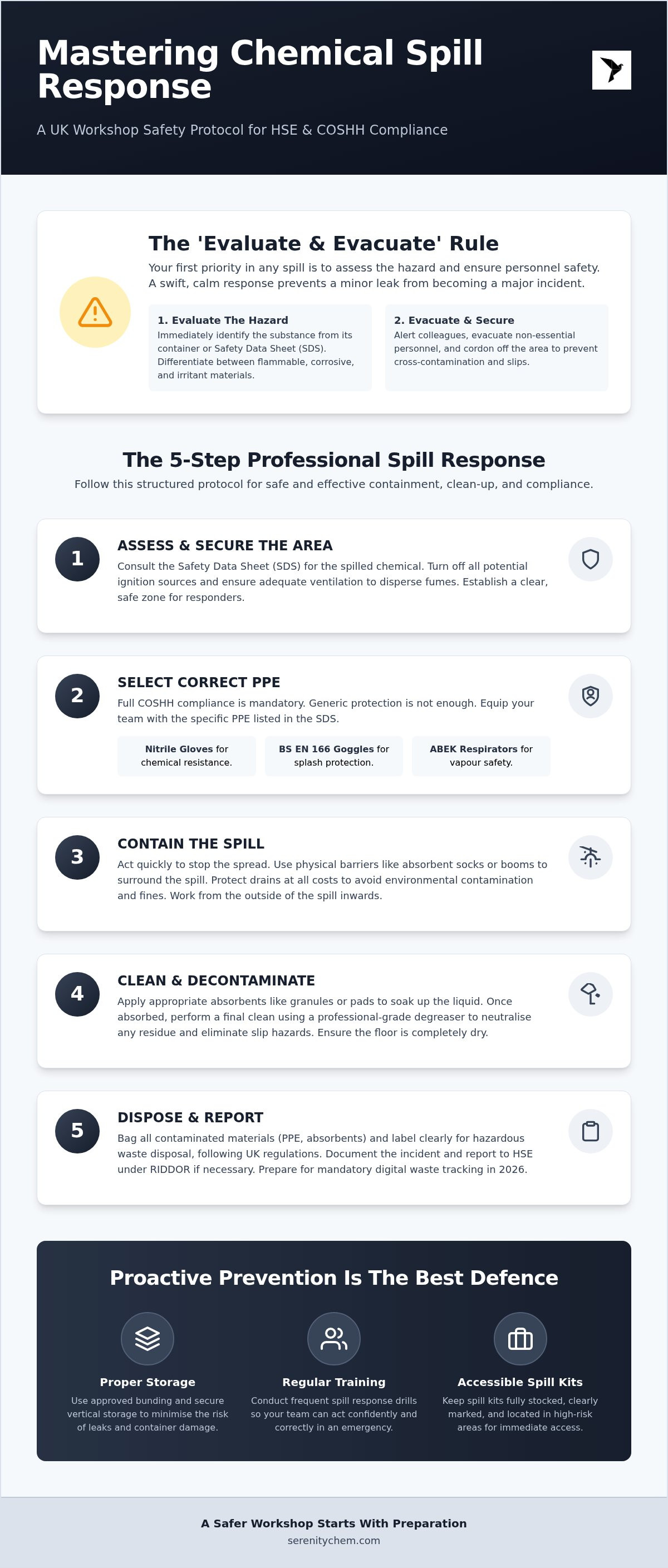
A chemical spill response is a prioritised safety protocol designed to neutralise hazards whilst protecting workplace personnel from harm. It's not merely a cleaning task; it's a critical sequence of actions that prevents a minor leak from escalating into a RIDDOR reportable incident. In a busy workshop, the speed of your response must be balanced with meticulous care. The first step in any incident is the 'Evaluate and Evacuate' rule. This requires you to identify the spilled substance immediately by checking the container label or recognising a distinctive odour. You should never approach a spill without knowing what it is. Clear communication is essential; alert your colleagues using established protocols that inform the team of the danger without triggering unnecessary panic. By cordoning off the affected area, you prevent cross-contamination and mitigate the risk of slip accidents, which remain a primary cause of workplace injuries across the UK.
Identifying the Chemical Hazard
Before you even consider applying the best degreaser for workshop floors UK, you must consult the relevant Safety Data Sheet (SDS). This document is your most valuable tool, providing specific details on reactive properties, flashpoints, and the correct neutralisation methods. You need to differentiate between flammable substances, corrosive liquids, and irritants during your initial assessment. Concentrated industrial products, such as Serenity Heavy Duty Degreaser, are formulated for high efficacy but require specific handling protocols due to their chemical strength. Understanding these nuances ensures you don't inadvertently create a hazardous reaction by using the wrong equipment or cleaning agent on a reactive spill.
Securing the Immediate Environment
Rapid Spill containment is vital for protecting both your staff and the local environment. You must turn off all potential ignition sources and ensure the area has adequate ventilation to disperse any concentrated fumes. Deploying physical barriers, such as specialist absorbent socks, prevents the chemical from reaching sensitive drainage systems or seeping into porous floor joints. This is a legal duty of care that helps you avoid environmental fines. Once the perimeter is secure, establish a designated safe zone. This area allows responders to organise their equipment and don PPE in a clean environment. Using the best degreaser for workshop floors UK as part of your final decontamination ensures that the floor is returned to a safe, slip-free condition with no residual chemical film left behind.
Understanding COSHH and Personal Protective Equipment (PPE)
Effective spill management starts with a robust understanding of the Control of Substances Hazardous to Health (COSHH) Regulations. These regulations aren't just red tape. They provide a vital framework for identifying which substances in your workshop pose a risk and how to control them. In the UK, every business must conduct thorough risk assessments to ensure that employees aren't exposed to harmful levels of chemicals. When you select the best degreaser for workshop floors UK, you're choosing a professional tool that requires a professional safety mindset. Relying on generic protection is often insufficient because different chemicals react uniquely with various materials. A glove that protects against water-based paints might fail instantly when exposed to a concentrated solvent or heavy-duty degreaser.
The Essential PPE Checklist for Workshops
Your spill kit must be tailored to the specific chemicals you store on-site. Standard latex gloves are rarely suitable for industrial environments; they lack the puncture resistance and chemical barrier properties of nitrile. For high-risk splash zones, a simple pair of safety glasses won't suffice. You should look for goggles or face shields that meet BS EN 166 standards to ensure full coverage against corrosive droplets. Respiratory protection is equally critical. If the Safety Data Sheet (SDS) indicates that a substance releases harmful vapours, a standard dust mask is inadequate. You'll need a respirator fitted with the correct gas and vapour filters, such as ABEK types, to prevent inhalation injuries. Maintaining these items in a clean, accessible spill kit ensures your team can act decisively during an emergency.
Regulatory Compliance and COSHH Documentation
Compliance is a continuous process of documentation and review. You should integrate your spill response procedures directly into your professional cleaning chemicals list. This ensures that every member of staff knows exactly which safety protocols apply to each product. Regular training is essential; designated staff must be competent enough to follow these procedures under the pressure of a live incident. With the 2026 RIDDOR reporting thresholds for accidental chemical releases being strictly enforced, accurate record-keeping is your best defence against legal action. If you're unsure about the specific safety requirements for your facility, you can speak with our technical team for tailored guidance. Ensuring that all personnel recognise colour-coded safety signals and hazard symbols will significantly reduce the likelihood of a major industrial incident in your workshop.
The 5-Step Professional Spill Response Procedure
Most workshop guides focus exclusively on oil or fuel leaks, but concentrated cleaning chemicals present unique challenges. These substances are designed to break down grease, but in their undiluted form, they can be highly reactive or dangerously slippery. Following a structured procedure ensures you don't just move the mess around; you actually remove the hazard. A professional response follows five clear stages. Step 1 is the immediate containment using specialist absorbent socks. Step 2 involves protecting drains and sensitive machinery from chemical ingress. According to HSE guidance on spill control, preventing a substance from entering the water system is a top priority for environmental safety. Step 3 requires the use of high-capacity granules or pads to soak up the bulk liquid. In Step 4, you neutralise reactive chemicals only if the SDS specifically instructs it. Finally, Step 5 is the secure collection and bagging of waste for professional hazardous disposal.
Containment and Absorption Techniques
You should always use the 'circle' method when containing a leak. Start by placing absorbent materials at the outer edge and work your way inwards. This prevents the spill from spreading further across the workshop floor. Standard mops must never be used for the initial containment phase. Mops often spread the chemical over a wider area and can become a secondary hazard themselves. For high-viscosity spills, like undiluted floor cleaners, rapid containment is vital to prevent surface ghosting, where the chemical etches into the floor finish. Once the bulk is absorbed, using the best degreaser for workshop floors UK as a final wash ensures the surface is safe for foot traffic again.
Neutralisation and Stabilisation
Some chemical spills require neutralisation to make them safe for handling. If you're dealing with strong acids or alkalis, you might need to apply pH-neutralising agents in a controlled, methodical manner. During this process, you must monitor the site for heat generation or off-gassing. Some reactions can be exothermic, creating steam or fumes that require additional ventilation. You shouldn't rush this stage. Only when you've confirmed the spill is chemically stable should you proceed to the final collection phase. This cautious approach is what defines the best degreaser for workshop floors UK users: a commitment to safety and integrity over mere speed.
Post-Spill Management: Disposal, Reporting, and Decontamination
Once the bulk of the liquid is absorbed, your responsibility shifts toward long-term safety and legal compliance. You can't simply dispose of chemical-soaked materials in the general waste. UK law requires businesses to treat these items as hazardous waste, necessitating secure storage and collection by a licensed waste carrier. You must also retain your waste transfer notes for at least two years. Neglecting these steps can lead to severe penalties under the Environmental Protection Act 1990. After the physical mess is gone, you must address the invisible hazards left behind. This is a critical phase where surface aftercare determines the ongoing safety of your work environment.
Decontaminating the Workshop Floor
Many managers make the mistake of reopening an area as soon as the liquid is gone. This often leaves a residual film that can be incredibly slippery or even corrosive to footwear. You should use the best degreaser for workshop floors UK to thoroughly wash the site, ensuring all chemical traces are neutralised and removed. Following this with a professional guide to antibacterial surface spray UK helps restore the hygiene standards of your facility. This is especially important if the spill occurred in a multi-use area. Your goal is to ensure the floor is slip-resistant, completely dry, and free from stubborn stains before any staff return to the zone.
Incident Investigation and Reporting
Every spill is a learning opportunity. You should conduct a root cause analysis to determine why the incident occurred, whether it was due to equipment failure, poor storage, or a training gap. This information allows you to update your COSHH register and refine your safety protocols. Under the 2026 RIDDOR guidelines, reporting is mandatory for any accidental release of a substance that has the potential to cause major health hazards or serious injury, regardless of whether anyone was actually harmed during the event. Restocking your spill kits immediately is the final, non-negotiable step. You don't want to discover an empty kit during your next emergency. Using the best degreaser for workshop floors UK as part of your standard inventory ensures you're always prepared for high-intensity cleaning. If you need assistance reviewing your workshop's chemical safety profile, you can contact our technical support team for expert advice.
Prevention and Preparedness: Sourcing the Best Degreaser for Workshop Floors in the UK
Proactive safety begins with how you store and manage your inventory. It's not just about having the best degreaser for workshop floors UK on hand; it's about ensuring that product remains stable and secure whilst in storage. Implementing bunding and vertical storage solutions for bulk liquids is a fundamental step in preventing container failure. You should ensure that all containers have clear, legible labelling and that Safety Data Sheets (SDS) are immediately accessible to all staff members. This level of organisation prevents confusion during an emergency and ensures that everyone knows exactly what they're handling. If a label becomes damaged or illegible, you must replace it immediately to maintain safety standards and avoid errors during the high-pressure environment of a spill response.
Safe Storage and Handling Strategies
You must segregate incompatible chemicals to prevent dangerous reactions within your storage areas. Storing oxidisers near flammables, for instance, is a recipe for disaster that could lead to fire or toxic gas release. Using secondary containment for all bulk liquid storage is a legal necessity that mitigates the risk of a leak reaching the floor. When you work with a professional commercial floor cleaner supplier, they can provide guidance on the correct storage temperatures and shelf-life considerations. Industrial chemicals should always be kept away from direct heat sources to prevent pressure build-up or degradation of the active ingredients. This meticulous attention to detail is what separates a professional workshop from one at risk of an HSE intervention or environmental fine.
The Role of Professional Formulations
Choosing a cleaning products manufacturer UK ensures you have direct oversight of the chemical formulations used in your facility. High-quality, stable chemicals are less likely to suffer from container degradation or accidental reactions. This reliability is a core part of being the best degreaser for workshop floors UK provider; it's about integrity and performance. Direct access to expert technical support means you can get immediate answers to complex safety queries. Integrating these prevention strategies into your wider workshop hygiene culture transforms safety from a checklist into a daily habit. Regular spill drills are the final piece of the puzzle. They maintain staff competence and ensure that response speeds remain high. These drills should simulate different scenarios, from minor leaks to major spills, to ensure the team remains calm and follows the established safety protocols whilst under pressure.
Securing Your Workshop’s Future Through Professional Standards
Managing a chemical spill effectively requires more than just speed; it demands a disciplined adherence to safety protocols and the right technical tools. You've learned how a structured five-step response, combined with the correct PPE and COSHH documentation, protects your team and ensures compliance with UK legislation. Sourcing the best degreaser for workshop floors UK from a principled manufacturer ensures your facility is prepared for any eventuality whilst maintaining pristine floor integrity. You shouldn't settle for generic solutions when professional integrity is at stake.
Serenity Chemicals Limited provides UK-manufactured solutions for guaranteed quality and safety. Every industrial product we supply comes with comprehensive SDS documentation, providing the technical clarity you need to manage risks with confidence. Our formulations are trusted by commercial and industrial facilities across the UK to deliver results that meet rigorous EN standards. Contact Serenity Chemicals Limited for expert advice on the best degreaser for workshop floors in the UK to enhance your workplace safety today. With the right preparations in place, you can lead your team with the peace of mind that comes from professional excellence.
Frequently Asked Questions
What is the first thing you should do if a chemical spill occurs?
The first action is to evaluate the hazard and evacuate the immediate area to ensure personnel safety. You must identify the substance using its label or Safety Data Sheet (SDS) before attempting containment. Alert your colleagues immediately using established workshop protocols to prevent accidental entry into the spill zone. Only once the area is secure and the substance is identified should you consider using the best degreaser for workshop floors UK for final decontamination.
How do I know if a chemical spill is too large to handle internally?
A spill is too large if it exceeds the volume capacity of your on-site spill kits or if it poses an immediate risk of fire, explosion, or toxic gas release. If the substance enters the drainage system, it becomes an environmental emergency that requires external intervention. If your team lacks the specific training or PPE required by the SDS, you should contact professional emergency services rather than attempting an internal cleanup.
Can I use a standard vacuum cleaner to pick up chemical spill granules?
You must never use a standard domestic or commercial vacuum cleaner to pick up chemical spill granules. Standard vacuums are not designed to handle hazardous materials and can create sparks that act as an ignition source for flammable vapours. They also risk aerosolising the chemical, which could lead to inhalation injuries for the operator. You should always use non-sparking shovels and brushes or specialist ATEX-rated industrial vacuum systems for this task.
What are the legal requirements for chemical spill reporting in the UK?
UK businesses must comply with the Control of Substances Hazardous to Health (COSHH) Regulations 2002 and the Environmental Protection Act 1990. Under the 2026 RIDDOR guidelines, you are legally required to report any accidental release of a substance that could cause major health hazards or serious injury. You must also maintain accurate waste transfer notes for at least two years to prove that all hazardous materials were handled by a licensed carrier.
How often should a workplace spill kit be inspected and restocked?
You should inspect your workplace spill kits at least once a month and immediately after any incident. These checks ensure that all components, such as absorbent socks and nitrile gloves, are present and in good condition. You must also verify the expiry dates on any chemical neutralisers. Keeping your kits fully stocked with professional supplies, such as the best degreaser for workshop floors UK, ensures your team can act decisively during an emergency.
What is the difference between an absorbent and a neutraliser?
An absorbent is a material designed to physically soak up and retain liquids, such as granules, pads, or pillows. A neutraliser is a chemical agent that reacts with a hazardous substance to change its pH level, making it less reactive and safer to handle. Whilst absorbents are used for almost every spill, neutralisers should only be applied if specifically instructed by the Safety Data Sheet (SDS) to avoid creating dangerous exothermic reactions.
Do I need a specific licence to dispose of chemical spill waste?
Whilst a UK business does not need a specific licence to produce hazardous waste, you have a legal 'duty of care' to ensure it is disposed of correctly. This means you must only use a registered waste carrier with a valid licence from the Environment Agency. You are responsible for accurately classifying the waste and ensuring it is securely packaged. Failure to follow these protocols can result in significant fines under environmental legislation.
Which chemicals require the most caution when handled in a commercial kitchen or workshop?
Concentrated acids, alkalis, and volatile solvents require the highest level of caution due to their corrosive and flammable properties. In a workshop environment, industrial-strength products like Serenity Heavy Duty Degreaser must be handled with specific PPE to prevent chemical burns or respiratory irritation. You should always review the SDS for any substance with a hazard symbol, as even common cleaning agents can become dangerous if they are mixed or stored incorrectly.

How to Prevent Cross-Contamination in a Commercial Kitchen: A Professional Guide
A single lapse in hygiene isn't just a mistake; it's a direct threat to your business's survival and your customers' health. ...

Developing a Robust Workplace Hand Hygiene Policy in the UK: A 2026 Guide
In 2025, minor illnesses and infectious diseases accounted for nearly half of the 148.8 million working days lost across the ...