

With the UK cleaning and hygiene sector contributing nearly £72 billion to the economy, maintaining professional standards is a critical pillar of operational success. You likely recognise that a visually tidy workspace doesn't always equate to a truly hygienic environment. It's often difficult to bridge the gap between daily maintenance and the deep, technical sanitisation required by a professional commercial spring cleaning checklist, especially when trying to remain compliant with the latest COSHH standards.
This guide provides a comprehensive framework tailored for 2026, moving your facility from surface-level neatness to professional-grade safety. You'll learn how to navigate updated Workplace Exposure Limits and the new "Simpler Recycling" regulations whilst ensuring your deep clean doesn't disrupt daily business. We'll outline exactly which professional-grade solutions, from heavy-duty degreasers to alcohol-free sanitisers, are required to create a safer, more productive space for your clients and team.
Key Takeaways
- Understand the vital difference between daily maintenance and a seasonal "hygiene reset" to target often-overlooked accumulation zones.
- Learn why professional-grade chemicals and correct "dwell times" are essential for achieving true sanitisation rather than just surface-level tidiness.
- Access a zone-by-zone commercial spring cleaning checklist designed to implement a top-to-bottom method that prevents cross-contamination.
- Ensure your facility remains compliant with the latest COSHH standards through proper storage and safe dilution of concentrated solutions.
- Discover the benefits of switching to alcohol-free, high-performance formulations that prioritise inclusive workplace safety and environmental responsibility.
Why a Commercial Spring Cleaning Strategy is Essential for 2026
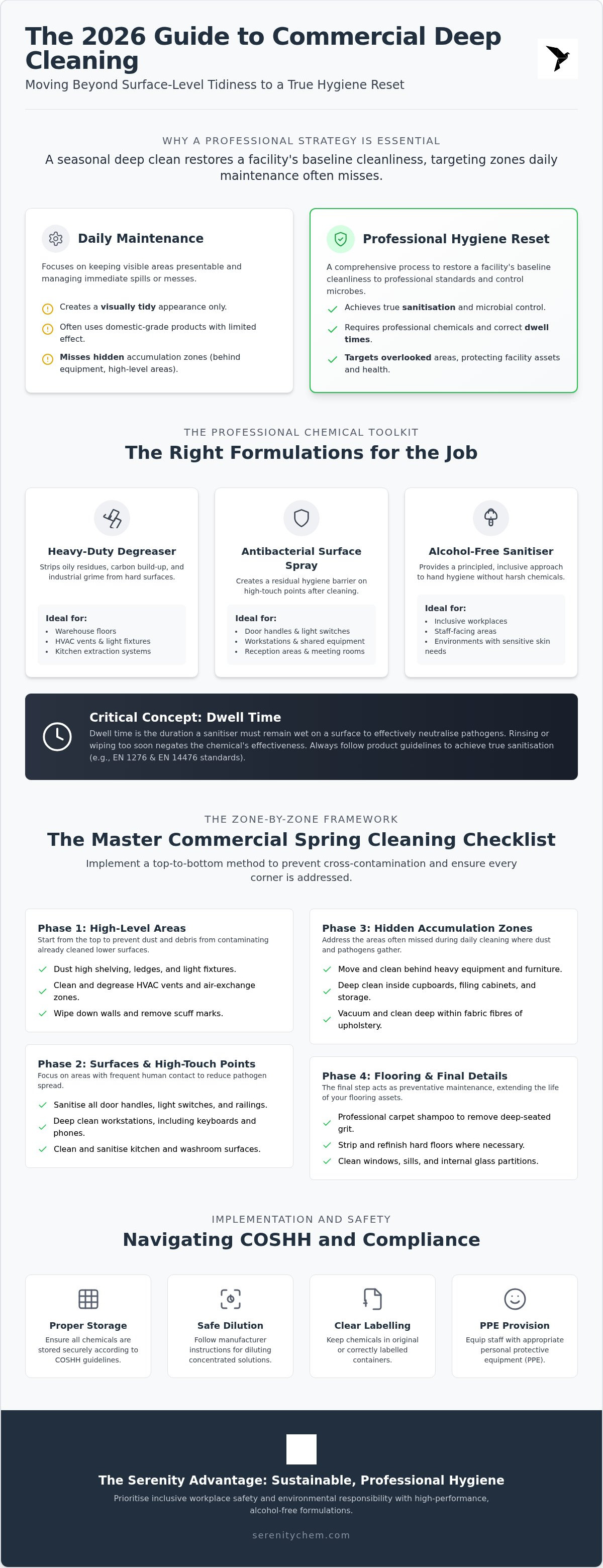
A commercial spring cleaning is far more than a simple seasonal tidy. It represents a comprehensive hygiene reset; a process where a facility's baseline cleanliness is restored to professional standards. Whilst daily maintenance keeps visible areas presentable, it often misses the accumulation zones that a robust commercial spring cleaning checklist is designed to target. These are the hidden areas behind heavy equipment, high-level shelving, and deep within fabric fibres where dust and pathogens gather over months. Commercial cleaning at this level requires a shift in mindset from maintenance to restoration.
Executing a deep clean also directly influences your professional brand image. Clients and staff are increasingly sensitive to the health of their environments. A facility that feels truly sanitised fosters trust and boosts employee morale, as it demonstrates a clear commitment to their well-being. When visitors enter a building where the air feels fresh and the surfaces are clinically clean, it reinforces a message of integrity and attention to detail. Additionally, this seasonal focus allows for the inspection of facility assets that are usually overlooked during a busy work week, identifying minor issues before they become costly repairs.
The Move Beyond Surface-Level Tidiness
In 2026, simply "looking clean" is no longer the benchmark for excellence. Professional facilities must prioritise microbial control, especially in high-traffic commercial environments where surface-level wiping doesn't eliminate deep-seated bacteria. A structured commercial spring cleaning checklist is vital here. It provides your internal teams with a logical roadmap, ensuring no corner is missed whilst preventing the "cleaning fatigue" that often occurs amongst staff during large projects. By following a methodical framework, you ensure that high-touch points and air-exchange zones receive the technical attention they require.
Protecting Facility Assets Through Deep Cleaning
Deep cleaning acts as a form of preventative maintenance for your most expensive assets. For instance, grit and microscopic debris trapped in commercial flooring act as sandpaper, grinding down fibres or finishes every time someone walks over them. Removing this deep-seated soil through a seasonal deep clean significantly extends the lifespan of carpets and hard surfaces. It's far more cost-effective to invest in high-quality carpet shampoo and floor care than to replace entire sections of flooring due to neglect. When you compare the cost of professional-grade chemicals to the premature replacement of furniture or HVAC components, the financial logic is clear. A hygiene reset is a tactical business investment for 2026 that protects both your people and your property.
The Professional Chemical Toolkit: What You Actually Need
Executing a robust commercial spring cleaning checklist requires more than just effort; it requires technical precision in your chemical selection. Domestic products found in supermarkets often lack the concentration and specific surfactants needed to break down industrial-grade grime or biofilm. Partnering with a cleaning products manufacturer UK ensures your team has access to formulations designed for high-traffic environments. These professional solutions are typically more cost-effective as they are designed for dilution, providing consistent quality across large facilities.
A critical concept often overlooked in facility management is "dwell time". This refers to the specific duration a chemical must remain wet on a surface to effectively neutralise pathogens. Professional sanitisers are formulated to meet EN 1276 and EN 14476 standards, but they only achieve these results if the dwell time is respected. All chemical applications should be handled with care, ensuring your team follows current COSHH regulations to maintain a safe working environment whilst achieving maximum sanitisation.
Heavy-Duty Degreasing and Surface Sanitisation
Deep cleaning extends well beyond the kitchen. Serenity Heavy Duty Degreaser is a versatile tool for stripping oily residues from warehouse floors or clearing carbon build-up from HVAC vents and light fixtures. Once surfaces are clear of organic matter, applying Serenity Antibacterial Surface Spray helps create a residual hygiene barrier on high-touch points. In staff-facing areas, Serenity Alcohol Free Hand Sanitiser provides a principled approach to hand hygiene. It's the preferred choice for inclusive workplaces, offering high-level protection without the skin irritation or dryness often associated with ethanol-based alternatives.
Specialist Floor and Glass Care
Different substrates require specific pH levels to avoid structural damage over time. Serenity Floor Cleaner is engineered to safely treat diverse surfaces, including ceramic tiles, modern vinyl, and sealed hardwood. For expansive glazing and internal partitions, Serenity Glass & Mirror Cleaner delivers a streak-free finish that allows natural light to highlight the results of your deep clean. Finally, Serenity Carpet Shampoo uses advanced chemistry to neutralise trapped odours and lift deep-seated allergens that standard vacuuming leaves behind. If you need assistance selecting the right formulations for your specific facility, you can contact our technical specialists for tailored guidance.
The Master Commercial Spring Cleaning Checklist: Zone-by-Zone
To execute an effective deep clean, you must first categorise your facility into logical hygiene zones. This structured approach, a core part of any professional commercial spring cleaning checklist, ensures that resources are allocated where they are needed most. Always employ a "top-to-bottom" cleaning method. By starting with ceiling vents and high-level shelving, you ensure that any dislodged dust or debris is captured as you work your way down to the flooring, preventing the re-contamination of already cleaned surfaces. For specific product pairings, consult the ultimate professional cleaning chemicals list. A professional checklist must prioritise high-touch points to break the chain of infection.
Zone 1: Communal Areas and Office Spaces
Communal areas often suffer from deep-seated soil accumulation that daily vacuuming cannot reach. Deep cleaning upholstery and carpets with professional-grade shampoo is vital for maintaining indoor air quality and extending the life of the fabric. Electronics like keyboards, phones, and printers require careful sanitisation with antibacterial sprays applied to microfibre cloths first to avoid moisture damage. Don't forget high-level areas; dusting ceiling vents and light fixtures reduces the circulation of allergens throughout the office whilst improving lighting efficiency.
Zone 2: High-Hygiene Areas (Kitchens and Washrooms)
These areas require the most technical attention due to the risk of cross-contamination. Using a food safe sanitiser for commercial kitchens is mandatory for all preparation surfaces to meet 2026 safety standards. In washrooms, a deep descale of toilets and urinals using Serenity Toilet Cleaner removes mineral deposits that harbour bacteria and cause odours. Degreasing extractor fans and cleaning behind heavy appliances removes the organic matter that often serves as a fuel source for pests.
Zone 3: Entrances, Glass, and Hard Floors
Your entrance defines the first impression for every client and visitor. Polishing mirrors and glass partitions ensures a sharp, professional appearance that reflects well on your brand. Hard floors should be stripped and re-cleaned with industrial-strength solutions to restore their original finish and remove scuff marks. Finally, sanitise door handles, push plates, and reception counters. Adhering to the Government Buying Standards (GBS) for cleaning products ensures your commercial spring cleaning checklist is supported by procurement choices that remain both effective and environmentally responsible.
Implementation and Safety: Navigating COSHH and Compliance
Compliance with the Control of Substances Hazardous to Health (COSHH) Regulations 2002 remains a non-negotiable legal requirement for UK businesses in 2026. If your organisation employs five or more people, you're legally required to record your COSHH assessment findings in writing. Integrating these safety protocols into your commercial spring cleaning checklist isn't just about ticking boxes; it's about protecting your workforce from respiratory risks and skin sensitisation. When using concentrated Serenity chemicals, precision in dilution is paramount. Over-concentrating a solution doesn't necessarily improve efficacy but can increase the risk of surface damage or chemical exposure.
Proper storage is equally vital. All chemicals should be kept in a cool, dry, and secure location, ideally in their original containers with legible labels. During a deep clean, the use of Personal Protective Equipment (PPE) such as nitrile gloves and safety goggles is essential, particularly when handling heavy-duty degreasers. To maintain productivity, your cleaning schedule should be phased or conducted outside of peak hours. This minimises staff exposure to wet floors and chemical vapours whilst ensuring the cleaning team can work without obstruction.
Understanding Safety Data Sheets (SDS)
Every chemical in your toolkit must be accompanied by a current Safety Data Sheet (SDS). These documents provide critical information on chemical properties, health hazards, and emergency procedures. You should ensure these are easily accessible to all staff members involved in the cleaning process. Clear labelling and colour-coded equipment are also necessary to prevent cross-contamination between hygiene zones. For example, using different microfibre cloths for washrooms and food prep areas is a basic but essential safety standard. Additionally, ensure adequate ventilation is maintained whilst using industrial-strength products like Serenity Carpet Shampoo to prevent the build-up of airborne particulates.
Staff Training and Accountability
A successful commercial spring cleaning checklist relies on the competence of the people executing it. Brief your internal team or contractors on the specific technical requirements of each task, including the correct dwell times for sanitisers. Implement a formal sign-off procedure where each completed zone is verified for quality by a supervisor. This creates a robust audit trail that is invaluable for insurance purposes and health and safety inspections. Maintaining a detailed hygiene log demonstrates your commitment to professional standards and provides peace of mind for both staff and clients. If you require assistance in developing a safety-first cleaning protocol, enquire with our technical team for expert support.
The Serenity Advantage: Sustainable Professional Hygiene
Choosing a supply partner for your commercial spring cleaning checklist is a decision that reflects your brand's values. Serenity Chemicals serves as a principled choice for UK businesses, offering a range of high-performance solutions that prioritise both technical efficacy and ethical responsibility. By purchasing directly from a UK manufacturer, you benefit from expert technical support whilst significantly reducing the carbon footprint associated with your procurement. This localised supply chain supports your broader sustainability and Corporate Social Responsibility (CSR) goals, ensuring your hygiene reset doesn't come at an environmental cost.
It's about providing a solution that is both effective and responsible. When you select professional-grade chemicals that are manufactured locally, you gain peace of mind knowing exactly what is in your toolkit. This transparency is vital for maintaining high safety standards across your facility. It also means you don't have to compromise on performance to meet your green targets, as our formulations are designed to tackle the toughest commercial grime whilst remaining mindful of their impact.
Why Alcohol-Free Hand Sanitiser is the Modern Standard
Serenity Alcohol Free Hand Sanitiser has become the modern standard for professional environments. It remains gentle on the skin even with frequent use, whilst maintaining high antiviral and antibacterial efficacy that meets rigorous EN standards. You can explore more about these benefits in our guide on alcohol free hand sanitiser UK. Beyond skin health, these formulations are non-flammable. This reduces fire risk in commercial storage areas, making them the safest option for high-security facilities, healthcare settings, and schools where traditional alcohol-based products might pose a hazard.
Bulk Buying for Economic and Environmental Efficiency
Efficiency is a core component of professional hygiene. Transitioning from supermarket-grade ready-to-use bottles to professional-sized concentrates offers substantial economic and environmental benefits. Buying in bulk reduces the volume of plastic waste generated by your facility and lowers the cost per application. Concentrated products like Serenity Multi-Surface Cleaner or Serenity Floor Cleaner allow you to control dilution rates precisely, ensuring you only use what's necessary for the task at hand. This methodical approach to resource management is the final step in a truly professional commercial spring cleaning checklist.
View the full Serenity range and prepare for your spring clean today.
Securing Your Facility’s Hygiene Standards
Implementing a structured commercial spring cleaning checklist is more than a seasonal task; it's a strategic investment in your facility’s longevity and the well-being of every occupant. By moving beyond surface-level tidiness and adopting a zone-by-zone approach, you ensure that every corner of your business meets the rigorous hygiene standards of 2026. Technical precision in chemical selection, particularly regarding dwell times and COSHH compliance, is what transforms a standard clean into a professional-grade sanitisation programme.
Serenity Chemicals stands as a dependable authority for UK businesses. As a UK manufacturer and alcohol-free specialists, we provide the industrial strength formulations required to execute these complex tasks with quiet confidence. Transitioning to professional-grade concentrates not only improves your results but also supports your commitment to sustainable and inclusive workplace practices. Protecting your assets and your people starts with the right tools and a principled approach to hygiene. We're here to help you maintain a safer, more productive environment for your staff and clients alike.
Browse the Serenity Chemicals Professional Range
Frequently Asked Questions
What is included in a commercial spring clean?
A commercial spring clean is a comprehensive hygiene reset that targets accumulation zones missed during daily maintenance. It includes high-level dusting of light fixtures and vents, deep carpet extraction, and the technical sanitisation of high-touch electronics. Using a structured commercial spring cleaning checklist ensures that often-overlooked areas, such as the space behind heavy appliances and deep within upholstery fibres, are thoroughly restored to professional standards.
How often should a business perform a deep clean?
Most UK businesses should schedule a comprehensive deep clean at least once per year, typically during the spring. However, high-traffic environments or those with strict hygiene requirements, such as commercial kitchens or medical facilities, may require these resets on a quarterly basis. Regular deep cleaning is a tactical investment that maintains high hygiene standards whilst significantly extending the operational lifespan of your facility assets.
What are the best chemicals for commercial carpet cleaning?
The most effective chemicals are professional-grade shampoos specifically formulated to neutralise trapped odours and lift deep-seated allergens. Serenity Carpet Shampoo is an industrial-strength solution designed for use in extraction machines. It effectively removes the grit that acts as an abrasive on fabric fibres. Unlike domestic alternatives, professional formulations don't leave behind sticky residues that can attract new soil and cause premature wear.
Is a commercial spring clean different from regular office cleaning?
Yes, a spring clean is a restorative process whilst regular cleaning is focused on daily maintenance. Daily cleaning handles visible tasks like emptying bins and wiping desks. In contrast, a commercial spring cleaning checklist directs your team to perform technical tasks like descaling washroom fixtures, degreasing extraction systems, and sanitising air exchange zones. It's the difference between surface-level tidiness and professional-grade facility sanitisation.
How do I ensure my cleaning chemicals are COSHH compliant?
Ensuring compliance requires you to conduct a formal risk assessment for every chemical substance used in your facility. You must obtain and review the latest Safety Data Sheets (SDS) provided by your manufacturer. Serenity Chemicals provides comprehensive SDS for our entire range, including our alcohol-free hand sanitisers and multi-surface cleaners. This documentation helps you identify necessary PPE and safe storage protocols to meet UK legal requirements.
Which areas are most commonly missed during a commercial deep clean?
High-level surfaces and internal equipment components are the zones most frequently overlooked. This includes the tops of tall storage units, ceiling fan blades, and the internal filters of HVAC systems. Other common misses include door frames, the undersides of communal tables, and the technical cleaning of computer keyboards. A structured checklist ensures these "hidden" zones are prioritised to break the chain of infection effectively.
Can I perform a commercial deep clean with an internal team?
Yes, internal teams can successfully execute a deep clean if they are equipped with professional-grade chemicals and clear instructions. By using concentrated solutions like Serenity Multi-Surface Cleaner, your staff can achieve results that supermarket brands cannot match. Providing your team with a zone-by-zone framework allows them to work methodically through the facility, ensuring every task is completed safely and to a high professional standard.
How long does a full commercial deep clean usually take?
The duration depends on the size and complexity of your facility, but most professional deep cleans take between one and three days. A standard office space of approximately 2,000 square feet typically requires 12 to 24 man-hours to complete thoroughly. Phasing the work over a weekend or during evening hours is a practical way to ensure a deep clean is performed without disrupting your daily business operations.

Hand Hygiene in Food Preparation Areas: The 2026 Professional Guide
The Food Standards Agency estimates that foodborne illness costs the UK economy approximately £9 billion every year, with a s...

Sanitising Commercial Kitchen Hard Surfaces: The Professional UK Guide (2026)
Did you know that the average fine for food hygiene offences in the UK has more than tripled since 2016, now reaching over £7...