

Why should the very act of protecting your health have to hurt? For thousands of professionals across the country, frequent hand hygiene has become synonymous with stinging sensations, painful cracks, and a persistent sticky residue. If you've found that traditional gels leave your skin feeling stripped and sensitive, you aren't alone. Finding the right moisturising hand sanitiser UK professionals need for daily use has often felt like a compromise between safety and comfort.
We understand that maintaining high hygiene standards shouldn't come at the cost of your physical well-being. This 2026 guide is designed to help you navigate the latest advancements in alcohol-free formulations that prioritise skin integrity without sacrificing antimicrobial power. You'll discover how to achieve soft, hydrated hands even with frequent use, whilst ensuring full compliance with the newest Great Britain cosmetic regulations regarding formaldehyde-releasing preservatives and CMR substances. We'll examine why modern, non-greasy solutions are replacing outdated alcohol-based gels as the professional standard for skin-safe protection.
Key Takeaways
- Understand the link between traditional high-alcohol gels and "sanitiser dermatitis" to protect your workforce from chronic skin barrier depletion.
- Learn how to differentiate between humectants and emollients to ensure your hygiene products actively hydrate whilst they disinfect.
- Compare the drying index of modern biocides against traditional alcohol formulas to find the most suitable option for sensitive skin types.
- Navigate essential British safety standards like EN 14476 to verify that your chosen moisturising hand sanitiser UK meets professional antiviral requirements.
- Discover the benefits of sourcing skin-safe hygiene solutions direct from a UK manufacturer to maintain both quality and supply chain security.
Why Moisturising Hand Sanitiser is Essential for UK Workplaces in 2026
The current professional environment in the UK has moved beyond the reactive, emergency-led hygiene measures of previous years. Today, businesses prioritise sustainable, long-term health strategies that protect staff from both pathogens and the side effects of harsh chemicals. Selecting a high-performance moisturising hand sanitiser UK teams actually enjoy using is now a strategic business decision rather than a procurement afterthought.
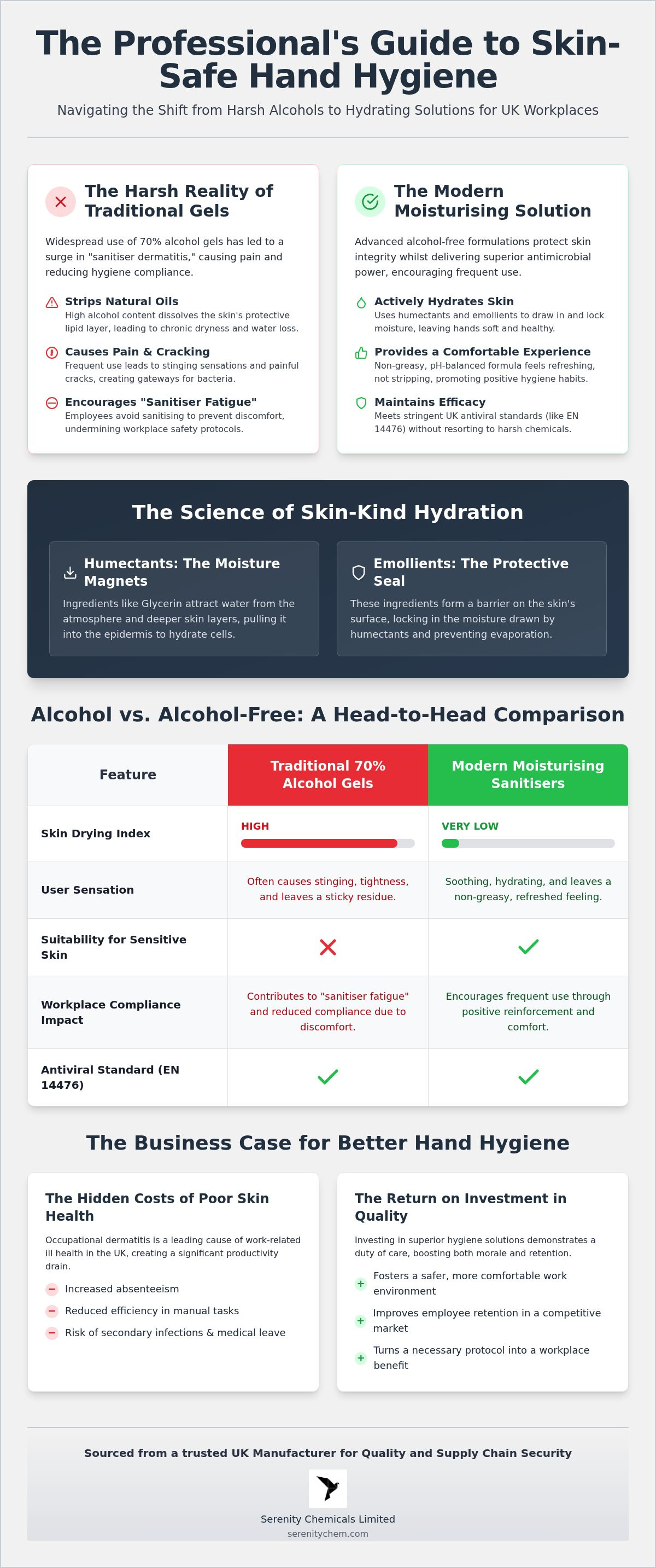
Traditional 70% alcohol gels were designed for short-term clinical use, yet their widespread adoption in offices and warehouses has led to a surge in "sanitiser dermatitis." These high-alcohol formulas work by dissolving the lipid layer of the skin, leading to transepidermal water loss and chronic dryness. For a comprehensive overview of hand sanitizer and its various formulations, it is useful to look at how these products have evolved from simple antiseptic solutions to complex skin-care hybrids. By 2026, the focus has shifted toward biocides that respect the skin's natural pH whilst providing superior antiviral protection.
The Problem with "Sanitiser Fatigue"
Sanitiser fatigue is the primary psychological barrier to workplace safety, occurring when employees consciously or subconsciously avoid hygiene protocols to prevent physical pain. When every application of a gel causes a stinging sensation on sensitive skin, compliance naturally drops. This isn't a lack of discipline; it's a physiological response to discomfort.
Maintaining consistent hygiene behaviour requires products that don't punish the user. High-quality, moisturising hand sanitiser UK formulations encourage more frequent use because they leave hands feeling refreshed rather than stripped. By removing the pain associated with sanitising, businesses can ensure that hygiene protocols are followed through positive reinforcement rather than just mandates. Long-term alcohol use can lead to deep cracking, which ironically provides a gateway for bacteria to enter the body, undermining the very purpose of the sanitiser.
Economic Impact of Poor Skin Health
Poor skin health in the workforce isn't just a comfort issue; it's a productivity drain. Occupational dermatitis is one of the most common causes of work-related ill health in the UK, often leading to increased absenteeism and reduced efficiency. Employees suffering from cracked, sore hands are less able to perform manual tasks effectively and may even require medical leave for secondary infections.
Investing in premium hygiene solutions also plays a role in employee retention. In a competitive labour market, staff value employers who demonstrate a duty of care through the quality of equipment provided. Switching to a gentler, more effective biocide shows a commitment to the long-term well-being of the team. This reduces the hidden costs of skin-related health issues and fosters a safer, more comfortable work environment where hygiene feels like a benefit rather than a burden.
The Science of Hydration: How Modern Sanitisers Protect and Moisturise
Effective hygiene in 2026 isn't just about killing germs; it's about preserving the biological integrity of the skin. A high-quality moisturising hand sanitiser UK formulation integrates hydration as a structural component rather than a surface-level additive. This is achieved through a precise balance of humectants and emollients that work in tandem with active biocides. By engineering the product to support the skin's natural functions, manufacturers can provide total protection without the damage associated with older technologies.
Humectants, such as Glycerin, are substances that attract water from the atmosphere and the deeper layers of the skin, pulling moisture into the epidermis. Emollients then act as a sealant, trapping that moisture to prevent evaporation. Unlike traditional gels that rely on high evaporation rates to feel "dry," modern sanitisers use advanced surfactants to ensure a non-greasy finish whilst maintaining the skin's natural pH balance. This scientific approach ensures that the disinfection process doesn't disrupt the skin's complex ecosystem.
Key Ingredients to Look for in a UK Sanitiser
When selecting a professional-grade product, the ingredient profile is paramount. Glycerin and Aloe Vera are industry standards for a reason; they provide reliable hydration without interfering with the efficacy of the biocide. It's a common misconception that "alcohol-free" implies a lack of active chemicals. Instead, these formulas utilise gentler active ingredients that target pathogens specifically without the indiscriminate solvent action of ethanol. Many organisations now prefer foam formulations over gels, as foam provides more even coverage and typically contains lower concentrations of drying thickening agents.
Maintaining the Skin Barrier
The skin's "acid mantle" is a slightly acidic film on the surface that serves as the body's first line of defence against infection. Traditional sanitisers often strip this mantle, leaving the skin vulnerable and prone to micro-tears. These tiny fissures are problematic because they can actually harbour bacteria, making them harder to reach with subsequent cleaning. Emollients create a protective film on the stratum corneum, reinforcing the skin's barrier and preventing the structural damage that leads to irritation.
Following FDA guidance on hand sanitizer safety helps users understand how to apply these products effectively to maximise protection whilst minimising risks. If you're looking to upgrade your workplace hygiene standards, you might consider contacting a UK manufacturer to discuss specific formulation benefits for your team.
Alcohol-Free vs. Alcohol-Based: Which is Better for Sensitive Skin?
A common misconception persists that hand hygiene requires a high concentration of alcohol to be truly effective. Whilst alcohol-based gels have been the historical standard, they aren't the only solution for virus control. Modern biocides prove that you don't need a harsh solvent to achieve high-level disinfection. For those seeking a moisturising hand sanitiser UK professionals can trust, the choice between alcohol and alcohol-free often comes down to skin tolerance and environmental safety.
Alcohol is an effective antimicrobial, but it's also a powerful desiccant. It works by breaking down proteins and lipids, which unfortunately includes the essential fats in your skin. This leads to a high drying index, causing the skin to lose moisture almost instantly upon application. In contrast, alcohol-free sanitisers typically utilise quaternary ammonium compounds like Benzalkonium Chloride. These active ingredients target pathogens without stripping the skin's natural oils, making them inherently more suitable for individuals with eczema or chronically dry skin.
Residual protection is another key differentiator. Alcohol provides a rapid kill but evaporates within seconds, leaving the skin vulnerable to re-contamination immediately. Alcohol-free formulations often provide a persistent effect, remaining active on the skin surface for longer periods. This makes them a practical choice for high-traffic environments where constant re-application might not be possible.
The Alcohol-Free Advantage
Safety considerations extend beyond skin health. Alcohol-based sanitisers are highly flammable, which presents a significant risk in specific settings like schools, mental health facilities, or care homes. Alcohol-free foam sanitisers are non-flammable and significantly reduce the risk of accidental ingestion or misuse. They are also the preferred choice for those with religious requirements that prohibit alcohol contact. You can explore more about these benefits in our Alcohol-Free Hand Sanitiser UK: The Professional Guide (2026).
Comparison Framework
When evaluating products, consider the "sting factor." Alcohol-based solutions cause intense pain when applied to broken or recently washed skin, which directly discourages frequent use. Alcohol-free options are much gentler on thin skin, making them ideal for children and elderly users. Following FDA guidance on hand sanitizer safety is essential to ensure you're using any product correctly, regardless of its base. Ultimately, for sensitive skin, the lack of a stinging sensation and the lower irritation potential make alcohol-free formulas the superior professional choice.
Sourcing Quality: UK Standards and Bulk Buying for Businesses
Procurement for UK businesses has matured significantly. It's no longer enough to simply provide any disinfectant; companies must now ensure their chosen moisturising hand sanitiser UK meets specific, rigorous safety benchmarks. Navigating British standards like EN 1276 and EN 1500 is essential for basic bactericidal and hygienic handrub efficacy. However, for 2026, the vital certification is EN 14476, which proves the product is effective against enveloped viruses.
Choosing a UK-based manufacturer offers more than just supply chain security. It ensures that every batch complies with the latest Great Britain cosmetic regulations. As of July 2026, labelling requirements for formaldehyde-releasing preservatives have tightened to a 0.001% threshold. Additionally, since January 2026, it's mandatory for the name and address of a UK-based "Responsible Person" to be clearly displayed on all labels. Sourcing direct from the manufacturer guarantees that your COSHH (Control of Substances Hazardous to Health) documentation is always current and accurate.
Essential UK Hygiene Certifications
The EN 14476 standard is the benchmark for professional antiviral efficacy. When a product carries this certification, it has undergone independent testing to prove it can neutralise complex pathogens. For any moisturising claim to be valid in a professional setting, the product should also be dermatologically tested to ensure it doesn't cause irritation during frequent use. For a broader look at how these standards apply to your entire facility, see our Professional Guide to Antibacterial Surface Spray UK.
Sustainable Bulk Procurement
Moving away from single-use plastic bottles toward bulk refill stations is a practical way to reduce your business's carbon footprint. Sourcing from a UK supplier further reduces "product miles" and supports local industry. Logistically, foam sanitisers often prove more cost-effective than gels because they provide significantly more doses per litre. This efficiency, combined with a non-drip application, makes them the superior choice for high-traffic commercial environments. You can find more essential supplies in The Ultimate Professional Cleaning Chemicals List.
Implementing a high-quality hygiene programme doesn't have to be complex. If you need assistance selecting the right volume for your facility, you can contact our technical team for expert advice on bulk procurement and compliance.
Serenity Alcohol Free Hand Sanitiser: The Hydrating Alternative
Selecting the right moisturising hand sanitiser UK professionals can rely on involves more than just checking a label. It's about finding a product that integrates seamlessly into a busy workday without causing physical discomfort. Serenity Alcohol Free Hand Sanitiser was engineered specifically to bridge the gap between clinical-grade disinfection and advanced skincare. By removing the harsh alcohol base, we've developed a solution that protects against pathogens whilst actively supporting the skin's natural moisture levels.
Finding a moisturising hand sanitiser UK teams can use comfortably throughout an eight-hour shift is vital for maintaining workplace safety. The user experience is at the heart of our formulation process. Many traditional sanitisers fail because they're unpleasant to use, leading to reduced compliance. Our foam delivery system provides a lightweight, non-greasy application that absorbs almost instantly. You won't find any overpowering chemical smells or sticky residues that interfere with manual tasks. This makes it an excellent choice for high-traffic environments where staff must sanitise dozens of times each day.
Kind to Hands, Tough on Germs
Serenity Chemicals Limited operates as a principled expert in the UK chemical industry. We take our responsibility for public health seriously, ensuring that every batch of Serenity Alcohol Free Hand Sanitiser meets the highest standards of integrity. When you source direct from a UK manufacturer, you're guaranteed a product that's fully compliant with the latest 2026 Great Britain safety regulations. This includes total transparency regarding our biocide performance and ingredient sourcing.
Buying direct also offers logistical advantages for British businesses. It secures your supply chain and provides access to technical expertise that retail brands simply can't match. We're proud to be a national supplier that understands the unique challenges of the UK workplace. Our focus remains on providing solutions that are effective, responsible, and kind to the users who depend on them. Trusting a British-made solution ensures consistency in quality and reliability when it matters most.
View our range of Serenity Alcohol Free Hand Sanitisers and discover how our British-made formulations can improve your facility's hygiene standards today.
Elevating Workplace Hygiene with Skin-Safe Solutions
Maintaining high hygiene standards shouldn't be a trade-off with skin health. By 2026, the shift towards alcohol-free, hydrating biocides has proven that professional protection can be both gentle and effective. We've explored how "sanitiser dermatitis" is mitigated through the correct balance of humectants and emollients, ensuring your team stays safe without the discomfort of traditional gels. Providing a comfortable user experience is the most reliable way to guarantee long-term compliance with essential safety protocols.
Choosing a moisturising hand sanitiser UK businesses can trust means looking for products that meet EN 14476 standards whilst prioritising the skin's natural barrier. Serenity Chemicals remains committed to providing these advanced, British-made solutions to help you navigate the evolving landscape of workplace safety. Our alcohol-free formulations are specifically designed for sensitive skin, and our bulk options provide a sustainable, cost-effective way to manage your facility's requirements. Investing in the right products today fosters a culture of care and consistency for your workforce.
Explore our Serenity Alcohol Free Hand Sanitiser range to find a principled solution for your organisation.
Frequently Asked Questions
Is moisturising hand sanitiser as effective as regular sanitiser?
Yes, professional-grade moisturising formulas are just as effective as traditional ones at killing pathogens. They utilise active biocides that neutralise bacteria and viruses whilst incorporating skin-protecting humectants. Efficacy is determined by specific laboratory testing rather than the texture of the product. A high-quality moisturising hand sanitiser UK formulation ensures total skin safety without compromising the biocide's performance. Always look for EN 1276 and EN 14476 certifications to verify the product's antiviral and antibacterial claims.
Can I use moisturising hand sanitiser if I have eczema or sensitive skin?
Alcohol-free moisturising sanitisers are specifically formulated for individuals with eczema or sensitive skin. Unlike traditional alcohol-based gels that dissolve natural skin lipids, these products use gentle biocides that avoid the 'sting factor' on broken skin. They help maintain the acid mantle, which is the body's first line of defence against infection. If you suffer from chronic dryness, switching to a pH-balanced, alcohol-free alternative can significantly reduce irritation whilst ensuring high hygiene standards.
Does alcohol-free hand sanitiser meet UK antiviral standards like EN 14476?
Yes, many alcohol-free sanitisers are fully compliant with the EN 14476 standard for antiviral efficacy. This certification ensures the product is effective against enveloped viruses, providing a level of protection that matches high-alcohol alternatives. Serenity Alcohol Free Hand Sanitiser is a professional-grade solution that balances this high-level disinfection with skin-softening properties. It's vital to check for these specific British standards when you are procuring hygiene supplies for commercial or clinical environments.
Why does my current hand sanitiser make my hands feel sticky?
Stickiness is typically the result of low-quality thickening agents or an imbalance of glycerin in cheaper gel formulas. When the liquid carrier evaporates, these additives remain on the skin, creating a tacky residue that can attract dirt. Professional moisturising hand sanitiser UK products often utilise foam delivery systems or advanced surfactants instead. These formulations are engineered to absorb rapidly into the skin, leaving a clean, non-greasy finish that doesn't interfere with daily manual tasks.
How often should I apply moisturising hand sanitiser during the day?
You should apply sanitiser whenever you move between different tasks or communal environments, particularly in high-traffic workplaces. Because moisturising formulas protect the skin barrier, they can be used more frequently than drying alcohol gels without the risk of developing dermatitis. Most professionals find that applying a small amount after hand washing or when entering a new area provides consistent protection. Modern alcohol-free versions also tend to provide a longer-lasting residual effect on the skin.
Is foam hand sanitiser more moisturising than gel?
Foam sanitisers are generally more moisturising than gels because they require fewer harsh thickening polymers to maintain their structure. The foam allows for a more even distribution of hydrating ingredients like Aloe Vera across the palms and fingers. Additionally, foam formulations often use advanced surfactants that help moisturising agents penetrate the skin more effectively. This results in a softer feel and a more pleasant user experience, which naturally encourages higher hygiene compliance in professional settings.
Can I buy moisturising hand sanitiser in bulk for my office or school?
Businesses can purchase moisturising hand sanitisers in bulk to improve cost-efficiency and reduce environmental impact. Many UK manufacturers offer five-litre containers or larger volumes designed for refillable dispensers. This approach is ideal for offices and schools that need a reliable supply of professional-grade hygiene products. Buying direct from a manufacturer like Serenity Chemicals ensures that you receive the latest formulations and all necessary COSHH documentation for your health and safety records.
Are moisturising sanitisers safe for children to use at school?
Alcohol-free moisturising sanitisers are considered the safest option for children in schools. They remove the risks of flammability and accidental ingestion associated with high-alcohol gels. Since children often have thinner skin that is more prone to irritation, a gentle foam-based biocide provides effective protection without causing pain or dryness. These formulas are fully compliant with UK safety standards and are suitable for frequent daily use by students of all ages in educational environments.

Hand Sanitiser for Frequent Use: Professional UK Guide 2026
The very product you use to protect your health might be the primary cause of your skin's deterioration. While alcohol-based ...

Food Safe Antibacterial Spray UK: The Professional 2026 Hygiene Guide
Using the wrong disinfectant in a commercial kitchen isn't just a minor oversight; it's a direct threat to your Food Hygiene ...