

Could the very chemicals you use to maintain your facility be the silent cause of its gradual deterioration? Many facility managers discover too late that using the wrong pH-balanced solutions has stripped the protective seal from their expensive stone or hardwood flooring. Selecting the right commercial floor cleaning chemicals isn't just about removing visible dirt; it's about preserving a significant capital asset whilst ensuring a safe, hygienic environment for everyone who walks through your doors.
We understand that you're likely juggling inconsistent results from generic cleaners and the pressure of complex COSHH requirements. You need solutions that work efficiently without risking surface damage or regulatory non-compliance. This guide provides a professional roadmap to mastering industrial-grade floor care, ensuring your surfaces achieve a pristine finish and a significantly extended lifespan.
We'll examine the critical technical specifications you need to know, including the August 15, 2026, GB CLP compliance deadline and essential BS EN standards for sanitisers. You'll also learn how to optimise dilution ratios to reduce labour time and sourcing costs; providing you with the confidence that your maintenance regime is both highly effective and ethically responsible.
Key Takeaways
- Identify why floor surface material is the primary factor in chemical selection to avoid damaging expensive resilient or non-resilient finishes.
- Learn how to match industrial-grade commercial floor cleaning chemicals to specific soilage types, ensuring organic oils and inorganic scales are targeted effectively.
- Discover how the "Sinner’s Circle" framework helps you balance chemical action with time and mechanical force to achieve a pristine finish.
- Understand the importance of using low-foam formulations in automated machinery to protect equipment longevity and improve cleaning efficiency.
- Recognise the logistical and technical benefits of sourcing directly from a UK-based manufacturer, including shorter lead times and expert support.
Understanding the Science of Commercial Floor Cleaning Chemicals
Commercial floor cleaning chemicals aren't simply stronger versions of the products you find in a supermarket. They're specialised formulations engineered to withstand the rigorous demands of high-traffic environments like hospitals, warehouses, and retail hubs. These products must tackle layers of industrial grime whilst preserving the structural integrity of the floor surface, a balance that requires a deep understanding of chemical synergy.
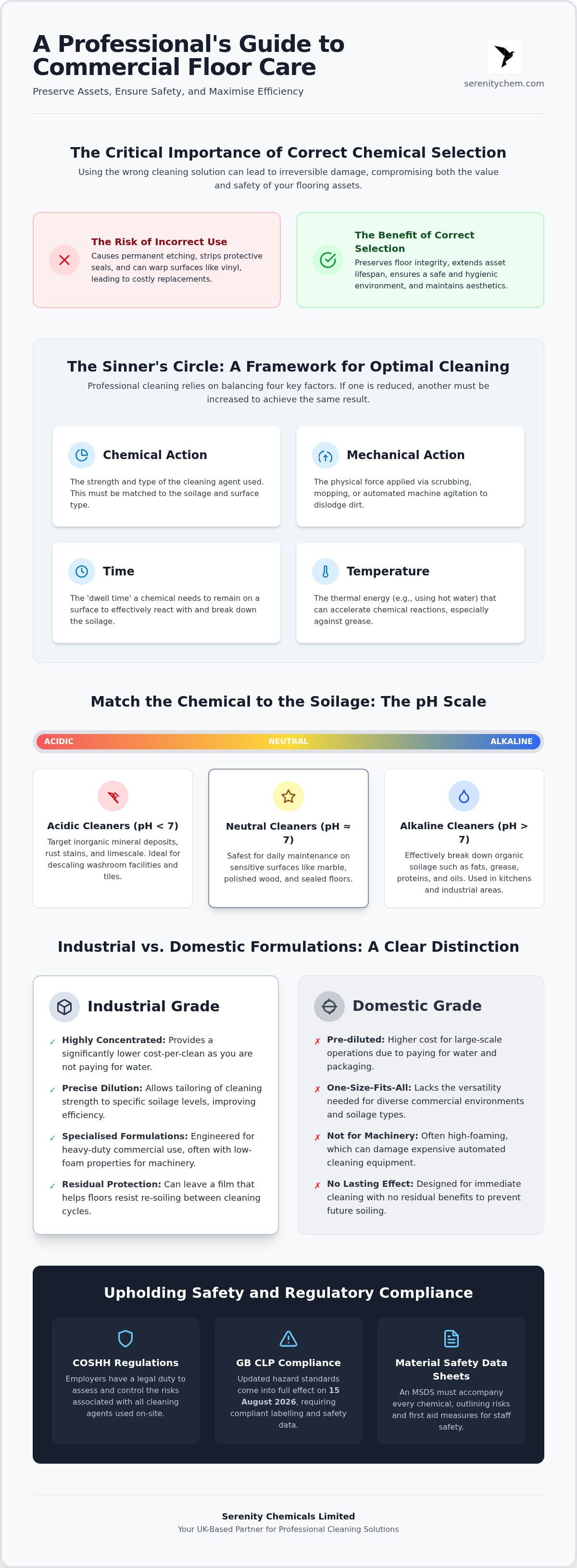
Professional cleaning relies on the "Sinner’s Circle," a framework that balances four essential variables to achieve optimal results:
- Chemical Action: The strength and type of the cleaning agent used.
- Mechanical Action: The physical force applied via mopping, scrubbing, or machine agitation.
- Time: The "dwell time" required for the chemical to react with and loosen soilage.
- Temperature: The thermal energy used to assist in breaking down stubborn grease or grime.
If you reduce one factor, such as using cold water (temperature), you must increase another, like the concentration of the chemical or the duration of contact, to maintain efficacy.
Understanding the science of cleaning agents is essential for effective maintenance. Surfactants are the "workhorses" of these formulations. They lower the surface tension of water, allowing the solution to penetrate porous surfaces and lift industrial soilage. By surrounding dirt particles, surfactants keep them suspended in the water so they can be easily rinsed or vacuumed away without settling back into the floor.
The pH scale is equally critical. Neutral cleaners are ideal for daily maintenance on sensitive surfaces like marble or polished wood. Conversely, alkaline solutions are needed to break down organic fats and oils, whilst acidic cleaners target inorganic mineral deposits and limescale. Using the wrong pH level can cause permanent etching or strip away protective seals.
The Difference Between Domestic and Industrial Formulations
Domestic brands are often pre-diluted for convenience, which isn't suitable for large-scale operations. Professional commercial floor cleaning chemicals offer a much lower cost-per-clean because you aren't paying to ship water. These concentrates allow for precise dilution tailored to the specific soilage level. Beyond the financial savings, industrial products often include residual protection agents that help floors resist re-soiling between scheduled cleans.
Safety Standards and COSHH Compliance
Every chemical used in a UK workplace must be accompanied by a Material Safety Data Sheet (MSDS). These documents ensure that staff understand the risks and required first aid measures. Professional-grade solutions are rigorously tested to meet UK safety and efficacy standards, such as the updated GB CLP hazard standards that come into full effect on August 15, 2026. Under the Control of Substances Hazardous to Health (COSHH) regulations, employers have a legal duty to assess and control the risks associated with every cleaning agent used on-site.
Selecting Chemicals Based on Floor Surface Material
The most critical decision in any maintenance regime is matching the solution to the surface. Choosing the wrong commercial floor cleaning chemicals can lead to irreversible damage, such as etching natural stone or causing expensive vinyl to warp. To avoid these pitfalls, you should first categorise your flooring into two main groups: resilient and non-resilient. This distinction dictates the pH levels and surfactant types required for safe, effective cleaning. For a comprehensive overview of compatible solutions, consult our Ultimate Professional Cleaning Chemicals List.
Identifying the surface material isn't just a technicality; it's a financial safeguard. High-traffic commercial environments often feature a mix of materials, each with unique sensitivities. Using a one-size-fits-all approach typically results in stripped protective seals or dull, slip-prone finishes that compromise safety and aesthetics.
Hard Surfaces: Concrete, Stone, and Tile
Non-resilient surfaces like concrete and natural stone require a nuanced approach. In warehouse settings, porous concrete floors act like a sponge for oils and greases. These environments benefit from alkaline formulations, such as Serenity Heavy Duty Degreaser, which penetrates deep into the pores to lift stubborn soilage. However, natural stone like marble or granite is highly sensitive to pH extremes. Acidic cleaners will etch the surface, whilst strong alkalis can cause permanent dulling. For daily maintenance of high-traffic tiled areas, Serenity Floor Cleaner provides a balanced, effective solution that preserves the integrity of the grout and the tile's original finish.
Resilient and Wood Flooring Care
Resilient flooring, including Luxury Vinyl Tile (LVT) and linoleum, is valued for its durability but remains vulnerable to harsh solvents. Using chemicals with incorrect dilution ratios can lead to shrinkage or adhesive failure. Wood flooring requires even tighter control. Excessive moisture and aggressive chemicals can cause the grain to swell or the finish to peel. It's vital to follow Health and Safety Executive guidance regarding floor moisture to prevent slip hazards whilst protecting the material's lifespan. Incorporating maintainers into your routine helps restore the protective shine amongst daily cleans, ensuring the floor remains resilient against foot traffic. If you're uncertain which formulation suits your specific facility, contact our technical experts for a professional recommendation.
Matching Chemical Formulations to Environmental Soilage
Effective floor maintenance requires more than just a high-quality mop; it demands a targeted approach to the specific type of contamination present. Soilage is rarely uniform across a facility. Understanding whether you're dealing with organic, inorganic, or microbial matter is essential when selecting commercial floor cleaning chemicals. A "one-size-fits-all" strategy almost always leads to poor hygiene outcomes, as a cleaner designed for dust won't touch industrial grease, resulting in increased labour time and wasted resources.
Soilage generally falls into three categories:
- Organic: This includes fats, vegetable oils, proteins, and animal grease. These require alkaline solutions to emulsify the lipids.
- Inorganic: Mineral scales, rust, and salt deposits. These typically require acidic formulations to break the chemical bond with the floor.
- Microbial: Bacteria, viruses, and fungi. These require specialised disinfectants or sanitisers that meet BS EN 1276 or 14476 standards.
For heavy industrial build-up, contact time is your most valuable tool. Instead of immediate scrubbing, allowing a solution like Serenity Heavy Duty Degreaser to "dwell" on the surface for several minutes gives the surfactants time to penetrate and lift the grime. This methodical approach reduces the physical effort required and ensures a more thorough result.
Industrial and Warehouse Environments
Logistics centres and manufacturing plants face unique challenges, particularly stubborn tyre marks and heavy carbon deposits. These marks aren't just an aesthetic issue; they can create slick spots that compromise workplace safety. Heavy-duty degreasing is a necessity in these zones to maintain traction and prevent slips. Given the vast square footage of these environments, sourcing your commercial floor cleaning chemicals in bulk directly from a UK manufacturer is the most cost-effective way to ensure consistent supply and performance.
Healthcare and Hospitality Standards
In sectors where hygiene is a matter of safety and compliance, the focus shifts toward microbial control. High-touch floor areas in hospitals and care homes require antibacterial properties to prevent cross-contamination. According to the British Cleaning Council, maintaining high standards in these environments is critical for public health. For commercial kitchens, using a food safe sanitiser on floors is a vital part of a robust HACCP plan. It's also important to consider fragrance-free options in healthcare settings to avoid triggering sensitivities amongst patients or residents whilst still achieving a deep, clinical clean.
Maximising Efficiency: Application Methods and Machine Compatibility
Efficiency in commercial floor care depends on the synergy between the equipment used and the chemistry applied. Whilst manual mopping is indispensable for confined spaces, automated scrubbing provides a level of consistency and soil recovery that manual methods cannot match. Choosing the right commercial floor cleaning chemicals for these machines is a technical requirement, not just a preference. It's about protecting your investment in hardware as much as it is about the finish on the floor.
One of the most overlooked aspects of machine cleaning is "low foam" technology. When a scrubber dryer agitates a solution, generic or high-foam chemicals create excessive bubbles in the recovery tank. This foam can easily be pulled into the vacuum motor, leading to moisture damage and costly mechanical failure. Professional formulations are engineered to remain stable under high agitation, protecting your equipment whilst ensuring the floor is left dry and safe for immediate use.
Cost-effectiveness is further enhanced through precise dilution. Using too much chemical doesn't result in a cleaner floor; instead, it leaves a sticky residue that attracts soilage faster. Conversely, insufficient concentration fails to break the surface tension of the water. For textile surfaces, using a specialised carpet shampoo for machines is essential to prevent over-wetting and ensure the fibres are cleaned deep into the pile without leaving soapy deposits.
Automatic Scrubber Dryers and Rotary Machines
Serenity Floor Cleaner is specifically formulated to work seamlessly with professional floor machinery. Its low-foam properties prevent tank foaming, allowing for uninterrupted operation and maximum soil recovery. Using the correct chemical also assists in machine maintenance. High-quality formulations won't leave mineral build-up or waxy residues that clog spray nozzles and internal pipes. This principled approach to chemical selection extends the life of your expensive hardware and reduces downtime in busy environments.
Manual Cleaning and Microfibre Technology
In areas where machines cannot reach, manual cleaning remains the standard. Using a "two-bucket" mopping system is vital to prevent cross-contamination, ensuring that dirty water is never returned to the floor. Modern microfibre technology enhances this process by using capillary action to lift dirt into the cloth rather than just pushing it around. When paired with the correct surfactants, microfibre mops require less liquid to achieve a superior finish, making them ideal for spot-cleaning in high-traffic retail centres or office environments.
If you're looking to optimise your fleet's performance and reduce maintenance costs, speak to our team about machine-compatible solutions.
Sourcing Direct: The Benefits of a UK-Based Chemical Manufacturer
Choosing a domestic partner for your commercial floor cleaning chemicals offers more than just logistical convenience. In a market where supply chain reliability is paramount, sourcing directly from a UK-based manufacturer like Serenity Chemicals Limited provides a level of stability that international imports often struggle to match. Shorter lead times mean you don't have to tie up capital in excessive on-site stock, whilst a reduced transport distance helps lower your facility's overall carbon footprint.
This "Principled Expert" approach ensures that you aren't just buying a product; you're gaining access to technical support from the people who actually formulate the solutions. If a specific floor surface presents a challenge, you can receive guidance rooted in chemical precision rather than a generic sales pitch. Buying in bulk directly from the source also provides significant economic benefits, allowing for more efficient budget allocation across your hygiene and maintenance departments.
Quality Assurance and Batch Consistency
Manufacturer-direct sourcing ensures that every 5-litre container of Serenity Floor Cleaner or Serenity Heavy Duty Degreaser meets the same rigorous specifications. We maintain high standards of integrity and safety by overseeing the entire production process from formulation to bottling. This level of control is essential for ensuring batch consistency, which is often a pain point when sourcing through third-party distributors who may mix various brands or formulations.
Our commitment to ethical manufacturing means we constantly balance high-performance efficacy with environmental responsibility. By managing our own production lines, we ensure that our commercial floor cleaning chemicals comply with the latest UK safety standards, including the August 2026 GB CLP regulations. This gives you total peace of mind regarding compliance and user safety, backed by a manufacturer that understands the technical nuances of the UK regulatory landscape.
Professional Support and Wholesale Partnerships
Understanding the functional difference between a commercial floor cleaner supplier and a direct manufacturer is key to long-term cost control. Suppliers often act as middlemen, which can add costs and distance you from technical expertise. By partnering directly with Serenity, you can streamline your procurement by sourcing a full range of high-performance hygiene products from a single, dependable partner.
Whether you're managing a single retail unit or a national logistics network, a direct wholesale relationship allows for more flexible ordering and tailored support. We're here to help you navigate the complexities of chemical selection and application, ensuring your floors remain a safe, pristine, and durable asset. Discover how we can organise your commercial chemical supply and provide the professional-grade solutions your business deserves.
Elevating Your Floor Care Standards for 2026
Mastering industrial-grade solutions requires a precise balance between chemical science and machine compatibility. By aligning your formulations with specific surface materials and soilage types, you protect the longevity of your assets whilst maintaining a pristine environment. Switching to high-concentration commercial floor cleaning chemicals improves cost-efficiency and reduces the environmental footprint of your daily maintenance routine.
Sourcing directly from a UK-based manufacturer ensures a reliable national supply and provides full COSHH and MSDS documentation with every order. It's the most effective way to ensure your facility remains compliant and operationally efficient. Our formulations are designed for maximum efficacy, supporting both manual and machine use across various sectors. We invite you to browse the full Serenity professional floor care range to see how our principled expertise can enhance your facility's safety and integrity. With the right chemistry and a methodical approach, achieving professional results becomes a consistent standard for your business.
Frequently Asked Questions
What are the most essential commercial floor cleaning chemicals for a new business?
A new business should start with a versatile neutral solution like Serenity Floor Cleaner for daily maintenance and Serenity Heavy Duty Degreaser for tougher areas like kitchens or workshops. If your facility has soft flooring, Serenity Carpet Shampoo is also essential. Investing in high-quality commercial floor cleaning chemicals from the outset prevents surface damage and ensures you meet health and safety standards without needing an overly complex inventory.
Can I use the same chemical for both manual mopping and a scrubber dryer?
You can use the same chemical provided it is a low-foam formulation designed for mechanical agitation. Serenity Floor Cleaner is engineered for both manual mopping and automatic scrubber dryers. Using a high-foam product in a machine can lead to "tank foaming," where bubbles enter the vacuum motor and cause mechanical failure. Always verify that your chosen solution is machine-compatible to protect your hardware whilst achieving a consistent finish.
How do I determine the correct dilution ratio for my floor cleaner?
The correct dilution ratio depends on the level of soilage and the specific application method. For light daily cleaning, a ratio of 1:100 is often sufficient, whereas heavy-duty restoration might require a stronger 1:10 or 1:20 concentration. You should always consult the product label or the Material Safety Data Sheet (MSDS) provided by Serenity Chemicals Limited. Using the precise amount ensures maximum cost-efficiency and prevents the sticky residue caused by over-concentration.
Why is pH neutrality important for certain types of commercial flooring?
pH neutrality is vital because acidic or highly alkaline cleaners can permanently damage sensitive surfaces like marble, limestone, and polished wood. These materials are prone to etching or losing their protective seals when exposed to harsh chemicals. A neutral solution like Serenity Floor Cleaner removes dirt without reacting with the floor's surface chemistry. It's the safest choice for maintaining the aesthetic integrity and longevity of expensive commercial floor cleaning chemicals installations.
Are Serenity floor cleaners compliant with UK COSHH regulations?
Yes, all our products are fully compliant with UK COSHH regulations and the latest GB CLP hazard standards. Serenity Chemicals Limited provides comprehensive Material Safety Data Sheets (MSDS) for every order, ensuring your business can conduct accurate risk assessments. Our formulations are manufactured in the UK to meet rigorous safety and efficacy requirements, helping you maintain a safe working environment and achieve full regulatory compliance by the August 2026 deadline.
How often should I use a heavy-duty degreaser on warehouse floors?
The frequency of degreasing depends on the volume of forklift traffic and the presence of organic oils. For most active warehouses, a weekly deep clean with Serenity Heavy Duty Degreaser is recommended to prevent the build-up of carbon deposits and tyre marks. Daily spot cleaning should be used for specific spills. Regular degreasing is a critical safety measure, as it maintains the slip-resistance of the concrete and prevents the accumulation of hazardous residues.
What is the best way to clean commercial carpets in high-traffic areas?
High-traffic commercial carpets are best maintained using a professional extraction machine paired with Serenity Carpet Shampoo. This combination allows the chemical to penetrate deep into the fibres to lift embedded grit and allergens. For optimal results, you should pre-treat stubborn stains and allow a short dwell time before extraction. Regular maintenance with a high-performance shampoo prevents the matting of fibres and significantly extends the life of the carpet in busy environments.
Do you offer bulk wholesale pricing for UK-wide delivery?
We operate a direct wholesale distribution model that provides competitive bulk pricing for businesses across the United Kingdom. As a UK-based manufacturer, we manage our own supply chain to ensure reliable national delivery and consistent batch quality. Buying in bulk from Serenity Chemicals Limited reduces your cost-per-litre and ensures you always have the necessary hygiene solutions on hand. Please contact our technical team to discuss bespoke wholesale arrangements for your facility.

How to Prevent Cross-Contamination in a Commercial Kitchen: A Professional Guide
A single lapse in hygiene isn't just a mistake; it's a direct threat to your business's survival and your customers' health. ...

Developing a Robust Workplace Hand Hygiene Policy in the UK: A 2026 Guide
In 2025, minor illnesses and infectious diseases accounted for nearly half of the 148.8 million working days lost across the ...